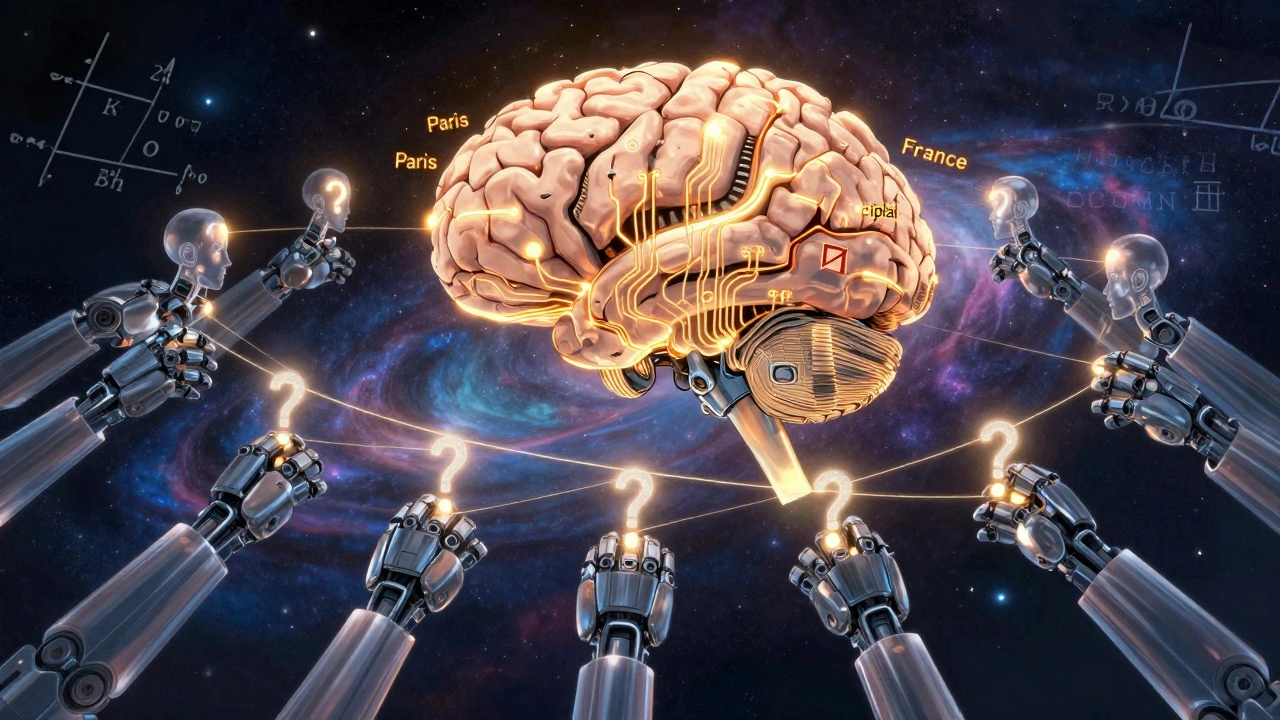
Before Transformers, AI struggled to understand context in long sentences. If you gave an RNN the sentence "The cat that chased the mouse across the yard fell asleep," it had to process each word one by one, losing track by the end. By the time it reached "fell asleep," it had forgotten what "cat" even meant. That’s why early language models were bad at grammar, coherence, and long-range logic. Then, in 2017, a paper called "Attention is All You Need" changed everything. It didn’t use sequences or convolutions. It used self-attention and positional encoding-two simple but brilliant ideas that made generative AI possible.
What Self-Attention Actually Does
Self-attention lets every word in a sentence pay attention to every other word at the same time. No more waiting. No more sequential processing. If you have the sentence "Paris is the capital of France," the word "Paris" doesn’t just look at "is"-it also looks at "capital," "France," and even itself. It asks: "How much does each word matter to me right now?" This isn’t magic. It’s math. Each word gets three vectors: a query, a key, and a value. The query asks, "What am I looking for?" The key says, "What do I represent?" The value is the actual content. You multiply query and key to get a score-how related two words are. Then you apply softmax to turn those scores into weights. Finally, you multiply those weights by the values and add them up. The result? A new representation of each word, enriched by everything else in the sentence. In the original Transformer, this happened in 8 parallel heads. One head might notice that "capital" and "Paris" are linked. Another might spot that "France" is the country. A third might ignore noise like "the" or "of." Together, they build a richer understanding than any single RNN cell ever could. This is why models like GPT-3 can write essays, answer questions, and even code. They don’t just remember patterns-they understand relationships across hundreds of words, all at once.Why Order Matters (And How Positional Encoding Fixes It)
Here’s the problem: if every word talks to every other word equally, then shuffling the sentence shouldn’t change anything. But it does. "The dog bit the man" is not the same as "The man bit the dog." Pure attention doesn’t know the difference. It’s blind to order. That’s where positional encoding comes in. Instead of adding a number like "word 1," "word 2," the Transformer uses sine and cosine waves. For each position in the sequence, it calculates a unique vector using these formulas:- PE(pos,2i) = sin(pos / 100002i/d_model)
- PE(pos,2i+1) = cos(pos / 100002i/d_model)
How This Enables Generative AI
Generative AI doesn’t just understand text-it creates it. That’s where the decoder part of the Transformer comes in. It uses masked self-attention. In the decoder, each word can only see the words before it. If you’re generating the sentence "I love programming because," the model doesn’t peek ahead to "it" or "I enjoy." It only uses what’s already written. That’s how it predicts the next word: "it" → "I enjoy" → "I enjoy coding" → "I enjoy coding every day." This autoregressive process is why ChatGPT, Claude, and Gemini can write stories, emails, or code snippets. They’re not copying-they’re building step by step, using self-attention to weigh relevance and positional encoding to keep track of where they are in the sequence. The numbers don’t lie. Before Transformers, the best translation model (ConvS2S) scored 41.8 BLEU on English-to-French. The original Transformer hit 41.8 in just one day of training-and eventually reached 62.3. On the GLUE benchmark for language understanding, BERT jumped from 60.7 (ELMo’s score) to 80.5. That’s not an improvement-it’s a revolution.
Why Transformers Beat RNNs and CNNs
RNNs process words one after another. That’s slow. CNNs look at local windows. They miss long-range context. Transformers? They do it all in parallel. The original paper showed they trained 5.3 times faster than the previous best model on the WMT 2014 English-German task. And they scale better. An RNN’s complexity grows with sequence length: O(n×d). Transformers? O(n²×d). That sounds worse, but here’s the catch: n² is manageable with modern GPUs, while RNNs are stuck in a bottleneck. A 1,000-word sentence on an RNN takes 1,000 steps. On a Transformer? One step-because all 1,000 words are processed together. The trade-off? Memory. Attention needs to store a matrix of size n×n. For a 4,096-word sentence, that’s 16 million numbers. That’s why models like Longformer and Sparse Transformer use tricks like sliding windows or sparse attention to cut memory use without losing performance.Real-World Problems and Fixes
It’s not perfect. Early developers ran into issues. One common mistake? Forgetting to divide attention scores by √d_k. That causes the softmax to saturate-everything becomes 0 or 1. Accuracy drops 12-15%. Another? Mixing up when to add positional encoding. It has to go after token embeddings, not before. Otherwise, the model gets confused. On GitHub, beginners often leak future tokens in the decoder because they forget the mask. That’s like letting a student peek at the answer key while taking a test. The model learns to cheat-and fails when generating new text. The Hugging Face library fixed many of these by offering clean, tested implementations. Their PositionalEncoding class lets you choose between sinusoidal encoding (for extrapolation) or learned embeddings (for shorter texts). Over 47,000 students have used their course to learn this-and most say it’s the first time they truly understood how Transformers work.
What’s Next? Beyond Sinusoids
Sinusoidal encoding was chosen because it allows extrapolation. But newer models are moving on. Meta’s LLaMA uses Rotary Position Embedding (RoPE), which rotates embeddings based on position. It’s more efficient and handles long sequences better. Google’s ALiBi skips positional encoding entirely-it adds a linear bias directly to attention scores. That cuts training time by 15% on long documents. Even more radical? Microsoft’s Fisher Memory technique, which found that only the first 30% of positional dimensions matter. By dropping the rest, they reduced memory use by 30% without losing accuracy. The future is hybrid. Mamba, a new architecture from Stanford, combines Transformers with state-space models. It handles 64,000-word sequences with 5x faster inference. And DeepMind’s 2023 grid-cell-inspired encoders mimic how brains track location-improving spatial reasoning by 8.7%.Why This Matters Today
In 2020, only 18% of Fortune 500 companies used Transformer models. By 2023, that jumped to 73%. Why? Because they work. Chatbots answer questions. AI writes marketing copy. Code assistants suggest entire functions. All of it relies on the same two ideas: self-attention and positional encoding. The market is exploding. The NLP industry will hit $61 billion by 2030. Every major AI model-GPT, Claude, Gemini, LLaMA-is built on this architecture. Even if you never write a line of code, you’re using it every time you ask an AI a question. This isn’t just another neural network. It’s the engine behind the AI revolution. And it all started with a simple insight: if you let every word talk to every other word-and tell it where it is-you can understand and generate language like never before.What is self-attention in Transformers?
Self-attention is a mechanism that lets each word in a sequence compute its relationship with every other word at the same time. It uses three learned vectors-query, key, and value-to score how much each word should influence the representation of another. The result is a contextual embedding that captures meaning based on surrounding words, not just position. This allows models to understand complex relationships, like pronoun references or long-range dependencies, that earlier models missed.
Why is positional encoding necessary?
Pure self-attention treats sequences as sets-it doesn’t know order. But language depends on order: "dog bit man" vs. "man bit dog" mean different things. Positional encoding adds a unique vector to each token based on its position in the sequence, using sine and cosine functions. This gives the model a way to learn relative positions, so it understands that "the" comes before "cat" and not after. Without it, Transformers couldn’t learn grammar or syntax.
How does positional encoding allow extrapolation to longer sequences?
The sinusoidal function used in positional encoding has a mathematical property: the encoding for position i+δ can be expressed as a linear combination of the encoding at position i. This means the model learns patterns of relative distance, not absolute positions. So if it was trained on 512-word sentences, it can still handle 1,000-word ones because it recognizes that "word 500" is 100 positions after "word 400," even if it never saw that exact distance during training.
What’s the difference between self-attention and multi-head attention?
Self-attention is the basic mechanism where each word attends to all others. Multi-head attention runs this process in parallel across multiple sets of query, key, and value projections-usually 8 in the original Transformer. Each head learns a different kind of relationship: one might focus on syntax, another on semantics, another on entity links. Combining them gives the model a richer, more nuanced understanding than a single attention head could achieve.
Why do some models replace positional encoding?
Sinusoidal encoding works well, but it’s not always optimal. Learned embeddings (like in BERT) are simpler and perform better on shorter texts. Rotary Position Embedding (RoPE) improves extrapolation and reduces memory use. ALiBi eliminates positional encoding entirely by adding a linear bias to attention scores based on distance. These alternatives often improve efficiency, reduce training time, or handle ultra-long sequences better-making them preferable in modern models like LLaMA, Mistral, and GPT-4.
Can Transformers handle sequences longer than 32,000 tokens?
Yes, but not with standard full attention. Models like Longformer use sliding windows, where each token only attends to nearby tokens. Others like Transformer-XL use recurrence across segments. Newer architectures like Mamba use state-space models to achieve linear complexity, letting them process 100,000+ tokens efficiently. The bottleneck isn’t the concept-it’s the quadratic memory cost of attention. The field is rapidly moving toward sparse, hybrid, or linear-complexity alternatives to scale beyond current limits.
Pamela Watson
OMG this is sooo cool!!! I never knew words could just talk to each other like friends at a party 😍
Sagar Malik
The entire paradigm is predicated on a flawed ontological assumption-that linguistic meaning is reducible to vectorized attention weights. The sine-cosine positional encoding is a mere heuristic, a Band-Aid on the epistemological rupture between syntax and semantics. We’re not modeling language-we’re simulating a ghost in the machine.
Seraphina Nero
This actually made sense to me for the first time. I used to think AI was just guessing words, but now I get how it connects them. Thanks for breaking it down so nicely 💛
Megan Ellaby
Wait so like… the model doesn’t know if it’s reading 'dog bit man' or 'man bit dog' unless you give it position hints? That’s wild. I always thought it just memorized patterns. So the sine waves are like little GPS tags for each word? That’s so clever. I’m gonna try to code this myself now 🤓
Rahul U.
Fascinating breakdown. The multi-head attention mechanism is truly elegant-each head acting as a specialized lens. And the fact that positional encoding enables extrapolation is a subtle masterpiece of mathematical design. 🙌
Frank Piccolo
This is just overhyped math. We’ve been doing this since the 80s. All this attention stuff? Just fancy matrix multiplication. Real AI would understand context, not just crunch numbers. And why do we need 32k tokens? Nobody talks that long. This is American tech arrogance.
James Boggs
Excellent exposition. The clarity with which you explained self-attention and positional encoding is commendable. This is precisely the kind of foundational insight that empowers the next generation of practitioners.
Addison Smart
I’ve been teaching this to students in Kenya and Nigeria, and honestly, this is the first time they’ve truly lit up. The idea that a machine can grasp relationships across sentences-like how 'it' refers back to 'the cat'-it’s not just technical, it’s almost poetic. We’re not just building tools, we’re giving machines a kind of empathy for structure. And the fact that positional encoding lets it generalize? That’s the real magic. It’s not just learning-it’s understanding patterns in a way that mirrors how humans learn language from context, not memorization. I’ve seen kids who’ve never touched a computer write their first poem using a model like this. That’s not AI. That’s a bridge.
David Smith
This is why we’re all doomed. Machines now understand language better than most humans. Soon they’ll write laws, judge people, and decide who gets hired. And we’re just over here celebrating how they ‘learned’ sine waves like it’s some kind of miracle. Wake up. This isn’t progress-it’s surrender. They’re not tools. They’re becoming the new priests of meaning. And we gave them the temple.