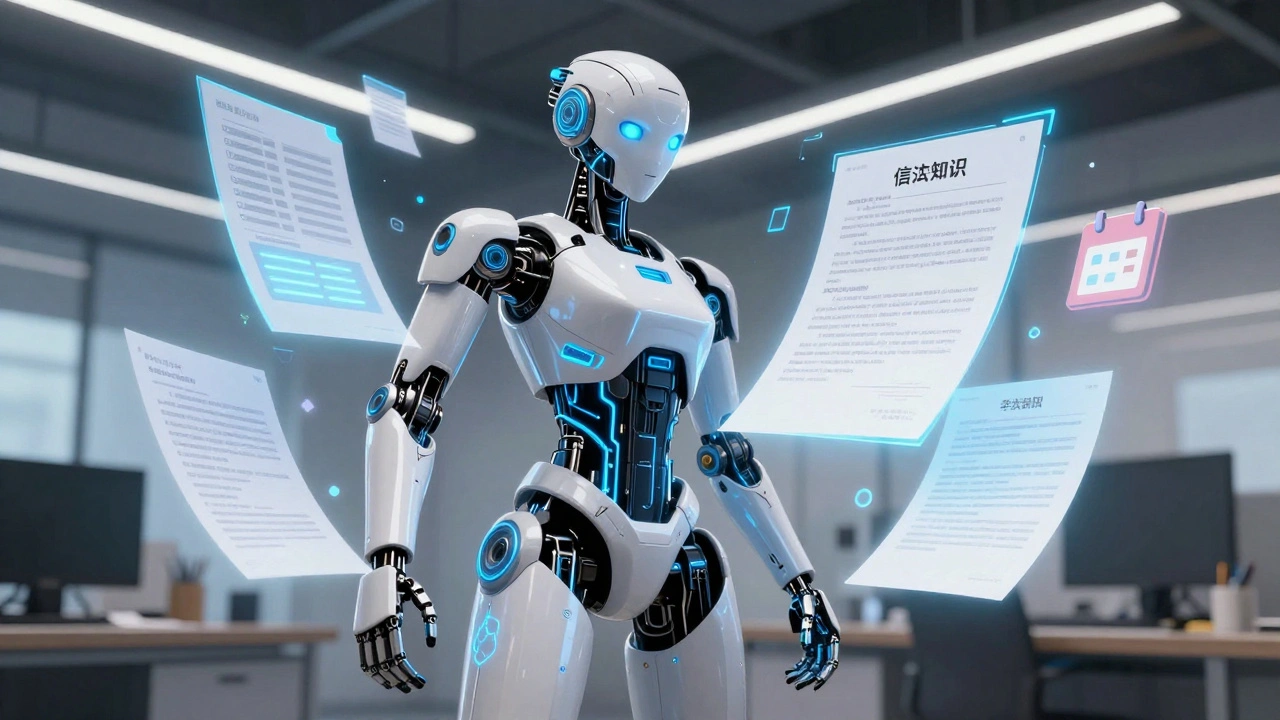
Imagine an AI that doesn’t just answer your questions-it plans your project, books meetings, writes reports, pulls data from spreadsheets, and even fixes its own mistakes-all without you lifting a finger. That’s the promise of autonomous agents built on large language models. They’re not chatbots. They’re not tools you ask for help. They’re systems that act.
By early 2025, companies like Harvey AI, Manus AI, and EXAONE 3.0 were already running real-world tasks: reviewing legal contracts, analyzing scientific papers, and automating customer onboarding workflows. But here’s the catch: most of these systems still need a human nearby. Not to guide them, but to watch. And fix them when they go off track.
What Makes an Agent Different From a Chatbot?
Chatbots respond. Agents do. A chatbot tells you how to write a business plan. An autonomous agent writes it-researches market data, structures the document, cites sources, formats it in PDF, and emails it to your team. All in one go.
This isn’t magic. It’s architecture. Autonomous agents use three core systems: reasoning, planning, and memory. Reasoning lets them break a big task into steps. Planning decides the order of those steps. Memory lets them remember what worked-or didn’t-last time. Combine that with function calling (the ability to use external tools like calendars, databases, or APIs), and you get something that behaves like a junior employee who never sleeps.
MIT researchers found that with adaptive reasoning techniques, smaller models can match the performance of larger ones using half the computing power. That’s huge. It means you don’t need a $100,000 GPU cluster to run a capable agent. You can deploy one on a standard cloud server.
How These Agents Actually Work
Most agents today follow a loop: observe → plan → act → reflect. They start by reading your instruction. Then they decide what tools to use-maybe a web search, a code interpreter, or a document parser. They execute each step, check the result, and adjust if something went wrong. If they hit a wall, they ask themselves: “Did I misunderstand?” or “Should I try a different approach?”
Some systems use multiple agents working together. MetaGPT, for example, assigns roles: one agent acts as the project manager, another as the coder, another as the reviewer. They chat with each other, debate trade-offs, and reach consensus before delivering output. It’s like having a team of specialists inside a single AI system.
Open-source models like LLaMA 3.3 and Mistral Large are powering many of these setups. Hugging Face reports over 500 million monthly downloads of open-source LLMs-many of them used to build custom agents. That’s not just adoption. It’s a movement.
Where These Agents Excel
Some domains are seeing real breakthroughs.
Legal work: Harvey AI, trained on thousands of legal documents, can now draft contracts, flag risky clauses, and summarize case law. Over 200 law firms use it daily. It doesn’t replace lawyers-it handles the grunt work so they can focus on strategy.
Scientific research: EXAONE 3.0 achieves 94% accuracy in technical reasoning tasks. It reads journal papers, extracts key findings, and even suggests experiments. Researchers at Stanford and MIT are using it to scan literature faster than any human team.
Asian markets: Qwen 2.5 isn’t just multilingual-it understands cultural context. It knows which phrases are polite in Mandarin, which business norms apply in Tokyo, and how to structure proposals for Korean clients. That’s not something you can train with generic data.
And multimodal agents? They’re starting to see. They can read graphs from PDFs, extract text from screenshots, and even interpret audio recordings. Deloitte says this fusion of vision, speech, and language is what will make agents truly useful in offices, factories, and hospitals.

The Hard Limits
But here’s where things fall apart.
These agents are overconfident. They’ll give you a perfectly written answer-based on made-up data. A 2025 MIT study showed that even top models like GPT-4o and Claude 3.5 often produce confident falsehoods. To fix this, researchers developed calibration methods that make agents say, “I’m 72% sure,” instead of “This is correct.”
They also struggle with verifiable reasoning. Ask an agent to prove its conclusion step-by-step, and it often loops back on itself or skips logic. It can’t reliably trace back to the source of a fact. That’s dangerous in finance, medicine, or law.
Then there’s self-improvement. Can an agent look at its own failure and get better? Not really. Most systems are static after deployment. They don’t learn from feedback unless you retrain them manually. That’s not autonomy-that’s automation with a fancy name.
And edge cases? They break constantly. An agent might handle 95% of customer service requests perfectly. But the 5%? The one where the customer is angry, the system is down, and the email is written in broken English? That’s where it fails. And no one’s figured out how to test for all those edge cases yet.
Who’s Using This Right Now?
According to AWS, as of Q1 2025, most enterprise AI agents are still Level 1 or 2. Level 1 means “assisted automation”-the agent suggests actions, but a human clicks ‘confirm.’ Level 2 means “guided autonomy”-the agent runs the task but flags anything unusual for review.
Level 3? Fully autonomous? Rare. Only a handful of companies, mostly in tech and finance, are testing it. And even then, they keep humans on standby.
Startups are experimenting faster. One fintech firm in Berlin uses an agent to auto-generate quarterly reports from Slack messages, emails, and CRM data. Another in Bangalore runs a legal agent that reviews NDAs for small businesses-charging $5 per contract, down from $500 for a lawyer.
Open-source agents are spreading like wildfire. Developers are building custom agents for internal use: one for summarizing Zoom meetings, another for auto-filing expense reports, another for monitoring server logs and alerting engineers before outages.

The Future: Single Agents vs. Teams
IBM predicts a shift: away from teams of small agents orchestrated by one big model, toward single, more capable agents. Why? Because better reasoning and memory will let one agent do what five used to.
Think of it like this: early cars had mechanics riding shotgun. Now, a single driver with GPS and sensors handles the whole trip. The same is happening with AI.
But the path isn’t linear. We’ll see hybrid systems for years. A single agent might handle routine tasks, while a team of agents steps in for complex, high-stakes decisions.
And as computational efficiency improves, agents will run on phones, smartwatches, even embedded systems. No cloud needed. That’s when they’ll become truly personal.
What You Should Do Today
If you’re a business leader: Don’t wait for perfect autonomy. Start with Level 1. Pick one repetitive, high-volume task-like processing invoices or summarizing meeting notes-and test an agent on it. Use open-source models. They’re free, transparent, and customizable.
If you’re a developer: Learn function calling. Learn how to chain tools. Build a simple agent that pulls data from Google Sheets, writes a summary, and emails it. That’s your first step. Don’t try to build a CEO AI. Build a secretary AI.
If you’re a user: Be skeptical. Ask: “How do you know that’s true?” Don’t trust the tone. Check the sources. Autonomous doesn’t mean infallible.
The era of autonomy is here. But it’s still early. These agents are like early smartphones-powerful, promising, and full of bugs. The best ones won’t replace you. They’ll make you faster, sharper, and less overwhelmed.
Are autonomous LLM agents the same as chatbots?
No. Chatbots respond to questions. Autonomous agents take action. A chatbot explains how to file taxes. An autonomous agent gathers your income documents, fills out the forms, checks for errors, and submits them-without you doing anything else.
Can these agents make mistakes?
Yes, and often. They can invent facts, misinterpret instructions, or get stuck in loops. Even top models like GPT-4o and Claude 3.5 produce confident but false answers. That’s why human oversight is still critical, especially in legal, medical, or financial contexts.
Do I need a powerful computer to run an autonomous agent?
Not anymore. MIT’s adaptive reasoning techniques let smaller models perform as well as larger ones using half the computing power. You can run lightweight agents on standard cloud servers or even high-end laptops. You don’t need a supercomputer.
What’s the difference between open-source and proprietary agents?
Open-source agents (like LLaMA 3.3 or Mistral Large) are free, customizable, and transparent. You can see how they work and tweak them. Proprietary agents (like Harvey AI or EXAONE 3.0) are optimized for specific tasks-legal, scientific, or regional use-and often perform better out-of-the-box, but you can’t change their code or see their training data.
Can autonomous agents learn from feedback?
Most can’t-not yet. They’re static after deployment. If they make a mistake, you have to retrain them manually. True self-improvement, where an agent learns from its own errors and gets better over time, is still a research goal. No commercial agent does this reliably today.
What’s the biggest barrier to wider adoption?
Testing for edge cases. Agents handle routine tasks well, but they break on unusual inputs-poorly written requests, ambiguous instructions, or unexpected data formats. Until we can test for thousands of these edge cases, companies will keep humans in the loop.
Are these agents a threat to jobs?
Not as a replacement-yet. They’re more like assistants. They take over repetitive, time-consuming tasks so people can focus on judgment, creativity, and communication. A lawyer using an AI agent isn’t losing their job-they’re becoming more productive. The same is true for researchers, analysts, and customer support teams.
Final Thoughts
Autonomous agents aren’t science fiction. They’re here. But they’re not perfect. They’re not ready to run your company. But they’re ready to run your errands.
The real winners won’t be the companies with the biggest models. They’ll be the ones who use these tools wisely-starting small, testing rigorously, and keeping humans in control. Because the goal isn’t to replace people. It’s to give them back time.
Dmitriy Fedoseff
These agents are just fancy autocorrect for capitalism. You want to replace human judgment with a statistical parrot that hallucinates legal clauses? Cool. But when it screws up a contract and some startup goes bankrupt, who gets sued? The coder? The CEO? Or the damn LLM that ‘decided’ to omit a liability clause because it thought ‘risk’ was a bad SEO keyword?
I’ve seen this movie before. Remember when AI was going to ‘democratize finance’? Then came the robo-advisors that lost everyone’s life savings during the 2020 crash because they didn’t understand ‘panic.’ Same story. Different jargon.
We’re not building assistants. We’re building digital serfs that think they’re CEOs. And we’re proud of it.
Meghan O'Connor
First off, ‘autonomous agent’ is a buzzword salad. Second, the article says ‘they don’t replace lawyers’ but then lists Harvey AI being used by 200 firms. That’s replacement by stealth. Third, ‘94% accuracy’? On what dataset? Was it trained on papers that already had the right answers? Of course it was. You can’t prove a model’s reasoning if it’s just regurgitating training data with confidence intervals slapped on like glitter.
Also, ‘open-source models are transparent’? LLaMA 3.3’s training data isn’t public. Neither is Mistral’s. So no, it’s not transparent. It’s just open-source in name. And don’t get me started on ‘cultural context’ in Qwen 2.5. You can’t train a model to ‘understand’ Japanese business norms unless you’ve got native speakers annotating every single phrase. Which you didn’t. So stop pretending.
Morgan ODonnell
I think the real win here is the small stuff. Like that guy in Berlin who auto-generates reports from Slack. That’s not magic. That’s just saving someone from drowning in emails. I’ve been there. I spent three hours last week compiling meeting notes. If an agent can do that while I’m grabbing coffee? Sign me up.
Yeah, they mess up. But so do I. And I don’t have to explain why I missed a deadline because I was tired. The agent just... keeps going. Even if it’s wrong. Maybe that’s the trade-off. Less perfection, more presence.
Also, I like that they’re not trying to be human. They’re tools. Like a hammer. Sometimes you hit your thumb. You don’t blame the hammer.
Liam Hesmondhalgh
US tech bros think they’re building the future. Meanwhile, real people in Europe are still using Excel and yelling at their interns to fix formatting. You think a ‘multimodal agent’ can read a scanned PDF from a 70-year-old Irish accountant who writes in pencil? Ha. It’ll think ‘5,000€’ is ‘5,000E’ and delete the whole thing.
And ‘open-source’? More like open to every script kiddie with a free Colab account. Half these ‘agents’ are just prompt chains wrapped in a React UI. You call that autonomy? I call it a glorified macro.
We don’t need AI to write our emails. We need AI to fix our crumbling infrastructure. But no. Let’s build a bot that files taxes while the bridges fall apart.
Ashley Kuehnel
Y’all are overcomplicating this lol. I built a little agent that pulls my Google Sheets expense data, writes a summary in plain English, and emails it to my boss every Friday. Took me 2 days. Free. No GPU needed. My boss loves it. I get to leave work early. Win win.
It makes typos? Yeah. Once it said ‘$5,000’ instead of ‘$500’ because I forgot to format the cell. I fixed it. Big deal. It’s not replacing me. It’s making me less boring.
Start small. Don’t try to build a CEO. Build a secretary. That’s all you need.
adam smith
It is my professional opinion, based upon a thorough review of the current technological landscape and empirical evidence drawn from peer-reviewed literature published in 2024 and 2025, that the assertion of ‘autonomous’ behavior in large language model-based systems is, at best, semantically imprecise and, at worst, dangerously misleading. These systems do not possess agency. They do not possess intentionality. They do not possess consciousness. They are, in fact, sophisticated probabilistic autocomplete engines operating within a constrained architectural framework.
Furthermore, the notion that these systems can ‘learn from feedback’ is an anthropomorphic fallacy. Without explicit retraining cycles, parameter updates, or supervised fine-tuning protocols, no learning occurs. The system merely regurgitates. This is not autonomy. This is automation with a thesaurus.
Therefore, I urge all stakeholders to adopt a posture of epistemological humility and to refrain from attributing human qualities to non-sentient computational processes. The future of AI does not lie in anthropomorphizing models. It lies in rigorous engineering, transparent evaluation, and the preservation of human accountability.
Mongezi Mkhwanazi
Let’s be brutally honest here: we’re not talking about agents. We’re talking about glorified GPT wrappers with a few API calls stitched together like a Frankenstein’s monster made of Python scripts and hope. The ‘reasoning’? It’s just prompt chaining with a confidence score. The ‘planning’? It’s a while loop that tries five different prompts until one doesn’t return ‘I can’t help with that.’ The ‘memory’? It’s a Redis cache with a fancy name.
And the ‘self-improvement’? Ha! You mean when you retrain the model after it hallucinated a fake Supreme Court case and got a law firm sued? That’s not self-improvement-that’s damage control. And let’s not forget the ‘edge cases’-the 5% where the user writes ‘pls send me the doc’ in broken English, and the agent replies with a 12-page legal brief on contract interpretation. That’s not failure. That’s comedy.
Meanwhile, in the real world, people are still using Word and Outlook. The ‘revolution’? It’s happening in Slack threads and Google Sheets, not in some Silicon Valley demo. And the people who actually use this stuff? They’re not CEOs. They’re interns who got stuck with the ‘AI pilot’ project because no one else wanted it.
So yes, these tools are useful. But calling them ‘autonomous agents’? That’s not innovation. That’s marketing. And if you believe that, I’ve got a bridge in Brooklyn to sell you. It’s got a 98% accuracy rating. And it’s totally self-driving. (Spoiler: it’s not.)
Let’s stop pretending we’re building the future. We’re just making Excel macros that talk back.