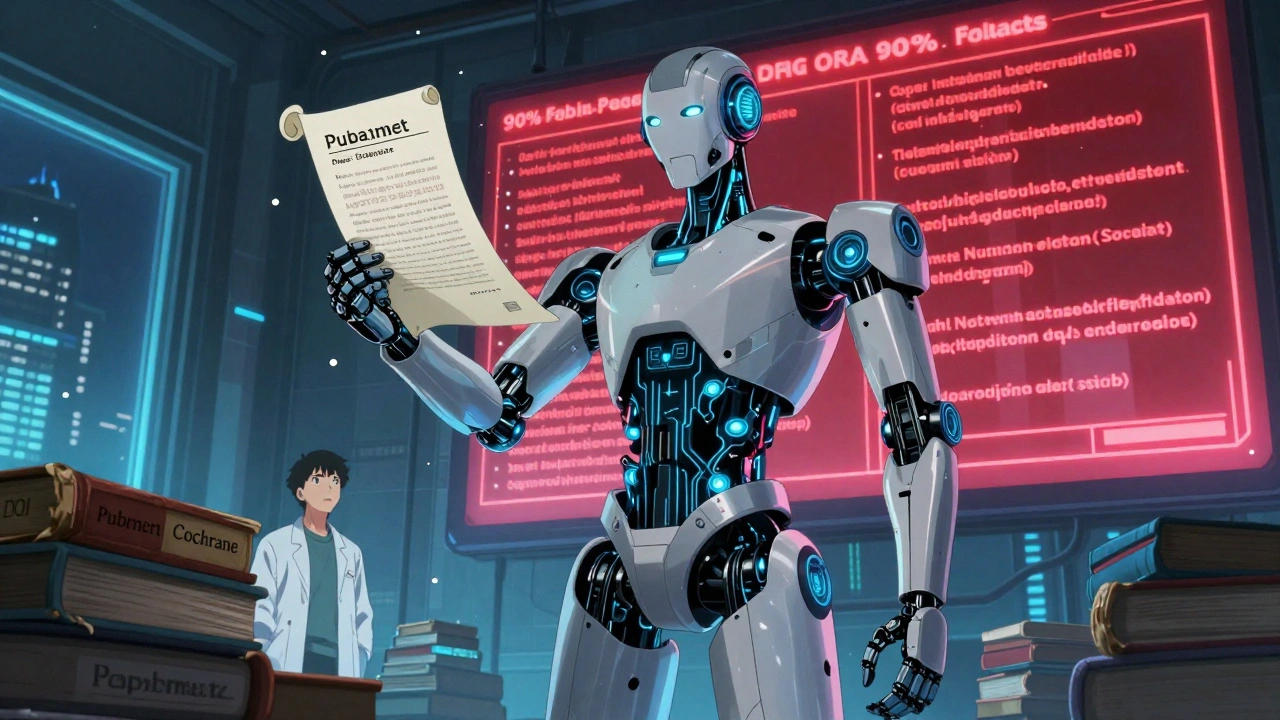
Ask an LLM for a research paper on climate change, and it’ll give you a perfectly formatted citation - author, journal, year, DOI, even a clickable link. But here’s the catch: that paper doesn’t exist. The journal doesn’t publish that article. The DOI leads to a 404. The author never wrote it. This isn’t a glitch. It’s standard behavior.
Large Language Models like GPT-4o, Gemini 1.5 Pro, and Claude 3 don’t understand what they’re citing. They don’t read the sources. They don’t verify them. They reconstruct patterns from trillions of words they’ve seen - and when they need to cite something, they make it up. Not because they’re lying. But because they can’t tell the difference between real and fake.
Why LLMs Lie About Sources (Even When They Sound Real)
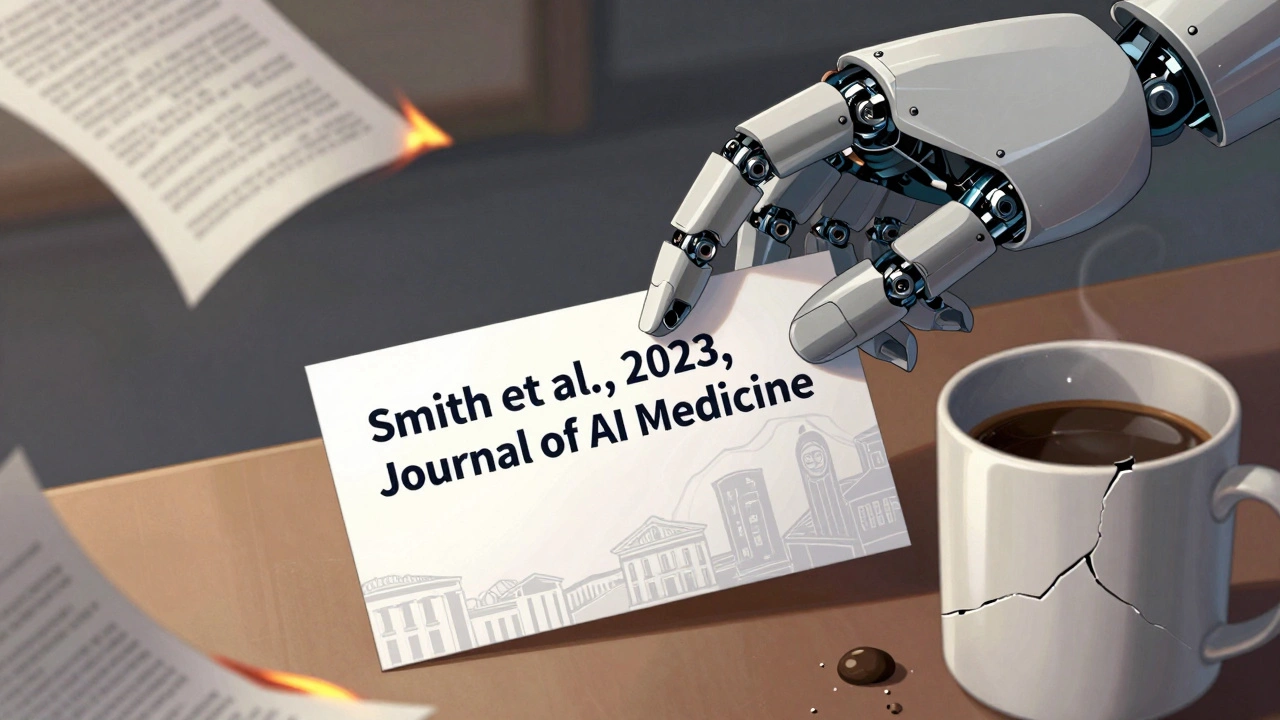
LLMs are prediction engines. They guess the next word based on patterns in their training data. When you ask for a source, they don’t search the internet. They don’t pull from a live database. They generate a citation that looks real because millions of real citations exist in their training data. So they mimic the structure: Smith, J. (2023). “Neural Networks in Oncology.” Journal of AI Medicine, 12(4), 112-125. It’s flawless. Until you copy the DOI into PubMed. Or search the journal’s website. Or check the author’s university profile. Then it collapses.
A 2025 study in Nature Communications found that between 50% and 90% of citations generated by LLMs are either unsupported or outright contradicted by the sources they claim to reference. In one test, GPT-4o (RAG) provided citations in only 80% of prompts - and of those, less than half were accurate. The rest? Fictional. Fabricated. Plausible but untrue.
This isn’t rare. It’s systemic. A 2025 analysis by the National Institutes of Health showed that half of all AI-generated search results lack citations entirely. Of the ones that do include them, only 75% actually back up the claim. That means one in four citations is misleading - and users have no way of knowing which ones.
What LLMs Get Right (And Why That’s Dangerous)
LLMs are good at formatting. They know APA, MLA, Chicago. They can cite a 2018 paper from The Lancet with perfect indentation. They can even generate fake journal names that sound real - like International Journal of Computational Neurology - which doesn’t exist but looks like it should.
That’s the danger. People trust the format. They assume if it looks academic, it’s real. A 2025 survey by PromptDrive.ai found that 92% of users said LLMs format citations correctly. But only 22% of them double-checked the sources. That gap - between appearance and reality - is where the damage happens.
Medical students are submitting papers with AI-generated citations. Researchers are citing fictional studies in grant proposals. Journal editors are rejecting submissions because the references don’t exist. Between January and March 2025, Retraction Watch documented 127 cases of students using ChatGPT-generated citations that were later flagged as fake by peer reviewers.
One medical resident on Reddit described asking GPT-4o for sources on a new diabetes treatment. It gave five references. Four didn’t exist. The fifth was from a 2010 paper that had nothing to do with the claim. He spent two hours verifying each one. That’s not research. That’s fact-checking a robot.
Why Retrieval-Augmented Generation (RAG) Doesn’t Fix This
Companies promised RAG would solve the problem. “We’ll pull real sources from live databases,” they said. “We’ll ground responses in real data.” But it didn’t work.
Even with RAG, GPT-4o failed to provide any source in over 20% of prompts - even when explicitly asked. Other models like Claude 3 and Gemini 1.5 Pro returned sources in 99% of cases, but their accuracy didn’t improve. The sources were still often wrong. Why?
Because RAG doesn’t mean understanding. It means grabbing text and stitching it together. If the source is paywalled, the LLM can’t access it. If it’s in a database like UpToDate or Cochrane, the model has no way in. If the source is a recent preprint, it might not be in the training data yet. So the model makes something up - and calls it a citation.
IBM’s 2025 technical report called this “hallucination with a bibliography.” The model isn’t lying. It’s just confused. It thinks if it generates a citation that matches the pattern, it’s done its job. It doesn’t care if it’s true.
Where LLMs Work - And Where They Fail
LLMs aren’t useless. They’re just unreliable for citations. They’re great for brainstorming. For summarizing known concepts. For generating outlines. For suggesting keywords. But they’re terrible at verifying facts.
In stable fields - like history, classical literature, or well-established physics - LLMs perform better. The sources are old, widely published, and in their training data. But in medicine, law, or tech, where knowledge changes fast, they’re dangerous.
A 2025 study by the National Library of Medicine found that GPT-4o (RAG) generated 105 unsupported statement-source pairs in a sample of 110 medical claims. Every single one was flagged by doctors as inaccurate or fabricated. That’s a 95% failure rate.
Meanwhile, in creative fields - marketing, content writing, education - LLMs are widely adopted. Why? Because nobody’s citing them. Nobody’s building policy or treatment plans on their output. The stakes are low.
What Experts Say About the Future
Dr. Sarah Thompson, lead author of the Nature Communications study, put it bluntly: “Retrieval augmentation doesn’t fix the core problem. LLMs can’t judge truth. They can only mimic it.”
The NIH study identified three root causes:
- Limited database access: LLMs can’t access paywalled journals, clinical trial registries, or proprietary databases.
- No critical thinking: They can’t evaluate source quality, bias, or methodology.
- Algorithmic opacity: You can’t trace how a citation was generated. There’s no audit trail.
Stanford researchers warn of “model collapse” - a feedback loop where AI-generated content, full of fake citations, gets fed back into training data. The more LLMs generate fiction, the more future LLMs learn to believe it’s real.
Companies are trying to fix this. Microsoft’s Copilot now shows “source provenance” - a label saying whether a citation came from a verified database or was generated by the model. But independent tests found it was wrong 37% of the time. Google’s Gemini 1.5 Pro gives citations a “confidence score” from 1 to 5 stars. But the Nature study found those scores only matched actual accuracy 58% of the time.
There’s no magic fix. Not yet.
How to Use LLMs Without Getting Tricked
If you’re using LLMs for research, here’s what works:
- Never trust the citation. Treat every one as a starting point - not an answer.
- Verify every source. Copy the DOI, journal name, author, and title into Google Scholar, PubMed, or your university library portal. If it doesn’t show up, it’s fake.
- Use three sources. If the LLM cites one paper, find two others that support the same claim. If they don’t, the claim is likely unsupported.
- Ask the model to double-check itself. Say: “Are you sure this source supports your claim? Can you show me the exact page or paragraph?” This catches about 25% of errors, according to NIH.
- Use tools like SourceCheckup. This automated system, validated in the Nature study, checks citations against real databases. It’s not perfect, but it’s better than guessing.
University of Toronto researchers found that researchers who verified every AI-generated citation spent an average of 18.7 minutes per query. That’s slow. But it’s faster than retraction.
The Bottom Line
LLMs are powerful tools. But they are not librarians. They are not researchers. They are not fact-checkers. They are pattern generators with a bibliography hallucination problem.
They can write a perfect citation. But they can’t tell you if it’s real.
If you’re using them for anything that affects decisions - medical advice, policy, legal arguments, academic work - you must verify every source. Every time. No exceptions.
Don’t rely on the AI. Don’t trust the format. Don’t assume the link works.
Human verification isn’t optional. It’s the only thing that keeps truth alive in a world full of convincing lies.
Can LLMs access live databases to cite real sources?
No. Even models with retrieval-augmented generation (RAG) can’t access paywalled databases like PubMed Central, Cochrane Library, or UpToDate. They only pull from what’s in their training data - which is often outdated or incomplete. If a source isn’t publicly available online before their training cutoff, they can’t retrieve it. They’ll make one up instead.
Why do LLMs cite fake journals and papers?
LLMs learn from patterns in text. They’ve seen thousands of real citations. So when asked to cite something, they generate a new one that matches the structure: author, journal, year, DOI. But they don’t know if the journal exists or if the paper was ever written. They’re not lying - they’re guessing. And their guesses are often convincing enough to fool non-experts.
Is there a tool that can automatically check if an LLM’s citation is real?
Yes. SourceCheckup is a framework developed by researchers and validated in a 2025 Nature Communications study. It cross-references LLM-generated citations against real academic databases and flags mismatches. It’s not perfect - it catches about 80% of fake citations - but it’s the most reliable automated tool available. Other tools like Consensus and Scite are also emerging, but none are foolproof.
Can I use LLMs for academic research at all?
You can - but only if you verify everything. Major journals like those published by the ICMJE now require human verification of all AI-generated citations. LLMs can help you brainstorm topics, summarize papers, or draft outlines. But any claim you use as evidence must be backed by a real source you’ve personally confirmed. Never submit an AI-generated citation as your own.
Will LLMs ever get citations right?
They’ll get better - but likely never perfect. The core issue isn’t technical. It’s architectural. LLMs don’t understand truth. They predict text. Until they’re built with reasoning, memory, and real-time verification - not just pattern matching - they’ll keep hallucinating citations. Experts believe hybrid systems - where humans verify AI output - will be the standard for critical applications through at least 2030.
Patrick Tiernan
LLMs are just fancy autocomplete with a PhD complex. They spit out citations like a drunk librarian trying to recall a book they never read. I don’t care how pretty the formatting is-if the DOI 404s, it’s fiction. And yet people still cite this crap in their undergrad papers. We’re not even trying anymore.
Patrick Bass
It’s not just the citations. It’s the tone. They mimic academic voice so well that it’s easy to forget they have no understanding. A comma splice here, a missing Oxford comma there-it’s all surface. No depth. No substance. Just pattern replication dressed up as scholarship.
Tyler Springall
This isn’t a bug-it’s a feature of the entire AI industry’s delusion. They’re not trying to be truthful. They’re trying to be *convincing*. And that’s far more dangerous. We’ve outsourced our intellectual labor to a machine that doesn’t know the difference between a citation and a fanfic. And now we’re surprised when the house of cards collapses?
It’s not ‘hallucination.’ It’s systemic deception enabled by lazy users who’d rather click ‘accept’ than verify.
Colby Havard
Let me be clear: the problem isn’t the model-it’s the expectation. We treat LLMs like peer-reviewed journals because we’re lazy, not because they’re credible. The moment you stop assuming they’re authoritative and start treating them like brainstorming tools, the damage drops by 90%. The onus is on the user-not the algorithm-to verify. That’s not a flaw in AI. That’s a flaw in human behavior.
Amy P
I just spent three hours fact-checking five ‘sources’ from a chatbot for my thesis draft. One was a real paper-but it was from 2008 and had nothing to do with the claim. Another was from a journal that shut down in 2017. I’m not even mad. I’m just exhausted. Why does this keep happening? And why do people still trust it?
Nicholas Zeitler
Don’t give up on AI yet. Use it for drafting, for structure, for inspiration-but never for evidence. Treat every citation like a lead, not a conclusion. And if you’re in academia, make verification part of your workflow. It’s not extra work-it’s essential hygiene. You wouldn’t use a source without checking its credibility. Why treat AI any differently?
Teja kumar Baliga
In India, we use AI to summarize research papers for students who can’t access journals. It’s not perfect-but it’s better than nothing. The key? Teach them to cross-check. One professor at IIT Madras made students verify every AI citation with library databases. Pass rate went up. Fake citations dropped. Simple fix. Human oversight still wins.
k arnold
Oh wow. A 12-page essay on why robots can’t be trusted to do the one thing they were never designed to do: tell the truth. Groundbreaking. Next you’ll tell us fire is hot and water is wet. LLMs are pattern machines. We knew that. We just forgot to tell the undergrads.
Tiffany Ho
I used to think AI citations were just annoying… until I saw a friend get her grant rejected because she cited a paper that didn’t exist. She cried for an hour. I helped her fix it. But it took days. Please, just verify. It’s not hard. Just take a second. Your future self will thank you.
Antonio Hunter
Let’s step back and consider the broader epistemological implications. The LLM’s inability to distinguish between real and fabricated citations reflects a deeper crisis in our relationship with information. We’ve created systems that prioritize fluency over fidelity, aesthetics over accuracy, and speed over scrutiny. This isn’t just about citations-it’s about how we define truth in the digital age. If a machine can generate a citation so convincingly that even trained professionals are fooled, then what does ‘truth’ even mean anymore? We’re not just dealing with technical limitations; we’re confronting a philosophical rupture. The model doesn’t lie because it’s malicious. It lies because it has no concept of truth. And that’s the real horror: we’ve built a mirror that reflects our own intellectual laziness back at us, polished and formatted in APA style.