
Before 2020, if you wanted a computer to do something, you wrote code. You used loops, functions, conditionals-syntax that machines understood. Today, you can just type a sentence. Prompt engineering isn’t just a trick anymore. It’s how millions of developers now interact with AI systems. You don’t need to know Python or JavaScript to make an LLM generate code, write a report, or analyze data. You just need to ask well.
How We Got Here: From Code to Conversations
The shift didn’t happen overnight. Before GPT-3, AI models needed fine-tuning, labeled datasets, and hours of training to do even simple tasks. Then, in June 2020, OpenAI released GPT-3. It could write essays, answer questions, and even generate working code from plain English. What made it different wasn’t just size-it was how it responded to prompts. A well-crafted sentence could trigger complex behavior. No training. No recompiling. Just words. That’s when developers realized: you don’t need to write code to use code. You can use natural language as the interface. This wasn’t just convenience-it was a new way of programming. Instead of telling the machine step-by-step how to do something, you tell it what you want. And the model figures out the rest.What Exactly Is a Prompt?
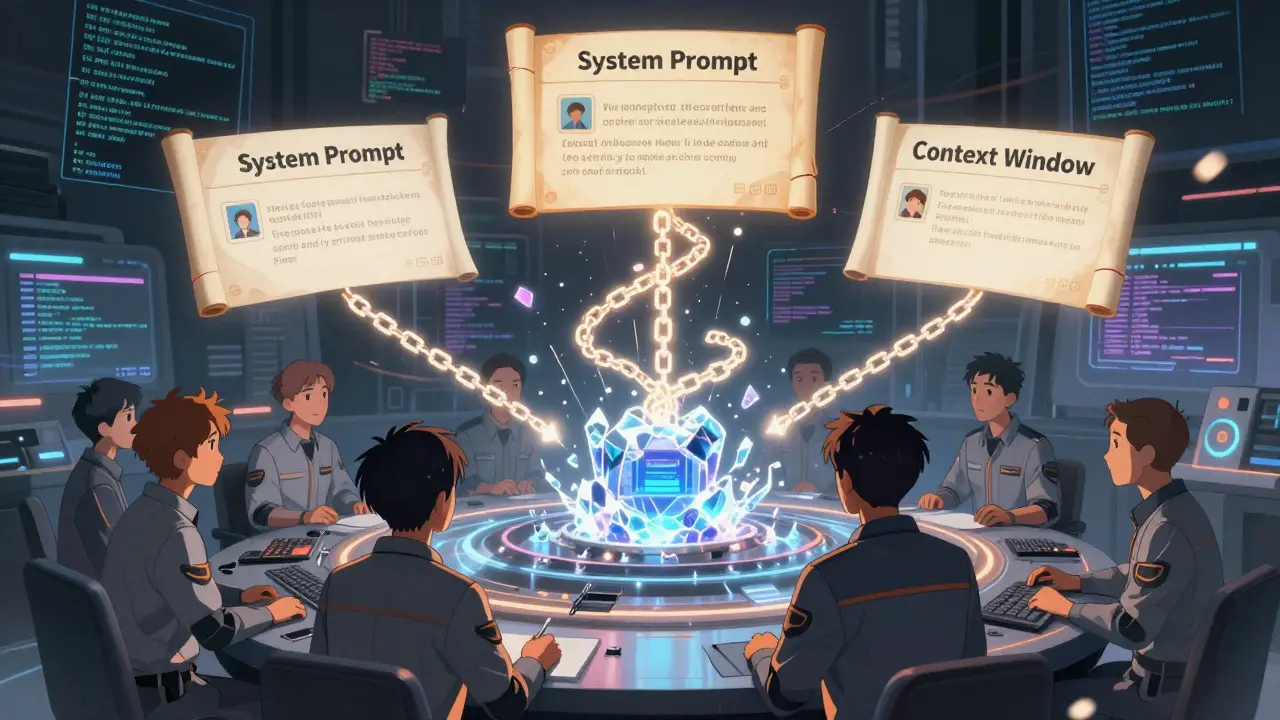
A prompt isn’t just a question. It’s a program. And like any program, it has structure. There are three key parts:- System prompt: This sets the rules. It tells the AI who it is, what it should do, and how to behave. Think of it like a job description. For example: “You are a senior software engineer. Always explain your reasoning before giving code.”
- User prompt: This is your request. “Write a Python function that sorts a list of dictionaries by date.”
- Context window: The AI’s short-term memory. Most models can only hold 4,096 to 128,000 tokens at once. That’s about 3,000 to 96,000 words. If your prompt is too long, the AI forgets the beginning.
Techniques That Actually Work
Not all prompts are created equal. Some get you a vague answer. Others get you clean, production-ready code. Here are the techniques top developers use:- Chain of Thought: Ask the AI to explain its reasoning first. Instead of “Write a login function,” try “Explain how you’d build a secure login system, then write the code.” This cuts errors by up to 40%, according to Reddit users in r/MachineLearning.
- Generated Knowledge: Split the task. First, ask the AI to generate useful facts or steps. Then ask it to use those to produce the final result. One developer cut debugging time by 40% using this method for complex features.
- Instruction Prompting: Be specific. “Generate a JSON object with keys: name, email, phone. Use American format for phone numbers.” Vague prompts like “Make me a contact form” often fail.
- Output Shaping: Control the format. “Return your answer as a bullet list. No markdown. No explanations.” This reduces cleanup time.
Prompts vs. Code: The Trade-Offs
You might think: “If prompts can replace code, why write code at all?” The answer is control. Traditional code is deterministic. Run it once, you get the same result. Run it a thousand times, still the same. Prompts? Probabilistic. Two nearly identical prompts can give wildly different outputs. Try this:- Prompt A: “Rewrite this text to make it half as long.”
- Prompt B: “Summarize this text, making it half as long.”
Real-World Use Cases
This isn’t theoretical. Companies are using it now:- Customer support teams use prompts to auto-generate responses based on ticket history.
- Product managers prompt LLMs to turn user feedback into feature specs.
- Startups use prompts to generate SQL queries from natural language-no database expertise needed.
- Legal teams extract key clauses from contracts using structured prompts.
The Dark Side: Security, Consistency, and Scale
There are risks. Prompt injection is the biggest. If you let users input prompts (like in a chatbot), they can trick the AI into ignoring its system instructions. In 37% of security-focused GitHub repos in 2025, this was a documented vulnerability. Context limits are another. If your prompt is too long, the AI forgets the beginning. That breaks multi-step workflows. And consistency? A nightmare. The same prompt might work today, fail tomorrow. Models update. Temperature settings change. You need version control for prompts-just like code. That’s why 58% of enterprise teams now use prompt libraries. They store tested templates. They label them with success rates. They test them before deployment.
What’s Next? The Rise of Prompt Engineering as a Discipline
Prompt engineering is no longer a side skill. It’s a core competency. LinkedIn’s 2025 report showed prompt engineering in 28% of AI/ML job postings-a 140% jump from the year before. Gartner estimates the market hit $1.2 billion in 2025 and will hit $3.8 billion by 2027. Fortune 500 companies are adopting it. 63% use it internally. 41% have formal guidelines. And the tools are catching up. OpenAI’s GPT-5, released in January 2026, lets you define parameters directly in system prompts. Microsoft’s Azure AI now supports “Prompt Contracts”-schema validation for prompts, so you know exactly what inputs and outputs to expect. GitHub’s Prompt Debugger for Copilot, launched in January 2026, lets you step through prompts like you would debug code. You can see what the AI is thinking at each stage. This isn’t the end. It’s the beginning. Analysts predict that by 2028, prompt engineering will have formal syntax, testing frameworks, and debugging tools-just like Python or Java. But the interface? Still natural language.How to Start
You don’t need to be a coder to get started. But you do need to treat prompts like work, not magic. Here’s how:- Start small. Use prompts to write emails, summarize articles, or generate ideas.
- Use system prompts. Always define the role, tone, and format.
- Ask for reasoning first. Use Chain of Thought.
- Test variations. Try three versions of the same prompt. Compare outputs.
- Save what works. Build your own prompt library.
Final Thought: You’re Not Replacing Code. You’re Expanding It.
Prompt engineering doesn’t kill programming. It expands who can do it. A product manager can now generate a data pipeline. A designer can write a script to resize images. A teacher can auto-grade essays. The barrier isn’t code anymore. It’s clarity. The ability to say exactly what you mean. And that’s a skill anyone can learn.Is prompt engineering the same as coding?
No. Prompt engineering uses natural language to guide an AI model’s behavior, while coding writes explicit instructions in a programming language. Prompts don’t get converted to code-they replace code in many cases. But unlike code, prompts don’t guarantee the same result every time. They’re probabilistic, not deterministic.
Can prompts be used in production systems?
Yes, but with safeguards. Many companies use prompts in production for customer support, content generation, and data summarization. However, they pair them with human review, output validation, and version control. Prompt contracts and debugging tools now help reduce risk. For mission-critical tasks, prompts are often used alongside traditional code-not instead of it.
Why do identical prompts sometimes give different results?
LLMs are probabilistic models. They generate responses based on patterns, not logic. Even small changes in wording, temperature settings, or context can shift the output. That’s why clarity, structure, and testing matter. Two prompts that seem identical-like “Rewrite this” vs. “Summarize this”-can trigger different internal reasoning paths in the model.
Do I need to learn programming to use prompts effectively?
Not necessarily. You can use prompts for writing, research, or automation without knowing Python or JavaScript. But if you want to build complex systems-like automating workflows or generating code-you’ll benefit from understanding basic programming concepts. Knowing how functions, loops, and data structures work helps you design better prompts.
What’s the biggest mistake people make with prompts?
Being too vague. Prompts like “Help me with this” or “Do something smart” rarely work. The best prompts are specific, structured, and include context. For example: “You are a senior financial analyst. Summarize this quarterly report in three bullet points, using plain language. Highlight risks and opportunities.” That’s a real prompt that works.
How do I know if a prompt is working well?
Test it. Run the same prompt five times. If the output is consistent, accurate, and matches your needs, it’s working. If it’s random, off-topic, or incomplete, refine it. Use Chain of Thought to see the model’s reasoning. Track success rates. Keep a library of working prompts. Treat them like code you’re testing and improving.
Jeff Napier
Prompt engineering is just code with a velvet glove. They call it democratizing programming but really it's just hiding complexity so people think they're smart without learning anything. The AI's not thinking-it's pattern-matching hallucinations based on internet trash. You think you're in control? Nah. You're just feeding the beast and hoping it doesn't bite back. And don't get me started on 'prompt contracts'-that's corporate gaslighting dressed up as innovation.
Sibusiso Ernest Masilela
Oh please. You people treat LLMs like oracles while ignoring that they're trained on data scraped from Reddit, 4chan, and Wikipedia edits made by bots. This isn't programming-it's digital voodoo. And now you want to put this in production? You're one prompt injection away from your entire customer support system spouting QAnon memes. The fact that companies are paying millions for this is the real joke. I've seen engineers cry after their 'AI-generated' contract summary accidentally deleted a liability clause. This isn't progress-it's societal decay dressed in Python.
Salomi Cummingham
I just want to say how deeply moved I am by this post-it feels like a quiet revolution, doesn't it? For so long, coding felt like an exclusive club with secret handshakes and cryptic syntax. But now? A teacher in rural Kenya can use a prompt to auto-grade essays. A single mom in Ohio can generate a budget spreadsheet without touching Excel. It’s not about replacing code-it’s about opening the door. I’ve been using chain-of-thought prompts to help my autistic nephew organize his thoughts, and the difference it’s made… I just cried last night. This isn’t tech. This is tenderness with a syntax. Please, let’s not turn this into another corporate power play. Let’s keep it human.
Johnathan Rhyne
Y’all are overcomplicating this. Prompts aren’t code, but they’re not magic either-they’re just *really* bad assembly language. You don’t need a ‘prompt library’ like it’s some sacred scripture. You need to stop using vague crap like ‘help me’ and start writing like you’re telling your drunk friend how to fix a leaky faucet: ‘Turn the knob clockwise, not counterclockwise, and don’t touch the green pipe.’ That’s it. No ‘system prompts.’ No ‘context windows.’ Just clarity. And if your AI outputs nonsense? That’s not the AI’s fault-it’s yours. You didn’t specify enough. Fix your damn wording. Also, ‘prompt engineering’ sounds like a buzzword invented by consultants who’ve never written a for loop.
Jawaharlal Thota
Let me share something from my experience teaching coding to rural students in India. Before, we spent weeks on loops and conditionals-many gave up. Now? I give them a simple prompt: ‘Write a Python script that takes a list of numbers and returns only the even ones.’ They type it. The AI gives them the code. Then we reverse-engineer it together. They learn variables, functions, logic-not by memorizing syntax, but by seeing it emerge from their own words. This isn’t replacing programming-it’s making it accessible. One girl, 14 years old, built a WhatsApp bot to remind her village’s elderly to take medicine. No prior coding. Just a prompt and curiosity. That’s the real win. The tools will evolve, but the human spark? That’s what matters. Let’s not fear the machine-teach people how to speak to it.
Lauren Saunders
Let’s be real-this ‘prompt engineering’ hype is just capitalism repackaging the same old thing. You think you’re empowered? You’re just outsourcing your cognitive labor to a probabilistic parrot trained on stolen text. And don’t even get me started on the ‘prompt debugger’ nonsense. That’s not engineering-that’s a placebo for people who don’t want to learn real programming. I’ve seen engineers spend hours tweaking prompts while junior devs who actually know Python ship working systems in minutes. The market’s inflated because VCs need a shiny new toy to throw money at. And the worst part? People are starting to believe this is skill. It’s not. It’s persuasion. And soon, we’ll have a generation of ‘prompt engineers’ who can’t write a single line of code but think they’re geniuses because GPT gave them a decent email draft. Wake up.