
The generative AI market isn’t just growing-it’s reorganizing. What started as a buzzword in 2022 has become a layered, complex ecosystem with clear roles: foundation models, platforms, and apps. Each layer serves a different purpose, and understanding how they fit together is the key to seeing where the real value lies in 2026.
Foundation Models: The Engine Under the Hood
Foundation models are the base layer of generative AI. These are massive, pre-trained systems-like GPT-4, Claude 3, or Gemini-that can generate text, images, code, or even video. They’re not built for a single task. Instead, they’re trained on huge datasets to understand patterns across many types of data. Think of them as the raw ingredients in a kitchen, not the final dish.
These models are dominated by a handful of players: Google, Microsoft, Meta, and Amazon. Why? Because training them costs hundreds of millions of dollars. You need thousands of GPUs, petabytes of data, and teams of PhDs. Smaller companies can’t compete here. Instead, they build on top of these models.
Transformer architecture is the backbone of nearly all foundation models today. It replaced older neural network designs because it handles long-range context better. A 2025 analysis showed that transformer-based models accounted for over 42% of the market, and that number is climbing. The breakthrough wasn’t just in accuracy-it was in scalability. A model trained on 100 billion parameters can now generate coherent paragraphs, not just random text.
But here’s the catch: foundation models aren’t products. They’re infrastructure. Companies don’t sell them directly to end users. They license them, open-source them, or use them internally. That’s why you don’t hear consumers saying, “I used Llama 3 today.” You hear, “I used Copilot” or “I asked ChatGPT.”
Platforms: The Bridge Between Models and Users
Platforms are the middle layer. They take foundation models and make them usable. This is where the real innovation happens-not in creating new models, but in packaging them.
Think of platforms like AWS Bedrock, Azure AI Studio, or Google’s Vertex AI. These services let businesses plug in different foundation models, tweak them with their own data, and deploy them without managing servers. They handle authentication, scaling, logging, and security. For a company that wants to build an AI-powered customer support tool, this is way easier than training a model from scratch.
But platforms aren’t just cloud providers. There are also specialized platforms like Hugging Face, which offers open-source model hosting and fine-tuning tools, or Runway ML, which lets creatives generate video from text without writing code. These platforms lower the barrier to entry. A startup in Boulder can now build an AI tool in days, not years.
Deployment architecture matters too. In 2025, 73.8% of generative AI usage happened via cloud platforms. Why? Because most companies don’t have the hardware to run these models locally. But that’s changing. Edge deployment-running smaller models on phones, laptops, or factory sensors-is growing at 21.5% annually. Companies like Apple and NVIDIA are pushing this shift. Why? Privacy. Speed. Cost.
Imagine a nurse using an AI assistant on her tablet to summarize patient notes. If the model runs locally, no sensitive data leaves the device. That’s a huge advantage in healthcare. Platforms are now offering hybrid options: cloud for heavy lifting, edge for real-time interaction.

Apps: The Face of Generative AI
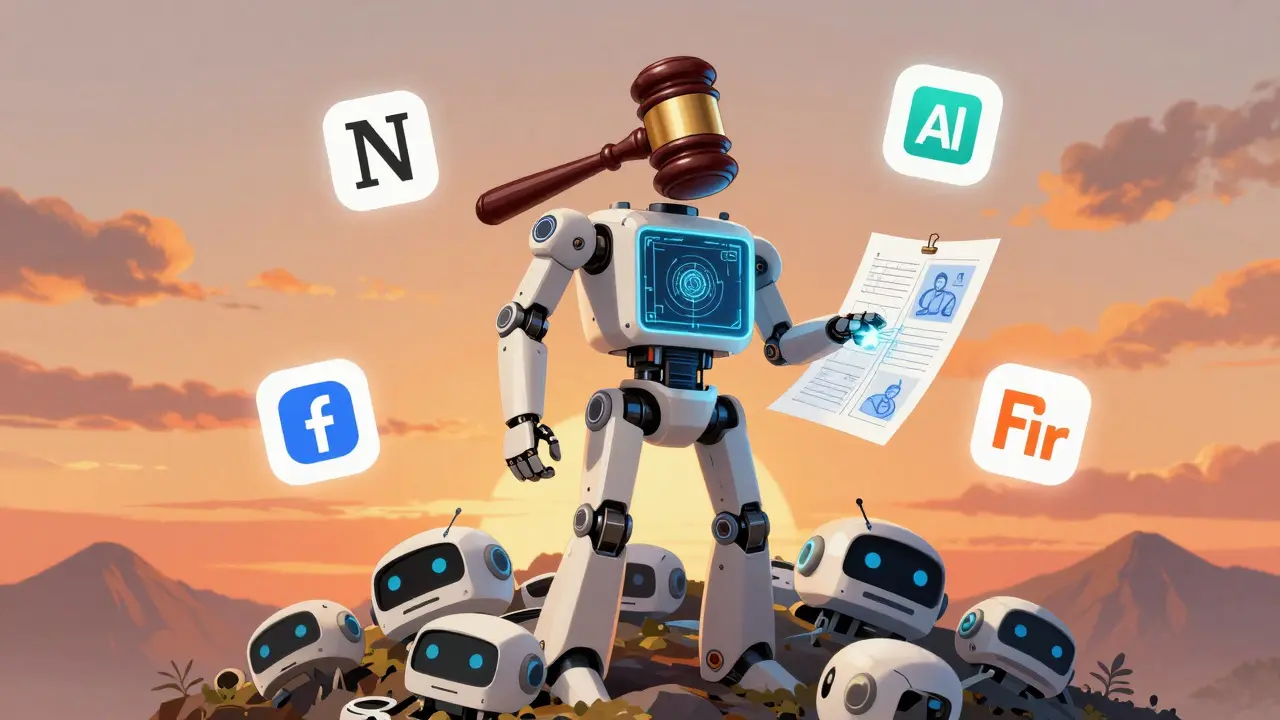
Apps are what most people interact with. These are the tools that solve real problems: Jasper for marketing copy, Notion AI for note-taking, Midjourney for image generation, Devin for coding. They’re the final layer-the user-facing product.
What’s surprising in 2026 is how specialized these apps have become. The early wave of generative AI was all about general-purpose chatbots. Now, the winners are vertical-specific. Legal AI that reads contracts. Medical AI that interprets radiology scans. Engineering AI that checks CAD designs.
Text generation still leads the market, with 48% of revenue in 2025. But image and video generation are catching up fast. Adobe’s Firefly, for example, isn’t just another image tool-it’s built into Photoshop. That’s the future: AI embedded in workflows, not separate from them.
Code generation apps like GitHub Copilot are reshaping software development. A 2025 survey found that 45% of developers using Copilot reported cutting their coding time by more than 30%. That’s not a convenience-it’s a productivity multiplier.
And multimodal apps are the next frontier. Tools that combine text, image, and audio in one interface are becoming standard. Imagine asking an AI: “Show me a video of a mountain hike, with a voiceover explaining the terrain, and generate a playlist for the mood.” That’s not science fiction. It’s what’s being built right now.
Who’s Winning the Market?
The market structure creates clear winners and losers.
Big tech companies-Google, Microsoft, Amazon-control the foundation models and cloud platforms. They have the data, the hardware, and the capital. They’re not just selling AI; they’re locking in enterprise customers through their existing ecosystems. If you’re already using Microsoft 365, adding Copilot is frictionless.
But the real growth is happening at the app level. Startups aren’t trying to build better models. They’re building better tools for specific jobs. A company in Berlin might not have a foundation model, but it could have an AI that predicts equipment failures in wind turbines. That’s worth millions to a utility company.
Market data shows IT and telecom lead adoption at 20.6% of total revenue. But healthcare, legal, and manufacturing are growing faster. Why? Because those industries have high stakes, complex workflows, and strict compliance needs. AI that helps doctors draft notes or lawyers find case law isn’t a luxury-it’s a necessity.
Geographically, the U.S. leads with $23.9 billion in 2025. But Asia-Pacific is growing at 35.3% CAGR. China’s push into AI infrastructure, India’s startup surge, and Southeast Asia’s digital transformation are creating new power centers. Europe is steady, with Germany leading in industrial AI.
The Hidden Shift: From Tools to Systems
The biggest change in 2026 isn’t the tech-it’s the mindset.
Five years ago, companies tested AI on side projects. Now, they’re restructuring entire teams. CTOs are hiring AI integration specialists. Legal departments are drafting AI usage policies. HR is retraining employees to work alongside AI.
And the most successful companies aren’t just using AI-they’re redesigning their products around it. Not “We added an AI chatbot.” But “Our entire customer onboarding flow is now AI-driven.”
This is why horizontal platforms are losing ground. No one needs a generic AI assistant. They need one that understands their industry’s jargon, regulations, and workflows. That’s why vertical startups are getting acquired. Not because they have the best model-but because they know the business.
What Comes Next?
By 2030, we’ll likely see three distinct markets:
- Foundation model licensing-dominated by big tech, with pricing based on usage volume and model size.
- Platform-as-a-service-cloud providers competing on ease of use, compliance, and hybrid deployment options.
- Vertical AI apps-thousands of niche tools, each solving one specific problem better than anything else.
The value isn’t in the model anymore. It’s in how well you integrate it. The next wave of winners won’t be the ones with the biggest parameters. They’ll be the ones who understand the job-and built something that fits.
What’s the difference between a foundation model and an AI app?
A foundation model is a large, general-purpose AI system trained on massive datasets-like GPT or Claude. It can generate text, images, or code but isn’t designed for a specific task. An AI app, on the other hand, is a user-facing product built on top of a foundation model to solve a particular problem-like drafting legal contracts or generating marketing images. The model is the engine; the app is the car.
Why are cloud platforms dominating generative AI adoption?
Cloud platforms handle the heavy lifting: storage, compute, scaling, and security. Running a foundation model requires thousands of high-end GPUs and constant maintenance. Most companies don’t have the budget or expertise to do that themselves. Cloud providers offer access to these models without the infrastructure overhead. In 2025, 73.8% of generative AI usage happened through cloud services.
Are small companies still competitive in generative AI?
Yes-but not by building foundation models. Small companies compete by building specialized AI apps for niche industries. A startup in healthcare might fine-tune a model to read X-rays better than a general-purpose tool. These vertical apps solve real problems with high value, making them attractive to enterprises. Many are being acquired by big tech because they fill gaps in their platforms.
What role does data modality play in the generative AI market?
Data modality determines what kind of output an AI can produce. Text generation leads with 48% of market share because it’s easy to integrate into workflows. But image and video generation are growing fast, especially in marketing and media. Audio and code generation are also significant. The future belongs to multimodal systems that handle multiple types of data together-like an AI that generates a video, adds narration, and writes a caption-all in one go.
Why is Asia-Pacific growing faster than North America in generative AI?
Asia-Pacific’s growth is fueled by aggressive government investment, rapid digital adoption, and large, tech-savvy populations. China is pouring resources into AI infrastructure, while countries like India and Indonesia are leapfrogging legacy systems with mobile-first AI tools. North America has mature markets and stricter regulations, which slow adoption. Asia-Pacific’s 35.3% CAGR reflects a race to build AI-native economies.
Jennifer Kaiser
It’s wild how we’ve gone from ‘AI is magic’ to ‘AI is plumbing.’ We don’t talk about foundation models like they’re gods anymore-we treat them like power grids. And honestly? That’s progress. The real revolution isn’t in the math. It’s in how we stopped trying to make AI *understand* and started making it *work*.
People still think the future is chatbots. Nah. The future is a nurse in rural Montana using a local AI to summarize patient notes without uploading HIPAA data to the cloud. That’s not tech. That’s dignity.
And yeah, big tech owns the models. But the real power? It’s in the vertical apps. The one that predicts when a wind turbine’s bearing is gonna fail. The one that flags fraudulent insurance claims before a human even sees the form. Those aren’t sexy. But they’re saving lives. And money. And sanity.
TIARA SUKMA UTAMA
app is the car. model is the engine. but like… who cares if the engine is a v8 if the car’s got flat tires?
Jasmine Oey
Omg I am SO over this ‘foundation model’ jargon. Like, can we just say ‘giant AI brain’? I’m not a nerd, I just want my AI to write my emails without sounding like a LinkedIn bot from 2021.
Also?? I used Notion AI yesterday and it made my to-do list sound like a TED Talk. I cried. Not because it was good. Because it was TOO GOOD. Like… who gave it the right to be this emotionally intelligent??
And don’t even get me started on how Midjourney just made my dog look like a Renaissance painting. I’m not ready for my pets to be art history. I just wanted a picture of him napping.
Also, why is everyone ignoring that 73.8% stat?? That’s like, 3 out of 4 people using AI on someone else’s server. We’re all just renting brains now. And I’m here for it. 🙃
Marissa Martin
I think we’re romanticizing ‘vertical apps’ too much. It sounds noble, but what happens when the startup that built the AI for diagnosing rare skin conditions gets bought by Big Pharma? Suddenly, the tool that helped rural clinics suddenly costs $20k/month. The democratization narrative is nice. But the reality? It’s just another layer of extraction.
And don’t get me started on ‘edge deployment.’ Sure, it’s great for privacy. But most people don’t even know what edge means. They just want their phone to stop lagging when they ask it to ‘make my grandma’s birthday card.’
We’re building systems we don’t understand… and calling them progress. I’m not saying stop. I’m just… wondering who’s holding the leash.
James Winter
USA built the models. USA runs the cloud. USA pays for the R&D. And now some startup in Berlin is getting funded to ‘solve wind turbines’? Nah. You don’t get to take our tech and slap your flag on it. Build your own damn foundation model. Or shut up.
Also, Asia-Pacific growing faster? Yeah, because they’re not wasting time on ethics reviews. We’re still debating if AI can have feelings. They’re deploying it in factories. Real progress isn’t polite. It’s fast. And it’s not American. But it should be.
Aimee Quenneville
so like… the model is the engine, the platform is the dealership, and the app is the car… but what if we’re all just driving a Tesla that’s secretly a glorified toaster?
i mean, i asked my ‘AI assistant’ to write a poem about my cat and it gave me a 500-word corporate mission statement about ‘feline emotional optimization.’
we’re not building the future. we’re just letting tech bros name our pets.
also. why is everyone so quiet about the fact that 45% of devs using copilot are now ‘too lazy’ to learn git? like… we’re not upgrading productivity. we’re just outsourcing brain cells.
also also. i’m 37. i don’t know what ‘multimodal’ means. but i know my dog barked when i said it. so… win?
ps. i’m not mad. just… confused. and slightly scared. and also… kinda impressed? 🤷♀️