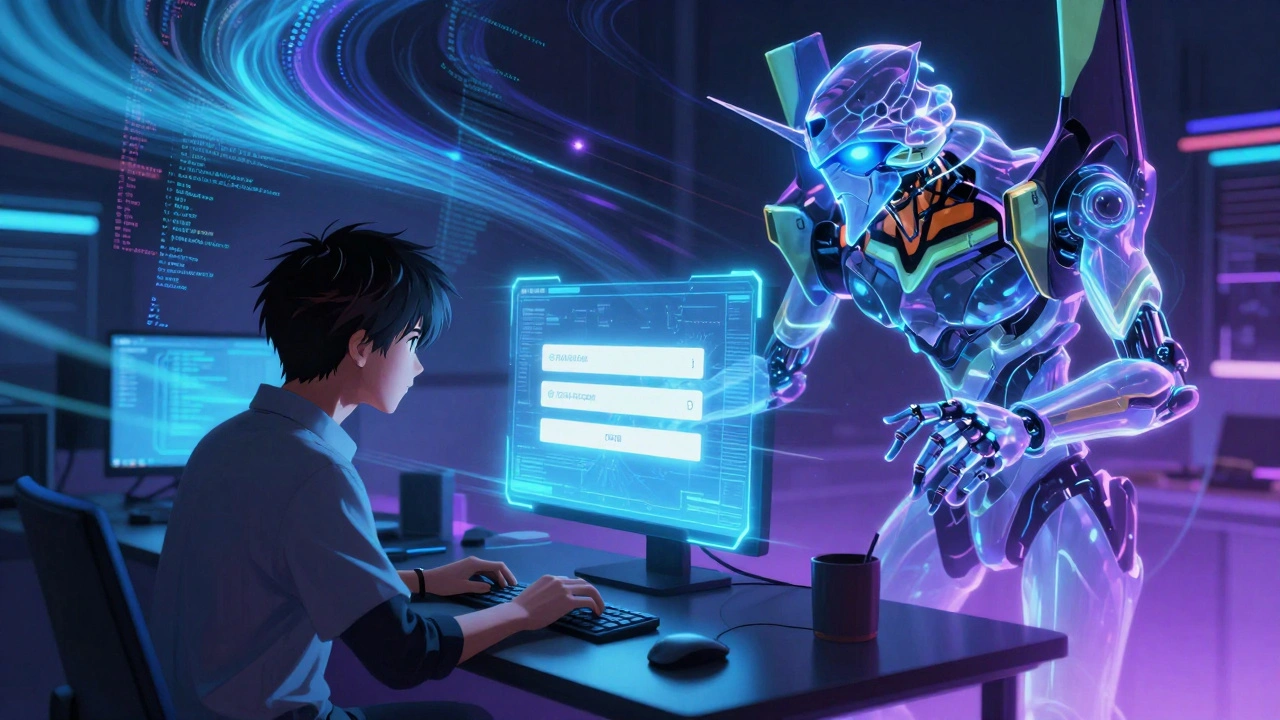
For years, developers talked about pair programming as the gold standard for clean, thoughtful code. Two minds, one keyboard. But what if one of those minds wasn’t human? Enter vibe coding and AI pair programming - two ways AI is reshaping how code gets written today. They sound similar, but they’re not the same. And picking the wrong one for the job can cost you time, security, or both.
What Is Vibe Coding?
Vibe coding is solo work, but with an AI assistant that anticipates your next move. You type a comment like “Create a login form with email validation and JWT token storage,” and the AI spits out working code in seconds. No need to manually write loops, API calls, or boilerplate. You stay in flow. You focus on the goal, not the syntax.
This isn’t magic. It’s powered by models like GitHub’s Codex, GPT-4, and Gemini 1.5, integrated directly into VS Code and JetBrains IDEs. GitHub Copilot, the most popular tool, costs $10/month for individuals and works with Python, JavaScript, TypeScript, and Java. According to GitHub’s 2024 productivity report, vibe coding cuts boilerplate time by up to 55%. Memberstack’s August 2024 study found it speeds up prototyping by 40-60% compared to traditional coding.
But here’s the catch: vibe coding works best when the task is clear. If you need to build a login page? Great. If you’re designing a microservice that handles real-time payments across three currencies? Not so much. AI-generated code in complex scenarios has a 15-30% chance of containing security flaws, according to Legit Security’s September 2024 study. One developer on Stack Overflow spent three days debugging an AI-generated auth module that skipped token expiration checks. That’s not a bug - that’s a breach waiting to happen.
What Is AI Pair Programming?
AI pair programming is like having a junior developer who never sleeps, never gets distracted, and never complains about coffee breaks. You’re still in charge - you drive the direction, make the decisions, and own the outcome. The AI acts as your co-pilot, suggesting alternatives, catching edge cases, and explaining why something might break.
It’s not just about generating code. It’s about conversation. You say, “This function is slow. How can we optimize it?” The AI suggests three approaches, shows benchmarks, and flags potential race conditions. You pick one, tweak it, and move on. It’s traditional pair programming without the salary, scheduling conflicts, or awkward silences.
Dino Cajic’s March 2025 article points out that AI pair programming brings back the 15% code quality boost from human pairs - but without doubling your team size. Companies like Shopify report 25-35% faster feature delivery when using this method for complex features. Google’s internal team saw a 35% reduction in delivery time by switching from vibe coding to AI pair programming during refinement phases.
But AI pair programming demands more from you. You need to know when to push back. You need to ask the right questions. You need to understand the domain well enough to spot when the AI is guessing. If you’re working on a healthcare app regulated by HIPAA, and the AI suggests storing patient IDs in localStorage? That’s a red flag. Your job isn’t to accept the code - it’s to question it.
When to Use Vibe Coding
Use vibe coding when you’re moving fast and the path is clear.
- Building prototypes for client demos
- Writing repetitive UI components (forms, modals, tables)
- Setting up API routes with standard authentication
- Generating test data or mock services
- Quickly scaffolding a new project structure
Small teams and solo devs love vibe coding because it removes friction. According to Memberstack’s August 2024 data, 87% of solo developers use it for prototyping. It’s perfect for hackathons, MVPs, or when you’re just trying to see if an idea works before investing weeks in it.
But vibe coding fails when:
- Business logic is fuzzy or evolving
- Security is non-negotiable (auth, payments, data encryption)
- You’re working with legacy systems that don’t follow modern patterns
- The AI’s context window can’t hold the full picture (like a 500-line config file)
Dr. Sarah Smith’s April 2025 DEF CON presentation showed that uncritical vibe coding increased vulnerability density by 22% in 500 codebases. That’s not a risk you take lightly in finance or healthcare.

When to Use AI Pair Programming
Switch to AI pair programming when the problem is complex, ambiguous, or high-stakes.
- Designing a new API architecture
- Refactoring a tangled legacy module
- Implementing compliance rules (GDPR, SOC2, HIPAA)
- Debugging a subtle race condition or memory leak
- Training junior developers through real-time feedback
It’s also the go-to for teams that need consistency. IT Revolution’s April 2025 survey found 63% of enterprises with 50+ developers use AI pair programming with formal review processes. They don’t just accept code - they audit it. They’ve built AI code review checklists. They’ve trained “prompt champions” to mentor others.
Google’s February 2025 case study showed that teams using AI pair programming for refinement - after initial vibe coding - achieved better quality and faster delivery than either method alone. The AI handles the grunt work. The human handles the judgment.
But AI pair programming doesn’t work if you’re not engaged. If you treat it like a magic wand, you’ll get garbage in, garbage out. You need to be an active participant. Ask “Why?” Ask “What if?” Ask “Is this secure?”
Real-World Workflow: How the Best Teams Combine Both
The top-performing teams don’t choose one or the other. They blend them.
Here’s how a typical day might look:
- Start with vibe coding to scaffold the feature - generate the base components, routes, and tests in 15 minutes.
- Switch to AI pair programming to refine the core logic - walk through edge cases, validate data flows, and stress-test error handling.
- Run automated security scans (like those now built into Gemini Code Assist) to catch OWASP Top 10 flaws.
- Have a human peer review the final code - not just for bugs, but for clarity and maintainability.
This hybrid approach is becoming standard. Tech Celerate’s November 2024 framework calls it “strategic AI augmentation.” GitHub’s January 2025 Copilot Workspace update now supports project-level context, reducing context-switching by 30%. That’s a big deal when you’re juggling multiple files.
And it’s not just about speed. It’s about confidence. When you know you’ve layered human oversight on top of AI efficiency, you ship faster - and sleep better.

Learning Curve and Team Adoption
Getting good at vibe coding takes time. Google’s February 2025 survey of 1,200 engineers found it takes 6-8 weeks for experienced devs to become proficient prompters. You can’t just say “make a button.” You need to say “Make a responsive button with hover animation, accessible keyboard navigation, and ARIA labels for screen readers.”
Teams that succeed invest in training. They create internal prompt libraries. They document what works. They hold weekly “prompt clinics.”
AI pair programming demands even more. You’re not just writing prompts - you’re having conversations. You need to learn how to steer the AI without micromanaging. You need to recognize when it’s stuck. You need to know when to say “no” and write it yourself.
On Reddit, a user named dev_in_the_trenches summed it up after six months: “I cut my boilerplate time in half - but now I spend 30% more time reviewing AI suggestions for edge cases.” That’s the new normal.
Market Trends and Future Outlook
The AI coding assistant market hit $1.2 billion in 2024 and is projected to hit $3.8 billion by 2027, per Gartner. GitHub Copilot holds 65% of the paid tool market. Amazon CodeWhisperer and Google’s Gemini Code Assist are catching up, with Gemini adding security-focused generation in March 2025 - now 92% accurate on OWASP Top 10 issues.
Adoption is exploding. In 2023, only 22% of enterprises used AI coding tools. By 2025, that’s 58%. Financial services (72%) and healthcare (68%) lead the pack - not because they’re tech-savvy, but because they can’t afford mistakes.
Regulations are catching up too. The EU’s AI Act will require documentation of AI-generated code in regulated industries starting July 2026. That means teams will need to track which parts of their code were AI-assisted - and why.
By 2027, Gartner predicts 95% of professional developers will use some form of AI assistance. The winners won’t be the ones who use AI the most. They’ll be the ones who use it the smartest.
Final Rule: Who Should Use What?
Here’s your simple decision tree:
- Use vibe coding if you’re solo, prototyping, or building something well-defined. Just review the output.
- Use AI pair programming if you’re on a team, working on complex logic, or handling security-sensitive code. Treat the AI like a junior dev you’re mentoring.
- Use both if you want to ship fast and stay safe. Start with vibe coding to get moving. Switch to AI pair programming to polish it.
The goal isn’t to replace developers. It’s to amplify them. The best coder in 2025 isn’t the one who types the fastest. It’s the one who knows when to let AI handle the details - and when to take control.
Is vibe coding the same as AI pair programming?
No. Vibe coding is solo work with an AI assistant that generates code based on your prompts. AI pair programming is a collaborative process where you actively guide the AI through your coding decisions, treating it like a partner in real time. One is about speed and flow; the other is about depth and accountability.
Can AI pair programming replace human code reviews?
No. AI can catch syntax errors and common vulnerabilities, but it can’t understand business intent, team standards, or long-term maintainability. Human reviews are still required - especially for security-critical code. AI is a tool, not a replacement.
Which is better for beginners: vibe coding or AI pair programming?
Vibe coding is easier to start with because it requires less interaction. Beginners can get quick wins by generating code and learning from it. But to grow, they need to move toward AI pair programming - asking questions, challenging suggestions, and understanding why code works. That’s where real skill develops.
Is vibe coding secure for production code?
Only if you review it carefully. Studies show AI-generated code has a 15-30% chance of containing security flaws. Never deploy vibe-coded code without human review, especially for auth, payments, or data handling. Use tools like Gemini Code Assist or automated scanners to help, but don’t skip the manual check.
How much does AI pair programming cost?
It depends on the tool. GitHub Copilot costs $10/month per user. Google’s Gemini Code Assist offers 6,000 free requests monthly, with enterprise plans starting at $20/user/month. Most tools include both vibe coding and AI pair programming features - the difference is how you use them, not the price.
Will AI replace developers entirely?
No. AI handles repetitive tasks and suggests solutions, but it doesn’t understand business goals, user needs, or trade-offs. Developers who learn to work with AI - asking the right questions, validating outputs, and owning the outcome - will thrive. Those who treat AI as a replacement will be left behind.
By 2027, the best developers won’t be the ones who write the most code. They’ll be the ones who know how to guide AI - when to push it, when to trust it, and when to say, “I’ve got this.”