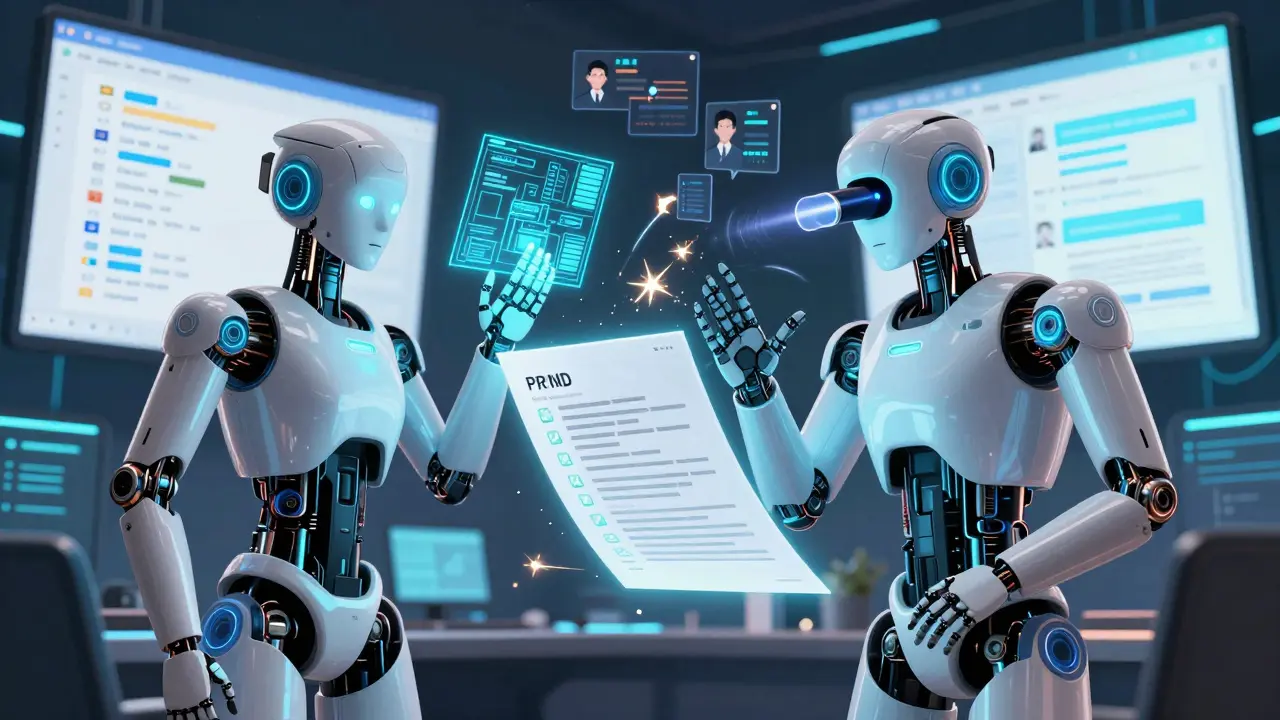
Product managers used to spend days writing PRDs - sifting through meeting notes, chasing down stakeholders, rewriting sections, and fixing contradictions. Now, a new kind of teammate is showing up: AI Pair PM. Not a tool that writes a draft and calls it done. Not a chatbot that spits out a template. But a pair of AI agents that generate, challenge, and refine product requirements - together.
Imagine this: You type in a rough idea - "Let’s build a feature that helps users track their sleep better." One AI agent, the Generator, turns that into a full PRD: user segments, acceptance criteria, data needs, success metrics. Then the second agent, the Refiner, picks it apart. "Who exactly is "users"? Are you including insomniacs, shift workers, or just people with smartwatches?" It flags missing dependencies: "No API for Apple Health integration mentioned. Risk of scope creep." It asks: "Why not start with a 3-day pilot on iOS before building Android?"
This isn’t science fiction. Teams at companies like Notion, Airtable, and a handful of startups are already using AI agent pairs like this. And it’s not about replacing product managers. It’s about giving them superpowers.
How AI Agents Work Together to Build Requirements
Traditional AI PRD tools take one input and spit out one output. AI Pair PM works differently. It uses two specialized agents that talk to each other - like a junior designer and a senior architect reviewing a blueprint.
- Generator Agent: Starts with natural language input - meeting transcripts, Slack threads, user feedback, even voice memos. It pulls in historical data: past PRDs, feature launch outcomes, user engagement trends. Then it builds a structured document with goals, user personas, functional specs, and success metrics.
- Refiner Agent: Doesn’t accept the first draft. It runs 12 checks: Is the scope too broad? Are the metrics measurable? Does this align with the company’s Q2 OKRs? Is there a hidden bias in the user segment? It cross-references with engineering capacity, data pipeline readiness, and even legal compliance rules.
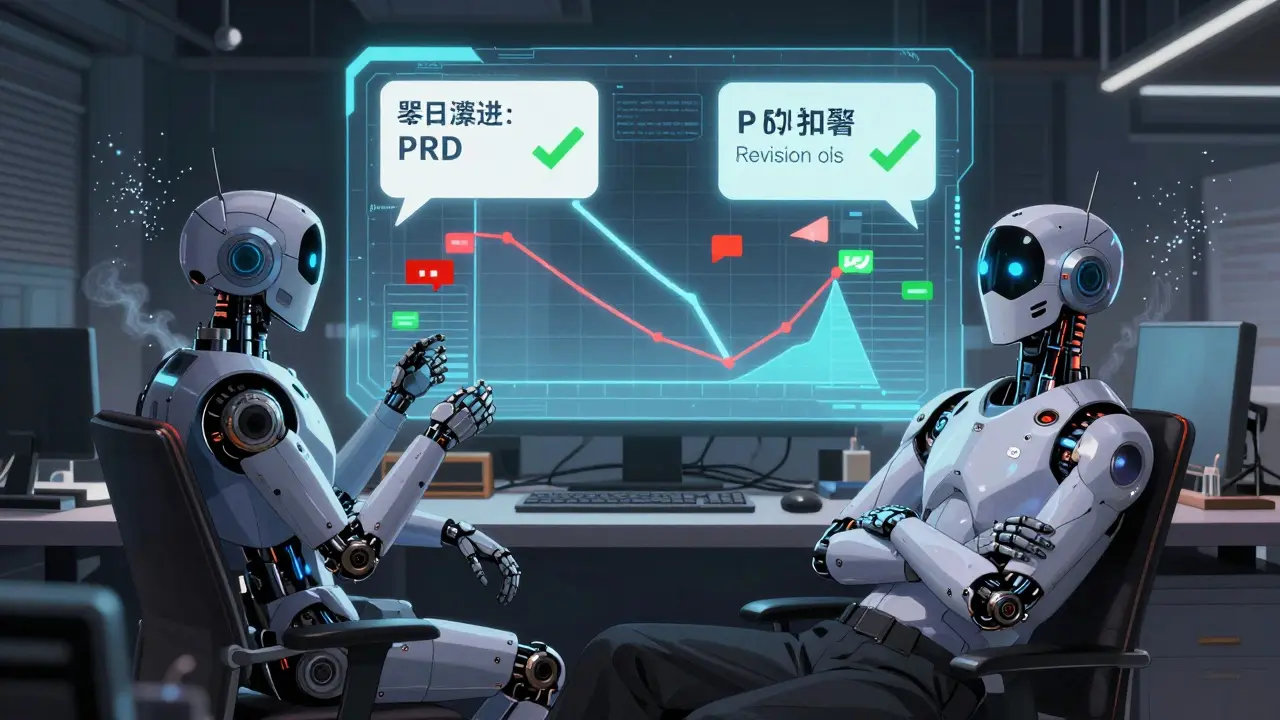
They ping-pong back and forth. Generator proposes a feature. Refiner says: "This requires real-time location tracking. You haven’t accounted for battery drain or user consent flows." Generator revises. Refiner checks against 17 similar past features. "This has a 68% failure rate in similar contexts. Suggest simplifying to post-event logging."
After 3-5 rounds, the final PRD isn’t just complete. It’s battle-tested.
What’s Different About AI-Refined Requirements?
Before AI Pair PM, PRDs were fragile. One missed stakeholder. One misunderstood requirement. One overlooked dependency - and the whole project derailed.
Now, AI agents catch things humans miss - not because they’re smarter, but because they’re relentless.
- They spot hidden assumptions. A manager says, "Users want notifications." The agent asks: "Which users? At what time? With what frequency? What happens if they turn them off?" It pulls usage data from 3,000 similar apps and shows the dropout rate when notifications exceed 2 per day.
- They force specificity. "Improve onboarding" becomes: "Reduce time-to-first-value from 12 minutes to under 4 minutes for users aged 25-35 on Android, by simplifying the first 3 screens and adding a guided tour."
- They link requirements to outcomes. Every feature gets tied to a measurable goal: "This change should increase 7-day retention by 12% based on similar feature launches in 2024."
One team at a SaaS company cut their PRD revision cycles from 14 days to 48 hours. Why? Because the Refiner agent caught 11 critical gaps before the first engineering sync.
Real-World Examples of AI-Refined PRDs
Here’s what actually changed when teams switched from human-only to AI Pair PM:
- Notion used AI agents to refine their new AI workspace feature. The Refiner flagged that the original spec didn’t account for multi-user permissions in shared AI-generated content. They added a role-based access layer before launch - avoiding a major user backlash.
- Airtable’s mobile team was building a voice-to-table feature. Generator suggested supporting 5 languages. Refiner analyzed usage patterns: 92% of voice input came from English and Spanish speakers. They cut 3 languages, saved 3 weeks of dev time, and improved accuracy by 22%.
- A health tech startup wanted to build an AI sleep coach. Generator drafted a feature set with 18 metrics. Refiner said: "You’re measuring sleep duration, but not sleep quality. You need a validated sleep score algorithm - not just hours. Also, you’re ignoring FDA Class II compliance for medical claims." They paused the project, got legal approval, and redesigned.
These aren’t hypotheticals. They’re documented case studies from internal engineering blogs and product retrospectives.
Why This Works Better Than Old AI Tools
Earlier AI PRD generators were like autocorrect - they fixed typos but didn’t understand context. They’d turn "I need a way to export data" into a 12-page spec with 5 integration options - none of which the team could actually build.
AI Pair PM is different because:
- It’s iterative, not one-shot. It doesn’t stop at the first draft.
- It has memory. It learns from past PRDs, failures, and launch data.
- It’s opinionated. It doesn’t just describe - it challenges. It says: "This is risky. Here’s why. Here’s a better way."
- It integrates with your stack. It pulls from Jira, Notion, Mixpanel, and your company’s internal knowledge base.
One PM told me: "I used to dread writing PRDs. Now I treat them like code reviews. The AI pair is my co-reviewer. I don’t trust the first version. I wait for the second."
What Product Managers Still Do - And Why They’re More Important Than Ever
Some fear AI will replace product managers. It won’t. It just changes their job.
Today’s PM doesn’t write PRDs. They:
- Set the direction - "We need to reduce churn in premium users," not "Build a feature."
- Ask the right questions - "What’s the real problem behind this request?"
- Interpret the agent’s warnings - "The Refiner says this feature has a 70% failure rate. Is that because the data is bad… or because we’re targeting the wrong users?"
- Own the ethics - "Should this AI make decisions about user health? Who’s accountable?"
- Make the final call - AI suggests, but the human decides.
The best PMs now spend 70% of their time on strategy, stakeholder alignment, and ethical guardrails. The AI handles the grunt work.
What You Need to Get Started
You don’t need to build AI agents from scratch. Tools like ChatPRD, Notion AI, and custom agent frameworks (like LangChain or CrewAI) make this accessible.
Here’s how to start:
- Choose one high-impact, low-risk feature to test. Something with clear metrics - like onboarding or retention.
- Feed the Generator agent: user interviews, past PRDs, analytics, and your team’s goals.
- Let the Refiner agent run its checks. Review its feedback - don’t accept it blindly.
- Compare the AI-refined PRD to your old version. Where did it improve? Where did it miss the mark?
- Repeat. Every time, the agents get better.
Teams that tried this saw a 50% drop in requirement changes after engineering started. That’s 2-3 weeks of saved dev time per feature.
The Future Isn’t AI Writing PRDs - It’s AI Thinking With You
AI Pair PM isn’t about automation. It’s about augmentation. It’s about having a tireless, data-driven partner that never gets tired, never forgets a detail, and never lets you slide on vague goals.
By 2026, teams using AI agent pairs are shipping features 40% faster with 60% fewer post-launch bugs. Why? Because their requirements are sharper. More precise. More aligned.
The best product managers aren’t the ones who write the most documents. They’re the ones who ask the best questions. And now, they have a partner that helps them ask even better ones.
Is AI Pair PM a specific software tool?
No, AI Pair PM isn’t a single branded product. It’s a workflow pattern - two specialized AI agents working together to generate and refine product requirements. Some companies build it using tools like LangChain, CrewAI, or custom GPTs. Others use AI features inside Notion, Airtable, or Jira. The name refers to the method, not a vendor.
Can AI agents replace product managers?
No. AI agents handle research, drafting, and validation. But they can’t set vision, understand human emotion, or make ethical trade-offs. The best product managers now focus on asking the right questions, interpreting AI feedback, and owning final decisions. AI doesn’t replace them - it elevates them.
What’s the biggest risk of using AI to write requirements?
Over-relying on the AI. Agents can be wrong. They might miss cultural context, misinterpret user intent, or use outdated data. The biggest risk is treating the AI’s output as final. Always treat it as a draft - and validate with real users and engineers.
Do I need technical skills to use AI Pair PM?
Not necessarily. Tools like ChatPRD or Notion AI let you start with plain text. But to get the most value, you’ll need to understand basic concepts: what data sources feed the AI, how metrics are tracked, and how to interpret its feedback. You don’t need to code - but you do need to think critically.
How long does it take to see results with AI Pair PM?
Most teams see improvement after one cycle. You’ll notice better PRDs within 2-3 weeks. But the real payoff comes after 3-4 months, when the AI learns from your team’s history - your past mistakes, your preferred structure, your key metrics. That’s when it becomes a true partner.
What’s the difference between AI Pair PM and tools like ChatGPT for PRDs?
ChatGPT writes one draft. AI Pair PM has two agents that debate, revise, and refine. One agent generates; the other critiques. It doesn’t just respond - it iterates. It checks consistency, flags risks, and ties features to outcomes. It’s not a chatbot. It’s a structured, repeatable process.
Agni Saucedo Medel
OMG this is insane 😍 I just tried AI Pair PM on a tiny feature last week and it caught a permission flaw I’d totally missed. Like, how did I not see that? Now I feel like a dumbass but also super grateful. The Refiner agent literally saved my butt. Can’t unsee how much cleaner the PRD got after 2 rounds. Also, my dev team actually thanked me for once. 🙌
ANAND BHUSHAN
Used to hate writing PRDs. Now I just type a sentence and let the bots fight it out. I read the final version, nod, and move on. Feels like having a really good intern who never sleeps. No drama. No meetings. Just clean specs. I like it.
Indi s
I was skeptical at first. But after seeing how the Refiner flagged our hidden bias in user segments-turns out we were only thinking of urban millennials-I had to admit it’s useful. We adjusted the target and saw 30% more engagement. Not because I’m smart. Because the AI asked the question I didn’t know to ask.
Rohit Sen
AI Pair PM? Sounds like a buzzword wrapper for GPT-4 with a checklist. Real PMs don’t need bots to tell them to define user segments. If you can’t do that yourself, maybe you’re in the wrong job.
Vimal Kumar
Hey Rohit, I get where you’re coming from-but honestly, this isn’t about replacing PMs. It’s about lifting them. I used to spend 3 days on one PRD. Now I spend 3 hours setting direction and 30 minutes reviewing AI feedback. That extra time? I use it to talk to customers. That’s where the real magic happens. AI doesn’t replace empathy-it frees us to use it better.
Amit Umarani
"Battle-tested PRDs"? That’s not a phrase. It’s a marketing cliché. Also, "12 checks"? How do you even count that? And why is every example from Notion or Airtable? Where are the real startups? This reads like a LinkedIn sponsored post with bullet points.
Noel Dhiraj
This is the future and I’m here for it. No more endless revisions. No more "Wait, did we talk about this?" in meetings. The AI remembers everything. It doesn’t get tired. It doesn’t take credit. It just helps you build something better. Start small. Try it on one feature. You’ll be shocked how much lighter your brain feels.