
Imagine building a full business app in under three hours - no coding experience needed. Just type what you want, and the AI builds it. That’s vibe coding in 2026. It’s not science fiction. It’s happening right now, and it’s rewriting the economics of software development. Companies are slashing development costs, but hidden bills are starting to show up. Some are thriving. Others are stuck with broken code and $200,000 repair bills. So what’s really going on? And who wins - and who loses - as this shifts from a novelty to a mainstream tool?
The Cost Drop That Changed Everything
Vibe coding cuts the initial cost of building software by 65% to 85%. That’s not a guess. It’s from Gartner’s 2025 report, backed by real data from companies using Google’s Firebase Studio, Microsoft’s GitHub Copilot, and Knack’s AI builder. A small business owner in Denver built a customer tracking system in 3 hours using Knack. She estimated it would’ve cost $15,000 if she hired a developer. With vibe coding? $0. Just her time.Traditional development meant hiring engineers at $150-$250 an hour. A simple internal tool could take 80+ hours. That’s $12,000 to $20,000 before testing. Vibe coding turns that into 5-10 minutes of prompting and 2-3 hours of tweaks. For startups and small teams, this isn’t an upgrade - it’s a revolution. The barrier to entry for custom software has collapsed.
But here’s the catch: the cheapest part is the start. The real cost comes later.
Why the Long-Term Costs Are Rising
Microsoft’s internal testing shows vibe coding can turn a 40-hour prototype into a 5-minute build. That’s incredible. But when that app grows - when users demand new features, integrations, or performance fixes - things get messy. IBM found that 15-25% of AI-generated code contains errors. Most are easy to fix. But when non-technical users build complex systems without understanding architecture, those errors pile up.A logistics startup in Chicago used vibe coding to build their route optimizer. It worked fine for 50 deliveries a day. When they scaled to 5,000, the system crashed. They spent $200,000 over six months just to rebuild it from scratch. Why? The AI didn’t know how to structure data for high volume. It didn’t know about database indexing, caching, or API throttling. It just followed prompts.
Forrester Research found that after 12 months, maintenance costs for vibe-coded apps are 20-30% higher than traditional ones. Why? Because the code is often messy, poorly documented, and built on assumptions that don’t scale. You save money upfront, but you pay for it in technical debt. And debt doesn’t disappear - it compounds.
Who’s Winning in the Market?
The vibe coding market hit $2.8 billion in 2024. It’s growing at 67% a year. By 2027, it could be worth $14.3 billion. But who’s taking the lead?Three players dominate:
- Microsoft (32% market share) - GitHub Copilot, now deeply integrated into Visual Studio and Azure. It’s the go-to for professional developers who want AI help without leaving their workflow.
- Google (28% market share) - Firebase Studio and Gemini Code Assist target business users. Their strength? Simplicity. You don’t need to know SQL or APIs. Just describe what you need.
- Specialized tools like Knack (15% market share) - Built for non-technical teams. Sales, HR, operations - they’re using it to build internal tools without IT tickets.
These aren’t just tools. They’re ecosystems. Google and Microsoft now offer usage-based pricing. You pay per AI request, not per user. That means a small team using it once a week pays almost nothing. A large company running 100 builds a day pays more - but still less than hiring three full-stack devs.
And now there’s a new twist: vibe coding marketplaces. Replit launched one in late 2024. Developers upload AI-generated components - a login module, a charting tool, a payment connector - and sell them for $5 to $50 each. Others reuse them. It’s like an App Store for code snippets. That’s creating a new class of micro-entrepreneurs: prompt engineers who build and sell reusable AI components.

The New Skills That Matter (And the Ones That Don’t)
Forget learning Python or JavaScript. The most valuable skill in vibe coding isn’t coding - it’s prompting.Business analysts are now the new product owners. They need to know how to write clear, structured prompts that guide the AI to build what they actually need. Upwork’s Q4 2024 data shows prompt engineers are earning $85-$120 an hour - more than junior developers in many markets.
Training non-technical users takes 8-12 hours, according to Microsoft. That’s a fraction of the 40+ hours it used to take to learn traditional no-code platforms. But here’s the problem: most companies don’t train their teams. They just hand them the tool and say, “Go build something.” That’s why 73% of users report scope creep - the AI keeps giving them options, and they keep adding features without planning.
The solution? Hybrid teams. One business user, one technical reviewer. The business person writes the prompt. The tech person checks the architecture, data flow, and security. That’s becoming standard at companies like PixelPulse, a marketing agency that cut tool development costs by 90% and now offers custom client apps at 40% lower prices.
The Hidden Rules: Governance and Compliance
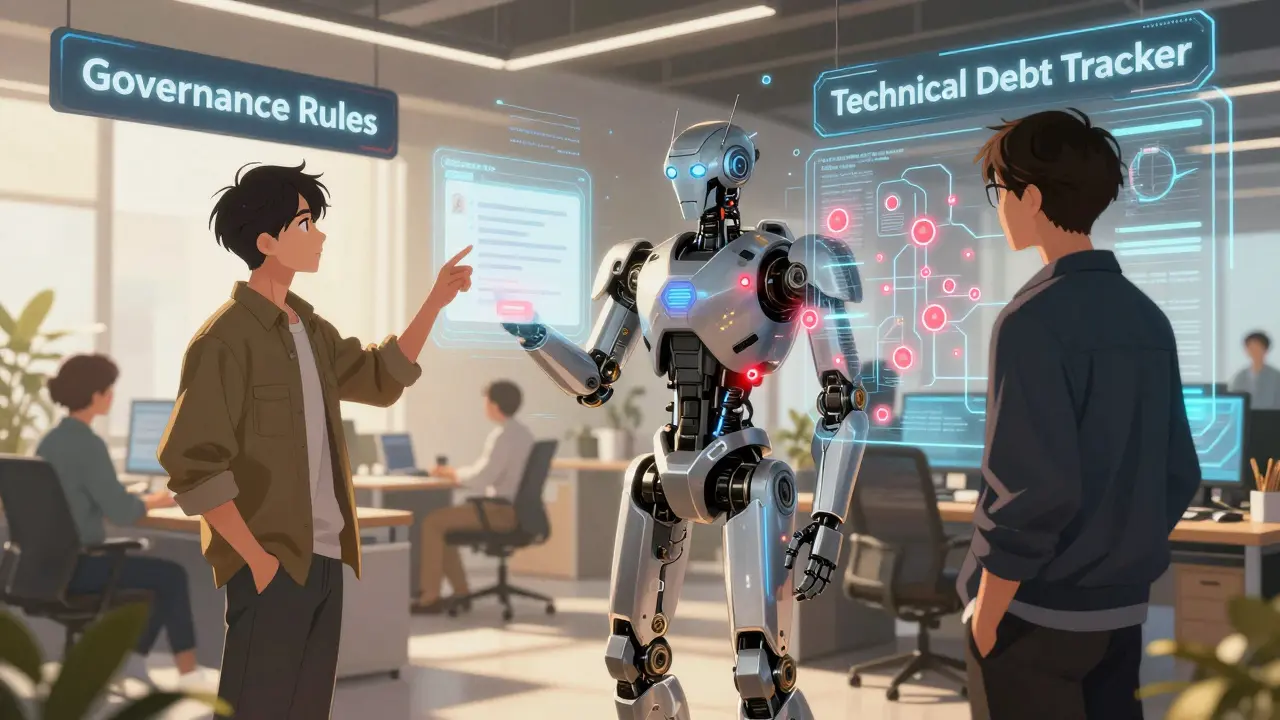
The EU’s AI Act, which went live in January 2025, requires companies to document all AI-generated code used in critical systems - finance, healthcare, logistics. That means you can’t just build something and forget it. You need to track every prompt, every change, every output. PwC estimates this adds 5-7% to development costs. For small teams, that’s a headache. For enterprises, it’s mandatory.Deloitte’s 2024 guide recommends three rules for any company using vibe coding:
- Set boundaries: No AI-generated code in core infrastructure (databases, payment systems, security layers).
- Review every build: Even if it’s “just a form,” have a developer sign off.
- Track technical debt: Use tools like Microsoft’s new Copilot for Business Applications, which scans vibe-coded projects for risk patterns.
Companies that ignore this are setting themselves up for disaster. TechValidate’s December 2024 survey found that 87% of enterprise architects now conduct monthly architecture reviews for vibe-coded apps. That’s not optional anymore.
Real Stories: The Winners and the Warnings
Sarah Chen, a small business owner in Austin, built a custom inventory system in 3 hours. She saved $15,000. She’s still using it. No issues. Why? Because it’s simple. It tracks 200 products. It doesn’t need to scale. She didn’t try to turn it into an ERP system.David Miller, a mid-level manager at a retail chain, used vibe coding to build a staff scheduling tool. It worked for six months. Then it started crashing during peak hours. He spent $8,200 in developer hours fixing it. He said: “I thought I was saving money. I was just delaying the real cost.”
And then there’s RouteOptimize - the logistics startup that spent $200,000 to rebuild. Their mistake? They used vibe coding for everything - including the core routing engine. The AI didn’t understand real-time traffic data or delivery windows. The result? Late deliveries, angry customers, and a $200K write-off.
The lesson? Vibe coding is perfect for internal tools, prototypes, and simple apps. It’s dangerous for anything that needs to scale, handle sensitive data, or integrate with legacy systems.
What’s Next? The 2026 Outlook
By 2028, Goldman Sachs predicts vibe coding will capture 35-40% of the $520 billion custom software market. McKinsey is more cautious - they think it’ll be 20-25%. Either way, it’s massive.The biggest risk? Technical debt. Morgan Stanley estimates that if companies don’t fix poor architecture now, the industry could face $120-$180 billion in cleanup costs between 2026 and 2028. That’s not a future problem. It’s a ticking clock.
But the opportunity is bigger. Vibe coding is letting non-developers build software. That means thousands of new apps - for schools, nonprofits, local shops - that never existed before. It’s democratizing creation. The question isn’t whether vibe coding will change software development. It already has.
The real question is: Are you using it wisely?