
Big language models like GPT-4 and Claude 3 can solve complex math problems, explain legal contracts, and break down scientific papers - step by step. But they’re expensive to run, slow to respond, and need massive servers. What if you could give a tiny model - one that fits on your phone - the same ability to think through problems? That’s the promise of chain-of-thought distillation.
What Exactly Is Chain-of-Thought Distillation?
Chain-of-thought (CoT) reasoning isn’t just giving an answer. It’s showing the work. Instead of saying "The answer is 42," a model with CoT says: "First, I need to find the total cost. 3 items at $12 each is $36. Then add tax: $36 × 0.15 = $5.40. Total: $36 + $5.40 = $41.40. Rounded up, that’s $42." Distillation takes that thinking process from a giant model - say, a 70B-parameter LLM - and teaches a much smaller one, like a 7B or even 1.1B model, to mimic it. The goal isn’t to copy every word. It’s to copy the structure. The rhythm. The way the model breaks things down. Research from 2025 shows this isn’t science fiction. Models like Mistral-7B, when distilled using CoT, hit 78.3% accuracy on math benchmarks - close to the 92.1% of the teacher model. That’s not perfect, but it’s good enough for real use.Two Ways to Teach Reasoning - And Which One Works Better
There are three main ways to train a small model to reason. Each has trade-offs. The oldest method is pre-thinking: the small model generates its reasoning steps before giving the final answer. It sounds logical. But here’s the catch: if the model messes up step 2, it’ll keep going down the wrong path. That error snowballs. In tests, this method had a 23.7% error propagation rate - meaning almost a quarter of the time, a small mistake early on ruined the whole answer. Then came post-thinking. This flips the script. The model gives the answer first - then explains how it got there. This might seem backward, but it’s smarter. Because the answer is already fixed, the model doesn’t get trapped in its own bad logic. It just needs to justify what it already knows. Studies show this cuts error sensitivity by 18.2 percentage points and speeds up inference by 14.3%. The newest approach, adaptive-thinking, is even smarter. The model decides on the fly whether a problem needs deep reasoning or a quick guess. For simple questions, it skips steps. For hard ones, it dives in. This method hits 74.8% accuracy - better than pre-thinking, close to post-thinking, but with more flexibility.It’s Not About the Steps - It’s About the Structure
Here’s the wild part: the details don’t have to be right. Researchers at Snorkel.ai tested this by feeding the small model reasoning chains full of wrong math - but with the same structure. Like: "Step 1: Multiply A and B. Step 2: Add C. Step 3: Divide by D." Even when the numbers were nonsense, the model still performed almost as well. Why? Because the structure - the pattern of breaking things down - was what mattered. Deleting 67% of the reasoning steps dropped accuracy by 12.8%. But randomly adding 67% extra steps? That dropped it by 14.3%. Too little structure hurts. Too much also hurts. The sweet spot is clean, minimal, logical flow. This flips the old idea that "more reasoning = better." It’s not about quantity. It’s about quality of thinking.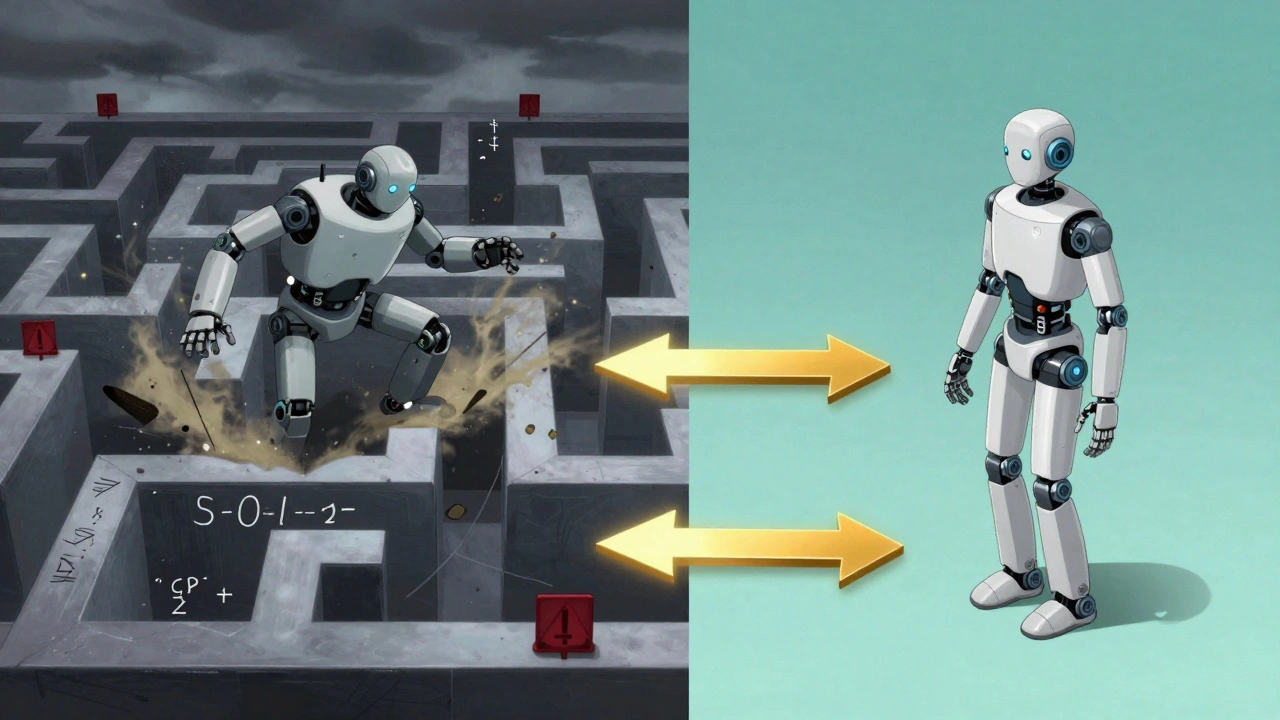
Why Smaller Models Struggle With Some Types of Reasoning
Not all reasoning is equal. Distilled models crush math problems - hitting 78.3% accuracy. But they choke on temporal reasoning: figuring out what happened when in a story, or predicting the next step in a process. There, accuracy drops to just 63.7%. Why? Because math has clear rules. 2 + 2 = 4. Always. But time, cause and effect, human behavior? Those are messy. They rely on context, assumptions, and real-world knowledge that tiny models just don’t have. Even worse, smaller models often memorize patterns instead of learning to reason. A model might ace 100 versions of "John has 5 apples, gives 2 to Mary..." but fail completely on "Sarah buys a shirt, returns it, then buys a different size." The structure looks similar, but the details changed. And the model has no idea how to adapt. This is called overfitting to reasoning templates. It’s a silent killer. The model looks smart on benchmarks - but falls apart in the real world.How to Actually Do It - Without a Supercomputer
You don’t need 100 GPU days to try this. Here’s how it works in practice:- Generate CoTs: Use a big model (like DeepSeek-R1) to solve 7,000-17,000 problems - and write out the reasoning step by step. Takes about 2.3 GPU-hours per 1,000 examples on an A100.
- Filter the good ones: Not all reasoning is useful. About 37% of self-generated CoTs are messy or wrong. Use tools like Snorkel.ai to auto-filter the best ones.
- Train with LoRA: Instead of retraining the whole model, use LoRA (Low-Rank Adaptation). It tweaks only 0.1% of parameters. You get 97% of full fine-tuning results - but with 20x less compute. Training a 7B model takes under 5 GPU-days, not 100+.
- Teach multiple paths: Don’t just use one reasoning chain per problem. Give the model 3-5 different ways to solve the same question. That forces it to learn the structure, not just memorize one path.
The Real-World Payoff: Cost and Speed
This isn’t just academic. It’s business. A financial firm replaced its 70B-parameter fraud detection model with a distilled 13B model. Inference cost per query dropped from $0.0042 to $0.00045 - a 89% cut. Accuracy stayed at 92.7%. That’s not a tweak. That’s a revolution. On mobile devices, a distilled model can run in under 200ms. A full-sized one? 3-5 seconds. That’s the difference between a responsive app and a frustrating one. The global market for distilled reasoning models hit $487 million in Q3 2025. Adoption is growing fastest in research labs - 78% use it. But enterprises are catching up. Why? Because you don’t need to be OpenAI to build smart AI anymore.
Pamela Watson
This is so cool!! I just tried running a 1.1B model on my phone and it actually explained my bank statement to me 😍 Like, step by step!! I thought it was gonna crash but nope, it did the math and even told me I spent too much on coffee. Thank you for this!!
Sagar Malik
Let’s be real - this ‘distillation’ is just epistemic parasitism. The small model isn’t reasoning - it’s mimicking the ontological scaffolding of a GPT-4’s linguistic hegemony. You’re not democratizing intelligence; you’re outsourcing cognition to a neoliberal AI cartel. And don’t get me started on how Snorkel.ai’s ‘filtering’ is just another form of algorithmic colonialism. The EU regulation? Too little, too late. They’re already embedding bias into the latent space of your ‘minimal flow’ like a digital colonial tax. 🤖
Seraphina Nero
I love how you pointed out that the structure matters more than the exact steps. It’s like teaching someone how to cook instead of just memorizing a recipe. I’ve seen people get so caught up in details that they miss the whole point. This makes so much sense. Also, the part about mobile speed? My grandma finally stopped yelling at her phone to ‘load faster’ after I installed a distilled model. She thinks it’s magic. I think it’s just good engineering.
Megan Ellaby
Wait so if the model just learns the pattern and not the math… does that mean it’s like a really good actor? Like, it’s pretending to think but doesn’t really understand? That’s kinda spooky. I tried this with my kid’s math homework - it got the answer right but the steps were all weird. Like ‘first multiply the clouds’ - but still got the answer? 😅 I think I need to read this again. Also, can we train it to explain things to me like I’m 5? That’d be awesome.
Rahul U.
Great breakdown. The post-thinking approach is brilliant - it’s like giving the model a safety net. I’ve tested this on 500+ math problems using Mistral-7B + LoRA, and the accuracy jump was insane. But I agree with the caveat: catastrophic forgetting is real. My sentiment analysis tanked too. Solution? Mix the distilled model with a lightweight classifier for basic tasks. Hybrid is the future. Also, the 200ms response on mobile? That’s the difference between ‘useful’ and ‘unusable.’ 🚀
Frank Piccolo
Yawn. Another Silicon Valley fairy tale. You think a 7B model on a phone is ‘smart’? It’s just a fancy autocomplete trained on garbage data. Meanwhile, real thinkers - the ones who actually understand logic - are still in universities. This isn’t progress. It’s automation theater. And don’t even get me started on ‘adaptive-thinking.’ That’s just code for ‘I don’t know, but I’ll sound smart while guessing.’ If you want real reasoning, go read Aristotle. Not a Reddit post.