Self-Attention in Large Language Models: How It Powers AI Reasoning and Efficiency
When you ask an AI to write an essay, summarize a contract, or explain a math problem, it’s not just guessing—it’s using self-attention, a mechanism that lets a model weigh the importance of every word in a sentence relative to every other word. Also known as attention mechanism, it’s what allows large language models to understand context, track long-range relationships, and generate coherent responses without losing track of what came before. Without self-attention, models would process text like a line of dominoes—each word only influencing the next. But with it, every word can reach back and connect to any other word, no matter how far apart. That’s why a model can spot that ‘it’ in a paragraph refers to a company mentioned 12 sentences earlier, or why it can spot contradictions in a legal document without rereading the whole thing.
This isn’t just theory. Self-attention is the foundation of the transformer architecture, the neural network design that made modern AI possible. It’s what powers models like GPT, Llama, and Claude. But it comes with a cost: memory and speed. Every time a model processes a new word, it calculates relationships with all previous words. That’s why long documents slow down AI, and why tools like FlashAttention, a technique that cuts memory use by skipping redundant calculations are now essential in production. The KV cache—a memory trick that stores past attention results—is now bigger than the model weights themselves in many systems. If you’ve ever wondered why your AI response takes a second or two, or why running a model on a phone is still hard, the answer is often self-attention’s hunger for resources.
Self-attention also enables reasoning techniques you see in the posts below—like chain-of-thought and self-consistency. These aren’t magic tricks. They’re built on the model’s ability to revisit and reweight information as it works through a problem. A model doesn’t ‘think’ like a human, but it can simulate steps by focusing on the right parts of its input at the right time. That’s why smaller models can now mimic the reasoning of larger ones through distillation—they’re learning how to use attention more efficiently, not just copying output.
What you’ll find here aren’t just abstract explanations. These are real-world breakdowns of how self-attention affects everything from token costs and inference speed to model accuracy and security. You’ll see how pruning, quantization, and attention optimization are changing what’s possible on consumer hardware. And you’ll learn why some AI tools fail—not because they’re dumb, but because they’re drowning in their own attention weights.
Transformer Architecture for Large Language Models: A Complete Technical Walkthrough

Transformers revolutionized AI by enabling models to process text in parallel using self-attention. This article breaks down how transformer architecture powers LLMs like GPT, from tokenization to attention heads and training costs.
Self-Attention and Positional Encoding: How Transformers Power Generative AI
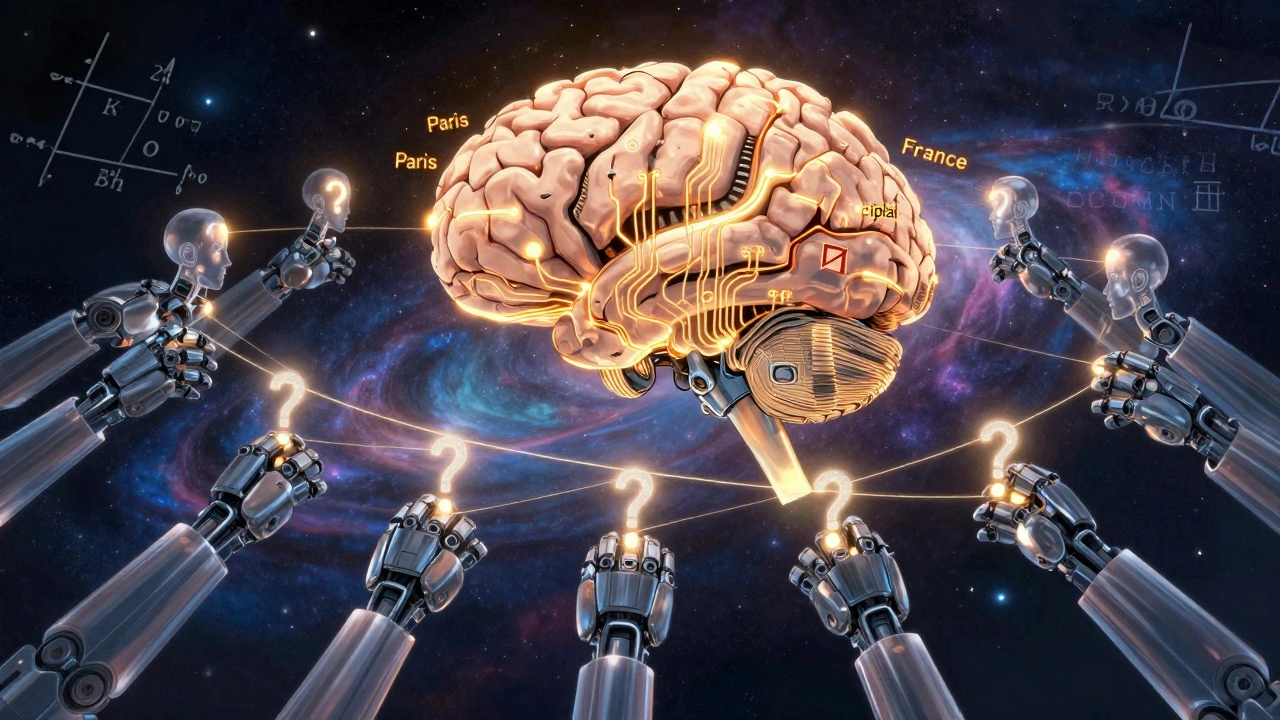
Self-attention and positional encoding are the core innovations behind Transformer models that power modern generative AI. They enable models to understand context, maintain word order, and generate coherent text at scale.