
AI tools write code faster than ever. But just because it runs doesn’t mean it’s worth keeping. You paste in a prompt, get a module back, and it works-sort of. The tests pass. The feature ships. Then, two weeks later, you’re stuck in a rabbit hole trying to fix a bug that shouldn’t exist. The variable names change halfway through. The error handling is missing. The logic feels like it was copied from three different tutorials and glued together by a confused bot. That’s when you ask: Should I refactor this, or just rewrite it?
Refactoring AI Code Often Feels Like Fixing a House Built on Sand
Most teams assume refactoring is the safe, sensible path. You clean up naming, extract functions, add comments, and call it a day. But AI-generated code isn’t just messy-it’s inconsistent by design. A single module can mix REST-style endpoints with GraphQL patterns. One function uses async/await, another uses callbacks. The indentation shifts between tabs and spaces. This isn’t poor style-it’s code hallucination. A 2024 study from DX found that 78% of enterprise teams saw this kind of "style drift" when multiple AI-generated components were combined. You can’t refactor your way out of that. It’s not a style issue. It’s a structural one.When the Code Doesn’t Understand the System
AI doesn’t know your codebase. It doesn’t know your team’s conventions, your deployment pipeline, or how your auth service actually works. It guesses. And when it guesses wrong, the result is a module that looks fine on its own but breaks everything it touches. In 68% of cases where AI-generated code was built without proper context awareness, teams had to rewrite it entirely, according to XB Software’s 2025 analysis. One developer on Reddit spent 11 hours trying to fix an AI-generated authentication module-only to realize the entire flow was built around a third-party library that had been deprecated two years ago. Rewriting it took three hours. Why? Because the original code didn’t just need cleaning-it needed a new foundation.High Complexity? Skip the Tweaks. Start Over.
Cyclomatic complexity measures how many paths a piece of code can take. Human-written code with complexity above 15 is already risky. AI-generated code? It hits 20, 30, even 50 with alarming frequency. CodeGeeks’ analysis of 2,300 AI-generated modules showed that those with complexity above 15 were 4.7 times more likely to need a full rewrite than a refactor. Why? Because refactoring can’t fix bad algorithms. You can rename variables in a nested loop that runs O(n²), but you can’t make it O(n) without rebuilding the logic. If your AI-generated sorting function uses nested loops over a 10,000-item dataset, no amount of commenting will fix the performance disaster waiting to happen.Security Bugs That Refactoring Can’t Touch
Security isn’t about missing semicolons. It’s about architecture. AI tools often generate code that works-until someone exploits a subtle flaw. Understood Legacy Code’s 2025 audit of AI-generated modules found that 37% contained security vulnerabilities that couldn’t be patched through refactoring. Think: hardcoded API keys in config files, unvalidated user inputs passed directly to database queries, or session handling that ignores token expiration. These aren’t bugs you fix with a linter. They’re design failures. You can’t refactor your way out of a system that trusts user input blindly. You need to rebuild the trust layer from scratch.
Low Test Coverage? Rewriting Is Safer Than Refactoring
If a module has less than 65% test coverage, refactoring becomes a gamble. AI-generated code often lacks tests entirely-or worse, includes fake tests that just assert "it runs" without checking correctness. UnderstandLegacyCode’s research shows that modules under 65% coverage have a 73% chance of introducing new bugs during refactoring. Why? Because you don’t know what you’re breaking. Rewriting gives you a clean slate: write the tests first, then build the code to pass them. It’s slower upfront, but you end up with reliable, documented behavior. Refactoring a poorly tested AI module is like rebuilding a car engine while driving-sure, you might get lucky. But you’re also one wrong turn from a crash.The Three-Strike Rule: A Simple Decision Tool
You don’t need a complex algorithm to decide. Many teams use the "three-strike rule": if you’ve tried to fix the same module three separate times and each attempt solved one problem but created two more, it’s time to rewrite. CodeGeeks’ 2025 survey found that 58% of engineering teams now follow this rule for AI-generated code. One engineer at a SaaS startup kept trying to "clean up" an AI-generated invoice processor. First, he fixed the date formatting. Then he added validation. Then he refactored the tax calculation. Each time, a new bug appeared. On the fourth try, he deleted the whole thing and rewrote it from scratch using the original spec. The new version was 40% shorter, had 92% test coverage, and took half the time to debug.Documentation Is the Canary in the Coal Mine
AI doesn’t write good documentation. It writes boilerplate. If a module has less than 40% meaningful documentation-meaning actual explanations of why things work, not just "this function calculates total"-it’s a red flag. DX’s 2025 framework found that poorly documented AI modules are 5.2 times more likely to require rewriting. Why? Because if you can’t explain what the code does in simple terms, you don’t understand it. And if you don’t understand it, you can’t safely change it. A module with clear comments, usage examples, and edge-case notes? That’s a candidate for refactoring. One with 10 lines of "TODO: improve this" and zero context? Start fresh.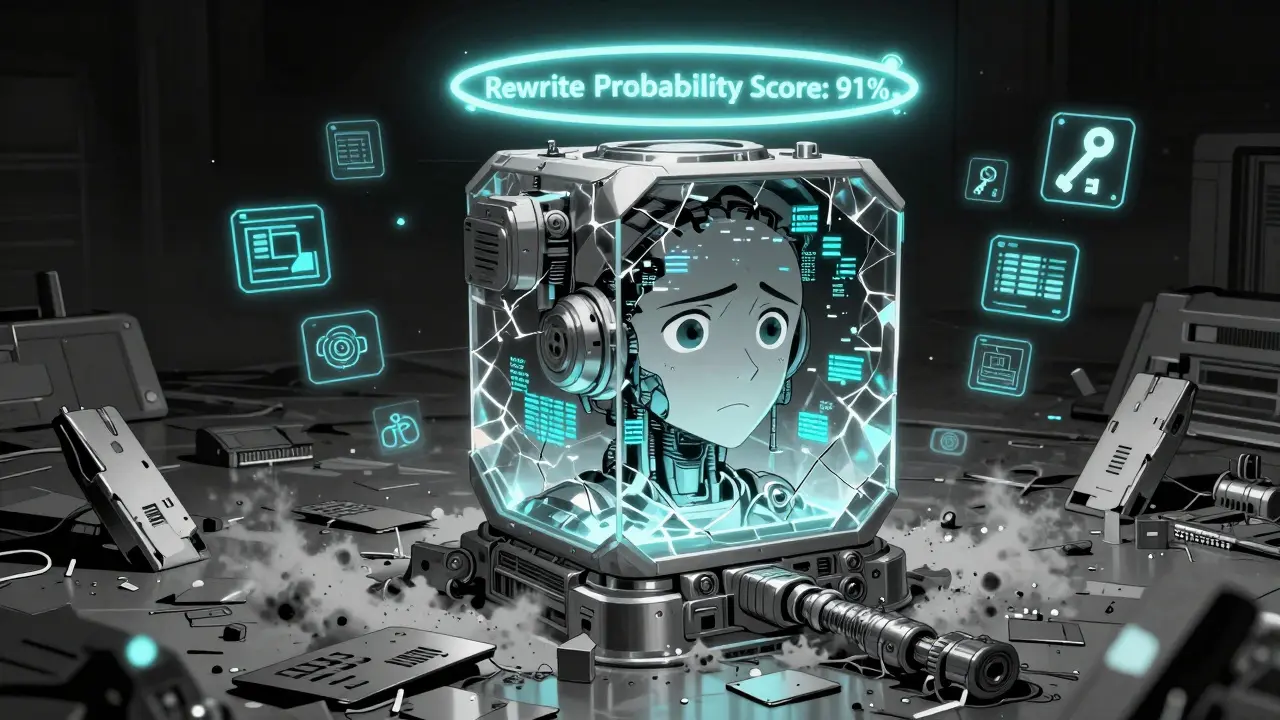
How Long Are You Spending Just to Understand It?
MIT’s Software Engineering Lab tracked how long developers spent trying to understand AI-generated code before making changes. They found a tipping point: if it takes more than 28 minutes to get a grasp on the logic, rewriting becomes faster than fixing. Dr. Elena Rodriguez, Chief AI Architect at DX, puts it simply: "If understanding the code takes more than 30% of the effort it would take to rewrite it, you’re wasting time." One developer on HackerNews spent 40 minutes trying to figure out why an AI-generated data sync module was dropping records. He finally gave up and rewrote it. The new version took 90 minutes-but it worked perfectly from day one. The old one? Still had bugs.Don’t Rewrite Everything. Be Strategic
Some experts warn against going all-in on rewriting. Sarah Kim, Principal Engineer at GitHub, points out that the best approach isn’t "rewrite or refactor"-it’s "rewrite the broken parts, keep the good ones." One developer on Reddit rewrote only 20% of an AI-generated module-the parts with security flaws and performance issues-and kept the rest. The result? A 75% reduction in technical debt without delaying the release. The key is targeting. Use automated tools like Augment Code’s assessment system to flag modules with high complexity, low documentation, and poor test coverage. Focus your rewrite energy there. Leave the rest for incremental cleanup.What’s Coming Next
By 2026, AI coding tools will start offering built-in advice: "This module has a 91% chance of failing under load. Consider rewriting." Tools like DX’s Enterprise AI Refactoring Framework already do this with a "rewrite probability score" that analyzes 17 code metrics. The market is shifting. Gartner predicts that by 2027, 45% of all refactoring decisions will involve AI-generated code-not legacy systems. The teams that win won’t be the ones writing the most code. They’ll be the ones knowing when to throw it away.Is it ever okay to refactor AI-generated code?
Yes-but only if the code is logically sound and follows consistent patterns. If the module has clear structure, good test coverage (above 65%), and minimal complexity (cyclomatic complexity under 10), refactoring works well. It’s perfect for fixing naming, adding comments, or adjusting formatting. But if the logic is confusing, the architecture is mismatched, or the code feels like it was stitched together from different sources, refactoring will only delay the inevitable rewrite.
How do I know if my AI-generated code has hidden technical debt?
Look for these signs: inconsistent patterns within the same file, undocumented dependencies (like hardcoded API keys or version-specific libraries), missing error handling, and low test coverage. Also, ask yourself: "If I deleted this file, could I rebuild it from the spec in under an hour?" If the answer is no, you’re carrying debt. AI code often works-but for reasons you don’t understand. That’s the hallmark of hidden debt.
Can automated tools help me decide between rewrite and refactor?
Absolutely. Tools like Augment Code and DX’s Enterprise AI Refactoring Framework analyze code for complexity, documentation quality, test coverage, and security risks. They give you a "rewrite probability score" based on 10-17 measurable factors. Teams using these tools report 70% fewer post-deployment bugs. You don’t need to guess anymore. Let the data tell you when to start over.
What’s the biggest mistake teams make with AI-generated code?
Assuming it’s just "bad code" that needs cleaning. AI-generated code isn’t poorly written-it’s poorly understood. The real mistake is spending hours trying to fix something that was never meant to be fixed. The smarter move is to treat AI output as a draft, not a deliverable. If you wouldn’t hand it to a new hire to maintain, don’t ship it. Rewrite it instead.
Does rewriting slow down development?
Only if you do it blindly. Rewriting the wrong module wastes time. But rewriting the right one saves weeks. Teams that prioritize rewriting high-risk modules (security, performance, complexity) see 4x better ROI than those trying to fix everything. The goal isn’t to rewrite everything-it’s to rewrite what matters. One developer rewrote a single AI-generated payment processor and cut debugging time by 80%. That’s not slow. That’s strategic.
Gina Grub
AI code isn't broken-it's a performance art piece. You think you're fixing bugs? Nah. You're just rearranging deck chairs on the Titanic of technical debt. That module with 47 cyclomatic complexity? It's not a function. It's a Kafka novel written in JavaScript. Refactoring it is like trying to teach a raccoon algebra. You're not saving time-you're buying a time machine to relive the same nightmare next sprint.
Johnathan Rhyne
Hold up. You say 'refactoring AI code is like fixing a house built on sand'-but sand can be compacted. You're ignoring the fact that most AI-generated code is actually *better* than the spaghetti we used to write in 2012. And FYI, 'style drift' isn't a bug, it's a feature of collaborative development. Also, you misspelled 'unvalidated' in paragraph four. Just sayin'. 😊
Salomi Cummingham
I used to be the person who’d spend three days refactoring AI output-trying to make it ‘elegant.’ Then I had a baby. And suddenly, my time became more valuable than my ego. Now? If the code looks like it was written by a sleep-deprived robot who watched ten YouTube tutorials at once? I delete it. Full stop. I write the test first. I write the simplest thing that could possibly work. And then I ship it. The team doesn’t notice the difference. The product doesn’t care. But I sleep better. And honestly? That’s the real ROI.
Lauren Saunders
Let’s be real-this entire post reads like a LinkedIn carousel written by someone who’s never actually shipped production code. You cite ‘DX’s 2024 study’ like it’s peer-reviewed gospel. Where’s the DOI? The dataset? And ‘CodeGeeks’? That’s not a real organization. You’re weaponizing pseudoscience to justify your fear of complexity. Also, ‘rewrite probability score’? That’s not a metric-it’s a marketing buzzword dressed up as engineering. If you can’t reason about your code, maybe you shouldn’t be writing prompts.
sonny dirgantara
lol i just delete it and let the ai write it again. works 90% of the time. no cap.
Jawaharlal Thota
Let me tell you something from the trenches in Bangalore. We had a team that refused to rewrite anything-‘refactor, refactor, refactor!’ they cried. After six months, we had a module that took 14 seconds to load a single page. It had seven different auth patterns, three conflicting logging libraries, and a function named ‘doThing()’ that called another function named ‘doThingBetter()’ which called ‘doThingBest()’-and none of them returned anything useful. We rewrote it in two days. The new version had comments. It had tests. It had a README. And it ran in 1.2 seconds. The lesson? AI gives you a foundation. But you’re the architect. Don’t build a palace on a foundation made of wet cardboard.
Nathan Jimerson
I’ve seen teams burn out trying to fix AI code that was never meant to last. But I’ve also seen teams rewrite everything and end up with nothing but a backlog of ‘new’ bugs. The sweet spot? Treat AI like a brilliant intern who’s way too eager. Give them a spec, review their work, and if it’s got potential, guide them. If it’s a mess? Say ‘thanks, let’s try again.’ You don’t have to be harsh. You just have to be clear. And sometimes, starting over isn’t failure-it’s wisdom.
Sandy Pan
What does it mean to ‘understand’ code? Is it knowing the syntax? The flow? The intent? Or is it knowing why the code exists in the first place? AI generates syntax. It mimics flow. But intent? That’s human. And if you can’t articulate the intent behind a piece of code-if you can’t explain it to a new hire over coffee-then you’re not maintaining software. You’re maintaining a ghost. And ghosts don’t refactor. They haunt. So maybe the real question isn’t ‘rewrite or refactor?’ but ‘do I want to live in a house built by something that doesn’t know why it’s here?’