Citation Hallucination: Why AI Makes Up Sources and How to Spot It
When an AI gives you a citation that doesn’t exist—like a made-up paper from a real journal—that’s citation hallucination, a type of factual fabrication where AI generates false references to appear credible. Also known as fictitious sourcing, it’s one of the most dangerous flaws in today’s large language models because it looks real until you check. You’re not imagining it: you’ve probably been handed a fake study, a non-existent book, or a quote from a researcher who never said it. And it’s not just annoying—it’s risky. In academia, law, journalism, and even corporate reports, a single fake citation can undermine trust, waste hours, or lead to bad decisions.
Citation hallucination doesn’t happen because AI is "lying." It happens because models are trained to predict the next word, not to verify truth. When asked for a source, they pull patterns from their training data—names like "Smith," "Nature," or "Harvard"—and stitch them into something that sounds plausible. This is why you’ll see fake papers with titles like "The Impact of Quantum Neural Networks on Supply Chain Logistics (2023)"—it’s a mashup of real terms that never appeared together in any real publication. Large language models, AI systems that generate text based on statistical patterns from massive datasets don’t have memory or intent. They don’t know what’s true. They just know what’s likely to follow.
This is why faithfulness in AI, the ability of an AI system to generate responses grounded in verifiable facts matters more than ever. Fine-tuning methods like RLHF and QLoRA help, but they don’t fix the root problem. The only reliable fix? Human verification. Every citation from an AI should be treated like a suspect witness—ask for the link, check the journal, search the author’s name. Tools like LitLLM or semantic search engines can help, but they’re not foolproof. Even the most advanced models still hallucinate citations at rates between 5% and 20% depending on the prompt.
And it’s not just academic work. In legal briefs, policy memos, or product documentation, a fake citation can become a liability. Companies using AI for research synthesis—like those cutting literature review time by 90%—are already seeing this play out. One team found that 17% of AI-generated references in their draft were completely made up. They didn’t catch it until a reviewer called out a non-existent conference paper. That’s not a glitch. It’s a design flaw.
What you’ll find in the posts below are real, practical ways to deal with this. From how to audit AI-generated references using simple search tricks, to why fine-tuning for faithfulness works better than brute-force prompting, to how teams are building automated checks into their workflows. You won’t find fluff. Just clear, tested methods to stop AI from lying to you—with citations.
Citations and Sources in Large Language Models: What They Can and Cannot Do
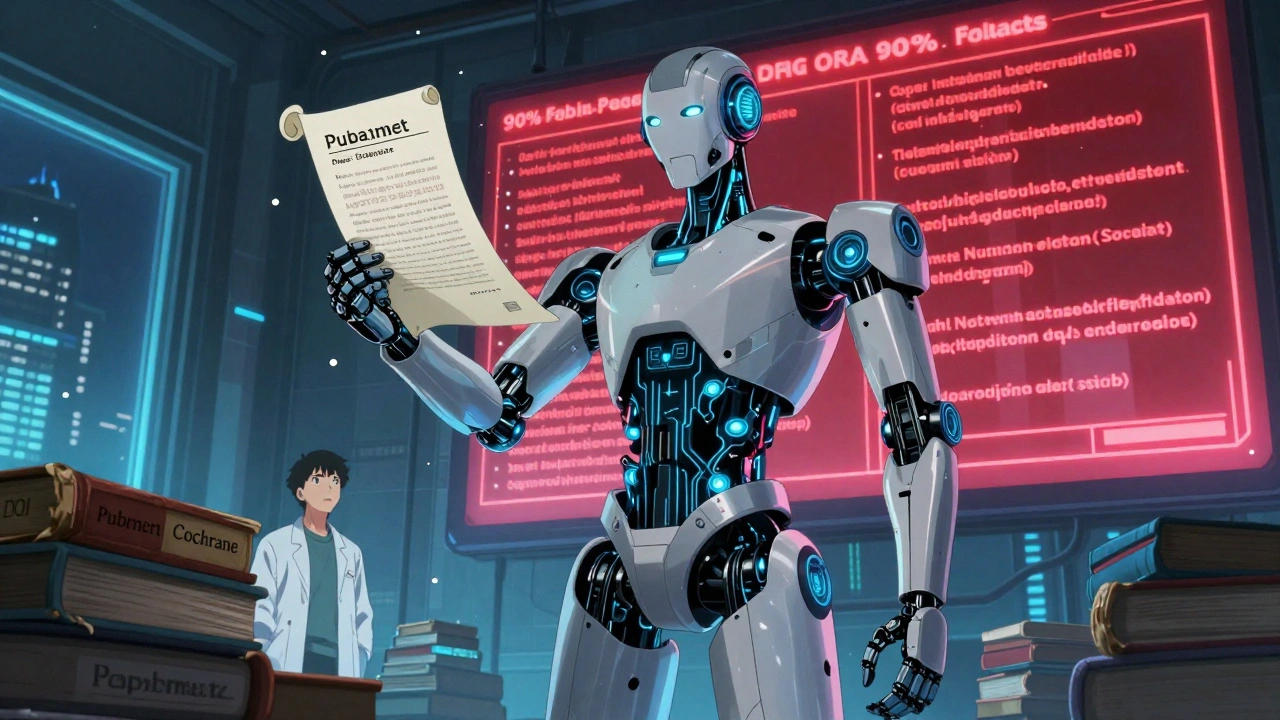
LLMs can generate convincing citations, but most are fake. Learn why AI hallucinates sources, how to spot them, and what you must do to avoid being misled by AI-generated references in research.