
Most teams using AI to write code today are building sandcastles. They get something working fast-maybe a prototype, maybe even a working feature-but within months, the whole thing starts crumbling. Why? Because they skipped the hard part: domain modeling. Without clear boundaries and shared language, AI doesn’t understand what you’re building-it just guesses. And guesses pile up into chaos.
Enter Domain-Driven Design (DDD) with Vibe Coding. It’s not about letting AI take over. It’s about using AI as a powerful assistant while keeping human architects firmly in charge. The secret? Two DDD pillars: Bounded Contexts and Ubiquitous Language. When you combine them with vibe coding-the practice of guiding AI through natural language prompts-you get a system that scales, stays clean, and actually makes sense to everyone on the team.
Why Vibe Coding Alone Fails After 3 Months
Andrej Karpathy’s phrase, "give in to the vibes," sparked a wave of developers typing prompts like: "Make a user login system with JWT." The AI delivers. It works. You deploy. It feels like magic.
But magic doesn’t last. By month three, you notice the same term-"Customer"-means different things in different parts of the code. One module treats it as a person with an address. Another treats it as a billing entity. A third uses it for permissions. The AI didn’t know the difference because you never told it. And now, fixing it takes days.
Instinctools’ 2025 survey found that 67% of vibe coding projects fail within six months-not because the code is buggy, but because the architecture collapsed. No one defined where one part of the system ends and another begins. That’s what Bounded Contexts fix.
Bounded Contexts: The Invisible Walls That Keep Your Code Alive
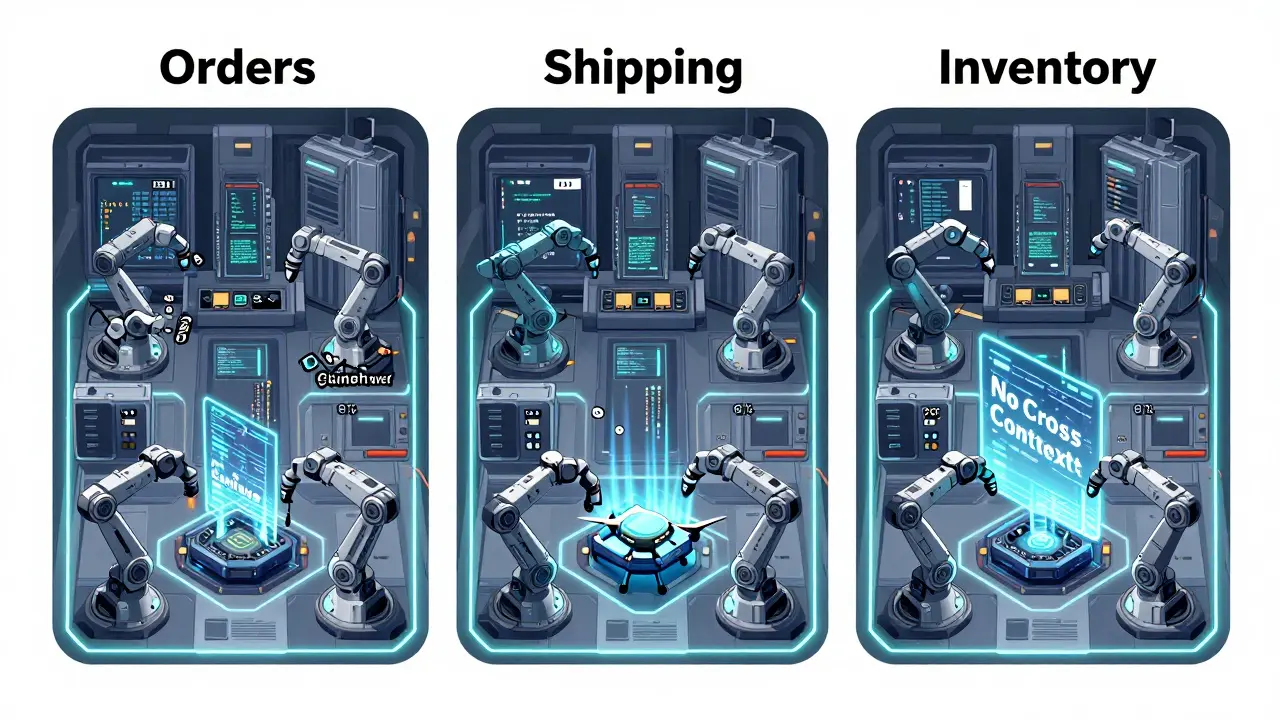
A Bounded Context is a clear, explicit boundary around a specific part of your domain. Think of it like zoning laws for your codebase. In one context, you have "Payments." In another, "Shipping." In a third, "Customer Support." Each has its own rules, its own data, its own language.
With vibe coding, you don’t just say: "Build a payment system." You say:
- Context name: "Payments"
- Boundary: "This context handles transaction processing, fraud flags, and reconciliation. It does NOT store customer names or addresses-that’s the Customer context. No direct access to user profiles. Use only the customer ID passed in from the API."
- Integration point: "It receives customer ID from Customer context via event stream. It sends payment status to Order context via REST endpoint."
- Ubiquitous Language: "We use 'transaction' for any money movement, 'settlement' for final clearing, and 'chargeback' for disputed payments. Never use 'refund' unless it’s a reversal after settlement."
That’s not just a prompt. That’s a contract. And AI respects contracts better than vague wishes.
Google Cloud’s research shows teams that define 3-5 Bounded Contexts before starting vibe coding see 63% fewer model inconsistencies. Why? Because the AI knows exactly where to stop. It won’t accidentally pull in logic from another context. It won’t reuse a class named "User" from the auth system in the billing system. It builds inside the lines.
Ubiquitous Language: The Shared Dictionary That Prevents Misunderstandings
Imagine a doctor telling a nurse: "Give the patient the anticoagulant." The nurse replies: "Which one? We have three in stock." The doctor meant "heparin." But "anticoagulant" isn’t precise enough.
In software, this happens every day. "User"? "Customer"? "Account"? These words mean different things to different people. To a salesperson, a "customer" is someone who bought something. To a developer, "customer" might be a database table. To the AI? It has no idea.
Ubiquitous Language fixes this. It’s a shared dictionary-defined by the team, agreed on by domain experts and developers-and used in code, tests, docs, and conversations.
Here’s how it works in vibe coding:
- You don’t say: "Create a class for the user who pays."
- You say: "Create a class called PaymentRecipient with fields: id, paymentMethodId, lastPaymentDate. This is not the same as Customer-the Customer has shipping addresses and preferences. PaymentRecipient only exists to receive payments."
Instinctools found that teams using documented Ubiquitous Language saw 58% fewer integration issues. Why? Because every prompt, every commit, every test uses the same terms. The AI learns the language. And when someone else reads the code later, they don’t have to guess.
One healthcare startup used this approach to let nurses and clinicians participate in vibe coding sessions. They created a glossary: "MedicationOrder" ≠ "Prescription" ≠ "TreatmentPlan." The AI generated code that matched clinical workflows. Result? 45% fewer misunderstandings between tech and non-tech staff.
The Vibe Coding Loop with DDD: A Step-by-Step Workflow
Here’s how to actually do it-without falling into the trap of "prompt and pray."
- Define the context. Before writing a single line of code, write a short document: "Context: Orders. Boundary: Handles order creation, cancellation, status updates. Does NOT handle inventory or shipping. Integrates with Inventory via event, with Shipping via REST."
- Define the language. List key terms: "Order" = a request to buy. "LineItem" = one product in the order. "Status" = pending, confirmed, canceled, shipped. No "cart"-that’s a session object, not a domain concept.
- Generate with context. Prompt: "Generate a class for Order in the Orders context. Use Ubiquitous Language: Order, LineItem, Status. Do not reference Customer directly-use customerId from the context boundary. Use event-driven updates to Inventory."
- Inspect and refine. Look at the code. Does it match your context? Does it use your terms? If the AI used "User" instead of "Customer," fix the prompt: "Never use 'User' in this context. Only use 'Customer' as defined in the Ubiquitous Language document."
- Test and commit. Run tests. If they pass, commit the code-and update the context document with any new terms or rules that emerged.
- Repeat for each context. Don’t try to build the whole system at once. Start with one bounded context. Get it right. Then move to the next.
This isn’t faster than pure vibe coding. It takes 25% longer upfront. But by month six, your codebase is clean. Your team understands it. Your AI doesn’t hallucinate across boundaries. And your maintenance cost? Half of what it would’ve been without DDD.
What Happens When You Skip DDD in Vibe Coding
It’s not a question of "if"-it’s a question of "when."
Stack Overflow user "DevInTrouble" posted in November 2025: "After 3 months of vibe coding, we have 17 different definitions of 'Customer' in our codebase. Some have email, some have phone, some have tax ID. No one knows which one to use. We’re rewriting from scratch."
This is context collapse. It happens when:
- No one defined boundaries.
- No one documented the language.
- AI was allowed to "just make it work."
Google Cloud’s research found that 78% of long-running vibe coding projects suffer from context collapse. The code looks fine on the surface. But deep down, it’s a mess of overlapping concepts. Debugging becomes a detective game. Onboarding new devs takes weeks. And AI can’t fix it-because it doesn’t know what the original intent was.
Eric Evans, the creator of DDD, put it bluntly: "Without careful attention to bounded contexts, AI will happily create inconsistent models across what should be separate domains."

Tools and Trends: What’s Changing in 2026
This isn’t just theory. The industry is moving fast.
Google’s AI Studio will roll out automatic bounded context detection in December 2025. Microsoft’s GitHub Copilot is building "DDD-aware prompting" for Q1 2026. ContextAI, a new tool launched in May 2025, already has 15,000 users because it forces you to define contexts before generating code.
And it’s not just startups. 61% of Fortune 500 companies now require explicit bounded context definitions in their AI coding guidelines. Why? Compliance. Audits. Risk. Financial and healthcare systems need clear boundaries for regulatory reasons. ISO/IEC 27001:2025 now includes domain boundary documentation as a control.
Adoption is highest in fintech (67%) and lowest in media (32%). Why? Fintech can’t afford context collapse. One wrong "Account" definition could cost millions.
Start Small. Build Right.
You don’t need to rewrite your whole system. Start with one small domain. Maybe it’s "User Onboarding." Define its context. Write its language. Use vibe coding to build it. Then document it. Commit it. Share it.
Next week, pick another. "Email Notifications." "Billing Plans." "Role Permissions."
Each time, you’re not just writing code. You’re building a shared understanding. You’re training your AI to think like a domain expert. And you’re creating a codebase that doesn’t rot.
AI won’t replace architects. But architects who use AI-with clear boundaries and shared language-will replace those who don’t.