
Have you ever asked an AI to write a 2,000-word article only to get back a mess of repeated phrases and off-topic rambles? If so, you are not alone. Long-form generation is the process of using Large Language Models (LLMs) to create extended texts, typically ranging from 500 to 5,000+ tokens. While these models excel at short answers, they often struggle to maintain focus over longer distances. This issue is known as topic drift, where the content deviates from the original prompt, and repetition, where the model cycles through the same ideas or words.
The problem gets worse as the output length increases. Research from RTS Labs in 2023 found that unguided LLMs exhibit topic drift in 68% of generations beyond 1,500 tokens. Furthermore, repetition rates increase by 32% for every additional 500 tokens generated. For developers and content creators, this means that simply asking for more text is not enough. You need specific strategies to keep the model on track and fresh.
Why LLMs Lose Focus in Long Outputs
To fix the problem, you first need to understand why it happens. Most modern LLMs use a Transformer architecture that processes text autoregressively. This means the model predicts each new word based on all previous words. It does not plan ahead; it just reacts to what came before. As the context window fills up, the model’s ability to remember the initial instructions weakens.
This limitation is tied to positional encoding constraints. Standard architectures often have limits around 2,048 to 8,192 tokens depending on the implementation. When you push past these thresholds, the model loses contextual awareness. A study published on arXiv in February 2024 showed that even advanced models like GPT-4 see a 47% drop in accuracy for maintaining topic consistency when generating beyond 2,000 tokens compared to shorter outputs. The model starts relying on its own recent output rather than the original prompt, creating self-reinforcement loops that lead to repetitive patterns.
Key Strategies to Reduce Drift and Repetition
You do not need to wait for better hardware to solve this. Several techniques can significantly improve coherence right now. Here are the most effective methods, ranked by practicality and impact.
- Prompt Engineering: Using chain-of-thought prompting reduces drift by 31%. By asking the model to outline its thinking before writing, you give it a structural guide. However, this increases computational overhead by about 22%.
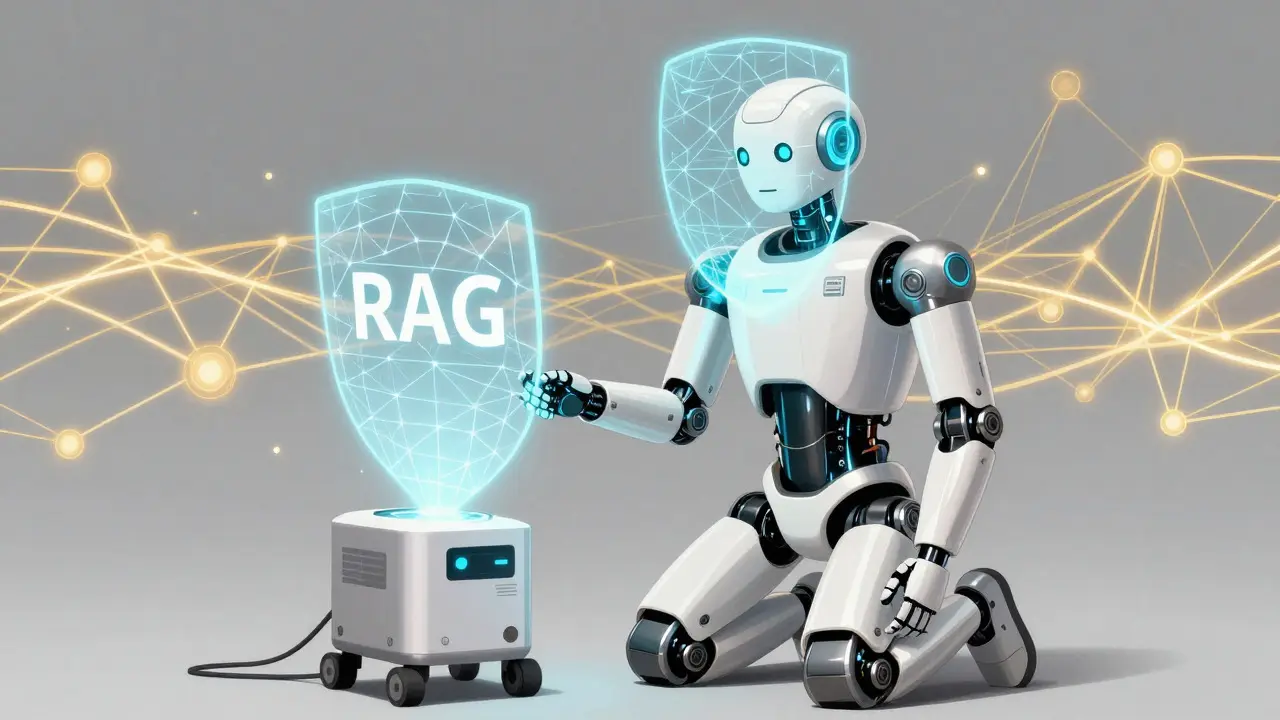
- Retrieval-Augmented Generation (RAG): RAG systems fetch relevant external data to ground the generation in facts. This approach improves factual consistency by 45% for knowledge-intensive content. The trade-off is latency, adding 300-500ms per retrieval call.
- Fine-Tuning: Training a model on specific long-form tasks yields the best results. Fine-tuning can reduce drift by 58% and repetition by 52%. But it is expensive, costing roughly $12,000 in cloud computing for a 7B-parameter model on AWS instances.
- Temperature Scaling: Adjusting the temperature parameter between 0.3 and 0.7 has been shown to reduce repetition by 18% while keeping the text creative. Lower temperatures make the model more deterministic, which helps avoid looping phrases.
The most robust solution combines these approaches. A system that uses RAG with temperature-scaled generation and selective fine-tuning achieves 73% coherence maintenance at 3,000 tokens. In contrast, base models without these optimizations only manage 29% coherence at the same length. This gap highlights why single-tool solutions rarely work for professional-grade long-form content.
Comparing Mitigation Techniques
Choosing the right technique depends on your budget, infrastructure, and quality requirements. The table below compares the main approaches based on performance metrics and costs.
| Technique | Drift Reduction | Repetition Reduction | Cost/Overhead | Best For |
|---|---|---|---|---|
| Prompt Engineering | 31% | Moderate | +22% Compute | Quick fixes, low-budget projects |
| RAG Systems | High (Factual) | Moderate | +300-500ms Latency | Knowledge-heavy content, documentation |
| Fine-Tuning | 58% | 52% | ~$12,000 Cloud Cost | Enterprise scale, consistent style needs |
| Temperature Scaling | Low | 18% | Negligible | Creative writing, general tuning |
If you are working with technical documentation, RAG is usually the winner because it grounds the text in verified sources. For marketing copy where creativity matters more than strict factuality, temperature scaling combined with good prompts might be sufficient. Fine-tuning is reserved for organizations that need high-volume, consistent output and have the budget to support it.
Practical Implementation Tips
Implementing these strategies takes time. Developers with intermediate LLM experience typically spend 2 to 6 weeks learning how to tune these parameters effectively. One common pitfall is not knowing when to summarize intermediate outputs. Checkpointing every 250 to 500 tokens helps the model reset its context and stay aligned with the original goal.
Another useful tip comes from community feedback. Users on HackerNews noted that adjusting temperature from 1.0 to 0.5 decreased repetitive phrases by approximately 35% in novel writing tasks. This simple tweak can save hours of editing. Also, consider using specialized models if available. BloombergGPT, for example, maintains financial terminology consistency 89% of the time in 1,500-token analyses, compared to 62% for generic models. Using a domain-specific model can drastically reduce the need for post-generation cleanup.
For those looking for ready-made solutions, resources like the 'Long-Form LLM Cookbook' maintained by the Stanford NLP Group provide 47 validated prompt templates. These tools lower the barrier to entry and help you avoid common mistakes in parameter configuration.
Future Outlook and Current Benchmarks
The landscape is changing rapidly. As of early 2024, Google's Gemini Ultra leads in long-form coherence benchmarks with 87% topic consistency at 2,500 tokens. Anthropic's Claude 3 Opus follows at 82%, and Meta's Llama-3-70b sits at 76%. These numbers show significant progress, but there is still room for improvement.
Experts remain divided on the future. Dr. Emily Bender from the University of Washington argues that current architectures fundamentally struggle with long-range dependencies. On the other hand, Yann LeCun from Meta believes that memory-augmented transformers will solve 80% of these issues within two years. Regardless of the debate, industry trends suggest that by Q4 2025, 75% of enterprise LLM deployments will incorporate specialized long-form optimization techniques. This shift indicates that avoiding drift and repetition is becoming a standard requirement, not a nice-to-have feature.
Frequently Asked Questions
What is the ideal token limit for long-form generation?
There is no single limit, but coherence drops significantly after 1,500 to 2,000 tokens for most base models. To generate longer texts, you should implement checkpointing or summarization every 250-500 tokens to refresh the model's context.
How much does fine-tuning an LLM cost?
Fine-tuning a 7B-parameter model can cost approximately $12,000 in cloud computing fees, depending on the provider and duration. Smaller models or parameter-efficient methods like LoRA can reduce these costs significantly.
Does RAG really help with repetition?
RAG primarily improves factual consistency, which indirectly reduces repetitive hallucinations. By grounding the model in fresh, relevant data, it prevents the model from cycling through the same limited internal knowledge base. However, combining RAG with temperature scaling is recommended for best results.
What temperature setting should I use for long-form text?
A temperature range of 0.3 to 0.7 is generally optimal for long-form generation. This range balances creativity with determinism, reducing repetition by about 18% compared to higher settings like 1.0.
Can small models handle long-form generation well?
Yes, smaller models like Phi-3-mini can achieve 79% coherence at 4,000 tokens while running on consumer hardware. With proper optimization techniques, size is less of a barrier than architectural design and prompt strategy.
Iva Grekova
Finally someone is addressing the elephant in the room! I’ve been wrestling with this exact issue for my content pipeline, and it’s honestly exhausting. Every time I try to generate a full blog post, the AI starts repeating itself like a broken record after about 800 words. It feels like the model just gives up halfway through and starts hallucinating filler text. This article really highlights how much of a pain point this is for anyone serious about automation. The stats on topic drift are eye-opening too. I never realized it was that common until now. Thanks for breaking down the technical reasons behind it so clearly.
Onyinyechi Nwosu
i use rag for almost everything now
it does help but the latency is real
Chandan Singh
Let's be honest here, most of these 'solutions' are just band-aids. The fundamental problem is that autoregressive transformers are inherently bad at long-range dependency tracking. You can tweak the temperature or add RAG, but you're still fighting the architecture. Fine-tuning is the only real fix if you want consistent output, sure it costs money, but isn't quality worth it? Also, the claim that checkpointing every 250 tokens helps is a bit misleading; it works for summarization but not necessarily for maintaining narrative flow over thousands of tokens. We need better positional encodings, not more prompt engineering hacks.
Brannen Hall
Oh great, another article telling us to spend $12k on cloud compute because our models are 'bad'. Typical. I've seen plenty of decent long-form outputs from base models if you just structure your prompts correctly. The whole industry is obsessed with making this seem harder than it is to justify their consulting fees. Temperature scaling is basically placebo, I've got it set to 0.7 and it works fine for my needs. Don't let them sell you on the idea that you need a PhD in NLP to write a coherent paragraph. Just prompt it better and move on.
tiffany King
This is such a relief to read! I always felt like I was doing something wrong when my generations got repetitive. Seeing that even GPT-4 struggles with this puts me at ease. I’m going to try the chain-of-thought prompting technique mentioned here. It sounds manageable without needing a massive budget. Really appreciate the practical tips instead of just theory. Here’s hoping we see more tools like this soon!
Brenna Gonedrman
You guys are missing the point entirely! Look at the table! It says right there that RAG adds 300-500ms of latency. Do you know what that means for user experience? It means waiting! And don't get me started on fine-tuning. Who has twelve thousand dollars to burn on a 7B model? Most of us are just trying to get by with what we have. The best advice in this whole thing is actually the simplest one: lower the temperature. That's it. Stop overthinking it. If the model repeats itself, turn the knob down. Simple as pie. Everything else is just fluff to make people buy more hardware. I have used a small local model with temp 0.5 and it worked perfectly for my last three projects. Why complicate things? Just keep it simple and stop listening to the hype. The future is here and it's cheap. Use what you have.