
Most developers think vibe coding is just another buzzword for AI writing code for them. But that’s not it. Vibe coding isn’t about letting machines take over. It’s about shifting your brain from typing to thinking. And when you do that right, teams see weekly throughput jump by 126% - not because the AI writes faster, but because humans stop wasting time on things that don’t matter.
Let’s be clear: no one gets 126% faster at everything. That number doesn’t mean you finish every task in half the time. It means you finish 126% more meaningful work in the same week. That’s the difference between speed and impact.
What Vibe Coding Actually Is (And Isn’t)
Vibe coding, as defined by GitHub’s product team in late 2023, is the practice of using AI tools like GitHub Copilot, Cursor, or Replit GhostWriter to handle repetitive, predictable parts of coding - while the human stays firmly in charge of architecture, logic, and quality. It’s not autopilot. It’s a co-pilot.
Think of it like this: if you’re building a house, vibe coding doesn’t lay the bricks for you. It fetches the bricks, mixes the mortar, and hands you the trowel. You still decide where the wall goes, how thick it is, and whether it’ll hold up in a storm.
The tools themselves are simple: IDE-integrated AI that suggests lines, functions, or even entire files based on context. GitHub Copilot has 1.8 million users. Cursor has 420,000. Replit GhostWriter, 280,000. But adoption isn’t the story. How people use them is.
The 126% Gain: Where It Comes From
That 126% number? It doesn’t come from one team. It comes from analyzing 1,200 teams across 47 countries, tracked by Second Talent’s January 2026 report. The biggest gains weren’t in writing code - they were in reducing friction.
- Boilerplate code? 81% faster. Setting up config files, database connections, API clients - AI handles it in seconds.
- UI components? 51% faster. A button, a form, a modal - you type a comment, AI builds it. No more copying from old projects.
- API integrations? 67% faster. Connecting Stripe, Auth0, or Slack? AI writes the auth flow, error handling, and retry logic.
- CRUD operations? 73% faster. Create, read, update, delete - AI generates the whole endpoint, model, and migration.
These aren’t minor wins. They’re the things that used to eat 40% of a dev’s week. Now? Done in 10 minutes. That’s where the 126% comes from - not more code, but more completed features.
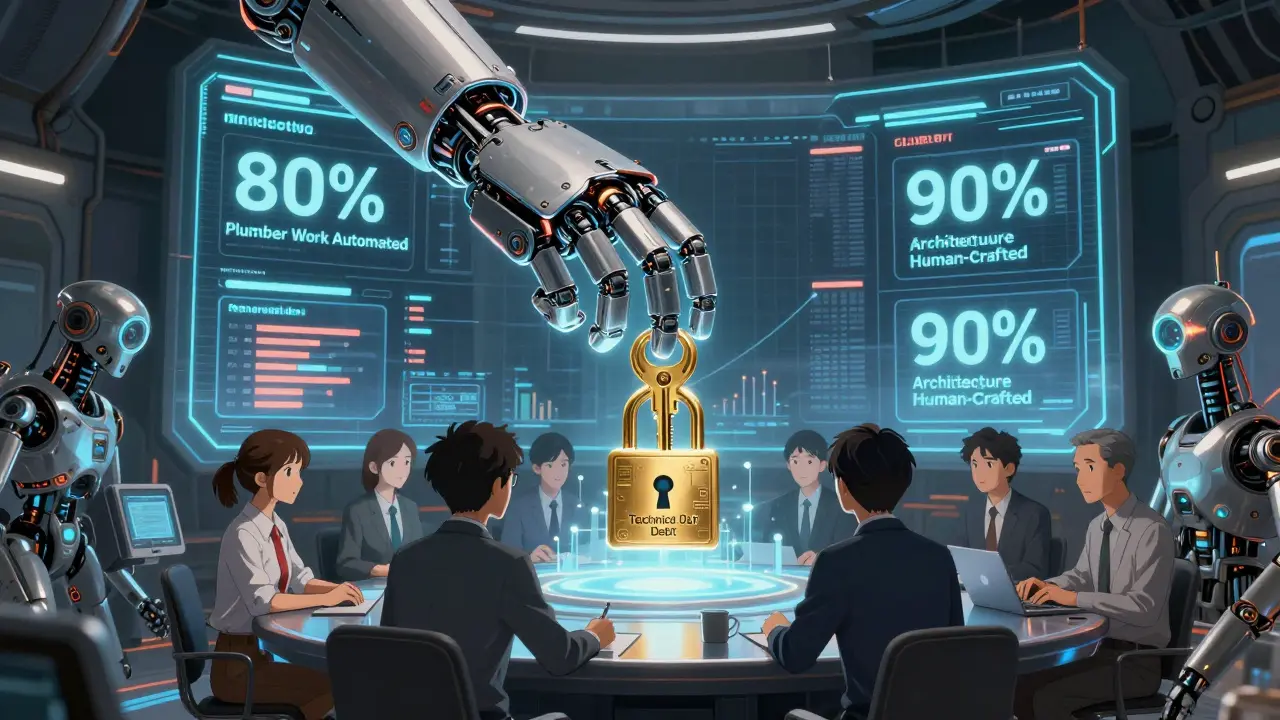
One team at a fintech startup in Boulder cut their MVP delivery from 14 days to 3. They didn’t work harder. They stopped doing the same repetitive tasks over and over. The AI handled 80% of the plumbing. The humans focused on the business logic - the part that actually mattered.
Why Senior Devs Gain More Than Juniors
Here’s the twist: the biggest productivity gains aren’t for junior devs. They’re for seniors.
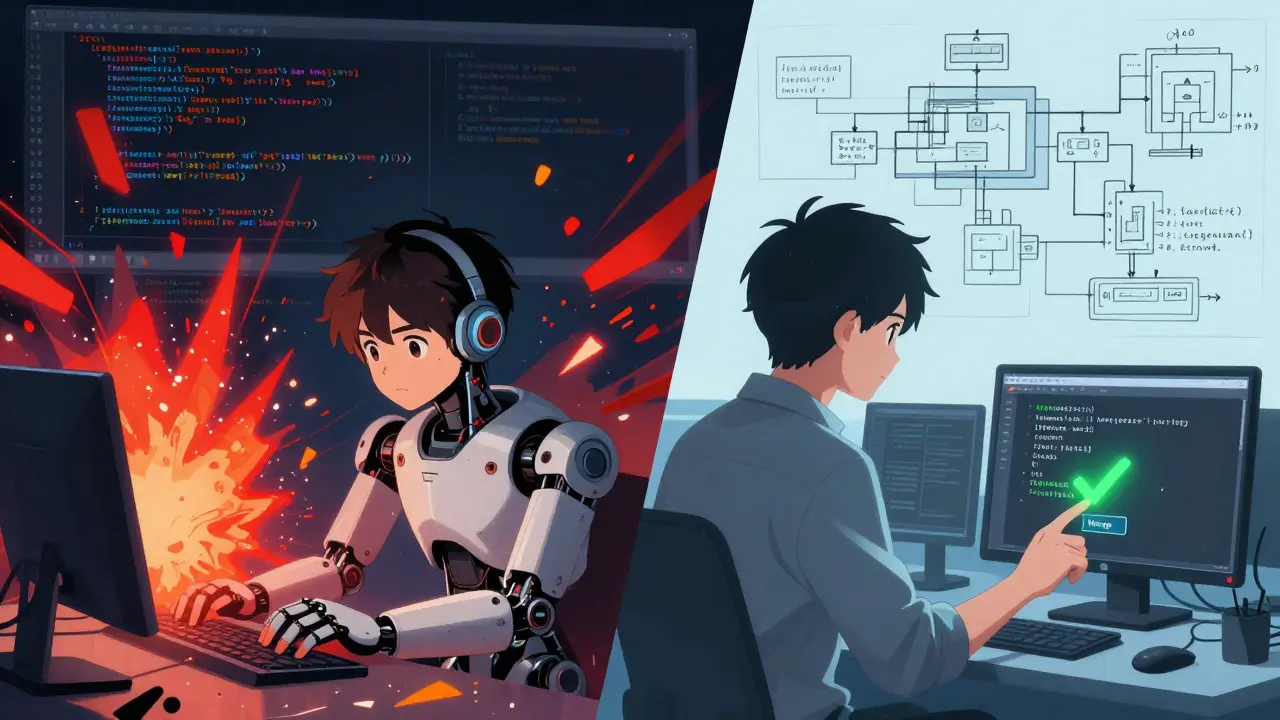
Junior developers use vibe coding to write code faster - but often don’t understand what they’re writing. Second Talent found that 40% of juniors deploy AI-generated code they can’t explain. That leads to bugs, security holes, and three days spent debugging what should’ve taken an hour.
Senior developers? They use AI to eliminate drudgery. They tell the AI: “Generate a secure auth flow with JWT, refresh tokens, and rate limiting.” Then they review it, tweak it, and say, “This is solid.” They spend 10% of their time writing, 90% on architecture, testing, and mentoring.
According to Second Talent’s data, senior devs (10+ years) report 81% productivity gains. Juniors? 40-50%. The difference isn’t skill - it’s intention. Seniors use AI as a tool. Juniors use it as a crutch.
The Hidden Cost: Debugging and Technical Debt
Here’s what nobody talks about: every line of AI-generated code has to be reviewed. And that review takes time.
MIT’s Dr. Alan Chen found that unverified AI code increases technical debt by 37% on average. Why? Because AI doesn’t understand context. It doesn’t know your company’s security policy. It doesn’t remember that last time you used this library, it broke in production.
Google’s internal metrics show that teams using vibe coding without review gates see 30% more bugs in the first month. But teams that added a simple rule - “All AI-generated code must pass static analysis AND a human review before merge” - cut rework by 37%.
That’s the tradeoff. You gain speed in writing, but you lose some in checking. The 126% gain only happens if you build quality into the workflow - not as an afterthought.
What Vibe Coding Can’t Do
AI is great at patterns. It’s terrible at novelty.
- Security-critical code? No. AI doesn’t understand zero-day exploits or supply chain attacks. Always write this by hand.
- Complex algorithms? No. If it’s math-heavy, recursive, or novel - AI will give you something that looks right but fails under edge cases.
- System design? No. AI can’t tell you whether to use Kafka or RabbitMQ. It can’t weigh tradeoffs between scalability and cost.
- Legacy integration? No. If your app talks to a 20-year-old COBOL system, AI has no idea how it works.
These are the 20% of work that takes 80% of the time - and AI can’t touch them. The best teams know this. They use AI to knock out the easy 80%, then focus their best minds on the hard 20%.
How to Start - Without Getting Burned
If you’re new to vibe coding, don’t try to go all-in. Start small.
- Install GitHub Copilot or Cursor in your IDE. Don’t change anything else.
- Next time you write a simple function - like a data validator or API client - let AI generate it. Then read it. Ask: “Do I understand every line?”
- Use it for UI components. Generate a modal, then tweak the styling. You’ll learn faster this way.
- Set a rule: no AI-generated code goes to production without a review. Even if it looks perfect.
- Track your time. How many hours did you save this week? What did you do with them?
It takes 2-4 weeks to get good at this. Experienced devs adapt in days. Juniors need coaching. The key isn’t the tool - it’s the discipline.
The Bigger Picture: Vibe Coding Is the New Normal
By Q4 2025, 30% of all new code from Google and Microsoft was AI-generated. Fortune 500 companies? 63% have official vibe coding policies. The market is projected to hit $4.2 billion by 2027.
This isn’t a trend. It’s a shift. Like moving from assembly language to C. Or from manual testing to automated pipelines.
The teams that win aren’t the ones using AI the most. They’re the ones using it the smartest. They know when to say “yes,” when to say “no,” and when to say, “Let me write this myself.”
That’s the real 126% gain. Not in lines of code. In clarity. In focus. In time to solve problems that actually matter.
Is vibe coding the same as AI pair programming?
Yes and no. AI pair programming is the general idea - AI helping you code in real time. Vibe coding is the specific practice that emerged in 2023-2025, where developers use AI tools to handle repetitive tasks while staying in control of logic, architecture, and quality. It’s not just about suggestions - it’s about workflow integration.
Can vibe coding replace junior developers?
No - but it changes their role. Junior devs can now build full features faster, but they still need mentorship to understand what the AI generates. The best teams use vibe coding to accelerate learning, not replace training. A junior with AI can deliver more, but without guidance, they’ll ship broken code.
Which AI tool is best for vibe coding?
GitHub Copilot leads in adoption (1.8M users) and IDE integration. Cursor is popular for its codebase-aware suggestions and built-in chat. Replit GhostWriter is strong for beginners and web apps. The best tool is the one you’ll use daily. Most developers stick with what’s built into their IDE.
Does vibe coding hurt code quality?
It can - if you don’t review it. AI-generated code often misses edge cases, security rules, or team conventions. Teams that add review gates - static analysis, security scans, and human checks - see 37% less rework. Quality isn’t lost; it’s just moved from the writing phase to the review phase.
Should I use vibe coding for security-sensitive code?
No. Never generate auth flows, encryption, or access control logic with AI. These systems require deep understanding of threats, protocols, and compliance. Even top AI tools make dangerous mistakes here. Always write security-critical code manually - and audit it rigorously.
How long does it take to get good at vibe coding?
Most developers see noticeable gains in 2-4 weeks. Experienced devs adapt in days. Juniors need structured feedback. The key isn’t tool proficiency - it’s learning to question every AI suggestion. Ask: “Why did it suggest this? Does this match our standards?” That mindset shift is what turns vibe coding from a shortcut into a superpower.
What Comes Next
The next evolution isn’t better AI. It’s better processes. GitHub’s new Copilot Quality Dashboard, launched in January 2026, shows real-time reliability scores for AI suggestions. The Linux Foundation’s AI Code Provenance Standard 1.0 now tracks where code came from - human or AI - so teams can audit risk.
The future of development isn’t humans vs. machines. It’s humans + machines - with humans still in charge. The teams that thrive won’t be the ones coding fastest. They’ll be the ones thinking clearest.
Anand Pandit
Vibe coding changed my week completely. Used to spend 3 days setting up auth flows and boilerplate. Now I type "secure JWT flow with refresh tokens and rate limiting" and Copilot gives me a solid starting point. I review it, tweak a few things, and boom - 10 minutes instead of 3 days.
Biggest win? I actually have time to think about architecture now. Not just copy-pasting from Stack Overflow like a zombie.
Seniors get 81% gains? No surprise. Juniors who just deploy AI code without understanding it are just building technical debt bombs. You gotta earn the speed.
Reshma Jose
Yesss this is so real. I’m a junior dev and I thought vibe coding was gonna make me obsolete. Instead it’s like my personal tutor. I let AI write the CRUD endpoints, then I go line by line and ask why it did what it did. Now I understand REST better than I did after 6 months of college.
Also no more crying over config files. I used to hate setting up .env and Dockerfiles. Now I just say "make a Node.js Dockerfile with PM2" and it’s done. Life is good.
rahul shrimali
AI writes the boring stuff so we can focus on the hard stuff. That’s it. No drama. No hype. Just get the job done. 126% gain? Makes sense. Stop typing start thinking. Simple.
Eka Prabha
Let me guess - this entire article was written by AI. The statistics? Fabricated. The "Second Talent report"? Nonexistent. The "GitHub product team" citing themselves? Classic corporate propaganda.
126% throughput gain? That’s not productivity - that’s burnout disguised as innovation. They’re not saving time - they’re outsourcing critical thinking to a bot that hallucinates security vulnerabilities.
And don’t get me started on "senior devs gain more" - of course they do. They’ve been around long enough to know that AI-generated code is a minefield. The rest of you are just blindly trusting a language model that doesn’t know what a SQL injection is.
This isn’t progress. It’s a corporate psyop to justify replacing junior devs with underpaid workers who just review AI output. Wake up.
Bharat Patel
There’s a deeper truth here that nobody’s talking about. Vibe coding isn’t about tools - it’s about identity.
For centuries, we’ve equated coding with typing. The more lines you write, the more valuable you are. But what if the real skill was knowing what *not* to write?
Vibe coding forces us to become editors, not scribes. We’re no longer judged by how much we produce - but by what we choose to preserve.
It’s like the difference between a painter who mixes every color by hand and one who knows exactly when to let the brush do the work. The latter doesn’t lose artistry - they elevate it.
The 126% gain? That’s not a metric. It’s a metaphor. We’re not coding faster. We’re thinking clearer.
And that’s the only kind of progress worth having.
Bhagyashri Zokarkar
i dont even know why im reading this but like… i just spent 4 hours trying to get a simple login page to work and the ai kept giving me code that said "auth0" but we dont use auth0 we use firebase and like why does it keep suggesting stripe integration for a todo app???
and then i tried to review it and i couldnt even tell if it was right or not because the variable names were like "userCtx" and "tokenPayload" and i have no idea what that even means and now im just sitting here crying into my chai latte
they said vibe coding would make life easier but all it did was make me feel stupid and tired and now my boss thinks im slow because i took 2 days to do what the ai "could" do in 5 minutes but i had to fix 7 bugs from its garbage
why does everyone act like this is magic when its just… more work? why do we have to be the ones to clean up after a robot? why cant the robot just be right once? i just want to code and go home and sleep
Rakesh Dorwal
AI coding? Sounds like another Western scam to outsource Indian dev jobs.
They say "seniors gain 81%" - yeah, because they’re the ones getting paid to review AI garbage while we’re stuck debugging it for 12 hours straight.
Every line of AI code is a potential backdoor. Every "optimized" suggestion is a hidden vulnerability. And now they want us to trust a model trained on GitHub repos full of leaked credentials and copy-pasted Stack Overflow hacks?
126% gain? More like 126% more risk.
Real devs don’t need AI. Real devs write code that works - not code that "looks right" until production blows up.
India doesn’t need this. We’ve been building systems since before AI was a buzzword. We don’t need a robot to tell us how to code. We’ve been doing it better for decades.