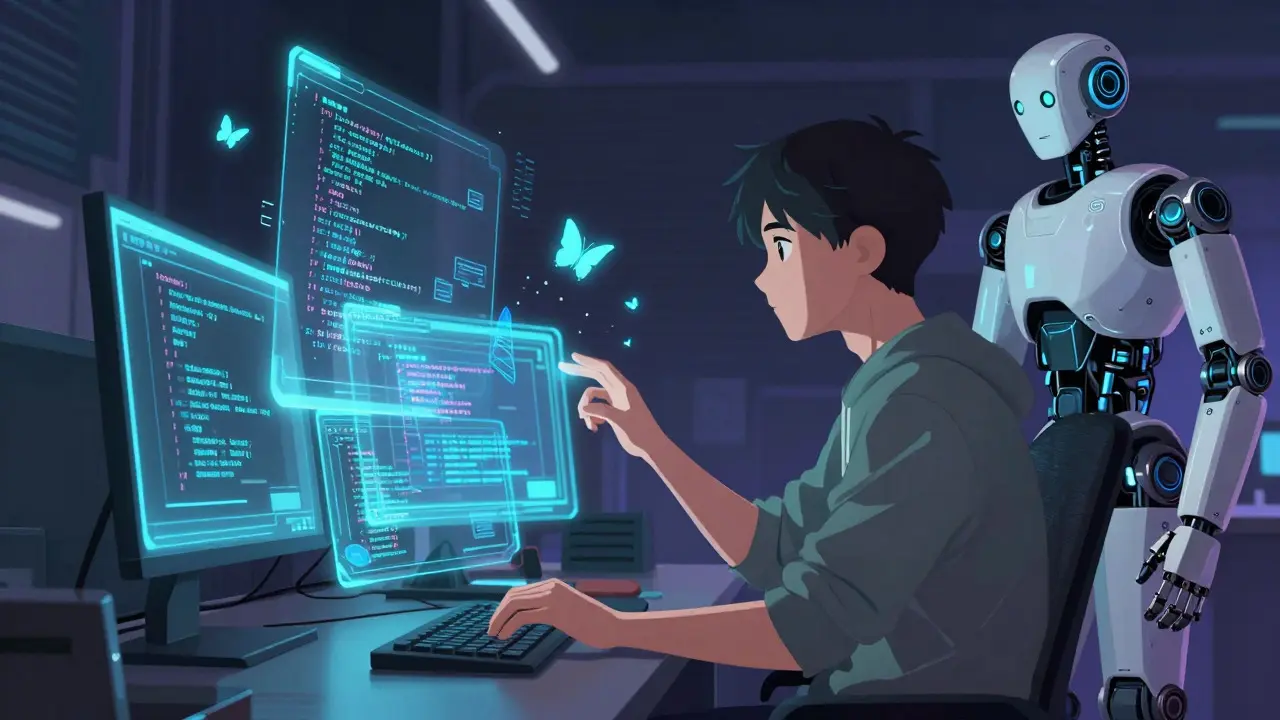
You just built a fully functional mobile app in three days. No lines of code written by hand-just prompts to an AI model that spit out Python, Swift, and SQL. It works. It looks good. But before you launch or sell it, there’s a quiet question hanging over your head: who actually owns this thing?
Vibe coding-describing what you want in plain English and letting an LLM handle the implementation-has democratized app creation. But it has also blurred the legal lines that have protected developers for decades. If you’re building with AI, you need to understand how copyright, licensing, and intellectual property (IP) work in this new reality. Get it wrong, and you might not own your own product.
The Core Problem: Does AI-Generated Code Have Copyright?
Under U.S. law, copyright protection requires human authorship. The U.S. Copyright Office has historically taken the position that works created solely by animals or machines without human input are not copyrightable. This creates a gray zone for vibe-coded apps.
If you type “Create a login page with OAuth” and the AI writes every line of code, is that code yours? Or is it public domain because no human “authored” it in the traditional sense? Legal experts generally agree that if you provide significant creative direction, selection, and arrangement, you likely hold copyright to the final output. But if you just accept the first suggestion without modification, your claim weakens.
Here’s the practical takeaway: document your process. Keep records of your prompts, your edits, and your design decisions. Courts look at the degree of human control. The more you curate, refine, and structure the AI’s output, the stronger your IP position becomes.
Licensing Traps: When Open Source Creeps In
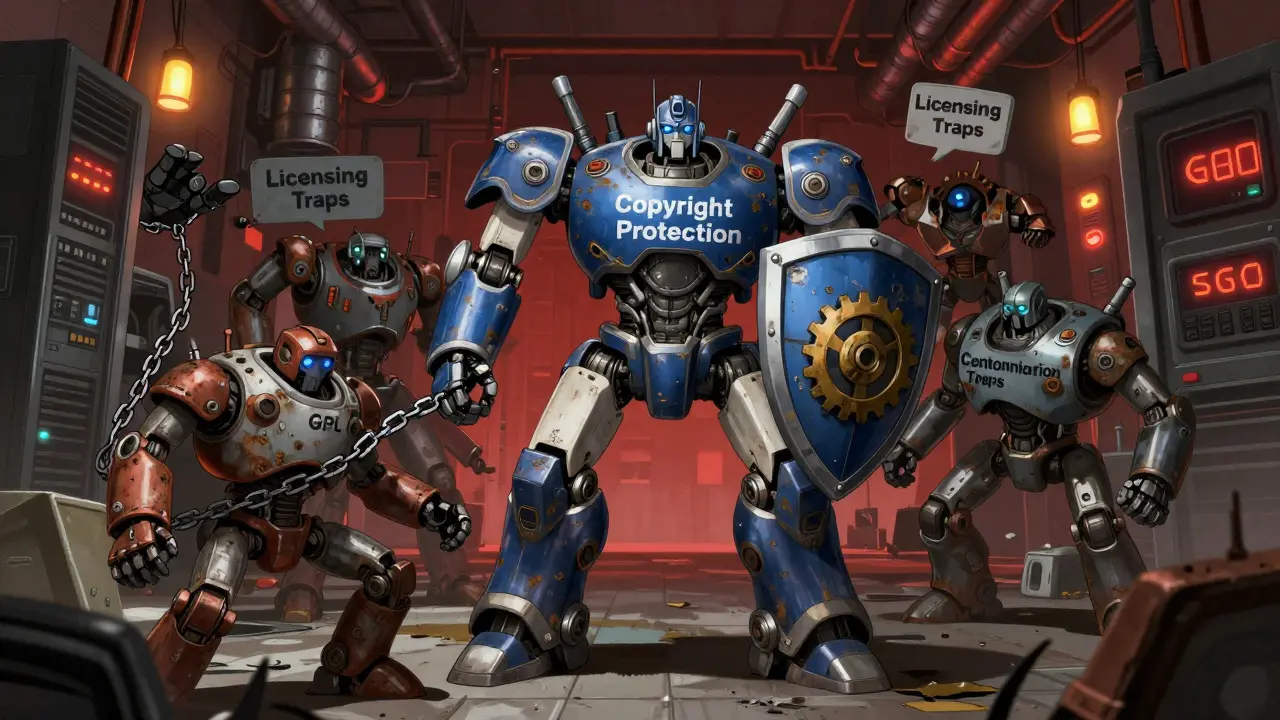
This is where most vibe-coding projects go off the rails. Large language models are trained on vast datasets, including millions of open-source repositories. When an AI generates code, it doesn’t just create from thin air-it often mimics patterns from its training data. Sometimes, it reproduces snippets almost verbatim.
If the AI spits out a function that was originally under the GNU General Public License (GPL), do you now have to open-source your entire app? Potentially, yes. GPL is “copyleft,” meaning derivative works must share the same license. If your app incorporates GPL code-even indirectly through AI generation-you might inherit those obligations.
MIT and Apache licenses are safer. They allow commercial use with minimal restrictions. But even these require attribution. If you’re building a proprietary SaaS platform and the AI inserts an MIT-licensed utility function, you need to include the original copyright notice and license text in your project.
| License Type | Risk Level for Proprietary Apps | Key Obligation | Action Required |
|---|---|---|---|
| MIT / BSD | Low | Include copyright notice and license text | Add attribution file; verify no other clauses |
| Apache 2.0 | Low-Medium | Include NOTICE file and patent grant terms | Review patent implications; add attribution |
| GPL v3 | High | Entire derivative work must be GPL licensed | Avoid unless open-sourcing the whole app |
| AGPL | Very High | Source code must be available to network users | Avoid for any closed-source SaaS product |
Terms of Service: The Fine Print You Skipped
Before worrying about copyright law, check the Terms of Service (ToS) of the AI tool you’re using. Platforms like GitHub Copilot, Cursor, Replit, and ChatGPT each have different rules about who owns the output.
Most major AI coding assistants currently assign ownership of the generated code to the user. However, they often retain a non-exclusive license to use your prompts and outputs for improving their models. Some platforms reserve the right to monetize popular templates or features derived from user submissions.
Always read the ToS section labeled “Intellectual Property” or “Ownership.” Look for phrases like “You own the Output” versus “We grant you a license to use the Output.” The difference matters if you plan to sell the app or raise investment. Investors will ask during due diligence. If your core asset rests on a revocable license rather than full ownership, your valuation drops.
Patents vs. Copyright: Protecting Your Logic
Copyright protects the expression of your code-the specific lines of text. It does not protect the underlying idea or algorithm. If you invent a novel way to compress video data using AI-generated code, copyright stops a competitor from copying your exact code file. But it won’t stop them from writing their own code that does the same thing differently.
For that level of protection, you need a patent. Patents are expensive and slow, but they protect the functional logic. If your vibe-coded app includes a unique method, process, or system architecture, consider filing a provisional patent application early. Don’t wait until you launch. Public disclosure can kill patent eligibility in many jurisdictions.
Also, remember that patents expire after 20 years. Copyright lasts much longer-typically the life of the author plus 70 years. For software, copyright is usually the primary shield. Use patents only when the innovation is structural or procedural, not just syntactic.
Liability: Who Pays When the Code Breaks?
If your vibe-coded app crashes and loses customer data, who is liable? You are. As the publisher, you bear the responsibility for the software’s performance, security, and compliance.
AI tools rarely guarantee bug-free code. Their disclaimers usually state that outputs are “provided as-is.” This means if the AI generates a SQL query that causes a database lockup, you’re on the hook for fixing it. If it generates insecure authentication logic that gets exploited, you face the breach costs.
To mitigate this risk:
- Run static analysis tools on all AI-generated code before deployment.
- Perform manual code reviews, especially for security-critical modules.
- Use version control to track changes so you can revert bad AI suggestions quickly.
- Carry tech E&O (Errors and Omissions) insurance if you’re serving enterprise clients.
Practical Steps to Secure Your IP
You don’t need a law degree to protect yourself, but you do need a process. Here’s a simple checklist for every vibe-coded project:
- Document Human Input: Save your prompts, sketches, and decision logs. This proves human authorship.
- Scan for License Contamination: Use tools like FOSSA or Black Duck to detect open-source components in your codebase.
- Review AI Tool ToS: Confirm you own the output and understand any data usage rights.
- Register Copyright: File with the U.S. Copyright Office. While registration isn’t required for protection, it’s necessary to sue for infringement and collect statutory damages.
- Trademark Your Brand: Protect your app name and logo separately. Code copyright doesn’t cover branding.
- Consider Patent Filing: Only if you have a novel technical solution, not just a better UI.
These steps take time, but they turn a risky experiment into a defensible business asset. The goal isn’t to fear AI-it’s to harness it while keeping the legal reins in your hands.
Do I own the code if an AI wrote it?
Generally, yes, if you provided creative direction and made meaningful selections. Pure machine output without human curation may lack copyright protection. Always check your AI tool's Terms of Service, as some grant you ownership while others offer a license.
Can AI-generated code violate open source licenses?
Yes. If the AI reproduces code from a GPL or AGPL repository, your app may inherit those copyleft obligations. Use dependency scanners to identify potential contamination and avoid high-risk licenses in proprietary products.
What happens if my AI-coded app infringes on someone else's copyright?
You are liable as the publisher. Even if the AI copied the code, courts typically hold the human creator responsible for due diligence. Mitigate risk by reviewing code, using licensed libraries, and maintaining documentation of your development process.
Should I register copyright for AI-assisted software?
Yes. Registration provides legal advantages, including the ability to claim statutory damages and attorney fees in infringement lawsuits. It also serves as public proof of ownership, which is valuable during fundraising or acquisition.
Does vibe coding change patent eligibility?
Not directly. Patent law focuses on the novelty and non-obviousness of the invention, not how it was created. If you conceive a novel algorithm via AI prompts, you can still patent it, provided you disclose the process and meet standard patent requirements.