
Most companies treated the first wave of Generative AI like a fancy autocomplete tool-great for drafting emails or summarizing meetings, but not exactly a needle-mover for the bottom line. The real money isn't in chatbots; it's in agentic generative AI is an evolution of artificial intelligence where autonomous, goal-directed systems execute complete business workflows without human intervention. Unlike standard LLMs that just talk, agentic systems act. We are moving from "AI that suggests" to "AI that does," and for the first time, this is where actual ai roi becomes measurable and massive.
Moving Beyond the Chatbot: What Exactly is Agentic AI?
If traditional automation is a train on a track-it goes exactly where the rails lead and stops if there's a pebble in the way-agentic AI is a self-driving car. It knows the destination, evaluates the traffic in real-time, and finds a detour if the main road is blocked. It doesn't just follow a script; it reasons through a goal.
The core difference lies in the operational loop. While a standard AI responds to a prompt, an agentic system follows a cycle of perception, reasoning, action, and learning. For example, consider a customer service scenario. A basic AI can draft a refund policy explanation. An AI Agent an autonomous entity capable of using tools and making decisions to achieve a specific business objective can look up the customer's order history in an ERP, verify the return shipping status via a carrier API, decide if the refund is warranted based on company policy, and then actually trigger the payment in the finance system. No human handoff, no "I'll get back to you," just a completed workflow.
The Economic Impact: Measuring the Value Capture
When we talk about capturing value, we're looking at two main levers: cost reduction and velocity. According to data from McKinsey's QuantumBlack division, companies embedding these agents into their workflows are seeing productivity gains between 20% and 60%. That isn't just a marginal improvement; it's a structural shift in how work gets done.
The speed of execution is where the most immediate ROI hits. Early adopters report workflow cycles moving 20% to 30% faster. In the world of IT service management, for instance, agents are now auto-resolving tickets that used to eat up 40% of a service desk's capacity. When a system can detect a server lag, diagnose the cause, and reroute traffic autonomously, the "cost per ticket" drops toward zero while the "time to resolution" vanishes.
| Feature | Robotic Process Automation (RPA) | Agentic Generative AI |
|---|---|---|
| Logic | Rule-based (If This, Then That) | Reasoning-based (Goal-oriented) |
| Adaptability | Breaks if the UI changes | Adapts to environment changes |
| Complexity | Simple, repetitive tasks | Multi-step, cross-functional workflows |
| Learning | Static until updated by human | Continuous learning via RL frameworks |

The Technical Engine Driving Autonomy
To make this work, agents don't just rely on a prompt. They use Hierarchical Task Networks (HTNs) a planning method that decomposes complex goals into a hierarchy of simpler tasks to break a massive objective (like "Onboard this new vendor") into a sequence of actionable steps. They often pair this with Retrieval Augmented Generation (RAG) a technique that optimizes LLM output by referencing a specific, trusted knowledge base outside of its training data to ensure they aren't hallucinating facts about your specific company policies.
The "brains" of the operation typically involve a combination of Large Language Models and Reinforcement Learning (RL) a machine learning type where an agent learns to make decisions by performing actions and receiving rewards or penalties . This allows the system to try different paths to a solution and remember which one worked best. However, the secret sauce is API connectivity. Without a deep integration into platforms like SAP a leading enterprise resource planning (ERP) software that manages business operations and customer relations or Salesforce a cloud-based CRM platform that helps companies manage customer relationships and sales pipelines , an agent is just a smart talker with no hands. To capture value, the agent must have the authority to push updates to the system of record.
High-Value Use Cases: Where to Start
Not every process should be agentic. If a task requires deep human empathy or nuanced ethical judgment, an agent will fail. The "sweet spot" for ROI is in high-volume, repetitive processes with clear patterns but high complexity.
- Supply Chain Optimization: Imagine an agent that monitors inventory levels in real-time. If it notices a shortage of a critical component due to a shipping delay, it doesn't just alert a human. It searches for alternative suppliers, compares prices, checks quality certifications, and triggers a procurement flow in the ERP to cover the gap.
- Finance and Invoicing: End-to-end invoice processing often stalls at "discrepancy resolution." An agentic workflow can identify a price mismatch, email the vendor for a corrected invoice, verify the new document against the original purchase order, and approve the payment-reducing processing time by up to 75%.
- IT Operations (AIOps): Using platforms like ServiceNow a cloud computing platform to help organizations digitize and automate their business workflows , agents can move from simply logging tickets to resolving them. They can reset passwords, provision software licenses, or troubleshoot VPN issues by executing scripts and verifying the result across different systems.
The Implementation Blueprint: Avoiding the "Automation Gap"
The biggest mistake companies make is rushing to automate a broken process. If your current workflow is a mess of undocumented spreadsheets and "tribal knowledge," an AI agent will only automate the chaos. This leads to what analysts call the automation gap, where initial accuracy rates hover below 65% because the AI doesn't have a clear map to follow.
To actually capture value, follow this three-step approach:
- Data Foundation: Clean up your structured and unstructured data. Agents are only as good as the knowledge base they can access. If your policies are buried in five different PDF versions, the agent will struggle.
- Workflow Mapping: Document the "Happy Path" and every possible edge case. You need to know exactly where the agent should take action and where it must hand off to a human.
- Symbiotic Deployment: Don't aim for 100% autonomy on day one. Start with a "human-in-the-loop" model where the agent proposes the action and a human clicks "approve." As confidence scores increase, you move toward full autonomy.
The Future of the Autonomous Enterprise
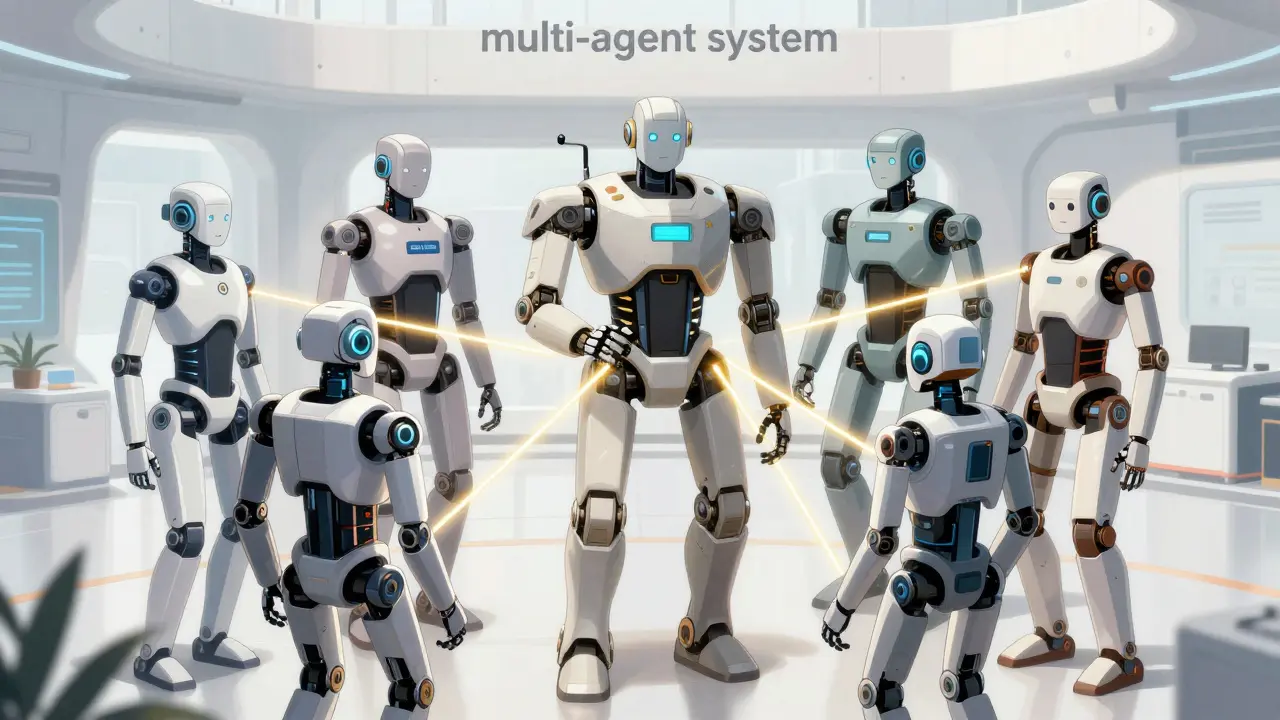
We are heading toward a world of multi-agent systems. In this setup, you don't have one giant AI; you have a fleet of specialized agents that talk to each other. A "Sales Agent" might hand off a closed deal to an "Onboarding Agent," which then coordinates with a "Billing Agent" to set up the account. This inter-agent communication removes the friction of departmental silos entirely.
The long-term play here isn't just about saving hours; it's about proactive business optimization. We're seeing a shift where agents don't just fix problems-they prevent them. An agent that notices a trend in increasing shipping costs can trigger a financial reassessment of all forecasts independently, shifting the company from a reactive posture to a predictive one.
How is agentic AI different from traditional RPA?
Traditional RPA follows strict, predefined rules; if a button moves one pixel to the left, the process often breaks. Agentic AI uses reasoning and LLMs to understand the goal. It can handle unstructured data and adapt to changes in the environment without needing a human to rewrite the code.
What is the typical ROI timeframe for agentic AI?
Early adopters typically see measurable results within 3 to 6 months of implementation, provided they have a clean data foundation and well-mapped workflows. Gains often manifest as a 20-60% increase in productivity for the targeted workflow.
Will AI agents completely replace human workers?
No. The most successful models are "symbiotic," combining agents, robots, and people. Agents handle high-volume, pattern-based tasks, while humans focus on complex edge cases, ethical judgments, and high-empathy customer interactions.
What are the biggest risks in deploying agentic workflows?
The primary risks are "over-automation" (where agents handle edge cases poorly, leading to higher customer frustration) and lack of transparency. Without proper governance and audit trails, it can be difficult to understand why an agent made a specific decision in a regulated environment.
What technical requirements are needed for these agents to work?
You need robust API connectivity to your enterprise systems (CRM, ERP, etc.), a high-quality knowledge base for RAG, and a governance framework to manage the agent's permissions and decision-making boundaries.
Lauren Saunders
The obsession with "ROI" is just so quaint and mid-market. Everyone is acting like agentic AI is this revolutionary leap when it's essentially just a recursive loop with a better marketing budget. I find the analogy of the self-driving car particularly pedestrian; it ignores the stochastic nature of LLMs entirely. Most enterprises aren't even capable of basic data hygiene, so the idea that they'll suddenly pivot to "symbiotic deployment" is laughable. It's just more buzzwords for the C-suite to pretend they understand while the actual engineers suffer through the implementation of half-baked APIs. Honestly, the whole premise that a machine can "reason" through a goal is a category error in philosophy, but I suppose that doesn't matter when you're chasing a 20% productivity gain for a spreadsheet.
Andrew Nashaat
Imagine thinking that a "stochastic nature" justifies a complete lack of professional decorum in a discussion!!! The logic here is fundamentally flawed, and frankly, it's offensive to those of us who actually value intellectual rigor!!! You're just being contrarian for the sake of it, which is a lazy way to engage with a topic!!! However, the post does correctly identify the data foundation issue, even if the formatting is slightly off!!!
Gina Grub
pure cope. the latency in multi-agent orchestration is a total nightmare and the token spend for recursive reasoning loops is absolutely astronomical. you're basically burning VC cash to avoid paying a junior analyst to do a vlookup. the a-g-i hype cycle is just masking the fact that rAG is still hallucinating at scale in edge cases. total disaster waiting to happen when the agent triggers a procurement flow for 10k units of the wrong SKU because of a semantic drift. complete circus
Jawaharlal Thota
I truly believe that we are standing on the precipice of a magnificent transformation in how we perceive the relationship between human ingenuity and machine efficiency, and it is heartening to see such a detailed roadmap provided here for those who might feel overwhelmed by the pace of change. If you are a business owner feeling a bit lost, remember that the journey toward an autonomous enterprise is not a sprint but a marathon, and the most important thing is to foster a culture of continuous learning where your employees feel supported rather than replaced. By focusing on the "human-in-the-loop" model mentioned, we can ensure that the transition is graceful and that the AI acts as a supportive scaffolding for our staff to reach higher levels of strategic thinking. It is all about guidance and patience; once the data foundation is solid, the rewards will be shared by everyone in the organization, leading to a more balanced and productive work-life harmony for all involved. Let us embrace this as an opportunity to elevate our roles and trust the process of incremental improvement. Keep pushing forward and stay positive about the synergy between man and machine!
Nathan Jimerson
This is exactly the kind of forward-thinking approach we need to see more of in the industry. The shift from suggestion to action is going to unlock so much potential for small teams to compete with giants.