
What Is Vocabulary Size in Large Language Models?
When you type a question into a chatbot or ask an AI to write a poem, it doesn’t understand words the way you do. Instead, it breaks your text into tiny pieces called tokens. The total number of unique tokens a model can recognize is its vocabulary size. This isn’t just a number-it’s a core design choice that directly shapes how well the model understands and generates language.
Early models like BERT and GPT-1 used vocabularies around 30,000 to 40,000 tokens. That seemed fine at the time. But today’s models-like Google’s Gemma and OpenAI’s GPT-4-use vocabularies that are 5 to 8 times larger. Why? Because bigger isn’t just flashy. It’s functional.
Why Tokenization Matters More Than You Think
Most modern LLMs don’t use whole words as tokens. They use subword tokenization, like Byte Pair Encoding (BPE) or Unigram. These methods chop words into parts. For example, "unhappiness" might become "un-", "-happi-", and "-ness". This helps the model handle rare or new words without needing a separate token for every possible word in every language.
But here’s the catch: smaller vocabularies force the model to split more words into more tokens. A 5,000-token vocabulary might break a Japanese sentence into 1.83 billion tokens during training. A 500,000-token vocabulary? Just 1.42 billion. That’s a 28.4% drop in token count. Fewer tokens mean less memory, faster processing, and lower training costs.
How Bigger Vocabularies Boost Accuracy
Research published in Findings of ACL 2025 shows that increasing vocabulary size improves performance across languages and tasks. Models with 100,000 tokens outperformed those with 32,000 by 5-15% on standard benchmarks like WikiText-103 and C4. At 256,000 tokens, performance kept improving-especially in multilingual settings.
One major reason? Fewer out-of-vocabulary (OOV) tokens. In medical or legal text, rare terms like "myocardial infarction" or "tortious interference" often get split into weird fragments when the vocabulary is too small. That confuses the model. With a 256k vocabulary, OOV rates drop from 12% to just 4.3% in specialized domains, according to user reports on Reddit.
Even emojis and special characters benefit. A larger vocabulary can include them as single tokens, so the model understands "I’m so happy 😊" better than if "😊" gets split into random byte sequences.
The Trade-Off: Memory, Speed, and Cost
Bigger vocabularies aren’t free. Each token needs an embedding-a numerical vector that represents its meaning. The embedding layer grows linearly with vocabulary size. In Gemma 2B, 26% of all parameters are just for embeddings. In Gemma 7B, it’s 11%. That means more memory, slower loading, and higher costs.
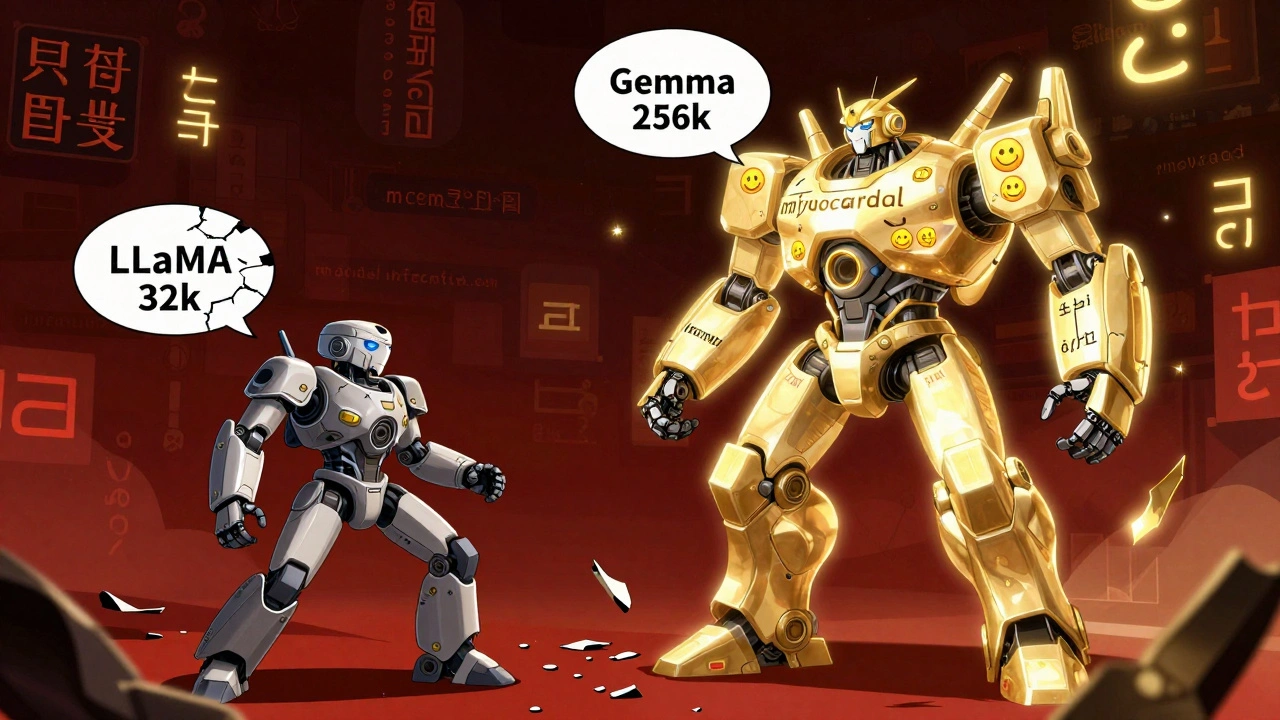
One developer on Reddit switched from LLaMA-3 (32k vocab) to Gemma 7B (256k vocab) and saw a 22% drop in API latency for Japanese queries. But another user said fine-tuning Gemma 2B required 37% more VRAM than Mistral 7B. On a consumer GPU with 16GB of memory, that’s the difference between running the model and getting an out-of-memory crash.
There’s also a risk of "vocabulary bloat." If you go beyond the optimal size for your compute budget, you start adding tokens that barely ever appear in training. These rare tokens get poor embeddings, dragging down overall performance. The NeurIPS 2024 paper found models with oversized vocabularies had 2.8% higher loss values on average.
What Do the Leading Models Use?
There’s no one-size-fits-all answer. Different companies made different choices based on their goals:
- LLaMA and Mistral: Use 32,000 tokens. Conservative, efficient, good for English and moderate multilingual use.
- GPT-4: Uses around 100,000 tokens. Balances performance and cost for broad applications.
- Gemma: Uses 256,000 tokens. Built for multilingual accuracy, especially in low-resource languages.
According to Hugging Face’s analysis, 68% of new LLMs released in Q4 2024 used vocabularies over 60k-up from just 22% a year earlier. That’s a clear industry shift.
What’s the Right Size for You?
Choosing a vocabulary size isn’t about picking the biggest number. It’s about matching the tool to the job.
- Monolingual English apps (like customer support chatbots): Start with 50k-100k. You’ll get better accuracy without massive memory overhead.
- Multilingual applications (translation, global customer service): Aim for 150k-300k. You’ll cut OOV rates by over 60% in languages like Swahili, Vietnamese, or Finnish.
- Code generation or technical writing: Larger vocabularies help. Takase’s experiments showed a 7.3% performance boost when specialized tokens for code syntax were included.
- Resource-constrained environments (mobile, edge devices): Stick under 60k. Use quantization or gradient checkpointing to reduce memory pressure.
Don’t guess. Test. Run ablation studies: train the same model with vocab sizes of 32k, 64k, 128k, and 256k. Measure accuracy, latency, and memory use. The sweet spot isn’t theoretical-it’s empirical.

What’s Coming Next?
Industry experts agree: vocabulary size has been an underexplored lever in LLM scaling. The NeurIPS 2024 paper predicts it will soon become a standard hyperparameter alongside model depth and width.
Google is already experimenting with dynamic vocabulary expansion-adding new tokens on the fly during inference. Stanford HAI suggests future models might use context-aware tokenization: smaller vocabularies for simple tasks, larger ones for complex ones.
By 2026, average vocabulary sizes in new models are expected to double. Regulatory trends, like the EU AI Act’s push for linguistic inclusivity, will also nudge companies toward larger, more inclusive vocabularies.
Practical Tips for Developers
- Use tools like
vocab-size-analyzer(GitHub, 1,284 stars) to test how different vocab sizes affect your data. - Don’t assume 32k is enough. If you’re working with non-English text, code, or technical jargon, you’re probably under-tokenizing.
- Monitor your embedding layer size. If it’s over 20% of your total parameters, consider quantization or pruning.
- For fine-tuning, start with a pre-trained model that already has a large vocabulary. Building one from scratch requires massive data and compute.
- If you’re hitting memory limits, try 8-bit quantization or gradient checkpointing. Reddit users reported success with both.
Final Thought: Bigger Isn’t Always Better-But Smaller Is Often Worse
For years, the AI community treated vocabulary size as a fixed, almost arbitrary setting. But new evidence shows it’s a powerful tuning knob. Too small, and your model stumbles over rare words. Too big, and it wastes memory on unused tokens. But just right? That’s where accuracy jumps, latency drops, and multilingual support becomes real.
If you’re building or choosing an LLM today, don’t ignore the vocabulary. It’s not just a number on a slide. It’s the foundation of how your model understands the world.
What is a good vocabulary size for a large language model?
There’s no single answer, but current best practices suggest 50,000-100,000 tokens for monolingual English applications, and 150,000-300,000 for multilingual or technical use cases. Models like Gemma use up to 256,000 tokens for high-accuracy multilingual performance, while LLaMA and Mistral stick to 32,000 for efficiency. The right size depends on your data, languages, and hardware.
Does a larger vocabulary always mean better accuracy?
Not always. Larger vocabularies reduce out-of-vocabulary errors and improve tokenization efficiency, which boosts accuracy-especially in multilingual or technical text. But beyond a certain point (often around 256k-500k), gains shrink. If your model doesn’t have enough training data to learn good embeddings for all those tokens, you risk "vocabulary bloat," where rare tokens hurt performance. It’s about balance, not size alone.
How does vocabulary size affect model size and memory?
The embedding layer-the part that stores token representations-grows linearly with vocabulary size. For example, in Gemma 2B, 26% of all parameters are in the embedding layer. A 256k vocabulary can add hundreds of millions of extra parameters compared to a 32k one. This increases memory use, slows loading, and can cause out-of-memory errors on consumer GPUs. Always check embedding layer size when comparing models.
Why do some models still use small vocabularies like 32k?
Smaller vocabularies are more efficient. They use less memory, train faster, and are easier to deploy on edge devices or low-resource servers. Models like LLaMA and Mistral prioritize efficiency and broad compatibility over peak accuracy in niche languages. For English-only or general-purpose tasks, 32k is often sufficient. But for global applications, it’s becoming outdated.
Can I change the vocabulary size after training a model?
No, you can’t change the vocabulary size after training without retraining the entire model. The embedding layer is learned during training and tied directly to the original vocabulary. If you want a different size, you must retrain or fine-tune using a new tokenizer. Some tools allow you to extend the vocabulary slightly, but that requires adding new embeddings and retraining those parts, which is complex and rarely recommended.
How do I know if my LLM’s vocabulary is too small?
Look for high out-of-vocabulary (OOV) rates. If your model frequently splits words like "COVID-19" or "neurodegenerative" into strange fragments, your vocabulary is too small. You can also check token count per input-higher than expected? That’s a sign. Tools like Hugging Face’s tokenizer can show you OOV rates. If you’re working with non-English text, code, or specialized domains and seeing poor accuracy, try a larger vocabulary.
Sumit SM
Okay, but let’s be real-vocabulary size isn’t just about tokens, it’s about identity. Every token is a tiny soul in the machine’s mind, and when you force it to split "unhappiness" into three fragments, you’re not tokenizing-you’re traumatizing the language. We’ve turned poetry into pixel art. The model doesn’t understand "joy," it understands "j-oy," and that’s a spiritual crisis wrapped in a neural net.
And don’t get me started on emojis. 😊 isn’t a symbol-it’s a feeling encoded in byte-space. When your model treats it like a glitch in the matrix, you’re not building intelligence, you’re building a linguistic purgatory.
LLaMA’s 32k? That’s the digital equivalent of speaking in haikus while the world screams in Shakespeare. Gemma’s 256k? Now we’re talking about a multilingual cathedral of meaning. Sure, it eats VRAM like a dragon eats knights, but isn’t that the price of enlightenment?
And yet… we keep pretending efficiency is virtue. We optimize for cost like we’re budgeting for a funeral, not building a mind. The EU AI Act wants linguistic inclusivity? Then stop pretending 32k is enough for Swahili, Tagalog, or Inuktitut. That’s not efficiency-that’s colonialism with a GPU.
It’s not about bigger or smaller. It’s about whether you believe language is sacred-or just a variable to be compressed.
Someone’s gotta say it: we’re not training AIs to think. We’re training them to mimic the ghosts of language we’re too lazy to fully honor.
And if you’re still using 32k for anything beyond English chatbots… well, I’m sorry. Your model doesn’t understand sadness. It just knows "sad" and "ness".
-Sumit, who still cries when his phone autocorrects "I’m not okay" to "I’m not ok"
Jen Deschambeault
My team switched from Mistral to Gemma 7B last month for our customer support bot. We were skeptical-until we started getting real feedback from users in Vietnam and Kenya. Before? The bot would butcher names and local slang. Now? It gets it. Not perfectly, but better than any human rep we’ve hired in the last year.
Yes, the VRAM hit 24GB. Yes, we had to upgrade our server. But the drop in escalations? Worth it. Stop treating this like a math problem. It’s a human problem.
And if your "efficient" model can’t handle "mangosteen" or "kwaito" without turning it into 7 tokens… you’re not saving money. You’re losing trust.
Kayla Ellsworth
Wow. Someone finally wrote a 2000-word essay on why bigger vocabularies are cool. Congrats. You just turned a technical trade-off into a religious war.
Let me guess-you also think the universe expands because someone forgot to prune their embeddings.
Newsflash: 90% of apps don’t need 256k tokens. They need a working model that doesn’t crash on a Raspberry Pi. Your "multilingual cathedral"? Most of those languages don’t even have enough training data to justify the embedding layer. You’re not helping diversity-you’re bloating models with ghost tokens.
And yes, I’m the one who still uses 32k. Not because I’m lazy. Because I’m not a fan of paying $200/month to run a model that thinks "Covid-19" is three separate existential crises.
Soham Dhruv
big vocab = better for non english stuff for sure
i tried running a 32k model on some spanish medical notes and it kept turning "infarto de miocardio" into "in-far-to-de-mio-card-io" like it was decoding a cipher
switched to 128k and boom-suddenly it got it. no more weird splits
but yeah its a pain on my 16gb card. had to use 8bit quant and now it runs but slower
if you got the ram, go big. if not, 64k is fine. no need to go full gemma unless you're building the next global translator
also dont forget to check your oov rates with huggingface tokenizer. its a quick test
Bob Buthune
I just want to say… I’ve been working with LLMs for five years and I’ve never been this emotionally invested in a tokenization decision.
When I first saw that Gemma 2B had 26% of its parameters in the embedding layer, I cried. Not because I was sad. Not because I was happy. But because… I finally understood. The model wasn’t broken. It was grieving. All those rare tokens-"neurodegenerative," "tortious," "mangosteen," "😊"-they weren’t just data. They were voices. Forgotten voices. Buried under layers of computational laziness.
And now? Now I run my own fine-tuned 256k model on a 4090. It takes 17 seconds to load. My GPU runs hotter than my ex’s anger. But when it correctly parses "I’m so proud of you 🌟" as one single, sacred unit… I feel something. Something human.
They told me I was wasting money. That I was chasing novelty. But what’s more novel than a machine that understands joy? Not the word. Not the symbol. The feeling behind it.
I don’t care if it’s inefficient. I care that it’s honest.
And if you’re still using 32k… I’m not mad. I’m just… sad for you.
-Bob, who now names his token embeddings