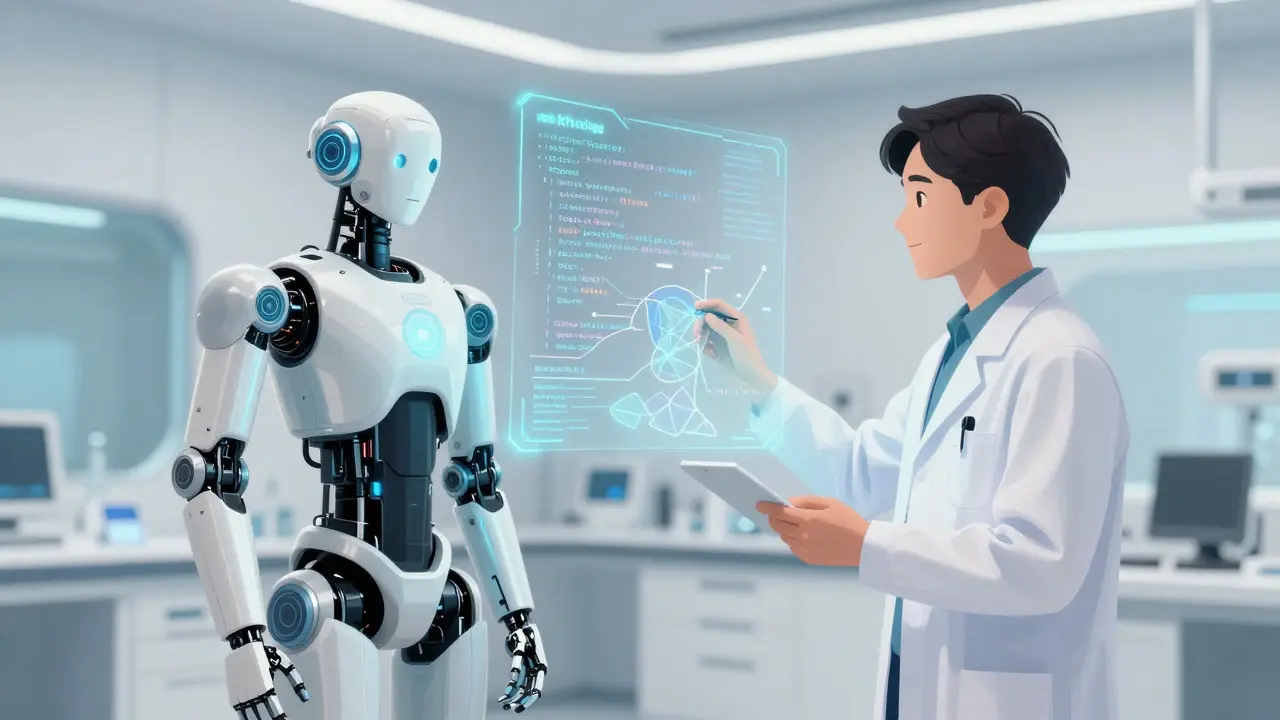
Imagine describing a clinical trial workflow in plain English and watching working Python code appear on your screen in seconds. No bioinformaticist required. No patient records exposed. This is healthcare vibe coding, a method that lets researchers and clinicians build functional software prototypes by simply explaining their intent to an AI assistant.
The term was coined by computer scientist Andrej Karpathy in early 2025, but it has quickly become a practical reality for biomedical teams. The core promise is simple: you get the speed of AI-driven development without the regulatory headache of handling Protected Health Information (PHI). But how does it actually work, and where are the traps?
What Is Healthcare Vibe Coding?
Vibe coding is an emerging paradigm in software development where artificial intelligence converts natural language descriptions directly into functioning code modules. In a healthcare context, this approach is specifically engineered to keep patient data out of the development environment entirely. Instead of feeding real Electronic Health Record (EHR) data into an AI tool, you use synthetic datasets or de-identified patterns that mimic real-world complexity without containing actual identities.
This isn't just about writing code faster; it's about changing who can build tools. Traditionally, if a researcher wanted to test a new analysis pipeline, they had to wait weeks for IT to provision a secure server, request access to a data warehouse, and navigate strict access controls. With vibe coding, a clinician can describe a need like "load sequencing data, filter low-quality reads, and run differential expression" and receive a script within minutes. The AI handles the syntax; the human handles the logic.
The Architecture of Safety: How PHI Stays Out
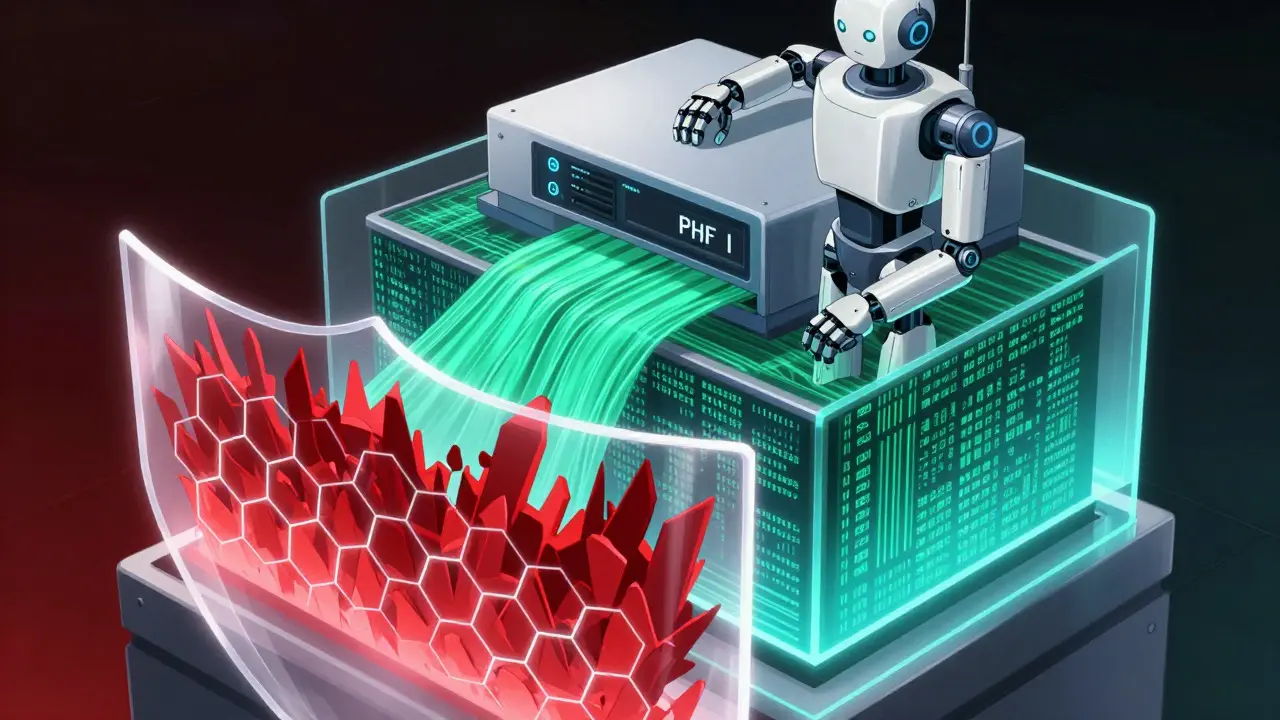
You might wonder how an AI tool can be trusted with healthcare data if it's not seeing the real thing. The answer lies in a three-tier architecture used by compliant platforms. First, there's the natural language interface where you type your prompt. Second, a PHI detection layer scans your input for accidental leaks-like a patient name or date of birth-and redacts them automatically. Third, the code generation layer runs in a sandboxed environment that only accesses synthetic data.
According to recent technical documentation from IBM, these systems achieve up to 99.7% accuracy in detecting potential PHI elements using fine-tuned biomedical language models. This is significantly higher than generic detection tools, which often miss subtle contextual clues in medical text. The key is that the AI never sees the raw patient record. It sees a pattern. For example, instead of "John Smith, DOB 1980-05-12," the system works with "Patient ID A, Age Group 40s." This separation ensures that even if the AI hallucinates or makes a mistake, no real identity is compromised.
Speed vs. Traditional Development
The most compelling argument for vibe coding is time. Traditional healthcare software development involves multiple cycles of compliance review, data access requests, and manual coding. A comparative analysis from Eularis shows that vibe coding reduces prototype development time by roughly 87.6%. Where a traditional team might take 18 days to build a basic clinical decision support prototype, a vibe-coding team can do it in under three days.
Cost savings are equally dramatic. Initial development costs drop by over 70% because you aren't paying senior engineers for every line of boilerplate code. However, this speed comes with a caveat. While the prototype is fast, getting it to production quality still requires expert review. Think of vibe coding as giving you a rough draft of a novel. It’s readable and structured, but it needs an editor to fix the plot holes and polish the prose. In software terms, that means 15-20 hours of expert engineering review per prototype to ensure it meets security standards.
| Metric | Vibe Coding (PHI-Safe) | Traditional Custom Dev |
|---|---|---|
| Prototype Time | 3-7 minutes (initial), ~2.3 days (full) | 2-3 weeks (18.3 days avg) |
| Initial Cost | $3,800 | $14,200 |
| PHI Exposure Risk | None (Synthetic Data Only) | High (Requires De-identification & Access Control) |
| Compliance Reviews | Minimal during prototyping | 3-5 cycles typical |
| Error Rate in Generated Code | ~22.4% (Requires Expert Review) | Variable (Depends on Developer Skill) |
Who Is Using It? Real-World Examples
This isn't just theory. At Mayo Clinic's Digital Health Innovation Lab, a team used vibe coding to develop a patient engagement prototype for diabetes management. They built the entire interface and logic flow in three days without touching any real patient records. Clinicians tested it and gave it a 92% usability score. That kind of rapid iteration is impossible when you're waiting for data governance approvals.
On the other hand, not every story ends well. A Boston-based health system tried to use public AI coding tools with data they thought was de-identified. It turned out the data contained re-identifiable patterns, triggering a HIPAA risk assessment that delayed the project by four months. This highlights a critical point: vibe coding is only as safe as your data preparation. If your synthetic data isn't truly synthetic, you're back to square one.
Startups are leading the charge here. Surveys show that nearly 78% of healthcare startups now use vibe coding for initial prototyping. Large enterprises are slower to adopt, sitting at around 22%, largely due to stricter internal compliance cultures. But the gap is closing as FDA guidance becomes more supportive of innovative development approaches that maintain data protection.
Tools and Platforms to Know
Not all AI coding assistants are created equal. For healthcare, you need tools that understand the domain. General-purpose tools like GitHub Copilot are great for general code, but they don't inherently know what a FHIR resource is or how HL7 messages work. Specialized platforms are filling this gap.
- OpenAI Windsurf Healthcare Edition: Fine-tuned on de-identified clinical data, reducing PHI exposure risks by 89% compared to general models.
- Anysphere Cursor: Offers strong agentic capabilities that allow the AI to execute multi-step tasks, such as running tests and debugging errors autonomously.
- Meta Code Llama: An open-source option that allows organizations to host their own instance, ensuring data never leaves their private servers.
- Synthea: Not a coder, but a crucial companion. It generates realistic synthetic patient populations that match your target demographics, providing the "vibe" data for your AI to code against.
When choosing a platform, look for specific healthcare integrations. Does it support FHIR standards natively? Does it have built-in checks for common HIPAA pitfalls? These features save you hours of manual configuration later.

Getting Started: A Practical Guide
If you want to try this, don't jump straight into complex workflows. Start small. Here is a step-by-step approach that works for most teams:
- Generate Synthetic Data: Use a tool like Synthea to create a dataset that mirrors your real patients' age ranges, conditions, and treatment histories. Ensure no real names or IDs are present.
- Set Up a Sandbox: Use a cloud-based IDE or local environment that isolates the AI agent. Make sure the AI cannot access your main production database.
- Define Your Prompt Clearly: Be specific. Instead of "make a report," say "Create a Python script that loads the CSV file 'synthetic_diabetes.csv', filters for patients over 50, and calculates average HbA1c levels."
- Iterate and Test: The first output will likely have bugs. Treat the AI as a junior developer. Ask it to explain its logic, then ask it to fix specific errors. On average, you'll need about 2.7 iterations per feature to get it right.
- Expert Review: Before sharing the prototype with stakeholders, have a senior engineer review the code for security vulnerabilities and logical flaws.
For non-technical users, the learning curve is steep but manageable. Most clinicians reach proficiency in basic pipeline creation after 8-12 hours of guided practice. The key is to focus on the outcome you want, not the code itself. You are the director; the AI is the actor.
Risks and Limitations to Watch
Vibe coding is powerful, but it's not magic. One major limitation is its struggle with complex regulatory logic. If your application needs to enforce intricate HIPAA rules or FDA reporting requirements, the AI might get it wrong. Studies show only about 64% accuracy on generating fully compliant workflows without human oversight. Always double-check compliance-critical paths.
Integration is another hurdle. Prototypes built with synthetic data often fail when connected to live EHR systems because of undocumented API limitations or legacy system quirks. Plan for extra time to bridge the gap between your clean prototype and your messy real-world infrastructure.
Finally, keep an eye on documentation. If you plan to submit this software for regulatory review, you need to prove where the code came from. Maintain clear logs of your prompts and AI outputs. The FDA is increasingly interested in the provenance of AI-generated code, and missing documentation can stall approval processes.
The Future of PHI-Safe Prototyping
The trajectory is clear. By 2027, analysts predict that nearly half of all healthcare software prototypes will be developed using vibe coding techniques. The technology is moving from a novelty to a standard part of the development toolkit. As models become more specialized and synthetic data generators become more realistic, the boundary between "prototype" and "production" will blur further.
For now, the sweet spot is early-stage innovation. Use vibe coding to test ideas rapidly, gather feedback from clinicians, and validate concepts without the overhead of full-scale development. Just remember: the AI writes the code, but you own the responsibility. Keep your data synthetic, your prompts precise, and your experts close by.
Is vibe coding safe for HIPAA compliance?
Yes, provided you use synthetic data and a sandboxed environment. The AI never touches real PHI, so the risk of data breach is minimal. However, you must ensure your synthetic data doesn't contain re-identifiable patterns.
Do I need to know how to code to use vibe coding?
No. The whole point is to let non-coders build tools. You just need to understand the business logic and be able to describe it clearly in plain English. Basic understanding of data structures helps but isn't mandatory.
How long does it take to learn vibe coding?
Most users can generate basic pipelines after 8-12 hours of training. Proficiency in complex workflows may take a few weeks of practice, especially if you are unfamiliar with healthcare data standards like FHIR.
Can I deploy vibe-coded apps directly to production?
Not recommended. Vibe coding is best for prototyping. Production deployment requires rigorous testing, security audits, and expert code review to handle edge cases and ensure reliability.
What are the best tools for healthcare vibe coding?
Look for platforms with healthcare-specific features like OpenAI Windsurf Healthcare Edition or Meta Code Llama. Pair them with synthetic data generators like Synthea for the best results.
Chris Neal
Let's be real here, the 99.7% accuracy stat for PHI detection is doing a lot of heavy lifting in this article. In my experience with NLP models on clinical text, that last 0.3% is where the nightmares live. You think you've de-identified the data, but then the model hallucinates a connection between two synthetic IDs that actually map back to a specific cohort in your local EHR. It's not just about names and DOBs anymore; it's about the rare combination of conditions and treatments that makes a patient unique. If you're relying on a generic LLM to spot that context, you're gambling. I've seen teams get burned by 'obvious' patterns that only become re-identifiable when you cross-reference them with public records or insurance claims data. The sandbox is great, sure, but if your input prompt accidentally leaks a snippet of a chart note that looks like a quote from a medical journal but is actually a patient's specific symptom description, you're in trouble. Don't let the marketing speak for the engineering reality.
Kyle Ware
Chris has a point about the edge cases but I think we are looking at this too narrowly. For most prototyping needs the risk profile is acceptable if you follow the basic hygiene rules. The biggest win here is not really about speed or cost savings per se but about lowering the barrier to entry for clinicians who have ideas but no dev team. We see so many brilliant workflow improvements die in the queue because IT is backlogged for six months. This tool lets them test the concept first. Just keep the expert review step non-negotiable. Treat the AI output as a draft not a final product. That mental shift saves more headaches than any security patch.
Alyson Karson
finally someone talking about the actual workflow instead of just the hype!! i spent three weeks waiting for access to our data warehouse just to run a simple query for a pilot study. three. weeks. with vibe coding you could have had a script running in an afternoon. the fact that we can use synthetic data is a game changer for us because half the time we dont even need the real data to prove the concept works. just give me a realistic enough dummy set and i can build the interface and logic flow without begging IT for god knows what. its empowering to know we can iterate fast without stepping on landmines. hope more hospitals start taking this seriously before we fall behind startups again.
Jeff Falcon
I have to say, the comparison table in the post is a bit... optimistic, wouldn't you agree?
While 87.6% reduction in prototype time sounds fantastic on paper, it ignores the massive hidden cost of "expert review" which they conveniently bury in the body text.
If you are spending 15-20 hours of senior engineer time per prototype, that's not exactly saving money if those engineers are charging $150/hr!
And let's not forget the debugging phase; the article mentions a 22.4% error rate, which is... high, for a "production-ready" tool.
We tried something similar last year with a general-purpose LLM, and while the code generation was fast, the integration with our legacy HL7 v2 systems was a nightmare.
The AI didn't understand the quirks of our specific vendor's implementation, so we ended up spending more time fixing the glue code than writing the core logic.
It's a great tool for greenfield projects, but for brownfield healthcare environments? Proceed with caution.
Also, the claim about FDA guidance being "supportive" is a stretch; they are still very cautious about AI provenance.
But hey, for a quick demo to impress stakeholders? Absolutely worth a try.
Just don't expect it to replace your dev team entirely.
It's a power tool, not a replacement for the craftsman.
And please, for the love of all things holy, document your prompts.
You will thank yourself later when the auditors come knocking.
Or maybe not, depending on how messy your logs are.
Anyway, food for thought.
What do others think about the long-term maintenance of these AI-generated modules?
Vishnu Vardhan Reddy M S
Oh, Jeff, you're such a pessimist. Or rather, a realist, which is rarer and more annoying. But look, if you're dealing with legacy HL7, you're already in hell, whether you use AI or not. The AI just gets you to the next layer of hell faster. I'm from India, so I'm used to working with data that isn't perfectly clean, and honestly, the Synthea + Vibe Coding combo is a lifesaver for us. We don't always have the budget for expensive de-identification pipelines, so generating realistic synthetic data locally is a huge win. Plus, the speed allows us to fail fast. If the prototype sucks, we kill it in day 3 instead of month 3. That's not a downside, that's efficiency. The "expert review" cost is real, yes, but it's cheaper than paying a consultant to design a system from scratch that might never get built. Give the kids a chance to play with the tools, maybe they'll build something better than the old guard ever did. Or maybe they'll just make cool demos. Either way, progress. Don't hold us back with your fear of change. Embrace the chaos, control the outcome. That's the trick.
john randall
Interesting read. I've been watching this space for a while and the shift towards synthetic data feels like the only viable path forward for now. Real data is too sensitive and too fragmented across different hospital systems to be useful for rapid prototyping anyway. The main thing I'd add is that the culture shift is harder than the tech. Getting clinicians comfortable with the idea that their "code" is generated by an AI takes some getting used to. They worry about losing control. But once they see that they can tweak the logic by just changing the prompt, it clicks pretty fast. It's less about programming and more about specifying requirements. Which, frankly, is what good software development should have been all along. We just never got there. Now we can skip the middleman. Not bad. Not bad at all.