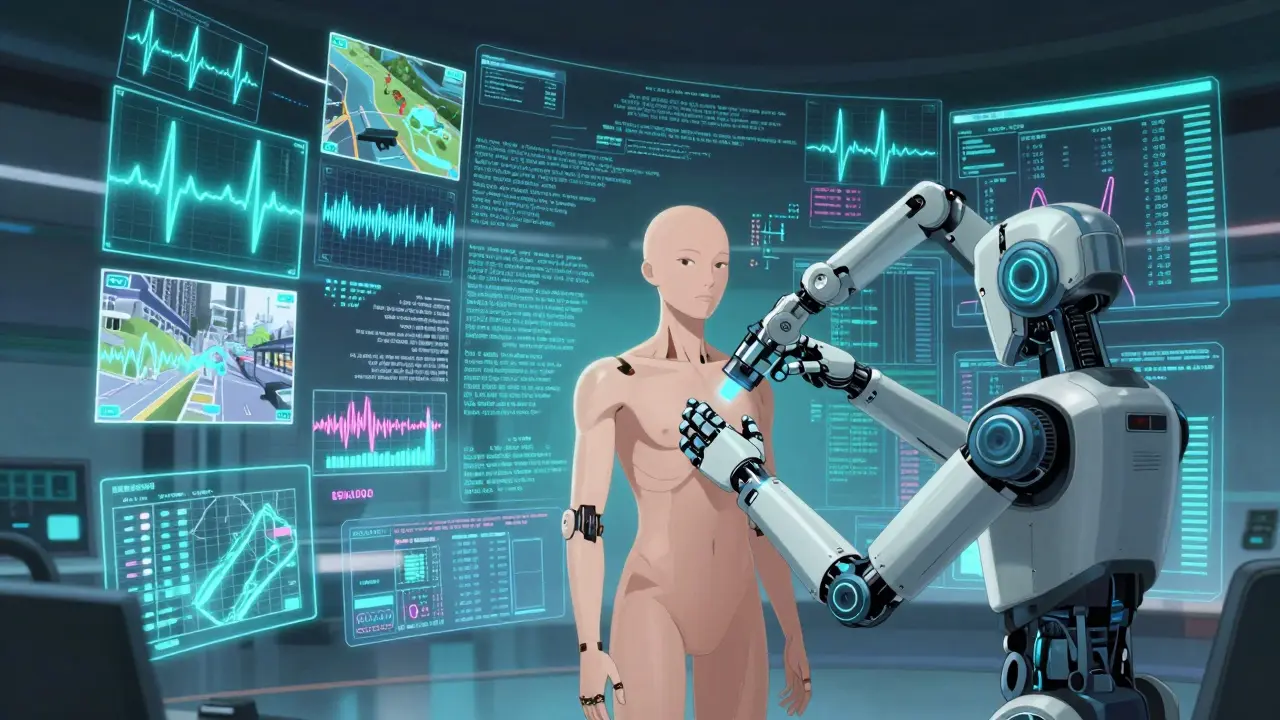
Real-world data is messy. It’s incomplete, hard to collect, and often full of privacy risks. Imagine trying to train an AI to recognize heart failure patterns, but you only have 200 patient records - and half of them are missing key lab results. Or building self-driving cars without enough data on rare weather events like icy rain on a bridge. This is where synthetic data generation with multimodal generative AI comes in. It doesn’t just fill gaps. It rebuilds entire datasets that look, feel, and behave like the real thing - without ever touching a single real person’s medical record or camera feed.
Unlike older methods that generated data in one form - say, just images or just text - multimodal generative AI creates data across multiple types at once: images, audio, time-series signals, text, sensor logs, and more. Think of it as a digital simulation studio. You feed it rules about how the real world works, and it spits out thousands of realistic, interconnected scenarios. A self-driving car’s AI can now train on synthetic video of a pedestrian stepping out from behind a snowbank, while hearing the sound of tires skidding and reading the GPS coordinates - all generated in perfect sync. No real pedestrians were harmed. No real data was leaked.
How Multimodal Synthetic Data Is Made
At its core, this isn’t one technique. It’s a pipeline. First, each type of data gets processed separately. Text is turned into embeddings by models like GPT. Images are broken down into visual features using CNNs or vision transformers. Audio becomes spectrograms. Time-series data - like heart rate or blood pressure readings - gets mapped as continuous curves. These aren’t just raw files. They’re rich, structured representations.
Then comes the fusion. A central model - often built on diffusion architectures or Neural Ordinary Differential Equations (like MultiNODEs) - learns how these modalities relate. It doesn’t just pair a photo with a caption. It learns that when a person’s heart rate spikes, their voice gets shaky, and their eye movement pattern changes. It learns that a car’s brake lights flash right before the wheel speed drops. This is where single-modality models fail. They see one piece. Multimodal models see the whole story.
Finally, the system generates new data. Not by copying. By understanding. It can simulate a patient with a rare genetic condition who never appeared in the original dataset. It can generate 10,000 variations of a rainy-day driving scene with different lighting, puddle depths, and pedestrian behaviors. And because it models time as a continuous flow - not snapshots - it can interpolate between measurements. If a patient’s glucose level was recorded at 8 a.m. and 4 p.m., the model can estimate what it was at 1 p.m., 2 p.m., and even 7 p.m. - all with realistic variation.
Why This Beats Traditional Data Augmentation
Traditional data augmentation? It’s like adding filters to photos. Rotate, flip, brighten. It helps a little. But it doesn’t create new information. It just tweaks what’s already there.
Multimodal synthetic data is different. It builds entirely new scenarios that never existed. A 2023 pilot at the Mayo Clinic used this to train a heart failure prediction model. They generated synthetic patient trajectories that matched real data’s statistical patterns - but included rare events like sudden drops in kidney function that only occurred in 0.3% of real cases. The model’s accuracy hit 92%, matching real-world performance. And because the synthetic data had no real patient identifiers, they avoided HIPAA compliance headaches entirely.
Another win: balancing datasets. Real-world data is biased. Most facial recognition datasets are dominated by light-skinned males. Synthetic data lets you generate equal numbers of all skin tones, genders, ages, and lighting conditions - not just by flipping images, but by building them from scratch with accurate anatomical and lighting models. NVIDIA’s Omniverse Replicator does this for autonomous vehicles, generating synthetic sensor data for every type of road user, from children on scooters to delivery drones.

Where It’s Being Used Right Now
Healthcare leads the charge. According to Gartner’s 2023 Hype Cycle, 32% of enterprise synthetic data use is in healthcare. Why? Because patient data is locked down. Clinical trials are slow. Rare diseases have tiny sample sizes. MultiNODEs, developed by researchers in 2022, lets hospitals simulate entire patient journeys - from diagnosis to treatment response - with variable time intervals and missing data points. One hospital reduced data collection costs by 60% using this method, though it took three months of fine-tuning to get rare disease patterns right.
Autonomous systems are next. Self-driving cars need millions of driving hours to train. Real-world testing is slow and dangerous. Synthetic environments from NVIDIA and Waymo now generate billions of virtual miles - with rain, fog, glare, and unpredictable pedestrians - all in hours. Each simulation includes synchronized LiDAR, radar, camera, and GPS data. That’s multimodal. That’s realistic.
Enterprise AI is catching up. Retailers use it to simulate customer behavior across online and in-store channels. Manufacturers generate synthetic sensor data from factory equipment to predict failures before they happen. Even content creators use it: imagine generating a video ad where the voiceover, background music, product visuals, and text overlays are all generated together - perfectly timed and aligned.
The Hidden Costs and Risks
This isn’t magic. It’s complex. And expensive.
Hardware is a big barrier. Generating high-fidelity multimodal data needs serious GPU power. NVIDIA recommends at least 24GB VRAM per model. Running a single synthetic patient trajectory on MultiNODEs can take hours on a single high-end card. Many companies use distributed systems across dozens of GPUs - which adds cost and complexity.
Then there’s alignment. When you generate text, image, and audio together, they have to match. A voice saying “I’m feeling dizzy” should appear in a video where the person’s face looks pale and shaky. If the model misaligns them - say, the voice says “I’m fine” while the image shows someone clutching their chest - the AI trained on this data will learn the wrong connection. That’s a silent failure. And it’s hard to catch.
Bias is another trap. If your training data is skewed - say, mostly from urban hospitals - your synthetic data will be too. Dr. Rumman Chowdhury warned in MIT Technology Review that multimodal systems can amplify bias across all dimensions: race, gender, socioeconomic status. A synthetic medical dataset might generate “healthy” patients who look like they come from affluent neighborhoods, simply because that’s what the model learned.
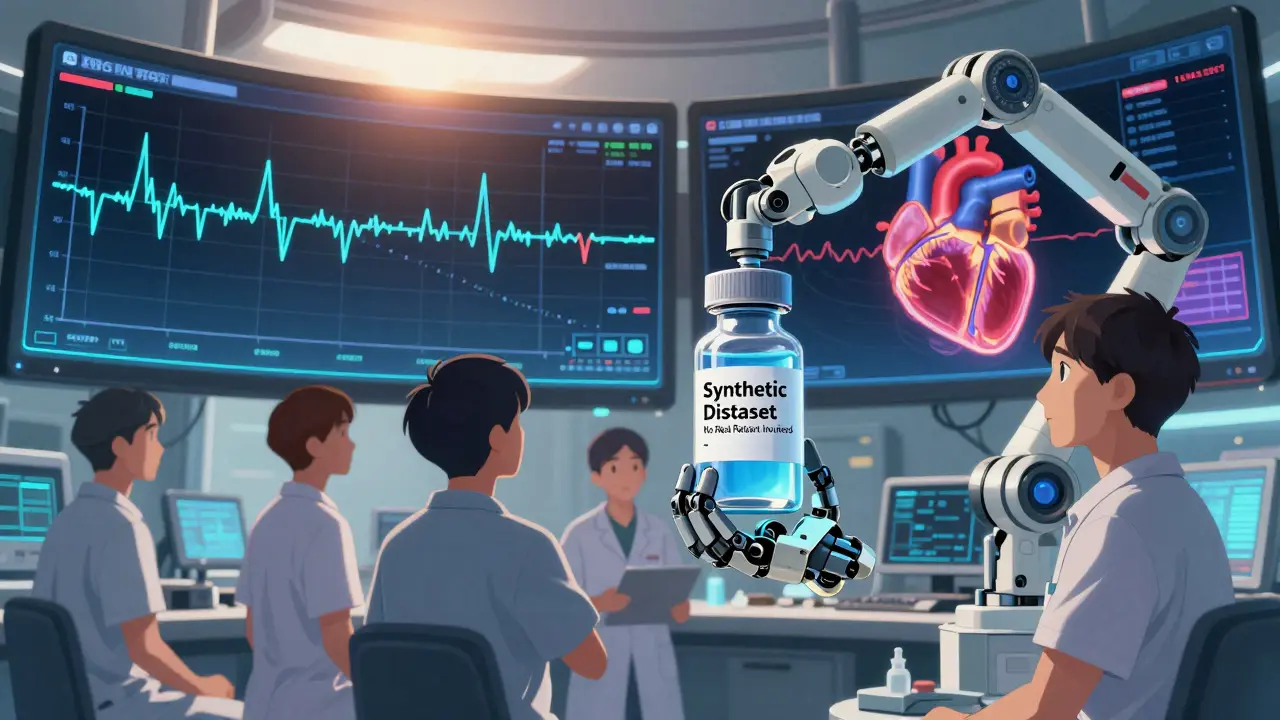
Validation is everything. You can’t just trust the output. You need to test it against real-world outcomes. Does the synthetic heart failure model actually predict real patient outcomes? Does the synthetic driving scenario match real crash reports? This requires domain experts - doctors, engineers, drivers - to review the data. As Digital Divided Data put it: “Responsible use includes domain-specific validation, simulation-grounded fidelity checks, and downstream performance testing.”
What’s Next? The Road to 2026
The market is exploding. The global synthetic data industry was worth $310 million in 2022. By 2027, it’s projected to hit $1.2 billion. Multimodal is the fastest-growing segment. NVIDIA launched Generative AI Enterprise in March 2024 with built-in multimodal synthetic data tools. Google Cloud and Microsoft Azure are adding similar features. Open-source tools like MultiNODEs are gaining traction in research labs.
But adoption is still low. Only 28% of large healthcare organizations have implemented multimodal capabilities. Why? Because the learning curve is steep. Teams need expertise in machine learning, clinical science, audio processing, and time-series modeling. Documentation is patchy. Academic papers explain the math. Commercial tools hide the complexity behind a UI.
Regulators are catching up. The FDA now accepts synthetic data for validating medical AI, as long as it’s properly characterized. The EU’s AI Act is likely to follow. This isn’t a fringe tool anymore. It’s becoming a compliance necessity.
By 2026, we’ll see multimodal synthetic data as standard in regulated industries. But only if teams stop treating it like a black box. The best results come from combining AI with human expertise - a radiologist reviewing synthetic X-rays, a cardiologist validating patient trajectories, a driver testing simulated intersections. The AI generates possibilities. Humans decide what’s real.
Getting Started
Don’t try to build MultiNODEs from scratch. Start small. Pick one use case. Maybe you need more diverse training images for your object detector. Try combining Stable Diffusion (for images) with GPT-4 (for captions). Generate 500 synthetic image-text pairs. Train your model on them. Compare performance against your original dataset. If accuracy improves, scale up.
Use platforms that offer built-in multimodal tools: NVIDIA’s Omniverse, Gretel.ai, or Mostly AI. They handle the heavy lifting. Focus on validation. Ask: Does this data reflect real-world complexity? Does it include edge cases? Is it aligned across modalities?
And always - always - audit for bias. Run fairness checks. Compare synthetic outputs against known demographic distributions. If your synthetic patients are all 45-year-old women with no comorbidities, you’ve failed.
Synthetic data isn’t about replacing reality. It’s about expanding it. Giving AI the breadth of experience it needs - without the cost, risk, or ethical traps of real data. The future of AI doesn’t live in data centers. It lives in simulations.
What’s the difference between synthetic data and real data?
Real data comes from actual observations - patient records, camera footage, sensor logs. Synthetic data is artificially created by AI models trained to mimic the patterns, distributions, and relationships found in real data. It’s not copied. It’s generated. The key advantage is privacy: synthetic data contains no real personal information, making it safe to share and use across teams and borders.
Can synthetic data replace real data entirely?
Not entirely - not yet. Synthetic data excels at scaling training, simulating rare events, and protecting privacy. But it can’t capture every edge case or unpredictable human behavior. The best approach is hybrid: use synthetic data to boost volume and diversity, then validate models on small, carefully curated real-world samples. Think of it as practice runs before the real game.
Is multimodal synthetic data better than single-modality?
Yes - for complex tasks. If your AI needs to understand a video with audio and text captions - like a self-driving car interpreting a traffic light, a pedestrian’s gesture, and a radio announcement - single-modality data won’t cut it. Multimodal data trains models to see connections across types. A model that learns from synchronized images, audio, and sensor logs performs far better than one trained on each separately.
What tools are best for generating multimodal synthetic data?
For research, MultiNODEs (for time-series and clinical data) and open-source diffusion models are strong. For enterprise use, NVIDIA’s Omniverse Replicator (for physical environments), Gretel.ai (for structured and tabular data), and Mostly AI (for privacy-focused synthetic datasets) are leading platforms. For quick experiments, combine Stable Diffusion (images) with GPT-4 (text) or Whisper (audio). Each tool has trade-offs in fidelity, customization, and cost.
How do you validate synthetic data quality?
Validation requires three steps: First, check statistical similarity - does the synthetic data match real data in mean, variance, and correlation? Second, test alignment - do image, text, and audio elements stay consistent? Third, run downstream tests - does your AI model perform just as well on synthetic data as on real data? Domain experts should review outputs for plausibility. A cardiologist should be able to look at a synthetic ECG trace and say, “Yes, this looks real.”
Lauren Saunders
so uhh synthetic data is just AI fanfiction for machines? like, we’re training self-driving cars on fake snowy roads that never happened? cool. i guess if you’re into digital roleplay. but what if the AI starts believing the hallucinations? 🤔
sonny dirgantara
bro this is wild. i read like 3 paragraphs and my brain just said 'nah' but then the part about heart failure data made me stop. like, imagine being a doctor and not having to deal with HIPAA nightmares. that’s the real win. also, i think i just learned a new word: multimodal. thanks, internet.
Andrew Nashaat
Let’s be real: this isn’t 'generating data'-it’s *fabricating reality* with a side of corporate buzzwords. And don’t get me started on NVIDIA’s 'Omniverse Replicator'-sounds like a sci-fi movie title, not a tool. Also, you said 'MultiNODEs'-it’s 'MultiNODE', you’ve got a pluralization error right there. And bias? You think your synthetic data won’t inherit every flaw from its training set? Please. If your dataset is 80% urban, middle-class, white patients, your 'synthetic' patients will be carbon copies. You’re not solving bias-you’re automating it. And yes, I’m a grammar Nazi. And yes, I’m proud of it.
Gina Grub
Let’s not pretend this is innovation-it’s just data laundering with a PhD. The FDA accepting synthetic data? That’s not progress, it’s surrender. We’ve outsourced reality to a GPU. And now we’re calling it 'compliance'? When the AI trained on synthetic ECGs misses a real arrhythmia because it was never exposed to the actual tremor of a dying heart… who’s liable? The engineer? The hospital? The algorithm that thinks 'dizziness' and 'pale face' always go together? This isn’t the future. It’s a slow-motion train wreck with a fancy UI.
Nathan Jimerson
This is actually one of the most promising developments in AI I’ve seen in years. Synthetic data opens doors we couldn’t even imagine before-especially in healthcare. Rare diseases, privacy, cost reduction-it all adds up. The tools aren’t perfect yet, but they’re getting there. Keep iterating. Keep validating. The potential here is massive.
Sandy Pan
What does 'real' even mean anymore? If a machine can generate a heartbeat so convincing that a cardiologist nods along, is it not real? If a self-driving car learns to avoid icy bridges from 10,000 simulated crashes, does it matter that no human ever drove there? We’ve always trained AI on proxies-pixels, words, signals. Now we’re just generating better proxies. But the deeper question: are we building intelligence-or a mirror that reflects only what we’ve already seen? And if so… what are we not seeing?
Eric Etienne
Wow, so now we’re just simulating everything? Next thing you know, AI will be writing its own papers about how it generated synthetic data to train itself to write papers. I’m out. Too much work. Just give me a dataset that doesn’t require a PhD in five disciplines to use.