
Every year, U.S. healthcare providers spend over $23 billion just on prior authorization letters. That’s not money going to patient care-it’s time doctors, nurses, and administrative staff waste filling out forms, chasing insurance approvals, and rewriting clinical summaries that insurers keep rejecting. The process is slow, repetitive, and exhausting. In 2025, the average clinician still spends 15 to 30 minutes per prior auth request. Multiply that by hundreds of cases a week, and it’s no surprise burnout rates are at record highs.
Enter generative AI. Not as a sci-fi fantasy, but as a working tool already cutting prior auth time in half. Hospitals like the University of Pittsburgh Medical Center saved $4.7 million in one year after deploying AI to draft authorization letters and clinical summaries. Staff now handle three times the volume without overtime. The tech isn’t replacing people-it’s removing the grunt work so humans can focus on what matters: patients.
How Generative AI Handles Prior Authorization Letters
Prior authorization isn’t just paperwork. It’s a complex game of matching clinical notes to insurer rules. Each payer-Medicare, UnitedHealthcare, Blue Cross-has different criteria. One might demand a specific ICD-10 code. Another requires a 30-day trial of cheaper drugs first. Getting it wrong means delays, denials, or worse: patients losing access to needed treatment.
Generative AI tools like Microsoft’s Nuance DAX Copilot and Epic’s Samantha system pull data directly from EHRs-patient history, lab results, diagnosis codes-and auto-generate letters that meet payer-specific rules. These systems use Retrieval-Augmented Generation (RAG), meaning they don’t guess. They pull real-time data from your EHR, cross-check it against insurer guidelines, and build a letter that’s accurate and compliant.
Here’s how it works in practice:
- The clinician starts a request in the EHR for a specialty drug or imaging test.
- The AI scans the patient’s record: allergies, prior treatments, lab values, progress notes.
- It cross-references the request against the insurer’s latest policy (updated daily via API).
- In under 60 seconds, it drafts a complete prior auth letter with supporting clinical evidence.
- The admin reviews it, makes minor edits if needed, and submits.
Studies show this cuts average processing time from 15.3 minutes to 4.7 minutes per case. That’s a 69% reduction. For a hospital doing 1,200 prior auths a month, that’s over 1,400 saved hours annually.
Clinical Summaries: From Chaos to Clarity
Clinical summaries are even messier. They’re supposed to give specialists a quick snapshot of a patient’s condition. But in reality, they’re often copied from unstructured, handwritten, or poorly formatted notes. One physician described them as “a 12-page novel where the diagnosis is buried on page 9.”
Generative AI turns that chaos into clarity. Tools like Abridge and Augmedix listen to doctor-patient conversations, transcribe them, and generate structured summaries that highlight:
- Chief complaint
- Key symptoms and duration
- Relevant past medical history
- Medications and allergies
- Plan and next steps
These summaries aren’t just faster-they’re more accurate. A 2024 Stanford review gave AI-generated clinical summaries a 4.2 out of 5 for accuracy. But here’s the catch: contextual understanding still lags. AI might miss that a patient’s “chest pain” is actually anxiety triggered by recent job loss. That’s why human review is mandatory.
Best practice? Use AI to draft the summary, then have the clinician spend 90 seconds reviewing and adding nuance. That’s far better than spending 20 minutes typing from scratch.
What AI Gets Right-and Where It Still Fails
Generative AI excels in predictable, rule-based cases. If a patient needs a MRI for a known herniated disc with documented failed physical therapy, AI gets it right 94% of the time. It knows the exact codes, the required documentation, and the insurer’s policy.
But it struggles when things get unusual:
- Patients with rare conditions (accuracy drops to 72%)
- Handwritten notes or poor-quality scans (65% accuracy)
- Novel treatments not yet in insurer guidelines
- Complex social determinants-like homelessness or language barriers
And here’s the scary part: AI can hallucinate. In one case at a Midwest hospital, an AI-generated prior auth letter falsely claimed a patient had tried three prior medications when they hadn’t. The insurer denied the request. The patient waited six weeks for treatment. The hospital had to manually reprocess 18% of all AI submissions.
That’s why the American Medical Association’s 2024 policy says: “No prior authorization decision can be fully automated.” AI drafts. Humans approve. No exceptions.

Comparing the Leading AI Tools
Not all AI tools are created equal. Here’s how the top players stack up in 2025:
| Tool | Accuracy (Prior Auth) | Insurance Coverage | Cost per Token | EHR Integration | Best For |
|---|---|---|---|---|---|
| Nuance DAX (Microsoft) | 91.3% | 92% | $0.0008 | Epic, Cerner, Allscripts | Largest health systems |
| Epic Samantha | 89.1% | 85% | $0.0006 | Epic only | Epic users |
| Google Duet AI | 85.7% | 78% | $0.0005 | Google Cloud Healthcare API | Cloud-native clinics |
| Amazon Bedrock | 78.2% | 75% | $0.0004 | AWS-based EHRs | Cost-sensitive providers |
| Abridge | 82.4% | 65% | $0.0007 | Most EHRs | Clinical documentation |
Nuance leads in accuracy and insurance coverage, making it the top pick for large hospitals. Epic’s tool is seamless if you’re already on Epic-but useless if you’re not. Amazon is cheapest but least accurate. Google’s integration is clean but limited. Abridge is great for note-taking but weak on prior auth.
Implementation: What It Really Takes
Buying the software is just step one. Real success takes planning.
Most hospitals take 6 to 9 months to fully deploy. Why? Because:
- 71% have EHR data silos-labs, billing, notes stuck in different systems
- 83% deal with inconsistent insurer rules across 10+ payers
- 67% face staff resistance-“Why should I trust a robot?”
Successful rollouts follow this path:
- Start small: Pilot with 5 providers on routine cases (e.g., MRI for back pain).
- Build an AI oversight committee: Include clinicians, admins, IT, and compliance.
- Train admins first-they’ll handle 80% of the edits.
- Train clinicians on how to review, not just approve.
- Track metrics: Denial rates, processing time, staff satisfaction.
- Scale slowly. Don’t go live with 200 providers on day one.
One hospital in Ohio cut its prior auth denials by 37% in six months by starting with just 12 providers. Their secret? Weekly feedback sessions where clinicians flagged AI errors. Those errors became training data. The system got smarter every week.
The Human Cost and Ethical Risks
It’s tempting to think AI will replace administrative staff. But the opposite is true. At UPMC, prior auth specialists now handle three times the volume-and they’re happier. Why? Because they’re no longer drowning in paperwork.
But there’s a darker side. A 2024 JAMA study found AI systems denied Medicaid patients 12.7% more often than privately insured patients when not properly calibrated. Why? Because training data reflected historical biases-fewer Medicaid claims in the dataset meant the AI learned to treat them as “higher risk.”
That’s why transparency matters. California’s 2024 AI in Healthcare Act now requires insurers to disclose when AI is used in prior auth decisions. Patients have the right to know if a robot denied their treatment.
And let’s not forget: AI can’t understand trauma, poverty, or fear. A patient skipping insulin because they can’t afford it? A single mom choosing between rent and meds? No algorithm can capture that. Only a human can.
What’s Next? The Road to 2027
The next wave is even bigger:
- Real-time prior auth (2025-2026): AI will approve or deny requests instantly during the clinic visit.
- Predictive authorization (2026-2027): AI will flag high-risk patients before they even request treatment-preemptively getting approvals.
- Blockchain verification (2027+): Immutable records of all prior auth decisions, shared securely between providers and payers.
By 2027, 68% of health systems plan to ditch standalone AI tools and use integrated platforms that handle scheduling, billing, and authorization all in one.
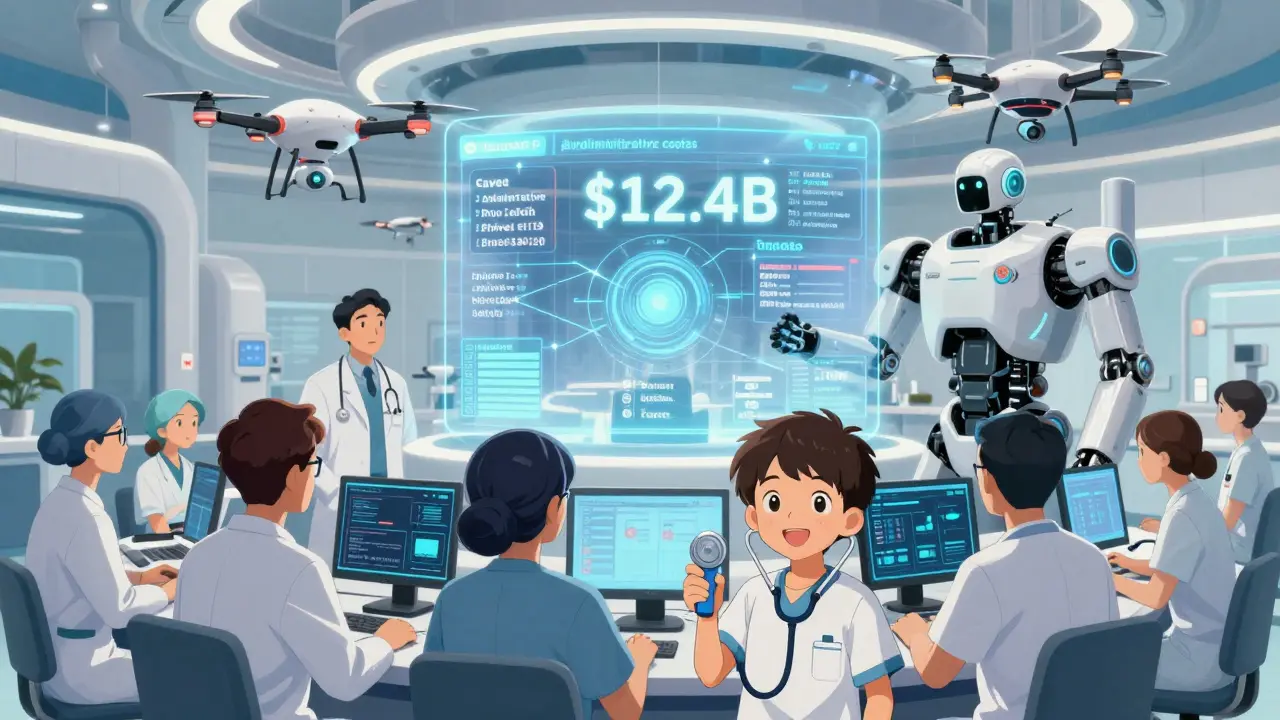
And the savings? The Congressional Budget Office estimates full adoption could cut $12.4 billion in administrative waste annually. That’s enough to fund 1.2 million additional patient visits.
Final Thought: AI as a Partner, Not a Replacement
Generative AI isn’t magic. It’s a tool. A powerful one. But it needs human judgment to stay on track.
Used right, it gives doctors back hours they lost to bureaucracy. It lets nurses focus on care, not forms. It helps administrators stop chasing paper trails.
The goal isn’t to automate healthcare. It’s to humanize it.
Can generative AI fully automate prior authorization decisions?
No. The American Medical Association and CMS require human-in-the-loop approval for all prior authorization decisions. AI can draft letters and summarize data, but only a clinician can approve or deny based on patient context, ethics, and clinical judgment. Fully automated denials are illegal under current U.S. healthcare rules.
Which EHR systems work best with generative AI for prior auth?
Epic and Cerner lead in integration. Epic’s Samantha tool is built natively into its platform and connects to 92% of major insurers. Cerner (now Oracle Health) works well with Nuance DAX. Systems using HL7 or FHIR APIs can integrate with most AI tools, but legacy systems without modern interfaces often require costly custom workarounds.
Is generative AI HIPAA-compliant?
Yes, if properly implemented. Leading tools like Nuance DAX, Epic Samantha, and Google Duet AI use end-to-end encryption, audit trails, and automated de-identification that removes protected health information with 99.8% accuracy. But compliance depends on the healthcare organization’s configuration. Using a non-HIPAA-compliant cloud service or sharing logs with third parties can break compliance-even with a certified AI tool.
How much does it cost to implement AI for prior auth?
Implementation costs average $185,000 for a 100-provider system, including integration, training, and setup. Annual maintenance runs about $42,000. Smaller practices may pay less through cloud-based subscriptions, but often sacrifice features like real-time payer updates. The ROI is clear: most hospitals recoup costs in under 10 months through reduced labor, fewer denials, and faster payments.
Why do some clinicians distrust AI-generated clinical summaries?
Because AI often misses context. It might correctly list a patient’s diabetes and hypertension but fail to note they’re homeless and can’t refill insulin. Or it might misinterpret a patient’s vague description of “feeling off” as anxiety when it’s actually early heart failure. Clinicians report 48% of AI summaries need significant editing for accuracy. Training and feedback loops help, but trust takes time to build.
Will AI replace healthcare administrative staff?
Not replace-redistribute. AI will reduce the need for entry-level prior auth specialists who manually retype notes and chase forms. But demand is growing for roles like AI oversight coordinators, clinical AI trainers, and compliance auditors. Staff who learn to work with AI are more valuable than ever. At UPMC, administrative staff now handle three times the volume and report higher job satisfaction.
Healthcare administration is broken. Generative AI won’t fix it overnight. But it’s giving us the first real shot in decades at making it work-not for insurers, not for paperwork, but for patients and the people who care for them.
Sanjay Mittal
Been using Nuance DAX at my hospital for 8 months now. The time saved is insane-my team went from 200 auths/week to 600 without hiring anyone. The AI doesn’t get everything right, but after two rounds of feedback, it learned our local insurer’s weird quirks. Now it even flags when a patient’s prior meds list is incomplete in the EHR. Huge win for staff morale.
Mike Zhong
Let’s be real-this isn’t about helping patients. It’s about insurers offloading their bureaucratic mess onto AI so they can deny more claims faster. The ‘human-in-the-loop’ is just a fig leaf. If the AI says no, 90% of docs just click approve because they’re too burnt out to fight. This isn’t innovation-it’s automation of neglect.
Jamie Roman
I love how this is turning admin work from soul-crushing to actually manageable. I used to spend my lunch break filling out forms. Now I get to eat, breathe, and actually talk to my patients. The AI still messes up sometimes-once it claimed my patient had a knee replacement when they’d never even seen an ortho-but after I corrected it twice, it got smarter. It’s like training a really fast, slightly clueless intern who never sleeps. And honestly? I’d rather train an AI than fight another insurance rep on hold for 45 minutes.
Salomi Cummingham
My heart breaks every time I hear about a patient waiting six weeks because an AI hallucinated a medication history. I’m not anti-tech-I’m pro-human. The moment we let algorithms decide who gets care and who doesn’t, we’ve lost something sacred. That patient who skipped insulin because they chose rent over meds? No AI can see that. No algorithm can feel the weight of that choice. We can’t outsource empathy to a machine that doesn’t know what hunger looks like.
And yes, I cried when I saw the JAMA study about Medicaid denials. Not because I was surprised. Because I knew it was coming. We built these systems on biased data, and now we’re punishing the most vulnerable with code.
Johnathan Rhyne
Hold up. Let’s talk about this ‘94% accuracy’ claim. That’s like saying your toaster works 94% of the time-until it sets your kitchen on fire. And let’s not ignore the fact that ‘accuracy’ is measured against insurer rules, not medical truth. If the insurer says ‘try metformin first’ even when the patient’s pancreas is toast, the AI’s gonna nod and write it up like it’s gospel. Also, ‘Epic Samantha’? Sounds like a bad sci-fi sidekick. And why is Amazon Bedrock even on this list? It’s the AI equivalent of a Walmart-brand blender-cheap, gets the job done, but you’re gonna regret it when it explodes.
Jawaharlal Thota
As someone who’s seen this play out in rural India too, I get it. Tech doesn’t fix broken systems-it just hides the cracks with a shiny layer. But here’s the thing: even a flawed tool that saves 10 minutes per case? That’s 10 minutes a nurse can spend holding a scared kid’s hand. Or a doctor can use to explain a diagnosis without rushing. We don’t need perfection. We need progress. Start small. Train your team. Let the AI learn from your corrections. And never forget-you’re the one who sees the whole picture. The machine just prints the paper.