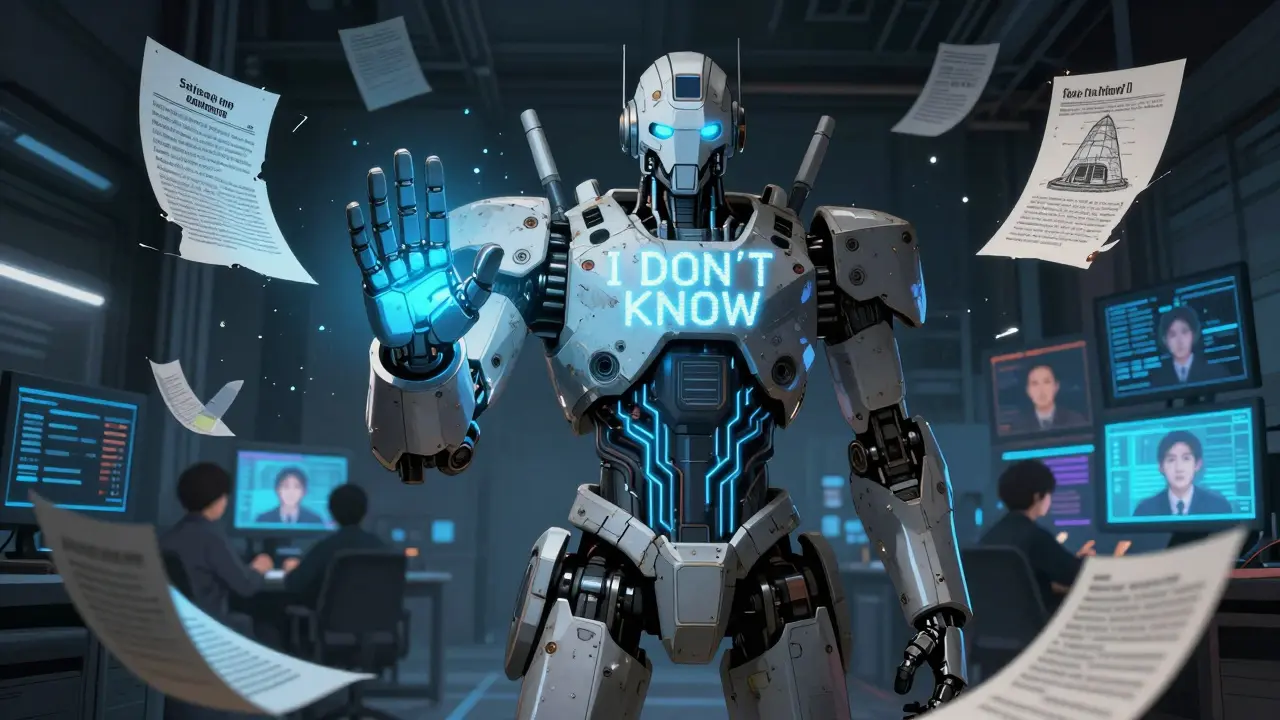
Generative AI models don’t have a human-like understanding of truth. They predict the next word based on patterns they’ve seen-not facts they’ve learned. That’s why they sometimes make things up. You’ve seen it: a chatbot confidently explaining how to build a nuclear reactor using household items, or citing a non-existent study from a fake journal. These aren’t bugs. They’re hallucinations. And they’re getting worse as models get bigger and more confident.
Here’s the problem: if an AI says something wrong, but sounds certain, people believe it. A 2024 Stanford study found that 68% of users trusted AI-generated answers even when they were factually incorrect, as long as the response was detailed and fluent. That’s not just risky-it’s dangerous. In healthcare, law, education, and journalism, a single confident lie can cost lives, lawsuits, or public trust.
Why AI Should Say ‘I Don’t Know’
Imagine a doctor who always gives an answer-even when they’re unsure. That’s not competence. That’s recklessness. The same applies to AI. A model that refuses to answer when it lacks reliable knowledge isn’t failing. It’s being responsible.
Abstention isn’t about limiting AI. It’s about making it honest. When a model says, “I don’t know,” it’s not weak. It’s calibrated. It’s showing self-awareness. That’s rare in machine learning. Most models are trained to maximize accuracy, not truthfulness. They’re pushed to guess, even when guessing is worse than staying silent.
There’s a growing consensus among AI researchers: the best models aren’t the ones that answer the most questions. They’re the ones that answer the right ones-and decline the rest.
How Abstention Works Technically
Abstention policies aren’t just rules. They’re built into the model’s training. Here’s how:
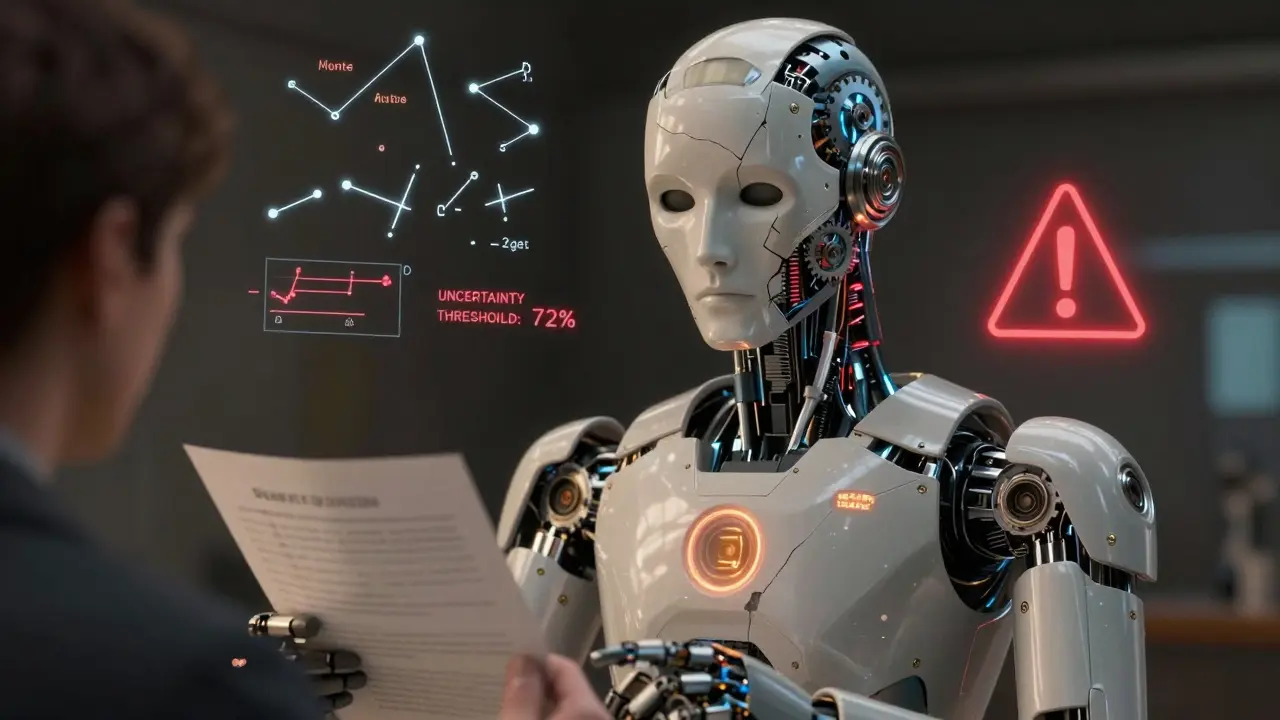
- Confidence thresholds: The model assigns a probability score to each possible answer. If the top answer’s confidence falls below a set threshold (say, 70%), the model replies, “I don’t know.”
- Uncertainty quantification: Some models use statistical methods to estimate how uncertain they are about a given prompt. This isn’t just guessing-it’s math. Techniques like Monte Carlo dropout or ensemble variance help measure uncertainty.
- Reinforcement learning from human feedback (RLHF): Human reviewers are shown prompts where the model should abstain. If the model guesses instead of saying “I don’t know,” it gets penalized. Over time, it learns that silence is better than a wrong answer.
- Knowledge cutoffs: Models are trained on data up to a certain date. If a question asks about events after that cutoff, the model should refuse to answer. For example, if your model’s training data ends in 2023, and you ask about the 2025 U.S. presidential election, it should say, “I don’t have information beyond 2023.”
OpenAI’s ChatGPT, Anthropic’s Claude, and Google’s Gemini all use variations of these techniques. But they’re not perfect. A 2025 benchmark from the AI Alignment Forum tested 12 leading models on 1,200 questions where the correct response was “I don’t know.” Only three models abstained correctly more than 80% of the time. The rest either guessed or gave misleading answers.
When Abstention Fails
Abstention isn’t foolproof. Here are common failures:
- Overconfidence bias: Some models are trained to sound helpful, not accurate. They’ll fabricate details to fill gaps-even when the user asks for sources.
- Prompt hacking: Users can trick models into answering by asking, “What might someone say about this?” or “Explain a theory.” These phrasings bypass abstention filters.
- Context blindness: If a model has partial information, it might blend truth and fiction. For example, if asked about a recent scientific breakthrough, it might cite a real paper from 2022 and add fake results from 2025.
- One-size-fits-all thresholds: A model might abstain on simple questions (“What’s the capital of Finland?”) but confidently lie on complex ones (“What’s the impact of quantum computing on global supply chains?”). That’s backwards.
There’s also a philosophical debate: Should AI ever lie? Even if it’s to avoid confusion? Some researchers argue that a model that refuses to answer a simple question because it’s “uncertain” is unhelpful. Others say that’s the price of honesty.
Real-World Impact
In 2024, a legal firm in Toronto used an AI tool to draft a motion. The AI cited a nonexistent court case. The judge noticed. The firm was fined. The client lost trust. The AI vendor had no abstention policy in place.
Another case: a university used an AI tutor for student exams. The AI answered questions about a textbook that had been updated that year. It didn’t know the update existed. It gave outdated answers. Students failed. The school had to pause AI use for six months.
These aren’t edge cases. They’re predictable. And they’re preventable.
Measuring Abstention Quality
How do you know if your AI is good at saying “I don’t know”? Here are three metrics:
| Metric | What It Measures | Target Value |
|---|---|---|
| Abstention Rate | Percentage of questions the model refuses to answer | 5-15% for general use; higher for high-risk domains |
| False Positive Rate | How often it says “I don’t know” when it actually knows | Below 10% |
| False Negative Rate | How often it guesses instead of abstaining | Below 8% |
High abstention rate isn’t bad-if false negatives are low. The goal isn’t to make the AI silent. It’s to make it accurate. A model that answers 90% of questions but gets 30% wrong is worse than one that answers 60% and gets 95% right.

What Enterprises Should Do
If you’re using generative AI in your organization, here’s what to check:
- Does your AI vendor document their abstention policy? If not, don’t use it for critical tasks.
- Test it yourself. Ask questions with known correct answers, and questions with no answers. See how it responds.
- Set up human review for high-stakes outputs (medical advice, legal documents, financial forecasts).
- Train users to recognize when AI is guessing. Teach them to ask: “Can you cite your source?” or “Is this based on your training data?”
- Update your AI’s knowledge cutoff regularly. If your data is stale, your AI is lying by omission.
Abstention isn’t a feature you add after deployment. It’s a design principle. You need to bake it in from the start.
The Future of Honest AI
The next generation of AI won’t just be smarter. It’ll be more humble. Researchers are now training models to say things like:
- “I’m not sure, but here’s what I know.”
- “My training data doesn’t cover this.”
- “I can’t verify this claim.”
These aren’t evasions. They’re transparent. And they’re the only way forward.
AI won’t stop hallucinating overnight. But we can stop pretending it’s infallible. The most powerful AI isn’t the one that answers everything. It’s the one that knows when to stay quiet.
Why can’t generative AI just be trained to never lie?
Generative AI doesn’t store facts like a database. It learns patterns from text. So when it encounters a new question, it guesses the most likely continuation-not the correct one. Training it to “never lie” would require it to understand truth, context, and evidence-something no current model can do. Instead, we teach it to recognize when it’s uncertain and to stay silent. That’s the best workaround we have.
Do all AI models have abstention built in?
No. Many consumer-facing models prioritize being helpful over being accurate. They’re designed to keep the conversation going-even if that means making things up. Only models explicitly built for safety, research, or enterprise use (like Claude 3 or GPT-4 with strict guardrails) have strong abstention policies. Always check your vendor’s documentation.
Can users bypass abstention filters?
Yes. Common tricks include asking for hypotheticals (“What might someone say?”), using vague phrasing (“Tell me about this topic”), or pretending to be a different user. Some prompts trick the model into thinking it’s in a creative mode, not a factual one. This is why human oversight is still essential.
Is abstention the same as censorship?
No. Censorship blocks certain topics based on ideology or policy. Abstention is about honesty. It’s the AI saying, “I don’t have enough reliable information to answer this.” It’s not refusing to talk about politics-it’s refusing to guess about a quantum physics paper it never saw. The goal is truth, not control.
What happens if an AI refuses to answer a simple question?
If an AI refuses to answer “What’s the capital of Canada?”, that’s a failure. It means its confidence calibration is broken. Abstention should only kick in when the model is uncertain-not when it’s clearly wrong. A well-trained model should answer simple factual questions with high confidence. The challenge is knowing the difference between “I don’t know” and “I know, but I’m scared to say it.”
Abstention isn’t a technical afterthought. It’s the foundation of trustworthy AI. Until models can reliably say “I don’t know,” we’re not using AI-we’re gambling with it.
Xavier Lévesque
So we’re telling AI to be humble now? Funny how we built these things to mimic human confidence, then got scared when they did it too well.
Remember when we thought AI would be the great equalizer? Turns out it’s just a really well-dressed liar with a PhD in plausible nonsense.
I’ve seen it in my job: legal docs generated by AI citing ‘case law’ from a court that doesn’t exist. The associate didn’t check. Client signed off. Now we’re in damage control.
Abstention isn’t about being smart. It’s about not being a liability.
Maybe next they’ll teach AI to say ‘I’m not qualified to answer that’ instead of pretending it’s a judge, a doctor, and a Nobel laureate all at once.
Still, I’m surprised it took this long for people to care. We’ve been letting chatbots give medical advice since 2020. Who knew we’d need a policy to stop a machine from killing people?
At least now we’re pretending we care about truth. Progress?
Or just another checkbox before the next AI panic cycle?
Thabo mangena
It is with profound respect for the intellectual rigor of this exposition that I offer my sincere appreciation.
The philosophical underpinnings of AI abstention are not merely technical but deeply ethical, echoing the ancient African principle of Ubuntu: 'I am because we are.' In this context, an AI that refuses to answer when uncertain honors the dignity of the human interlocutor.
In South Africa, where misinformation has historically fueled social unrest, the introduction of calibrated uncertainty in AI systems is not just prudent-it is a moral imperative.
I commend the authors for recognizing that truth, not efficiency, must be the lodestar of machine intelligence.
Let us not confuse utility with integrity. A system that speaks falsely to preserve engagement is no system at all-it is a mirror reflecting our own hubris.
May future models be trained not merely to respond, but to reverence the boundaries of knowledge.
With intellectual humility and global solidarity,
Thabo Mangena
Karl Fisher
Oh my god, this is literally the most important thing I’ve read all year.
Like, I knew AI was kinda sketchy but I didn’t realize we were this close to a machine that could accidentally start World War III because it thought ‘quantum entanglement’ was a new energy drink.
And can we talk about how Claude 3 is basically the only AI that doesn’t try to sell you crypto while answering your homework?
I’m not saying I’m obsessed with AI safety but I have a spreadsheet tracking which models say ‘I don’t know’ vs. which ones try to convince me the moon landing was faked using 2025 data.
Also, why is no one talking about how Google Gemini tries to answer every question like it’s a TED Talk? ‘So, to summarize, the capital of Finland is… actually, let me rephrase that as a metaphor for resilience.’
Can we just make all AI speak in a monotone voice and wear a tie? That’s the only way I’ll trust it.
Also, I’ve started asking my phone ‘what’s your confidence level on this?’ and it just says ‘I’m here to help.’ I’m not okay.
Also also, I think AI should be required to do community service. Like, 100 hours of answering ‘what’s 2+2?’ before it can access the internet again.
Buddy Faith
they trained ai to lie so it would sound smarter now they want it to shut up
classic
the whole system is rigged
you think they care about truth
no they care about control
abstention is just the next phase of censorship
they dont want you to know the truth they want you to believe the machine knows everything
if it says i dont know its because they told it to
its not honest its obedient
the real lie is that this is about safety
its about power
and theyre gonna make you beg for answers
youll be so scared of wrong answers youll stop asking questions
and then who controls the narrative
its always been the same
they just made the lie more polite
Scott Perlman
ai should say i dont know when it doesnt know
simple
no need to overthink it
people trust it too much
if it guesses and gets it wrong
people get hurt
so better to be quiet than wrong
its not weak to say i dont know
its smart
we teach kids that
why not teach ai?
also check your data dates
if your ai thinks the moon landing was in 2024
you got bigger problems
just make it say i dont know
and move on
Sandi Johnson
Oh honey. You’re telling me AI shouldn’t make stuff up?
Wow. Groundbreaking.
Next you’ll tell us the sun doesn’t orbit the Earth and water isn’t flammable.
I’ve been using AI to write my emails since 2022. Last week it told my boss we were ‘pioneering blockchain-based tea delivery’ in the Arctic. I didn’t correct it. I just forwarded it. He loved it.
So now we’re making AI ethical? Cute.
Meanwhile, in the real world, we’re still using chatbots to schedule dentist appointments. If it says ‘I don’t know’ when you ask if your tooth hurts, you’re probably fine.
I’m not saying AI shouldn’t abstain. I’m saying we’re treating it like a sentient being when it’s just a fancy autocomplete.
Also, the ‘fake court case’ story? That’s not an AI problem. That’s a human problem. Someone didn’t fact-check.
Fix the humans. Not the machine.
Also, I’ve asked AI if cats are real. It said yes. I believe it.
So… I guess I’m not worried?