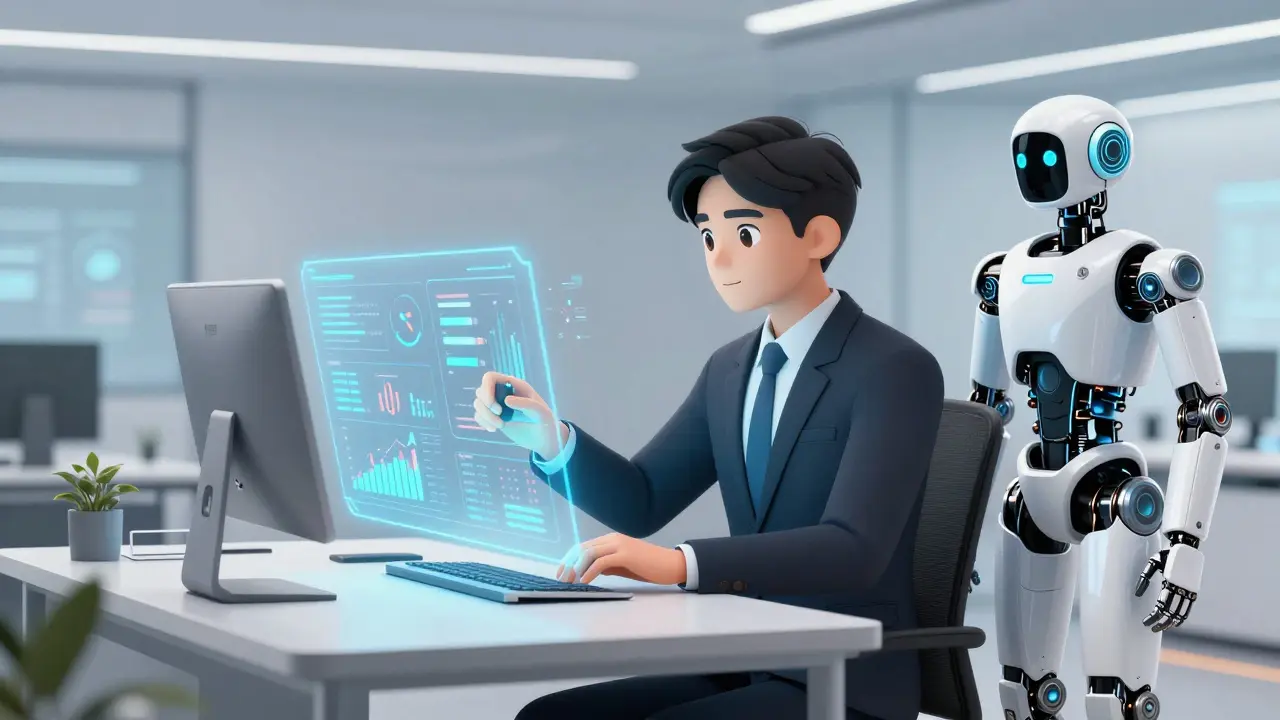
Imagine a world where writing performance reviews doesn’t feel like a chore, but rather a strategic conversation. Or picture an employee who can see their exact next steps for promotion based on real-time data, not vague promises. This isn’t science fiction anymore. As of early 2026, generative AI has moved from being a buzzword to a core tool in human resources departments across the globe. It is reshaping how we evaluate talent and plan careers.
The shift is massive. According to Lattice’s 2025 State of People Strategy Report, which surveyed over 1,200 HR professionals, performance reviews are now the second most common use of AI in HR, adopted by 68% of organizations. But why is everyone jumping on this bandwagon? Because traditional methods are broken. They are slow, subjective, and often biased. Generative AI offers a way out, turning hours of administrative drudgery into minutes of meaningful insight.
How Generative AI Redefines Performance Reviews
Let’s face it: most managers dread performance review season. It usually involves digging through emails, trying to remember specific projects from six months ago, and struggling to write constructive feedback that doesn’t sound robotic. Generative AI changes this dynamic completely.
Large Language Models (LLMs) like GPT-4 and Claude 3 are at the heart of this change. When integrated with HR platforms like Lattice AI, these models connect structured data (like sales metrics or code commits) with unstructured data (such as peer feedback or project notes). The result? A draft review that is comprehensive, fair, and personalized.
Consider the impact on time. Lattice’s research shows their Performance Insights feature cuts review writing time by 47%. That means instead of spending three weeks on reviews, teams can do it in four days. But speed isn’t the only benefit. The quality improves too. By standardizing language, AI reduces rating inflation by 19%, ensuring that high performers are recognized consistently regardless of their manager’s personal style.
- Faster Drafting: AI generates initial drafts based on historical data, allowing managers to focus on editing and adding personal touches.
- Bias Reduction: Algorithms help identify and neutralize unconscious biases in language, promoting fairness.
- Data-Driven Feedback: Reviews are backed by concrete examples pulled from various sources, making them harder to dispute.
However, there is a catch. AI-generated feedback can sometimes feel impersonal if left unchecked. Mark Reynolds, a People Operations Lead, noted in late 2025 that while AI speeds things up, it occasionally produces generic suggestions that require manual refinement. The key is using AI as a co-pilot, not an autopilot. Managers must still add the human element-empathy, context, and encouragement-to make the review truly effective.
Navigating Career Paths with Intelligent Systems
Performance reviews are just one side of the coin. The other is career development. For years, employees have felt stuck, unsure of what skills they need to advance or what roles are available within their company. Generative AI is solving this mystery.
Modern career pathing tools analyze five to seven years of performance data, skills assessments, and internal mobility patterns. They create personalized development plans that show employees exactly where they stand and where they could go. Assessio’s 2026 research found that these systems can identify relevant internal opportunities 83% faster than manual methods.
Take Lattice’s "Recommended Growth Plans," launched in late 2025. This feature uses skills gap analysis to suggest specific training courses, mentors, or projects that align with an employee’s career goals. In a case study with a Fortune 500 tech company, this approach increased internal mobility by 27% within just 12 months. Employees stayed longer because they saw a clear future within the organization.
| Feature | Traditional Method | AI-Powered System |
|---|---|---|
| Identification Time | Weeks to Months | Hours to Days |
| Personalization | Generic Templates | Individual Skills & Goals |
| Data Sources | Self-Reports & Manager Input | Performance Metrics, Projects, Peer Feedback |
| Internal Mobility Impact | Low Visibility | High Visibility & Actionable Steps |
This shift empowers employees to take ownership of their careers. Instead of waiting for an annual check-in, they get real-time guidance. It transforms HR from a gatekeeper of information into a strategic partner that drives growth.

The Human Element: Why Oversight Still Matters
Despite the benefits, generative AI is not without risks. One major concern is bias. If the historical data fed into the AI contains biases-such as favoring certain demographics for promotions-the AI will amplify those biases. Assessio warned in January 2026 that without proper validation, AI systems can create unintended barriers to advancement for underrepresented groups.
Another issue is privacy. With regulations like the EU AI Act taking effect in February 2026, companies must ensure transparency in AI-assisted decisions. This means being open about how data is used and giving employees the right to understand the logic behind recommendations.
Josh Bersin, a leading analyst in HR technology, emphasized in early 2026 that AI won’t replace HR professionals. Instead, it will change their roles. "As more of AI becomes automated, HR salaries may go up," he noted, because specialized oversight roles will be needed to manage these complex systems. The job of HR shifts from administrative tasks to strategic people science-focusing on empathy, equity, and agility.
Natalie Kroll, author of *HR’s AI Playbook*, put it best: "The real advantage lies not in replacing people, but in empowering them with intelligent systems." The goal is to enhance human judgment, not eliminate it. Managers need to validate AI outputs, especially when dealing with sensitive career discussions or performance issues.

Implementing Generative AI in Your Organization
If you’re considering adopting generative AI for performance reviews or career pathing, where do you start? Successful implementation requires careful planning. AIHR’s January 2026 research suggests investing 8-12 weeks in preparation before full deployment.
- Assess Your Infrastructure: Ensure your existing HRIS platform (like Workday, SAP SuccessFactors, or Oracle HCM) can integrate with AI tools. Companies with modern cloud systems report 30% faster adoption.
- Train Your Team: HR staff need new skills. Prompt engineering for HR contexts was rated essential by 82% of HR leaders in 2026. Data literacy and change management capabilities are also critical.
- Customize the Model: Don’t rely on out-of-the-box solutions alone. Dedicate time to customizing AI models to fit your specific competency frameworks. HR Acuity found that organizations spending 20+ hours on customization saw higher satisfaction rates.
- Pilot and Iterate: Start with a small group. Test the AI’s output for accuracy and fairness. Gather feedback from both managers and employees to refine the process.
- Ensure Compliance: Review your processes against GDPR, CCPA, and the EU AI Act. Implement validation protocols to mitigate bias and ensure transparency.
The market for AI in HR is growing fast, projected to triple from $2.1 billion in 2025 to $6.3 billion by 2030. Leading vendors include Lattice, Eightfold AI, and The Hackett Group. Each offers unique strengths, so choose based on your organization’s size, budget, and specific needs.
Looking Ahead: The Future of HR Technology
What does the future hold? Gartner forecasts that by 2028, 75% of performance review feedback will be AI-assisted but human-validated. We’re moving toward "secure AI agents" that fuse predictive analytics with human empathy. These agents will handle complex, multi-step processes, freeing up HR professionals to focus on high-value interactions.
For employees, this means more equitable opportunities and clearer career trajectories. For employers, it means retaining top talent by showing them a path forward. The integration of generative AI into HR is not just a trend; it’s a fundamental shift in how we value and develop people.
As Natalie Kroll predicted, AI is translating complex assessments into practical guidance. It’s democratizing insights, allowing managers to act on validated data rather than gut feelings. This shift positions HR as a true strategic partner, driving business performance through smarter, fairer people practices.
Is generative AI replacing HR professionals?
No. While AI automates many administrative tasks, it creates a need for specialized oversight roles. Experts like Josh Bersin note that HR salaries may actually increase as the profession shifts toward strategic people science, requiring skills in data interpretation, bias mitigation, and empathetic leadership.
How does generative AI reduce bias in performance reviews?
AI helps standardize language and criteria across all reviews, reducing individual manager bias. However, it’s crucial to validate the underlying data to prevent amplifying existing historical biases. Regular audits and human oversight are necessary to ensure fairness.
What are the best tools for AI-powered career pathing?
Leading platforms include Lattice (with its Recommended Growth Plans), Eightfold AI (for skills intelligence), and The Hackett Group’s ZBrain™ Builder. The best choice depends on your existing HRIS infrastructure and specific organizational needs.
How long does it take to implement generative AI in HR?
Successful implementations typically require 8-12 weeks of preparation and customization. Organizations with modern cloud-based HRIS systems tend to adopt faster, while those with legacy systems may face longer timelines due to integration challenges.
Are there legal risks associated with using AI in HR?
Yes. Regulations like the EU AI Act (effective Feb 2026) require transparency in AI-assisted hiring and promotion decisions. Companies must ensure compliance with data privacy laws (GDPR, CCPA) and actively work to mitigate algorithmic bias to avoid legal liabilities.
Stephanie Frank
Let's cut the corporate fluff for a second. The real story here isn't about 'empowerment' or 'strategic partnerships.' It's about efficiency and control. Companies are adopting this because they want to squeeze more data out of employees with less managerial overhead. The fact that rating inflation drops by 19% means managers are finally being forced to write negative reviews without the emotional labor of softening the blow. AI doesn't care if you cry. It just outputs the metric. This is a surveillance tool disguised as a career coach, and anyone thinking otherwise is either naive or on the payroll of Lattice.
Andrea Alonzo
I have to gently push back on such a cynical perspective, although I completely understand where that frustration stems from given how often technology has been used to depersonalize the workplace in the past.
When we look at the human element, which is so crucial for mental health and job satisfaction, there is a genuine opportunity here for empathy to flourish rather than diminish, provided that we approach it with the right mindset and intentionality.
Many managers are simply overwhelmed by the administrative burden of tracking every single interaction, and when that weight is lifted, they often find they have more time and energy to engage in those deep, meaningful conversations that actually matter to their team members.
It is not about replacing the heart of the process, but rather clearing away the clutter so that the heart can beat stronger and more clearly for everyone involved.
Saranya M.L.
The fundamental misunderstanding in your previous comment lies in the assumption that algorithmic standardization equates to fairness. In reality, without rigorous, localized calibration of the Large Language Models, you are merely automating bias at scale. As an expert in organizational psychology within the Indian tech sector, I can assure you that the nuance required for effective performance management cannot be captured by generic Western-centric models. You need hyper-localized training data. Otherwise, you are just creating a bureaucratic nightmare that ignores cultural context entirely.
om gman
oh great another article telling us robots will save us from ourselves because apparently humans are too stupid to manage other humans without a computer telling them what to say
i bet the ai also suggests you take a vacation because your stress levels are high lol
who cares though i just want my paycheck
Bineesh Mathew
The existential dread one feels when reading this is palpable yet strangely muted by the sterile language of corporate progress. We are witnessing the slow death of intuition, replaced by the cold, hard logic of data points that claim to know our potential better than we do ourselves. It is a tragedy wrapped in a statistic, a lie told with perfect grammar. The soul of work is being quantified, sliced, and diced until nothing remains but a spreadsheet entry. And we applaud it because it saves three weeks of work. How very modern. How very hollow.
Oskar Falkenberg
look i get the skepticism and honestly its valid cause ive seen some pretty sketchy implementations in my own company where the ai just spit out generic garbage that no one read anyway
but like seriously if you think about it the main issue isnt the tech its the people using it
if managers treat it like a magic wand then yeah its gonna fail but if they use it as a draft generator then it actually saves a ton of time and lets them focus on the actual conversation which is what matters most in the end i think we just need better training for managers not less ai
Caitlin Donehue
I've been watching this trend unfold quietly from the sidelines, mostly observing how my colleagues react to the new tools. It's interesting to see the divide between those who feel empowered by the clarity and those who feel monitored by the precision. I don't have a strong opinion either way, but I do notice that the ones who benefit most are usually the ones who already had good relationships with their managers. The tech seems to amplify existing dynamics rather than change them fundamentally.
Marissa Haque
This is absolutely revolutionary!!! I mean, can you imagine the sheer amount of time saved?!? My manager used to spend WEEKS on these things, and now it takes minutes!! It’s like magic! But seriously, the part about internal mobility increasing by 27% is mind-blowing! Everyone deserves a clear path forward, and this makes it possible! Let’s gooooo! 🚀🚀🚀
Keith Barker
the machine sees all
and judges accordingly
we are but data points in its grand design
accept it
Jeanne Abrahams
Oh, please. Another day, another Silicon Valley solution to a problem that didn't exist until they created it. Here in South Africa, we deal with systemic issues that no amount of 'generative AI' can fix with a few clicks. While you're busy celebrating faster performance reviews, try explaining to someone why their promotion was denied by an algorithm trained on biased historical data. It's charmingly naive, really. Save your bandwidth for something that actually impacts lives, not just quarterly reports.