You’ve built your Retrieval-Augmented Generation (RAG) is a system that combines large language models with external knowledge bases to provide accurate, context-aware responses pipeline. It works beautifully in testing. But when you look at the monthly bill from your cloud provider or API vendor, something feels off. The costs are creeping up faster than expected.
The hard truth about production RAG systems is that most of your money isn’t going to storing data or generating embeddings. According to recent analysis by CostLens.dev, LLM inference accounts for 90-95% of total operational costs in RAG systems. That means if you’re obsessing over which vector database to use or tweaking embedding dimensions by a few points, you’re polishing the hubcaps while the engine burns fuel. To actually save money, we need to flip the script. We have to stop looking at storage as the enemy and start treating context length as the primary lever for cost control.
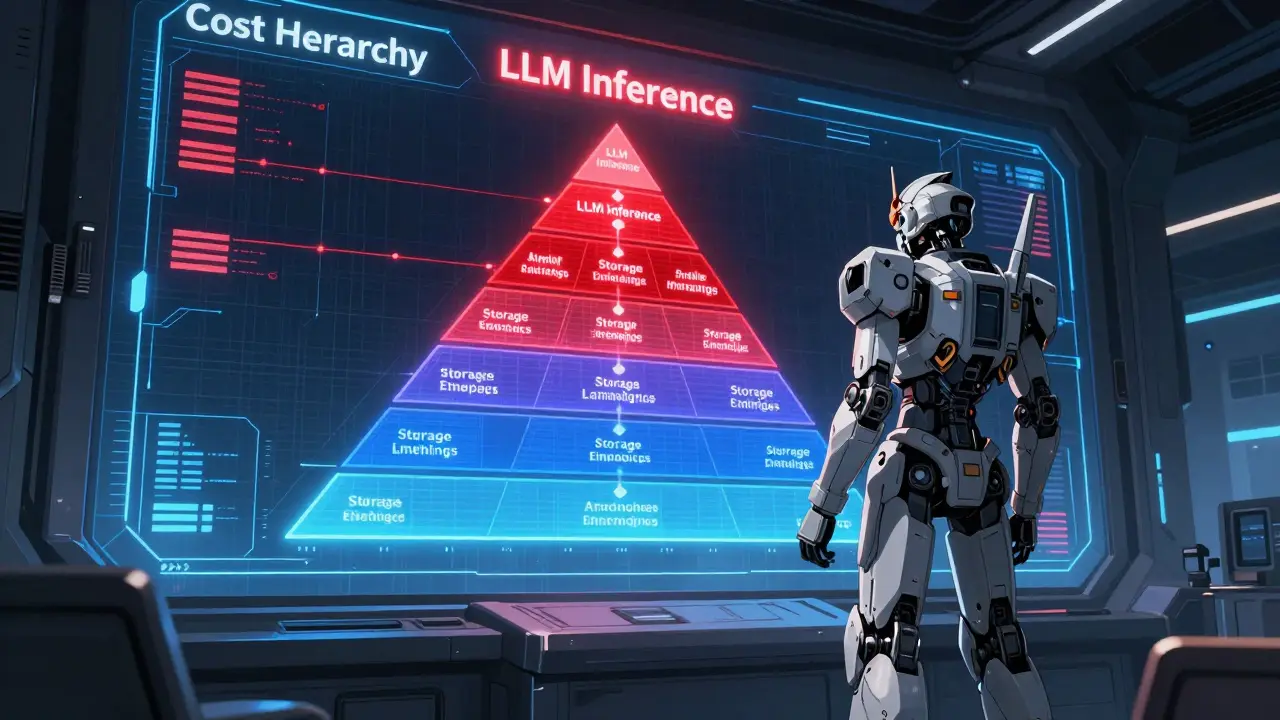
The Real Cost Hierarchy: Where Your Money Actually Goes
Before we dive into specific optimizations, let’s map out where the cash disappears. Understanding this hierarchy is the single most important step in cutting costs because it tells you what to ignore and what to prioritize.
| Component | Share of Total Cost | Optimization Priority |
|---|---|---|
| LLM Inference | 90-95% | Critical (Highest Impact) |
| Reranking Services | 3-7% | High (Quality vs. Cost Trade-off) |
| Vector Database Operations | 1-2% | Low |
| Embedding Generation | <1% | Negligible |
Look at those numbers. Embedding generation costs less than one percent of your total spend. If you switch from a high-cost embedding model to a cheaper one, you might save pennies on a hundred-dollar bill. But if you reduce the number of tokens sent to the LLM by just 10%, you cut nearly $10 off that same bill. This reality check changes everything. Our strategy must focus on reducing the load on the expensive components first.
Context Budgets: The Highest-Impact Lever
Since LLM inference dominates your expenses, controlling the context window is the amount of text and retrieved documents passed to the LLM for processing is your best defense against runaway costs. Every token you send to the model costs money, so every unnecessary word is a leak in your budget.
Here is how you tighten that budget without sacrificing answer quality:
- Implement Reranking: You might think adding a reranker increases costs since it’s an extra step. But here’s the trick: rerankers are cheap compared to LLMs. By using a lightweight reranker to score initial retrieval results, you can filter out noise and pass only the top 2-3 most relevant chunks to the LLM instead of the top 10. This often reduces context size by 60-80%, saving far more in inference fees than the reranker costs.
- Truncate Aggressively: Don’t send whole documents. Use smart truncation to keep only the sentences surrounding the matched keywords. If a document has 2,000 words but only one paragraph is relevant, cut the rest. The LLM doesn’t need the fluff.
- Hierarchical Retrieval: Start broad, then narrow down. Retrieve summaries first, then fetch detailed content only if the summary matches the query intent. This prevents sending massive blocks of text for queries that could be answered briefly.
Think of context reduction like packing for a trip. You wouldn’t pack your entire wardrobe if you’re only staying for two days. Similarly, don’t feed the LLM your entire knowledge base when it only needs a snippet.

Storage Optimization: Quantization and Dimensionality Reduction
While storage costs are low, they do add up at scale, especially if you’re managing millions of vectors. Fortunately, modern techniques allow us to shrink these vectors significantly without losing much accuracy. Research published on arXiv (2505.00105v1) provides clear guidance on what works best today.
The old standard was float32 is full-precision floating-point format used for vector storage, which takes up the most space. Many teams jumped to int8 quantization is an 8-bit integer representation that reduces storage by 4x compared to float32, which cuts storage by half again. But there’s a better option now: float8 quantization is an 8-bit floating-point format that offers similar compression to int8 but with better performance retention.
Float8 achieves a 4x storage reduction compared to float32 while keeping performance degradation below 0.3%. It’s simpler to implement than complex binary quantization schemes and performs better than int8 in many benchmarks. If you want to go further, combine float8 with Principal Component Analysis (PCA) is a dimensionality reduction technique that compresses vector dimensions while preserving key information.
By applying PCA to retain only 50% of the original dimensions and then quantizing to float8, you achieve an 8x total compression ratio. This combined approach often outperforms int8 quantization alone. For example, if you’re storing 1 million vectors with 1,536 dimensions, switching from float32 to PCA+float8 can reduce your storage footprint from gigabytes to mere megabytes. The formula is simple: Storage (bytes) = N × (Original Dimensions × PCA Ratio%) × Bytes per Dimension. Use this to model your savings before implementing.
Embedding Models: Choosing Wisely
Even though embedding costs are under 1% of your total, choosing the right model affects storage and retrieval speed. OpenAI’s text-embedding-3-small is a cost-effective embedding model costing $0.02 per 1 million tokens with 1536 dimensions costs $0.02 per 1 million tokens, while text-embedding-3-large is a higher-quality embedding model costing $0.13 per 1 million tokens with 3072 dimensions costs $0.13 per 1 million tokens. For most applications, the small model is sufficient. Unless you’re dealing with highly nuanced semantic searches where every decimal point matters, stick with the smaller, faster option.
Consider also using specialized open-source models like BGE or E5, which offer competitive performance at zero API cost if you self-host. A 384-dimensional model can reduce storage by 62.5% compared to a 1024-dimensional one, often with negligible impact on retrieval quality for domain-specific tasks.

Pipeline Efficiency: Deduplication and Incremental Processing
Your ingestion pipeline is where silent waste happens. If you re-process static documents every time you update your knowledge base, you’re burning compute cycles and API credits for no reason.
- Use Content Hashing: Generate a checksum for each document before processing. If the hash hasn’t changed, skip the embedding step entirely. This ensures you only pay for new or modified content.
- Deduplicate Early: Duplicate content inflates storage and skews retrieval results. Use algorithms like MinHash or SimHash to detect near-duplicates before chunking. Removing redundant chunks saves both embedding generation costs and vector database space.
- Batch Process: Never embed documents one by one. Batch processing improves GPU utilization and reduces overhead. Frameworks like sentence-transformers support CUDA-accelerated batch operations, making ingestion orders of magnitude faster and cheaper.
Smart chunking also plays a role. Overly fine-grained chunks create too many embeddings, increasing storage and query complexity. Coarse chunks lose precision. Find the sweet spot-usually 300-500 tokens with minimal overlap-to balance retrieval accuracy against volume.
Monitoring and Continuous Optimization
Cost optimization isn’t a one-time fix. It’s a continuous process. Set up monitoring to track key metrics: raw data volume, number of chunks generated, total storage size, and API costs. Use cloud provider budget alerts to catch spikes early.
Adopt a Pareto-optimal mindset. Plot your configurations on a graph with retrieval performance (e.g., nDCG@10) on the Y-axis and storage size on the X-axis. Identify your memory constraint line, then pick the configuration that delivers the highest performance within that limit. This systematic approach ensures you’re not over-engineering solutions for marginal gains.
Finally, remember that simplicity wins. Float8 quantization and moderate PCA reduction are easier to maintain than complex autoencoder-based pipelines. Start with the basics: reduce context, deduplicate data, and choose efficient models. Once those are locked in, you can explore advanced techniques if needed.
Is it worth optimizing embedding costs in RAG?
Generally, no. Embedding costs account for less than 1% of total RAG expenses. Focus your efforts on reducing LLM inference costs through context budget management, which offers 90-95% of potential savings.
What is the best quantization method for vector storage?
Float8 quantization is currently recommended over int8. It provides 4x storage reduction compared to float32 with less than 0.3% performance loss. Combining float8 with PCA dimensionality reduction can achieve 8x compression.
How does reranking help reduce costs?
Reranking filters retrieved documents to keep only the most relevant ones before sending them to the LLM. This reduces the context window size, significantly lowering expensive LLM inference tokens despite the added cost of the reranker itself.
Should I use text-embedding-3-small or large?
For most applications, text-embedding-3-small is sufficient and cost-effective ($0.02 per 1M tokens). Use text-embedding-3-large only if you require higher semantic precision for complex queries, as it costs $0.13 per 1M tokens.
How can I prevent redundant embedding generation?
Implement content hashing to detect unchanged documents and skip re-embedding. Also, use deduplication techniques like MinHash to remove near-duplicate chunks before processing, saving both compute and storage resources.