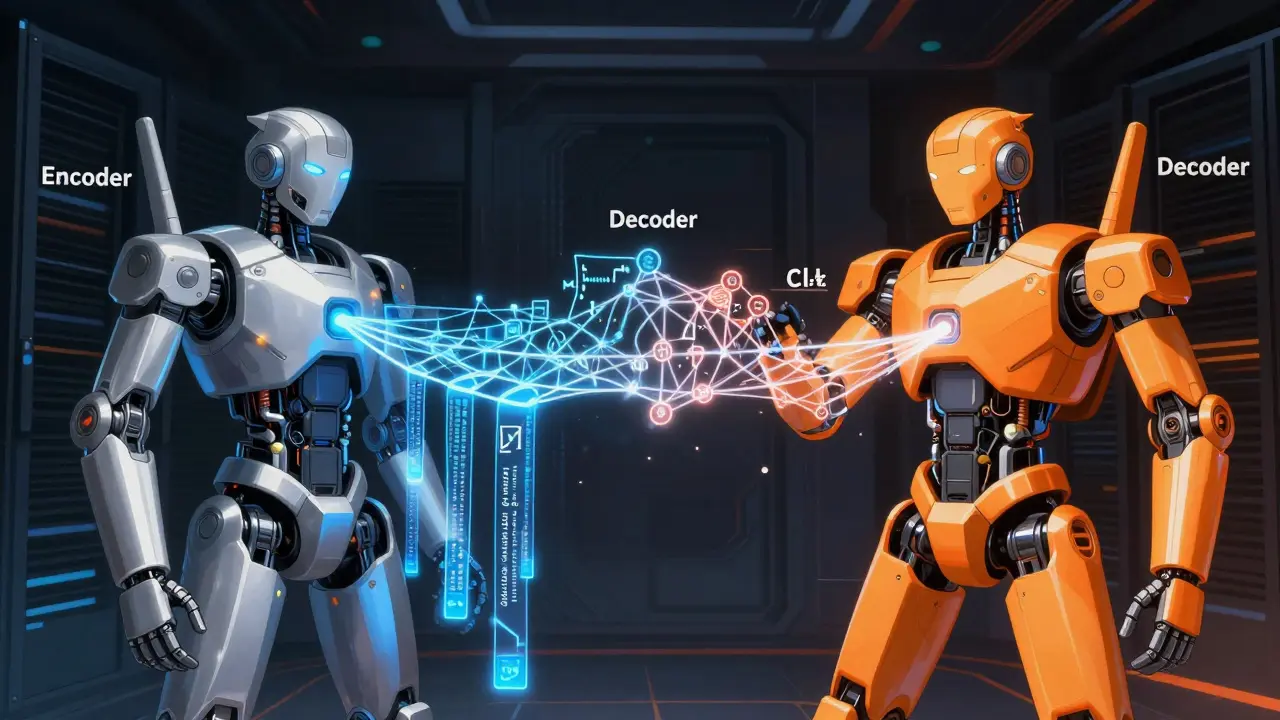
Imagine trying to translate a sentence from French to English without ever looking back at the original French words. You’d be guessing blindly, right? That’s exactly what happens if you remove cross-attention is the mechanism that allows a decoder to look at an encoder's output from a transformer model. It’s the bridge between understanding input and generating output. Without it, modern AI systems like translation tools or image generators would fall apart.
Most people talk about "self-attention" when discussing Large Language Models (LLMs). But cross-attention is the unsung hero behind sequence-to-sequence tasks. It solves a specific problem: how do we condition the generation of new text on existing context? In this article, we’ll break down how cross-attention works, why it matters for encoder-decoder architectures, and how it enables complex multimodal AI.
What Is Cross-Attention and Why Do We Need It?
To understand cross-attention, you first need to know where it lives. It sits inside the decoder part of an encoder-decoder transformer is a neural network architecture with separate encoding and decoding components. Think of the encoder as the reader and the decoder as the writer. The encoder reads the input (like a source sentence) and compresses its meaning into a set of vectors. The decoder writes the output (like the translated sentence).
The problem? The decoder doesn’t automatically know what the encoder read. Self-attention only lets the decoder look at its own previous outputs. If the decoder relies solely on self-attention, it can only generate text based on what it has already written, not on the original input. This leads to repetitive or nonsensical results because the model loses track of the source material.
Cross-attention fixes this by giving the decoder a direct line to the encoder’s notes. It allows the decoder to ask, "Which parts of the input are relevant to the word I’m about to write?" This creates a dynamic alignment between input and output. For example, when translating "The cat sat," the decoder generates "The" while paying attention to "Le" in the French input. When it generates "cat," it shifts its focus to "chat." This word-by-word alignment is powered entirely by cross-attention.
How Cross-Attention Works Under the Hood
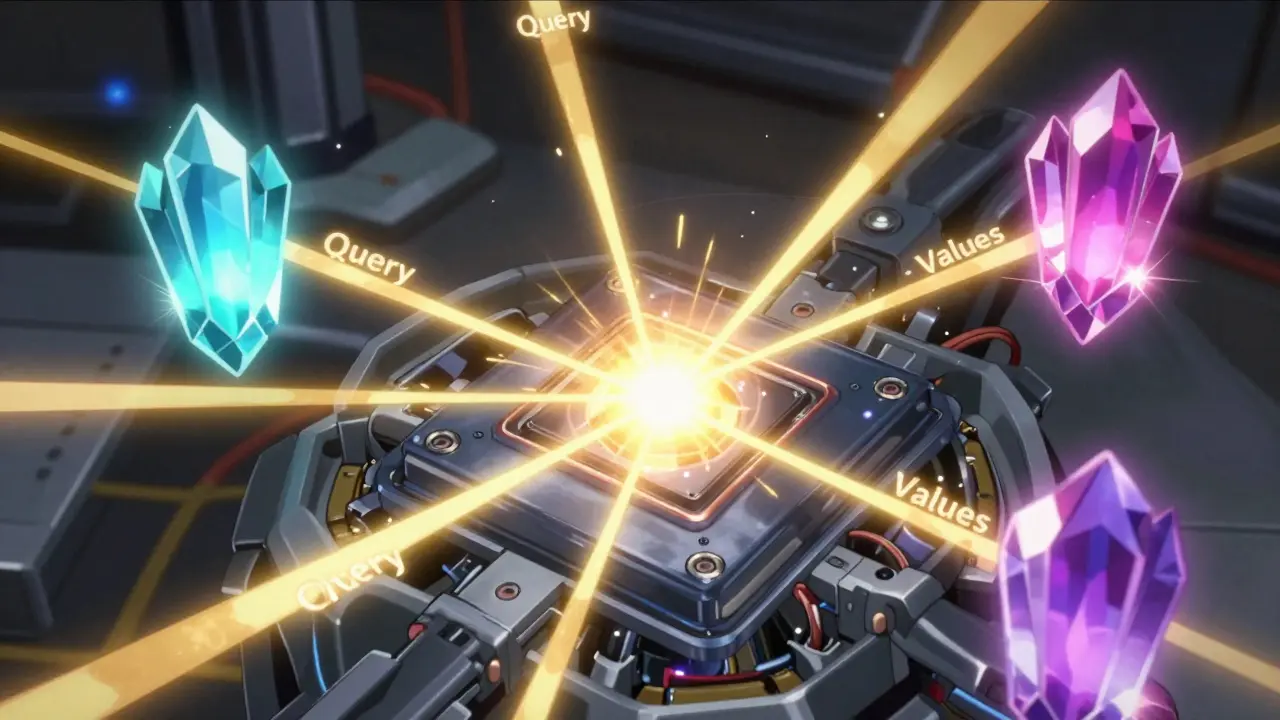
Let’s strip away the jargon. At its core, attention is just a way of calculating importance. Cross-attention uses three main ingredients: Queries, Keys, and Values. Here’s how they interact:
- Queries (Q): These come from the decoder. They represent what the decoder is currently trying to predict. If the decoder is trying to write the next word, the query asks, "What information do I need right now?"
- Keys (K) and Values (V): These come from the encoder. The keys act like labels or indexes of the input data. The values contain the actual content or meaning associated with those labels.
The process starts by projecting the decoder’s state into queries and the encoder’s output into keys and values using learned matrices ($W_Q$, $W_K$, $W_V$). Next, the model calculates a score for every pair of query and key. This score tells us how well the current decoder position matches each part of the input.
We then apply a softmax function to these scores. This turns them into probabilities that add up to one. A high probability means the decoder should pay close attention to that specific part of the input. Finally, we multiply these probabilities by the values and sum them up. The result is a weighted average of the input information, tailored specifically to what the decoder needs at that moment.
A crucial detail here is the scaling factor. We divide the dot product of Q and K by the square root of the dimension size ($\sqrt{d_k}$). Why? Because without this scaling, the numbers get too big. Big numbers cause the softmax function to produce extremely sharp peaks, which kills the gradients during training. Scaling keeps the math stable and helps the model learn effectively.
Cross-Attention vs. Self-Attention: Knowing the Difference
It’s easy to mix these two up since they use similar math. But their jobs are completely different. Let’s compare them side-by-side.
| Feature | Self-Attention | Cross-Attention |
|---|---|---|
| Data Source | Same sequence (e.g., input text) | Different sequences (Encoder & Decoder) |
| Location | Both Encoder and Decoder layers | Only in Decoder layers |
| Primary Goal | Understand internal relationships within a sequence | Align input context with output generation |
| Example Use Case | Resolving pronouns in a single sentence | Translating a sentence from one language to another |
In a standard decoder layer, the order matters. First, masked self-attention runs. This lets the decoder see only the tokens it has already generated, preventing it from cheating by looking ahead. Then, cross-attention kicks in. Now the decoder looks outward to the encoder’s summary of the input. Finally, a feed-forward network processes this combined information. This strict ordering ensures that the model builds its output step-by-step, grounding each new token in both previous context and source material.
Why Cross-Attention Matters for Multimodal AI
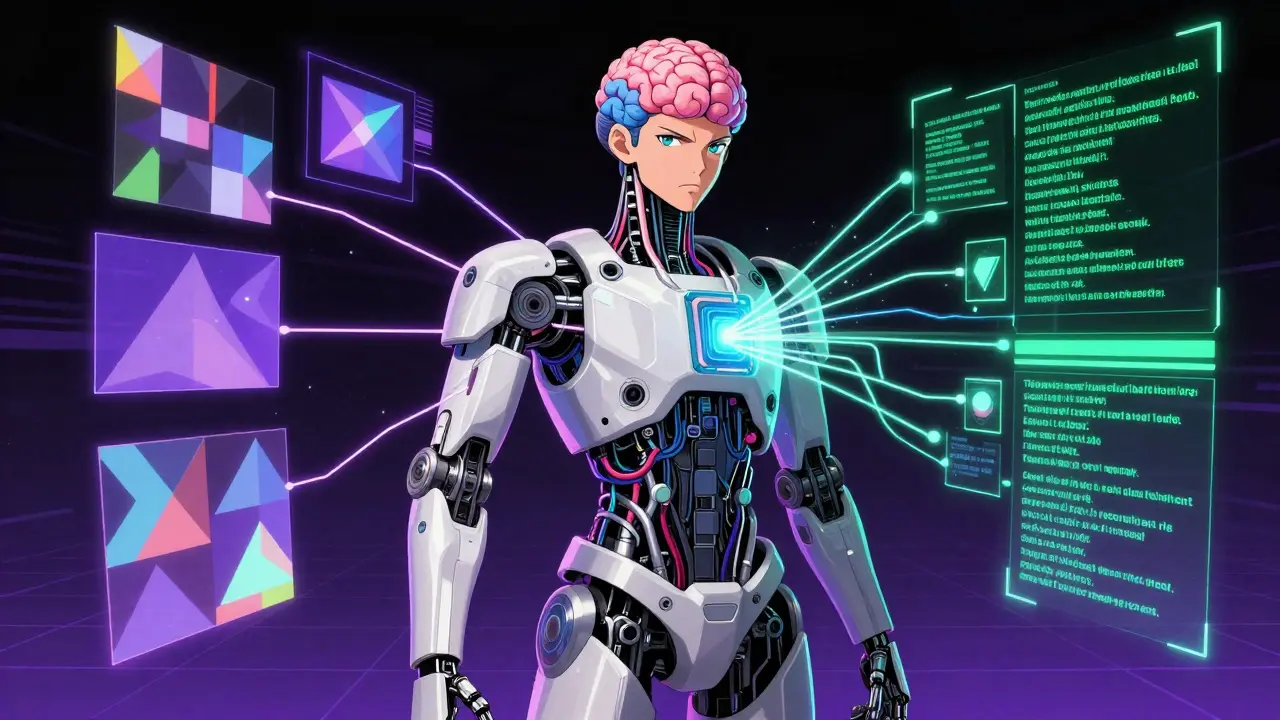
Cross-attention isn’t just for language translation. It’s the backbone of multimodal models that combine text, images, and audio. Take DALL-E or Stable Diffusion. These models use cross-attention to connect text prompts to visual features.
Here’s how it works in practice. An image encoder processes a picture and creates a grid of feature vectors. A text encoder processes your prompt (e.g., "A red car") and creates text embeddings. The decoder (which might be generating an image or describing one) uses cross-attention to let the text queries attend to the image keys/values. This allows the model to understand that the word "red" should influence the color channels in the image generation process.
You can implement this in two ways. One approach concatenates all modalities into a single list of keys and values. The other uses separate cross-attention heads for each modality. The latter gives you more control. You can tune how much the model listens to the text versus the image. Libraries like Hugging Face Transformers make this setup straightforward, allowing developers to stack encoders and route their outputs through dedicated cross-attention layers.
Handling Masks and Practical Implementation Tips
If you’re building these models, you’ll run into padding issues quickly. Neural networks prefer fixed-size inputs, so we pad short sentences with empty tokens to match the longest one in the batch. But the model shouldn’t pay attention to those empty spots.
This is where masks come in. Before applying the softmax function, we take the attention scores and replace any score corresponding to a padded token with a very large negative number (effectively negative infinity). When softmax processes this, the probability for that position becomes zero. The model ignores the padding completely. This simple trick ensures that the cross-attention mechanism focuses only on real content.
Another tip involves initialization. The projection matrices ($W_Q$, $W_K$, $W_V$) need careful initialization. If they start with random values that are too large or too small, the signal can vanish or explode during early training. Using normalized random values scaled by the input dimensions helps maintain healthy variance across the network.
The Future of Conditioning in Transformers
As models grow larger, cross-attention becomes computationally expensive. It requires calculating interactions between every decoder position and every encoder position. For long documents or high-resolution images, this quadratic cost adds up fast.
Researchers are exploring sparse attention patterns to cut down on compute. Instead of attending to everything, the model attends only to the most relevant local regions. There’s also work on efficient variants like Linear Attention, which approximates the softmax operation to speed things up. Despite these optimizations, the core idea remains unchanged: cross-attention provides the essential link that allows conditional generation. Whether you’re translating languages, generating code from comments, or creating art from text, cross-attention is the engine making it possible.
Is cross-attention used in GPT-style models?
No, GPT models are autoregressive decoders only. They do not have an encoder component, so they rely exclusively on causal self-attention. Cross-attention is specific to encoder-decoder architectures like T5, BART, or mT5.
Can I use cross-attention with non-text data?
Yes, absolutely. Cross-attention is modality-agnostic. As long as you can encode your data (images, audio, video) into vector representations, you can use cross-attention to align them with text or other modalities in the decoder.
Why is the scaling factor $1/\sqrt{d_k}$ important?
Without scaling, the dot products of queries and keys tend to have large variances. This pushes the softmax function into regions with extremely small gradients, causing the vanishing gradient problem. Scaling keeps the values in a range where gradients flow smoothly during backpropagation.
What happens if I remove cross-attention from a translation model?
The model would struggle significantly. It would lose the ability to align specific words in the source language with the target language. Translations would become generic, repetitive, or inaccurate because the decoder couldn't reference the detailed context provided by the encoder.
How does masking work in cross-attention?
Masking prevents the model from attending to padding tokens. Before the softmax activation, attention scores corresponding to padded positions are set to a large negative value (e.g., -1e9). This results in near-zero probabilities after softmax, effectively ignoring those positions.