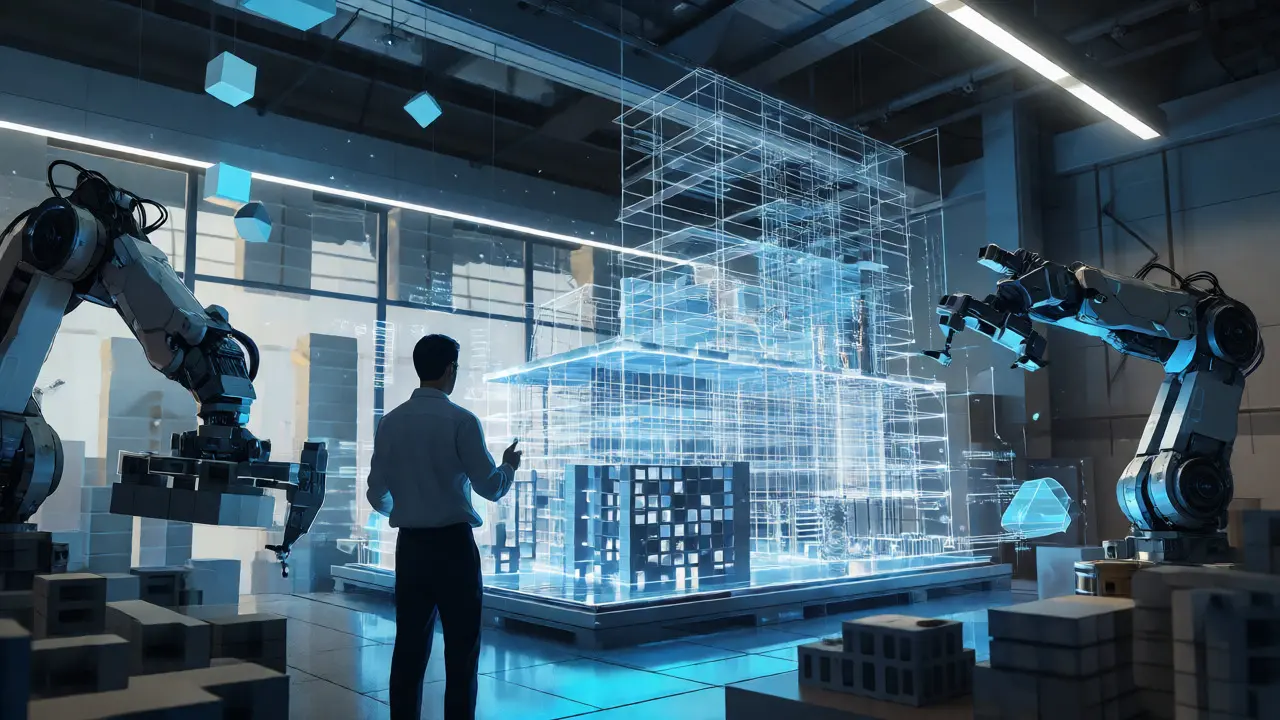
You’ve probably heard the hype: AI is going to replace architects and developers. But if you’re actually shipping code or designing buildings today, that feels a bit off. The reality isn’t replacement; it’s augmentation. AI doesn’t take your job, but it absolutely changes how you make decisions. Whether you are tweaking a floor plan for a housing complex or refactoring a monolithic backend, the core challenge remains the same: balancing trade-offs under constraints. The difference now? You have a machine that can simulate millions of scenarios before you finish your coffee.
This shift demands a new kind of literacy. It’s not just about knowing which tool to click. It’s about understanding the architectural considerations that define a system’s lifespan. In both building and software architecture, we are moving from manual iteration to algorithmic exploration. This article breaks down how technical decision-making evolves when AI enters the room, and why human oversight matters more than ever.
The Shift from Manual Iteration to Algorithmic Exploration
Traditionally, architectural design was slow. If an architect wanted to test how sunlight hit a courtyard at 3 PM in July, they ran simulations manually. If a software engineer wanted to see how a database sharding strategy affected latency, they built prototypes. Both processes were bottlenecked by human speed.
Generative design flips this script. Instead of drawing one solution, you define constraints-budget, material strength, API response time limits-and let the AI generate dozens of viable options. A prime example comes from the Delve project by Quintain. Their AI models didn’t just copy human designs; they outperformed them. By increasing building heights in specific zones and creating unconventional courtyard shapes, the AI maximized daylight access while hitting quality-of-life targets that human designers had missed. This wasn’t magic; it was high-speed optimization across variables humans struggle to track simultaneously.
In software, this looks like using AI to suggest microservice boundaries based on traffic patterns rather than team structure. You stop guessing. You start testing hypotheses at scale. The key takeaway here is that AI handles the "what if," allowing you to focus on the "so what."
Bridging Building Architecture and Software Systems
It might seem odd to compare bricks with bytes, but the structural logic is surprisingly similar. Both disciplines rely on parametric design principles. In building architecture, parametric tools use geometric rules tied to parameters like material costs or spatial limits. Change one variable, and the whole model adjusts.
Software architecture does the same thing with configuration management and infrastructure-as-code. When you change a dependency version or a server region, the entire system topology shifts. AI accelerates this by predicting the ripple effects. For instance, MBH Architects used Forma, an AI-powered tool, to cut design time from two weeks to six hours. They optimized for cost, carbon emissions, and livability in real-time. Similarly, in software, AI-driven static analysis tools can flag architectural anti-patterns-like tight coupling between services-before they become critical failures.
| Aspect | Traditional Approach | AI-Assisted Approach |
|---|---|---|
| Ideation Speed | Days to weeks per iteration | Minutes per iteration (e.g., Delve Project) |
| Optimization Scope | Limited by human cognitive load | Multi-variable (cost, energy, latency) |
| Compliance Checks | Manual review against codes/specs | Automated pre-validation via NLP |
| Risk Detection | Post-implementation debugging | Pre-deployment pattern detection |
The parallel is clear: both fields are using AI to reduce the feedback loop. Faster feedback means fewer expensive mistakes. But speed without direction is chaos. That’s where your judgment comes in.

Technical Decision-Making Frameworks for AI Integration
So, how do you actually make decisions when AI suggests three different architectures? You need a framework. Treating AI as a consultant, not an oracle, is step one. Step two is defining clear success metrics.
In software, this means validating AI suggestions against established patterns like CQRS (Command Query Responsibility Segregation) or Event Sourcing. If an AI suggests splitting a service, ask: Does this align with our domain boundaries? Will it increase operational complexity beyond our team’s capacity to manage?
In building architecture, the questions are physical. Does the AI-suggested facade material meet local fire codes? Is the supply chain stable for those custom panels? Tools like Forma help by simulating wind, noise, and solar shading impacts instantly. AFRY used these features to accelerate stakeholder approvals because they could show data-backed outcomes, not just pretty renders.
- Define Constraints First: Don’t let AI wander. Set hard limits on budget, energy usage, or latency.
- Validate Against Standards: Check AI outputs against LEED certifications or ISO software standards.
- Assess Operational Load: An elegant AI solution that requires five new DevOps engineers is a bad trade-off.
This structured approach prevents "solutionism"-adopting tech just because it’s cool. You’re looking for robustness, not novelty.
Sustainability and Efficiency as Core Metrics
Sustainability isn’t a bonus feature anymore; it’s a primary constraint. In building design, embodied carbon and operational energy use drive decisions. AI excels here because it can correlate thousands of environmental factors. The Phoenix housing project, for example, used AI to optimize facade materials that cut embodied carbon while speeding up construction. Factory_OS paired this with modular assembly, shrinking timelines from years to weeks.
For software, sustainability translates to efficiency. Inefficient code burns CPU cycles, which burns electricity. AI tools can analyze codebases to identify redundant computations or inefficient database queries. While less glamorous than carbon tracking, this "digital sustainability" reduces cloud costs and improves user experience. If your app takes four seconds to load, you’re wasting energy and patience. AI helps pinpoint exactly where that waste happens, suggesting optimizations that balance performance with readability.
Consider the IoT angle too. Modern buildings are packed with sensors. AI integrates with Building Information Modeling (BIM) to predict maintenance needs based on live sensor data. This predictive capability mirrors software observability, where logs and traces predict outages before users complain. The goal is identical: proactive management over reactive firefighting.

The Human Element: Oversight and Ethical Boundaries
Here’s the catch: AI is brilliant at optimization but terrible at context. It doesn’t know that the client hates the color blue, or that your team has never used Kubernetes. It optimizes for the math, not the mission.
Human oversight remains non-negotiable. An architect must critically evaluate AI recommendations for aesthetic coherence and cultural fit. A software lead must ensure AI-generated code aligns with the organization’s long-term technical vision. Over-reliance on AI can lead to brittle systems-code that works in simulation but fails in production due to edge cases the AI ignored.
Think of AI as a junior partner with superhuman calculation skills but zero intuition. You guide it. You validate its assumptions. You own the final call. This division of labor-AI for routine analysis, humans for strategic judgment-is the emerging best practice. It frees you from tedious drafting and boilerplate coding, letting you focus on creative problem-solving.
Practical Implementation Steps
Ready to integrate AI into your architectural workflow? Start small. Don’t overhaul your entire process overnight.
- Audit Your Current Process: Identify bottlenecks. Is it compliance checking? Resource allocation? Pick one area.
- Select Specialized Tools: Use tools like ARK for schematic generation in architecture or GitHub Copilot for code scaffolding in software. Avoid general-purpose chatbots for deep architectural tasks.
- Establish Feedback Loops: Track how often AI suggestions are accepted versus rejected. This data tells you where the AI understands your context and where it doesn’t.
- Train Your Team: Teach your architects and developers to prompt effectively. Garbage in, garbage out still applies.
Remember, the technology is just a lever. Your expertise determines how much weight it moves.
Can AI completely automate architectural design?
No. AI automates optimization and iteration, but it lacks contextual understanding, aesthetic judgment, and strategic foresight. Human architects and engineers must validate outputs against project-specific goals, regulatory environments, and organizational culture.
What are the biggest risks of relying on AI for technical decisions?
The main risks include "black box" opacity, where the reasoning behind a decision is unclear; bias in training data leading to suboptimal solutions; and over-engineering, where AI suggests complex solutions for simple problems. Rigorous validation and explainable AI practices mitigate these risks.
How does AI impact sustainability in architecture?
AI enables rapid simulation of energy consumption, material lifecycle impacts, and environmental factors like wind and sunlight. This allows designers to optimize for low carbon footprints early in the design phase, often achieving better results than traditional manual calculations.
Is AI useful for legacy software modernization?
Yes. AI tools can analyze large, undocumented codebases to map dependencies, identify dead code, and suggest refactoring strategies aligned with modern architectural patterns like microservices or event-driven architectures.
What skills should architects develop to work with AI?
Focus on data literacy, prompt engineering, and critical evaluation of algorithmic outputs. Understanding the underlying principles of parametric design and system thinking is more valuable than memorizing specific software buttons.
Ian Mason-Laurence
While the comparison between parametric architectural design and infrastructure-as-code is intellectually stimulating, it lacks practical rigor. The latency constraints in software are deterministic, whereas environmental factors in building architecture are stochastic. Conflating these domains oversimplifies the risk profile of AI-assisted decision-making.
Lauren Martin
You're missing the forest for the trees, Ian. This isn't about deterministic vs stochastic; it's about cognitive offloading. If you don't understand that AI changes the *velocity* of iteration, not just the method, you're already obsolete. Stop trying to apply legacy engineering paradigms to a post-scarcity intelligence landscape. It's embarrassing.
Tommy Cahyadi
I think we need to respect the boundaries here. Not every problem needs an AI hammer. Sometimes a simple sketch or a basic script does the job without the overhead of training models. Let's keep it grounded.
evelyn starcher
Ugh, finally someone said it! 🙄 We are drowning in tech hype while our actual foundations crumble. It’s like watching a house burn down while arguing about the color of the fire extinguisher. I’m so tired of this nonsense. 😤
Kathy Mccoy
That is a very valid perspective, Tommy. It is important to remember that tools should serve us, not dictate our workflow. For those feeling overwhelmed by the rapid pace of change, try starting with just one small task where AI can help you save time, rather than overhauling everything at once. You have the skills to guide these tools effectively, so trust your instincts and take it one step at a time. Remember, progress doesn't have to be perfect, it just has to be forward-moving. Keep encouraging yourself to experiment safely within your comfort zone. You are doing great work navigating this transition. Stay positive and focused on your core goals. The technology will wait for you if you need a moment to breathe. Your expertise is still the most valuable asset in the room. Don't let the noise drown out your own professional judgment. You've got this!