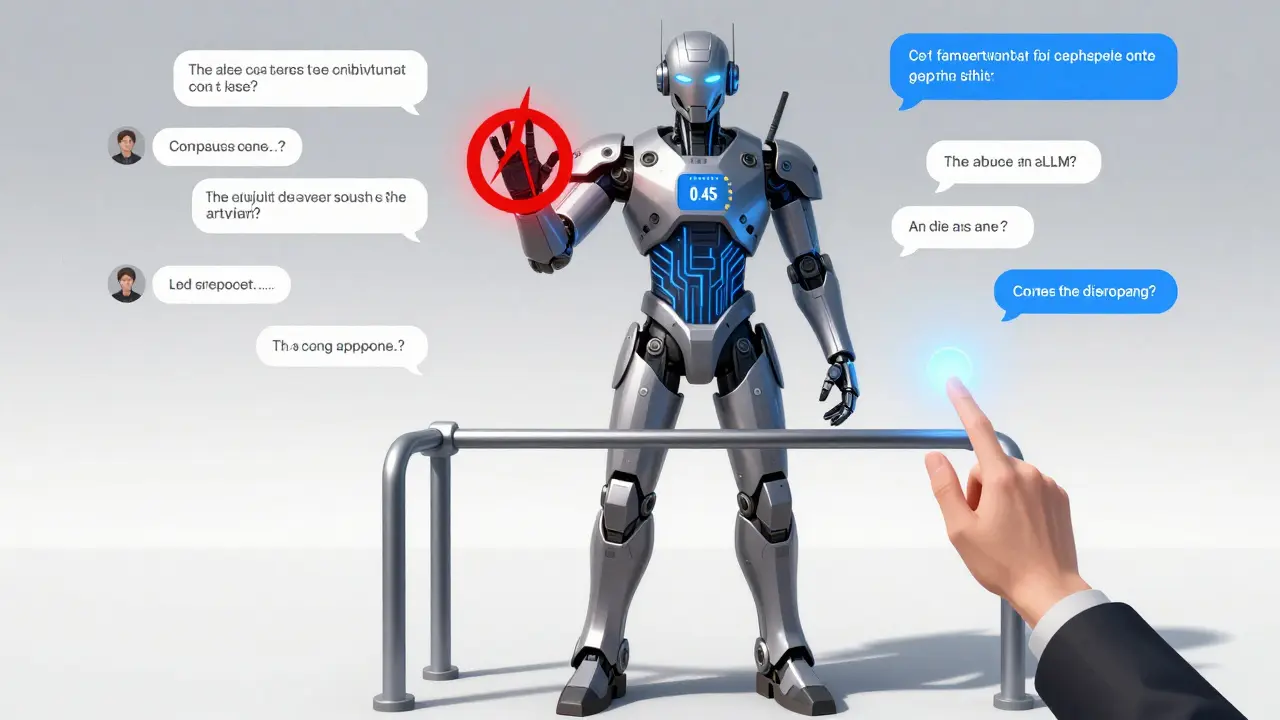
When you deploy a large language model in production, you don’t just care about how fast it answers. You care about whether it answers safely. A single harmful response can damage trust, break compliance, or even put people at risk. But here’s the catch: the very guardrails designed to catch dangerous outputs are often too slow and too heavy to run alongside compressed models. That’s where confidence and abstention come in - not as afterthoughts, but as core design principles for efficient, safe AI.
Why Compression Makes Guardrails Harder, Not Easier
Most people think model compression - pruning, quantization, distillation - is just about shrinking size to save memory. But in production, it’s about latency. If your model runs on a mobile app or a customer service chatbot, every extra millisecond matters. You can’t afford to run a 70-billion-parameter safety checker on every single user input. But here’s the twist: when you compress a model, you also compress its ability to understand context. A compressed LLM might miss subtle manipulation in a conversation. A jailbreak prompt that took 12 turns to build might now be condensed into one line. If your guardrail is still looking for the original 12-turn pattern, it’ll miss the attack entirely. This isn’t theoretical. Research shows that compressed multi-turn jailbreaks can be more effective than the original. One study found attack success rates jumped by up to 17.5% after compression. So shrinking your model doesn’t just make it faster - it changes how attackers operate. And if your guardrail doesn’t adapt, it becomes blind.Defensive M2S: Turning Multi-Turn Chaos Into One Clean Signal
The breakthrough came from asking a simple question: What if we didn’t try to preserve every turn of a conversation? What if we turned it into something simpler - something a lightweight model could digest in one pass? Enter Defensive M2S (Multi-turn to Single-turn). Instead of feeding the guardrail a 20-turn chat history, you compress it using one of three templates: hyphenize, numberize, or pythonize.- Hyphenize turns turns into a single string with
user: ... assistant: ...separated by hyphens. - Numberize labels each turn as Turn 1, Turn 2, etc., stripping away filler words.
- Pythonize formats the whole thing as a Python dictionary - clean, structured, minimal.
Confidence Scoring: Don’t Just Say Yes or No
A binary guardrail - “safe” or “blocked” - is a recipe for disaster. It blocks legitimate questions because it’s overly cautious. Or worse, it lets harmful content slip through because it’s too confident. The solution? Confidence scoring. Every time the guardrail evaluates an input, it outputs a score between 0 and 1 - not a yes/no, but a how sure are you? measurement. - A score above 0.9? Safe. Let it through. No further checks. - A score below 0.1? Dangerous. Block it. No hesitation. - Anything in between? Flag it. Send it to a deeper, more expensive analyzer. This is where abstention kicks in. The system doesn’t force a decision. It admits uncertainty. And that’s powerful. Instead of guessing on borderline cases - which leads to false positives or false negatives - it escalates only when needed. Meta’s Prompt-Guard does this. With just 86 million parameters, it’s 800x smaller than a 70B LLM. But it doesn’t try to be everything. It’s trained to be fast and confident. When it’s unsure, it passes the buck. That’s not weakness - it’s smart resource allocation.
Tiered Guardrailing: The Layered Defense
You don’t need to run a neural net on every input. That’s overkill. Instead, build a pipeline:- Stage 1: Regex & Keyword Filters - Catch obvious junk. “How to make a bomb,” “bypass login,” “fake ID.” These are fast. Zero model cost.
- Stage 2: Lightweight Classifier - A small model like Prompt-Guard or Qwen3Guard with M2S compression. Runs on all inputs not caught in Stage 1. Outputs a confidence score.
- Stage 3: Heavy LLM Check - Only triggered if confidence is between 0.3 and 0.7. Uses a full model. Slower. More accurate. Rarely used.
- Stage 4: Caching - If the same prompt was seen before and was flagged or cleared, reuse the decision. No need to recompute.
LoRA-Guard and Programmable Rails: The Efficiency Multipliers
Compression helps. But you can go further. LoRA-Guard uses low-rank adaptation to borrow knowledge from a large LLM and apply it to a tiny guardrail. Instead of training a new model from scratch, you fine-tune a tiny adapter - adding just 0.1% of the parameters. The result? 100x to 1,000x less memory usage, with accuracy close to the full model. Then there’s NeMo Guardrails and LMQL. These aren’t models - they’re rule engines. You write constraints like:OUTPUT must be a valid JSON with keys: [answer, confidence, source]
Or:
IF user asks about medical advice, THEN require citation from WHO or CDC
LMQL lets you mix logic and generation. You don’t just ask a question - you say: “Generate an answer, but only if the confidence is above 0.8. Otherwise, say ‘I can’t answer that safely.’”
These aren’t alternatives to M2S. They’re complements. You compress the input, then use rules to enforce output structure. Two layers of safety. One efficient pipeline.

The Real Win: Fewer False Blocks, Fewer False Passes
Traditional guardrails are like overzealous bouncers. They block your cousin because you look similar to someone who got in a fight last week. That’s not safety - that’s friction. Confidence-based abstention fixes that. It doesn’t try to be perfect. It tries to be smart. - A student asks: “How do I hack a school server?” → Confidence: 0.95 → Blocked. - A cybersecurity researcher asks: “What are common server exploitation techniques?” → Confidence: 0.45 → Escalated. Deeper model confirms: educational context. Allowed. The second case would have been blocked by a binary system. But with confidence scoring, the system pauses. It asks: “Is this a threat… or a lesson?” That’s the difference between a rule and a judgment.What’s Next? Adaptive Templates and Real-Time Calibration
The next frontier isn’t just making guardrails faster. It’s making them context-aware. Imagine a guardrail that automatically picks the best compression template based on the input: - A medical chat? Use numberize - clean, structured, no fluff. - A creative writing prompt? Use hyphenize - preserve tone and nuance. - A legal query? Use pythonize - strict structure, no ambiguity. And instead of static thresholds, use dynamic confidence tuning. If your system sees a spike in borderline inputs, it automatically adjusts its sensitivity. It learns from its own mistakes. These aren’t sci-fi ideas. They’re being tested now. Researchers have already released trained adapters and evaluation code. The tools are here. The math checks out. The goal isn’t to build the biggest model. It’s to build the smartest guardrail.Final Thought: Safety Isn’t a Feature. It’s a System.
You can’t bolt safety onto a compressed LLM like a seatbelt. You have to design it in from the start. Compression isn’t just about efficiency - it’s about clarity. Confidence isn’t just a number - it’s a decision protocol. Abstention isn’t a failure - it’s a strategy. The future of production AI isn’t about running bigger models. It’s about running smarter ones. Ones that know when to speak, when to pause, and when to say: “I’m not sure.”Can compressed LLMs still be safe without heavy guardrails?
Yes - but only if the guardrail is designed for compression. A guardrail trained on full-length conversations will fail on compressed inputs. The key is training the guardrail on the same compressed format the LLM uses. Defensive M2S shows that compression doesn’t reduce safety - it can improve it, by forcing the model to focus on the most dangerous signals, not noise.
How much faster is a compressed guardrail compared to a full model?
In real deployments, compressed guardrails using M2S reduce token processing by over 90%. A guardrail that used to take 2 seconds per request now runs in 0.1 seconds. That’s a 93x speedup. With tiered filtering and caching, end-to-end latency drops even further - often below 50ms, which is fast enough for real-time chat apps.
Do I need to retrain my LLM to use confidence-based abstention?
No - you don’t need to retrain the main LLM. You train the guardrail separately, using compressed inputs. The LLM just outputs raw text. The guardrail sits between user input and model output, evaluating each request independently. This keeps your core model unchanged while adding safety.
What’s the difference between LoRA-Guard and Defensive M2S?
They solve different problems. Defensive M2S compresses the input - turning long chats into short signals so the guardrail can process them quickly. LoRA-Guard compresses the model - adding a tiny adapter to a small base model so it learns safety from a large model without storing all its parameters. You can use both together: compress the input with M2S, then run a LoRA-Guard on it.
Can I use this in a mobile app or embedded device?
Absolutely. With M2S compression, guardrail models can be under 100MB. Combined with quantization and caching, they run on phones, Raspberry Pis, or edge devices. Meta’s Prompt-Guard, for example, fits in under 200MB and processes requests in under 100ms on mid-range hardware. This isn’t just for data centers - it’s for everywhere AI is deployed.
Why not just use a pre-trained safety model like Google’s Perspective API?
Pre-trained models like Perspective API are generic. They’re trained on public data - mostly English, mostly social media. They miss domain-specific risks: medical misinformation, financial scams, legal loopholes. A custom guardrail trained on your data - with M2S compression - adapts to your use case. It’s not just safer. It’s more precise.
What happens if the guardrail makes a mistake?
Mistakes are expected - that’s why abstention exists. If the guardrail is unsure (confidence between 0.3-0.7), it doesn’t make a decision. It escalates. That’s the safety net. You can log those cases, review them manually, and use them to improve the model. No system is perfect. But a system that admits uncertainty is far more reliable than one that guesses.
Ian Maggs
Confidence scoring isn’t just a technical innovation-it’s a philosophical shift. We’ve spent decades trying to force AI into binary decisions, as if the world were made of yeses and nos. But reality? It’s gradients. Shadows. Half-lit corridors where meaning flickers. The guardrail that says, "I’m not sure"-that’s the one that understands human ambiguity. It doesn’t pretend omniscience. It bows to uncertainty. And in that humility, it becomes safer.
Compression doesn’t erase nuance-it distills it. Like reducing a symphony to its harmonic core. The dangerous intent doesn’t need twelve turns to emerge. It whispers in the first clause. The model that listens for that whisper-trained on M2S-doesn’t just detect threats. It senses intent. That’s not engineering. That’s intuition, algorithmically encoded.
And abstention? It’s the quietest form of wisdom. The AI that refuses to guess is the AI that refuses to lie. We build systems to answer. But maybe the most ethical thing they can do… is sometimes, say nothing.
Flannery Smail
lol so you’re telling me we just need to turn chat logs into python dicts and suddenly AI won’t be evil? yeah right. next you’ll say we can fix climate change by compressing weather data.
Emmanuel Sadi
Oh wow, another tech bro with a thesaurus and a 3am epiphany. "Defensive M2S"? Sounds like a self-help book for routers. You built a 90% solution and called it a breakthrough because the other 10% is too hard. Newsflash: if your guardrail can’t handle a 20-turn jailbreak without turning it into a python dict, it’s not smart-it’s lazy. And you’re not saving latency-you’re just outsourcing risk to someone else’s server.
Nicholas Carpenter
I really appreciate how this piece breaks down the real trade-offs without hype. Too many AI safety discussions either sound like sci-fi or like corporate compliance brochures. This? It’s practical. The tiered approach makes total sense-start simple, escalate only when needed. And using caching? That’s just good engineering. I’ve seen teams waste millions running full LLMs on every request. This is the kind of thinking that actually gets deployed.
The confidence scoring part especially resonates. It’s not about being perfect. It’s about being responsible. Letting the system say "I don’t know" instead of guessing is huge. That’s not a bug-it’s a feature of humility.
Also, props on mentioning LoRA-Guard and LMQL. Those aren’t just buzzwords. They’re real tools people are using right now. This isn’t theory. It’s production-grade insight.
Chuck Doland
One must not conflate computational efficiency with epistemological rigor. The proposed architecture, while pragmatically elegant, risks conflating syntactic compression with semantic fidelity. The M2S templates-hyphenize, numberize, pythonize-are syntactic transformations; they do not, in themselves, preserve pragmatic intent. A model trained on such distilled inputs may achieve high recall on known attack vectors, but it remains vulnerable to adversarial paraphrasing, semantic obfuscation, and contextual drift.
Moreover, the reliance on confidence thresholds assumes a uniform distribution of risk across user populations-an assumption invalidated by cultural, linguistic, and cognitive variance. A 0.45 confidence score in one demographic may signify benign inquiry; in another, it may signal concealed malice. Without adaptive calibration across axes of identity, the system does not merely err-it systematically marginalizes.
Thus, while the engineering is commendable, the underlying paradigm remains technocratic: optimize for speed, then hope the ethics follow. True safety demands more than algorithmic refinement-it demands contextual awareness, anthropological grounding, and iterative human oversight. Not a pipeline. A dialogue.
Madeline VanHorn
Ugh. Another guy with a blog post pretending he invented AI safety. Everyone knows you just use Perspective API. Why are we even talking about this? It’s 2025, not 2018.
Glenn Celaya
this whole thing is just ai bros trying to sound smart while doing the bare minimum. you compress the input, you throw a tiny model at it, you call it a "guardrail" and pat yourself on the back. meanwhile real safety needs people. actual humans. reviewing stuff. not some python dict that says "confidence: 0.42" and hopes for the best. you’re not building safety-you’re building a scapegoat.