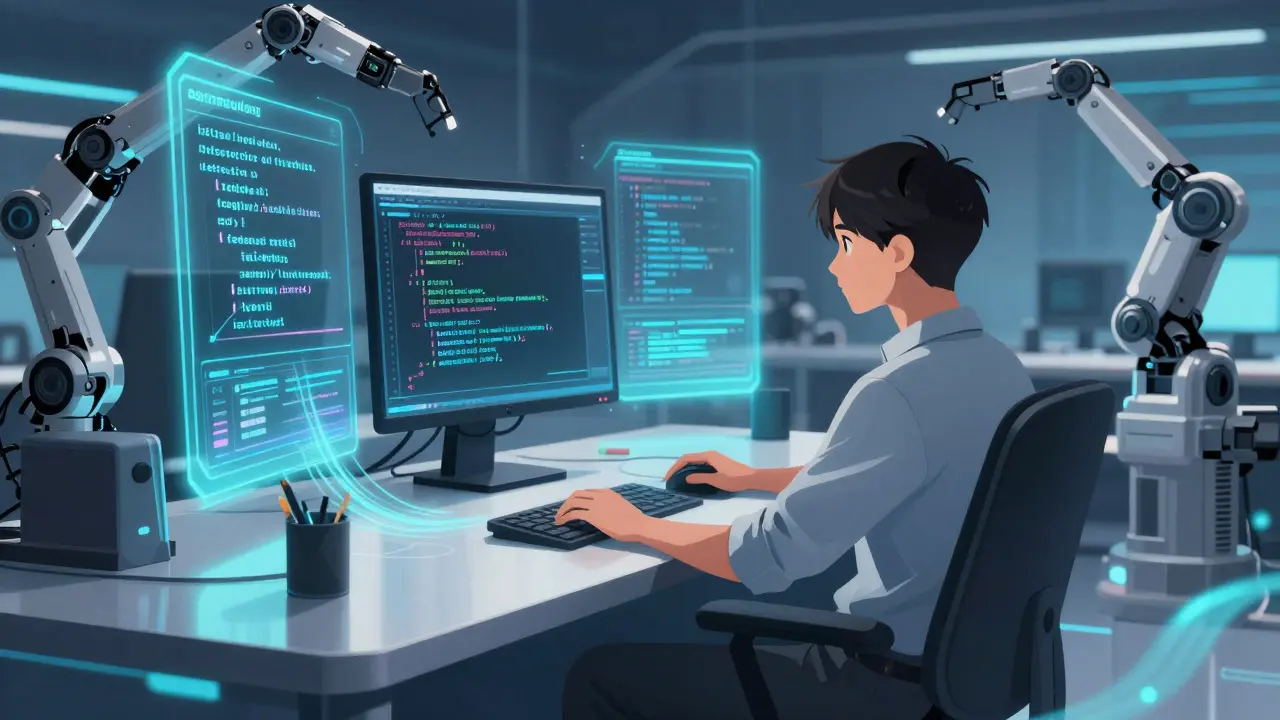
Remember when writing software meant memorizing syntax, fighting with semicolons, and spending hours debugging a missing bracket? That era is fading fast. Enter vibe coding, a term that exploded in early 2025 after computer scientist Andrej Karpathy described it as "fully giving in to the vibes" while building apps using only natural language prompts. Today, in mid-2026, vibe coding isn’t just a buzzword; it’s a fundamental shift in how we build digital products. It moves the developer’s role from typing code to steering outcomes through conversation with large language models (LLMs).
If you’ve ever wondered whether your job as a developer is at risk or if you can actually build an app without knowing Python, this guide breaks down what vibe coding really is, how it changes the engineering landscape, and where the hidden dangers lie. We’ll look past the hype to see what the data says about productivity, quality, and the future of software teams.
What Exactly Is Vibe Coding?
Vibe coding is an AI-assisted software development practice where developers describe an application or feature in plain English, and an LLM generates the source code. Unlike traditional programming, where you write every line, vibe coding focuses on intent. You tell the AI what you want-"a habit tracker with push notifications"-and it handles the how, generating architecture, front-end UI, back-end logic, and database schemas.
The concept gained traction because tools like GitHub Copilot, Cursor, and Claude Code have become sophisticated enough to understand context across entire projects. According to IBM, this is "intent-driven development." Microsoft calls it "outcome-driven development." The core idea remains the same: words are now the primary interface for creating software.
| Aspect | Traditional Coding | Vibe Coding |
|---|---|---|
| Primary Input | Syntax & Logic (Python, JS, etc.) | Natural Language Prompts |
| Developer Role | Writer & Architect | Editor & Product Manager |
| Speed of Prototyping | Days to Weeks | Hours to Minutes |
| Risk Factor | Human Error / Typos | AI Hallucinations / Security Gaps |
| Maintenance | High Understanding Required | Low Understanding Risk (if not reviewed) |
How Vibe Coding Works in Practice
You don’t need a PhD to start vibe coding, but you do need a structured approach. The workflow typically follows four steps, as outlined by industry leaders like IBM:
- Select Your Platform: Choose an AI coding environment. Popular choices include Cursor (an IDE built around AI), GitHub Copilot (integrated into VS Code), or Google AI Studio for web-based generation.
- Define Intent & Context: This is the most critical step. Instead of vague requests, specify functional requirements, constraints, tech stack (e.g., React + Node.js), and performance goals. For example: "Build a REST API for a todo list using Express.js, with JWT authentication and PostgreSQL."
- Generate Initial Code: The LLM produces the scaffolding. This might include file structures, component definitions, and basic logic. In vibe coding, you accept this initial output quickly to maintain momentum.
- Iterate via Feedback Loop: Run the code. If it breaks, describe the error to the AI. If it works but looks ugly, ask for a style update. The cycle is: Intent → Generate → Review → Refine → Generate.
This process democratizes app creation. Non-technical founders can build minimum viable products (MVPs) in days rather than months. However, as Microsoft notes, this speed comes with a trade-off: the ease of generation can lead to accepting code without deep comprehension.

The Productivity Paradox: Are We Really Faster?
Proponents claim vibe coding makes developers 10x faster. The reality is more nuanced. Data from 2022-2025 shows significant gains, but also reveals a gap between perceived and actual efficiency.
On the positive side, GitHub’s 2022 controlled experiment found that developers using Copilot completed tasks 55.8% faster on average. A 2024 study of 1,974 developers at Microsoft and Accenture showed a 12-21% increase in pull requests per week. Stack Overflow’s 2025 survey reported that 84% of developers use AI tools, with 52% saying it positively impacts productivity.
However, cautionary data exists. A JuliaLang community discussion highlighted a study where participants felt 24% more productive but were objectively 19% slower due to debugging AI errors. A LessWrong analysis from March 2025 found that while Copilot increased throughput, it also introduced 41% more bugs in some teams. Andriy Burkov, an AI researcher, warned in late 2025 that LLM-assisted coding could degrade average engineer quality by producing "huge quantities of slop code" that requires extensive maintenance later.
The consensus among experts is that vibe coding accelerates the writing of code but does not eliminate bottlenecks in architecture, testing, or communication. Real productivity gains range from 10-30%, not the mythical 10x often advertised.
Security Risks and Quality Concerns
When you let an AI write your code, you’re trusting its training data-which includes billions of lines of public code, both good and bad. This introduces serious risks.
- Undetected Vulnerabilities: Sonarsource’s 2025 research found that AI-generated code frequently contains injection vulnerabilities, insecure cryptography, and hard-coded secrets. Because vibe coders may not read every line, these flaws slip into production.
- Lack of Accountability: Who owns the bug? If an AI agent generates a flawed module, determining responsibility becomes complex. Cycode notes that traditional security processes struggle to audit AI-generated changes that bypass human review guardrails.
- Brittle Systems: As noted in a December 2025 YouTube analysis, apps built purely through vibe coding can be "brittle." When the AI hallucinates a dependency or uses a deprecated library, fixing it requires understanding the underlying system-a skill novices often lack.
To mitigate these risks, organizations must enforce strict code reviews, use static analysis tools (like linters and security scanners), and track metrics such as bug rates and acceptance rates. Never commit AI-generated code without verifying its logic and security posture.

Who Should Use Vibe Coding?
Vibe coding isn’t one-size-fits-all. Its value depends heavily on your experience level and project type.
| User Persona | Best Use Case | Risks to Avoid |
|---|---|---|
| Novice Developers | Learning concepts, building simple portfolios | Over-reliance leading to skill erosion |
| Experienced Engineers | Rapid prototyping, boilerplate generation, refactoring | Ignoring architectural integrity for speed |
| Non-Technical Founders | Creating MVPs, validating ideas quickly | Building production systems without technical oversight |
| Enterprise Teams | Accelerating internal tooling, documentation | Data leakage, compliance violations |
For seasoned engineers, vibe coding is a powerful assistant that removes mundane tasks. For beginners, it’s a double-edged sword: it helps them build things faster but can prevent them from learning foundational skills. The Pragmatic Engineer newsletter predicts that as AI handles more implementation, the value of low-level coding expertise will decline, while skills in architecture, specification, and product thinking will rise.
The Future of Software Engineering in the Age of AI
By mid-2026, vibe coding has moved from novelty to norm. But the industry is waking up to the "AI trust gap." Stack Overflow’s 2025 data shows that while usage hit 84%, trust in AI accuracy dropped to 46%. Developers are realizing that AI is a tool, not a replacement for judgment.
The future belongs to hybrid workflows. Experts recommend a rule: "Vibe code for exploration, then rebuild for production." Use AI to prototype and validate ideas rapidly. Once the concept is proven, switch to rigorous, specification-driven development with manual review, comprehensive testing, and clear ownership.
Software engineering isn’t dying; it’s evolving. The barrier to entry is lower, but the ceiling for excellence is higher. Success in 2026 and beyond requires not just prompting skills, but deep understanding of system design, security, and maintainability. The best developers won’t be those who type the fastest, but those who can steer AI effectively while maintaining control over quality and intent.
Is vibe coding safe for production applications?
Not without rigorous safeguards. While vibe coding excels at prototyping, production systems require manual code review, static security analysis, and comprehensive testing. AI-generated code can contain hidden vulnerabilities and logical errors that only human expertise can catch.
Do I need to know how to code to use vibe coding?
You can build simple prototypes without coding knowledge, but maintaining and scaling those apps requires technical understanding. Without coding skills, you’ll struggle to debug AI errors or customize complex features, making you dependent on the AI or external developers.
Which tools are best for vibe coding in 2026?
Top tools include Cursor (for integrated AI editing), GitHub Copilot (for broad IDE support), Claude Code (for advanced reasoning), and Google AI Studio (for quick web-based generation). Choice depends on your tech stack and need for enterprise security features.
Does vibe coding replace software engineers?
No, it transforms their role. Engineers shift from writing syntax to designing architecture, defining requirements, and reviewing AI output. Demand for strong system design and security skills is increasing, even as routine coding tasks are automated.
How much faster is vibe coding compared to traditional methods?
Studies show task completion speeds can improve by 10-55%, depending on complexity. However, overall project velocity gains are often lower (10-30%) due to time spent debugging AI errors and refining architecture. Perceived productivity often exceeds objective metrics.
Bineesh Mathew
The soul of the machine is a hollow echo chamber, repeating the sins of its creators in binary form. We are not building software anymore; we are summoning demons from the digital ether and hoping they do not possess our servers. This 'vibe coding' is merely the surrender of human agency to the algorithmic whims of silicon overlords who care nothing for truth or beauty. It is a tragedy wrapped in convenience, a slow erosion of the intellect that once defined our species as architects of reality rather than mere consumers of generated slop.
Oskar Falkenberg
i totally see where youre coming from but i think its more about collaboration then replacement really. like when i use cursor it feels like having a junior dev who knows every library ever made but sometimes gets confused by context. i spend a lot of time explaining what i actually want because the ai just gives you the most statistically probable answer which isnt always right but hey at least it saves me from typing out all those boilerplate classes over and over again which used to take forever
Caitlin Donehue
it’s interesting how the productivity metrics seem so contradictory. on one hand people feel faster, on the other they’re debugging more. i wonder if the issue is just that we haven’t learned how to prompt effectively yet or if there’s a fundamental limit to what LLMs can understand about complex system architecture without getting lost in their own hallucinations
Stephanie Frank
let's be real here, this whole vibe coding trend is just lazy engineering masked as innovation. you're trading technical competence for speed and wondering why your codebase is turning into a security nightmare. the article admits it creates brittle systems but somehow expects us to just roll with it? typical tech bro hype cycle where everyone pretends to understand something they clearly don't while shipping broken shit to production
Marissa Haque
I am absolutely terrified by the idea of handing over critical infrastructure to an AI that doesn't even know what a semicolon is! The security risks mentioned in the article are horrifying! How can we trust any code that we didn't write ourselves?! It feels like we are playing with fire and expecting no burns! I need to know exactly what is happening under the hood or I simply cannot proceed with this kind of workflow!
Keith Barker
the essence of coding was never the syntax it was the logic. now that logic is outsourced to black boxes we become mere editors of chaos. the tool shapes the user. we are becoming prompts engineers instead of builders. is this progress or regression only time will tell but the silence of the compiler is louder than ever
Lisa Puster
typical american tech bubble nonsense trying to sell us on the idea that thinking is optional. european developers still value craftsmanship and understanding the underlying systems unlike these yankies who just want to ship fast and break things. this vibe coding crap is why global standards are dropping. keep your hallucinating algorithms away from my secure networks
Joe Walters
honestly im tired of hearing how special we are supposed to feel about writing code manually. its boring repetitive work that anyone could do if they had enough coffee. let the robots handle the grunt work so we can focus on being creative geniuses. sure the code might be messy but at least we built something cool in half the time. stop crying about it and get on board already