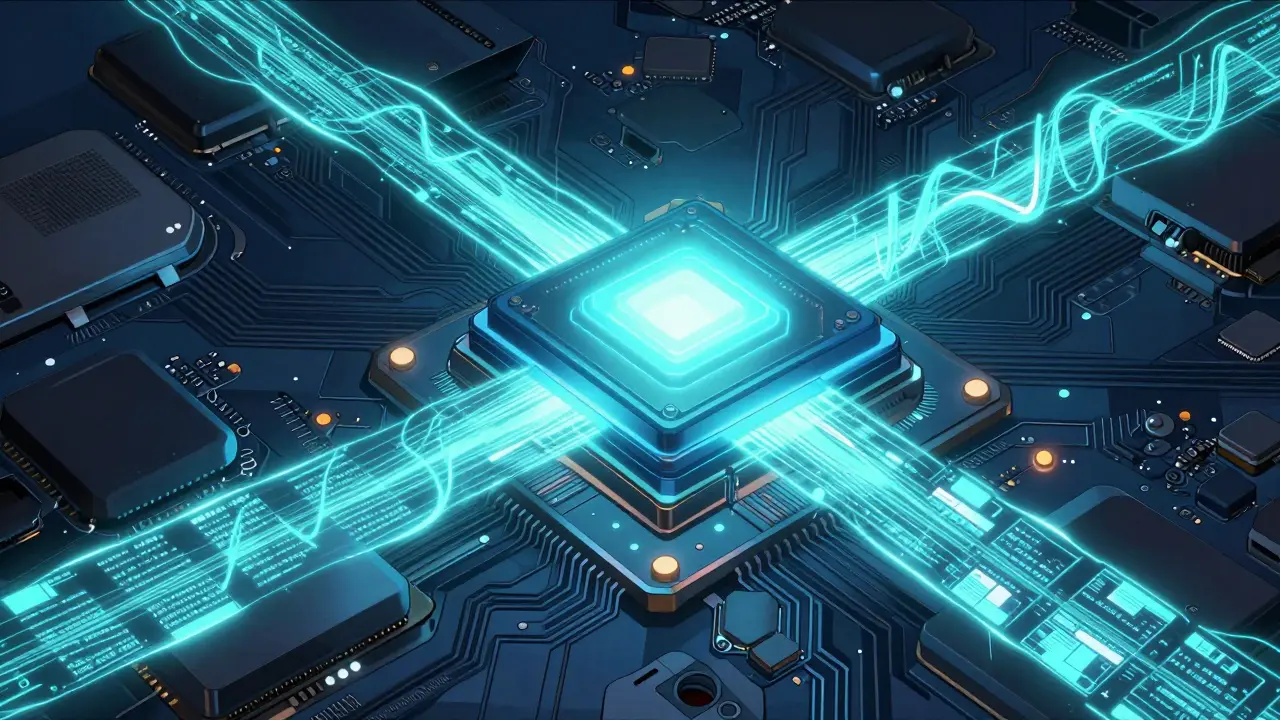
When you ask a modern AI system to generate a video clip while describing it in text and adding background music, you aren't just asking for creativity; you're asking for a computational marathon. By March 2026, this shift toward truly Multimodal Generative AI has forced hardware engineers to rethink everything from silicon design to memory management. Traditional single-modal models could get away with focusing solely on tokens, but fusing audio, visual, and textual streams in real-time creates bottlenecks that standard CPUs simply cannot solve. We've moved past the era where software optimization alone could save the day.
The core challenge lies in the sheer volume of data fusion required. A unified model doesn't just process images or text separately; it aligns them in shared representational spaces. This demands a level of parallel processing power that was previously reserved for supercomputers. As we evaluate the landscape of accelerators available in 2026, three distinct hardware categories emerge as critical pillars: Graphics Processing Units (GPUs) for heavy lifting, Neural Processing Units (NPUs) for efficiency, and specialized Edge devices designed for latency-sensitive tasks. Understanding which chip does what-and why-determines whether your deployment succeeds or crumbles under latency constraints.
The Computational Cost of Multisensory Data
To build systems that see, hear, and speak simultaneously, you have to account for the massive increase in floating-point operations (FLOPs). While Large Language Models (LLMs) were computationally expensive, integrating video and audio into the inference pipeline increases the demand significantly. Estimates suggest that truly unified Multimodal Generative AI systems require 10 to 100 times more FLOPs than their text-only predecessors. This isn't just because there is more data, but because the cross-modal attention mechanisms are complex.
Memory bandwidth becomes the primary constraint here. When processing long sequences across multiple modalities, the time spent moving data often exceeds the time spent computing it. High-bandwidth memory (HBM) is no longer a luxury feature; it's a baseline requirement. For instance, NVIDIA's H100 and subsequent generations rely heavily on memory architecture to keep the compute cores fed. If the data pipeline stalls, even the fastest processor sits idle. In enterprise stacks validated by companies like Lenovo and NVIDIA, ensuring fast interconnects between storage and compute units is prioritized over raw clock speed.
This shift changes how we view training versus inference. Training requires massive clusters of GPUs connected via NVLink or InfiniBand, but inference is where the hardware diversity truly matters. You don't need a data center to run every query, but you do need hardware capable of sustaining the throughput of multi-modal streams without dropping frames or introducing lag.
GPUs: The Workhorse of Model Training and Inference
Despite the rise of specialized chips, the Graphics Processing Unit remains the dominant force for initial model development and high-throughput inference. GPUs are highly parallel processors originally designed for rendering graphics but repurposed for matrix multiplication workloads essential in deep learning. GPU ecosystems, particularly those built around CUDA, offer mature libraries that streamline complex operations.
The reason GPUs still lead is simple versatility. A single GPU can handle the sparse attention matrices required by LLMs and the dense convolution operations needed for image generation. However, running pure inference on consumer-grade GPUs is becoming inefficient due to energy consumption. For production environments, the focus shifts to data-center grade options like the NVIDIA A100 or H100, which support specific optimizations like Flash Attention.
Recent developments have introduced tools like PyTorch SDPA (Scaled Dot-Product Attention) that leverage these GPU capabilities directly. Research indicates that implementing SDPA can accelerate inference performance by 43% in maximum-batch settings on A100-class hardware. These optimizations reduce the overhead of kernel launches, allowing the GPU to stay active longer. Without such algorithmic improvements, the raw hardware specs are wasted. The industry has reached a point where hardware vendors and software frameworks must evolve together to realize true potential.

The Rise of NPUs and AI PC Integration
While GPUs dominate the cloud, the local device market is pivoting aggressively toward Neural Processing Units. An NPU (Neural Processing Unit) is a specialized processor designed explicitly for accelerating machine learning tasks, offering higher efficiency per watt than general-purpose GPUs. NPU handles the specific mathematical patterns of neural networks much better than a CPU or even a generic GPU. By 2026, Intel and AMD have integrated robust NPUs into mainstream laptops and desktops, enabling "AI PCs" to run local versions of Stable Diffusion or smaller language models.
This integration allows for practical implementation of multimodal learning without relying entirely on the cloud. Using toolkits like OpenVINO, developers can optimize models to run on these heterogeneous platforms. The benefit is privacy and latency. When you run a voice-to-text transcription locally, the data never leaves your device, and there's no network roundtrip delay. Intel has actively promoted combining GPUs and NPUs to handle different parts of the workload-leveraging the GPU for heavy graphics rendering while offloading the math-heavy AI tensors to the NPU.
The trade-off remains raw power. An NPU on a laptop might consume 25W compared to a server GPU consuming 400W+, meaning local generation will inevitably be slower for high-resolution video synthesis. However, for real-time filtering, summarization, and basic generative tasks, the NPU provides a sustainable performance profile that keeps battery life reasonable.
Edge Constraints and Real-Time Processing
Deploying multimodal AI at the edge introduces the toughest constraints: power and physical size. Traditional edge devices like smartphones or cameras cannot house large cooling systems or draw significant power. Yet, the need for low-latency interaction in physical AI (like robotics or autonomous vehicles) forces us to push these boundaries.
Edge computing challenges are defined by three factors: thermal dissipation, battery drain, and limited RAM. Standard transformer models are too heavy for most mobile form factors. To combat this, the industry is moving toward distillation techniques where smaller "student" models learn from larger "teacher" models. Additionally, hardware architectures now prioritize on-chip memory. If the model fits within the edge accelerator's cache, you avoid the energy penalty of fetching data from external RAM.
Consider the implications for robotics. A robot processing video and tactile sensors requires instantaneous feedback loops. Sending sensor data to the cloud for processing introduces a latency floor that makes control impossible. Therefore, dedicated edge accelerators utilizing RISC-V architectures are gaining traction, offering custom instructions for specific sensor fusion tasks. This is where hardware abstraction layers become critical, allowing developers to port code across different edge chips without rewriting kernels.

Optimization Techniques That Bridge Hardware Gaps
Buying powerful hardware solves part of the problem, but software optimization is the multiplier. Recent characterizations of multi-modal generation show that optimization methods like quantization and compilation can drastically alter performance numbers. Quantization reduces the precision of weights from 16-bit or 32-bit floats down to 8-bit integers. This shrinks model size and speeds up computation with negligible loss in quality.
CUDA Graphs are another vital tool for GPU users. By pre-compiling the entire workflow of a model execution, developers can eliminate the scheduling overhead that typically slows down auto-regressive generation. Combined with LayerSkip techniques-which allow models to bypass certain attention layers during inference-researchers have seen inference speeds jump by 58%. When you combine these algorithmic tricks with efficient hardware, the results compound.
Tokenizers also play a hardware role. New architectures like Cosmos tokenizers utilize 3D wavelets to compress pixel information more efficiently before the model sees it. This reduces the input size the hardware needs to process. During inference, these tokenizers deliver up to 12 times faster reconstruction compared to older standards. This proves that data representation formats directly impact hardware utilization.
Unified Architectures: The Path Forward
We are witnessing a shift from modular pipelines to unified neural networks. Historically, vision and text models were separate, requiring manual stitching of outputs. Systems like GPT-4o demonstrate the alternative. By training a single network on images, audio, and text simultaneously, the resulting model utilizes a unified representational space. This architectural change impacts hardware usage significantly.
A unified model removes the latency associated with passing data between different specialized modules. Where a legacy pipeline might incur 2.8 seconds of latency by juggling three models, a unified approach brings that down to sub-second response times. For hardware, this means the accelerator doesn't need to switch contexts between different types of tensor operations as frequently. It sustains a more consistent memory access pattern, which improves cache hit rates and overall throughput.
However, this places new demands on the compute fabric. The cross-modal attention required by unified models is far more intensive. It demands a wider interconnect bus so that different parts of the chip can share activations freely. As we move forward, expect hardware designs that prioritize high-speed internal communication (NoC - Network on Chip) alongside raw compute density.
Why can't I just use my CPU for multimodal generation?
CPUs lack the massive parallel processing capability required for tensor operations in deep learning. Running multimodal tasks on a CPU would result in latencies measured in minutes rather than milliseconds. GPUs and NPUs provide thousands of cores optimized specifically for the matrix multiplications inherent in neural networks.
Is NPU better than GPU for AI?
It depends on the context. NPUs excel in efficiency and battery life, making them ideal for AI PCs and edge devices. GPUs remain superior for raw throughput and training, especially for large-scale model development. Most modern systems now use both in tandem for different stages of the workflow.
What is the biggest bottleneck in hardware acceleration right now?
Memory bandwidth is currently the limiting factor. Even if compute cores are fast, they sit idle waiting for data to load from VRAM. Technologies like High-Bandwidth Memory (HBM) and on-package memory controllers are essential to keeping the pipeline full.
Do I need to retrain my models to use NPU hardware?
Yes, usually. You must optimize or recompile your model for the specific instruction set supported by the NPU. Tools like OpenVINO or ONNX Runtime help bridge this gap, but direct compatibility isn't always guaranteed out of the box.
How does quantization affect hardware performance?
Quantization reduces model precision (e.g., from FP32 to INT8), which decreases memory usage and increases inference speed. It allows the hardware to process more data bits per cycle, significantly lowering latency and power consumption with minimal quality loss.
Mbuyiselwa Cindi
It is wild seeing how fast NPUs are catching up on laptops. I used to think I needed a dedicated graphics card for every little ML task. Now my daily driver handles transcription without touching the network. Privacy is definitely the big selling point for me personally. Local inference means no data leakage risks either. Companies really need to stop pushing cloud-only solutions for basic tasks. We can build much cooler workflows when latency isn't a barrier. Hope you found the comparison table useful for your setup decisions.
sampa Karjee
Consumer grade NPUs are toys compared to server clusters.
You cannot expect HBM speeds on a silicon-on-package laptop chip.
Stop confusing hobbyist tinkering with actual engineering requirements.
This guide glosses over thermal throttling issues completely.
Sheila Alston
People keep forgetting the carbon footprint of training these massive models in the first place. We celebrate efficiency while ignoring the energy grid strain required to sustain this growth. It feels like we are solving problems we do not actually have yet. The necessity of local video generation remains unproven given our currently saturated content ecosystem. The push for always-on AI sensors creates privacy violations we might not survive. Corporations claim optimization but they just mean higher margins for their hardware sales. We saw this trend with crypto mining and the e-waste pile up was inevitable. Every new accelerator sold is another device destined for a landfill in three years. Software updates should extend lifespan instead of forcing hardware obsolescence cycles. The focus on speed ignores the human cost of the supply chain entirely. Ethical AI requires ethical hardware procurement which is rarely discussed here. We need regulations on minimum efficiency standards before allowing sales in consumer markets. Otherwise we are just building a more expensive waste management system disguised as innovation. It is disheartening to see such enthusiasm for technology that lacks accountability measures. True progress should measure value in lives improved rather than frames per second.
Kieran Danagher
Oh wonderful another lecture on the inherent evil of computation while using a battery powered device. Efficiency gains directly reduce the total energy cost per operation globally. If you stopped using your laptop because of climate guilt we could still run the servers. It is funny how hardware criticism focuses only on the manufacturing phase. The net benefit of automation outweighs the initial extraction costs easily. Maybe skip the sermon and try running the model yourself first.
Shivam Mogha
Memory bandwidth is indeed the primary constraint holding back widespread adoption.
mani kandan
There is something magical about watching generative art happen right on your screen without buffering. Latency used to be this invisible wall keeping us from real interaction. Now everything flows like water instead of stuck packets in a queue. I love how the new tokenizers compress visual noise so well. It feels like the machine actually understands the texture of reality. Developers should prioritize smoothness over raw resolution for better immersion. The aesthetic experience of local processing is underrated by engineers. We are entering an era where digital creation becomes almost tactile.
Rahul Borole
Quantization strategies remain essential for maintaining quality on resource constrained environments. Reducing precision allows significantly more parameters to fit into on board memory. We must carefully monitor accuracy drops when switching from float thirty-two to int eight. Many engineers overlook the calibration steps required for optimal performance results. Without proper scaling factors the output degradation becomes immediately visible to users. It is critical to implement error correction mechanisms during the inference pipeline stages. Recent papers show mixed quantization preserves layer sensitivity better than uniform methods. This approach stabilizes the gradients while reducing overall memory footprints drastically. Implementing this requires specific compiler support within the underlying runtime framework. CUDA Graphs help bypass overhead but quantization addresses capacity limits directly. Users demand speed but developers must prioritize stability during batch processing. We can achieve near native performance levels with careful weight pruning techniques applied correctly. Training free distillation also provides a viable path for legacy model deployment scenarios. Future architectures will likely support dynamic precision modes natively on chip. This evolution marks a turning point for sustainable high performance computing infrastructure. We must continue validating these methodologies against real world benchmarks rigorously.
Sheetal Srivastava
Your discussion on gradient stabilization misses the nuance of non-linear activation scaling. We must integrate sparsity patterns early to avoid vanishing signal propagation. The tensor cores rely on specific bit-width alignment for maximum throughput efficiency. Ignoring the interconnect topology leads to significant latency spikes during cross-modal attention. High bandwidth memory controllers dictate the ceiling for effective parameter utilization rates. Optimization pipelines require end-to-end compilation graph profiling for true gains. We see diminishing returns beyond certain quantization thresholds regarding model perplexity scores. Dynamic batching strategies further complicate the memory coalescing logic on the fly. Hardware abstraction layers often obscure the true thermal headroom available for sustained loads. Engineers need to revisit the fundamental arithmetic logic units for better sparse matrix support.