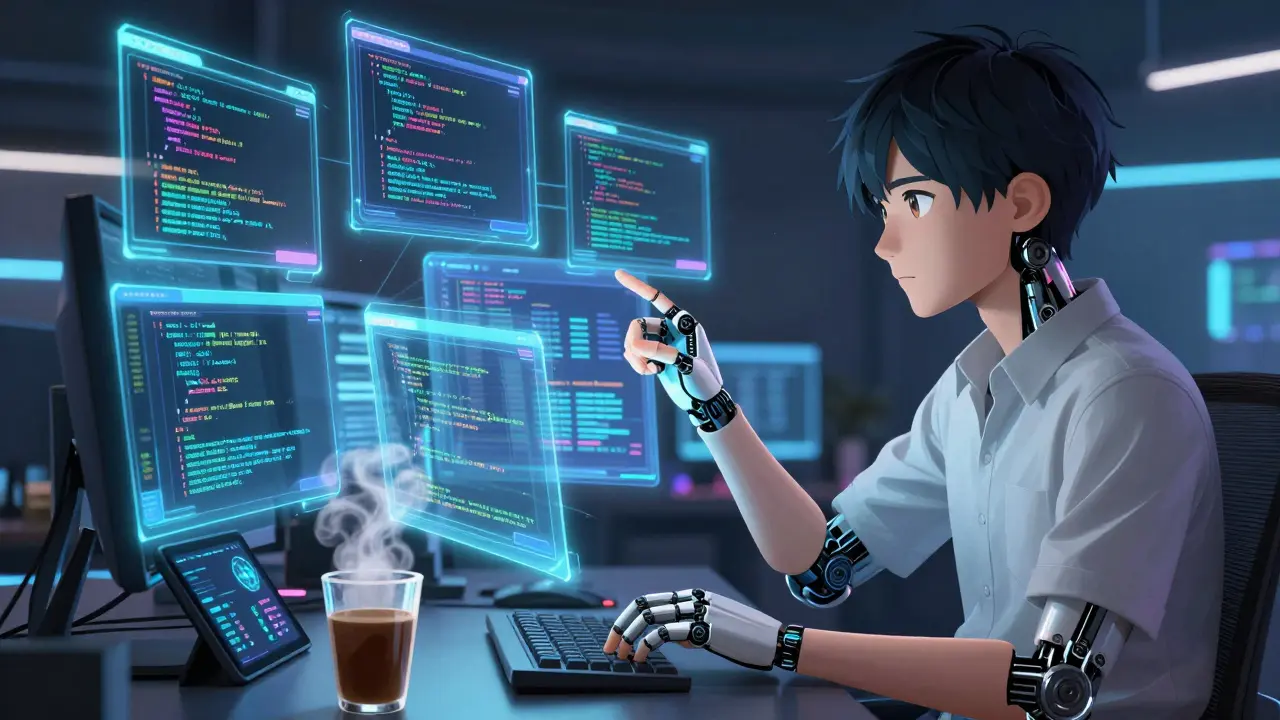
Five years ago, hiring a developer meant looking for someone who could write clean, efficient code from scratch. Today, it’s about who can vibe code-who can think out loud, iterate fast, and let AI do the heavy lifting while they steer the ship. Companies aren’t just hiring coders anymore. They’re hiring orchestrators.
What Is Vibe Coding, Really?
Vibe coding isn’t a programming language. It’s not even a tool. It’s a mindset. It’s when a developer types a vague idea into Cursor or Replit, watches AI generate five versions of a feature, picks the one that feels right, tweaks it with a few commands, and ships it before lunch. No debugging marathon. No stack overflow deep dives. Just flow.
Tools like v0 by Vercel, Windsurf, and Lovable have turned UI design into a conversation. You say, "Make a dashboard for tracking user engagement," and it builds you a fully responsive, accessible, styled interface in seconds. The developer’s job? Tell it what to fix. Not how to build it.
This shift isn’t theoretical. In Q4 2025, over 62% of startups in Silicon Valley and Boulder reported that their core product features were built using AI-assisted workflows. Not by junior devs. Not by outsourced teams. By their top engineers-using vibe coding.
What Skills Are Employers Actually Paying For?
If you think employers still care about memorizing Python syntax or knowing every React hook, you’re behind. Here’s what’s on their radar now:
- Prompt engineering for code-not just "build a login page," but "build a login page that feels like Apple’s, uses OAuth 2.1, and handles edge cases for users in rural areas with spotty internet."
- Decision filtering-AI gives you 12 options. Which one scales? Which one breaks under load? Which one matches your brand tone? That’s your job now.
- Context awareness-Can you explain why the AI suggested a Node.js backend when a Python one would be better for your team’s expertise? Can you spot when the AI is hallucinating a deprecated API?
- Iterative refinement-You don’t wait for perfect code. You ship a rough version, watch real users interact with it, then say, "Make it faster," "Make it friendlier," "Make it less scary for non-tech users."
- Tool fluency-You don’t need to be the best coder. You need to be the best user of AI coding assistants. Know when to use Cursor vs. Replit vs. GitHub Copilot. Know their limits.
Companies aren’t asking for GitHub stars anymore. They’re asking for velocity with intention. A 2025 survey by HackerRank of 1,200 tech hiring managers found that 78% prioritized a candidate’s ability to refine AI-generated code over their ability to write code from scratch.
The New Resume Red Flags
Here’s what gets you rejected now:
- A resume that lists "10 years of Java experience" without mentioning AI tools you’ve used.
- Code samples that look like they were written in 2018-no comments, no AI annotations, no iterative history.
- Claims like "I built this entire app myself"-when it’s clear AI generated 80% of it.
On the flip side, candidates who show how they worked with AI win. A portfolio that includes:
- Before-and-after prompts: "Original request: 'Make a chart.' → Final version: 'Make a chart that auto-updates every 5 seconds, highlights outliers in red, and explains trends in plain language.'"
- Video walkthroughs of their coding session-showing how they guided the AI, corrected mistakes, and iterated.
- Metrics: "Reduced feature delivery time from 4 days to 4 hours using AI-assisted workflows."
Who’s Getting Hired-and Who’s Getting Left Behind?
It’s not about seniority anymore. It’s about adaptability.
Junior devs who grew up with AI tools are outpacing veterans who resisted them. A Boulder-based SaaS company hired a 22-year-old developer who had never written a line of code without AI. In six months, she shipped three major features that had been stuck for over a year. Why? She didn’t fight the tools. She used them like a DJ uses a mixer-knowing when to cut, when to loop, when to layer.
Meanwhile, mid-level engineers who still think "real coders don’t use AI" are being quietly phased out. One manager in Austin told me, "I gave three devs six months to adapt. Two left. One became our best performer. The other two? They kept saying, 'This isn’t real programming.' I said, 'Neither is typing 'Hello World' in 2026.'"
Salaries Are Changing Too
Base pay for full-stack devs hasn’t skyrocketed-but the bonus structure has.
Companies are now offering:
- Velocity bonuses-extra pay for shipping features faster than the team average.
- AI adoption credits-bonuses for using AI tools to reduce technical debt or improve code quality.
- Refinement incentives-reward for catching and fixing AI errors before they hit production.
In 2025, the average salary for a vibe coder in the U.S. was $132,000-up 18% from 2023. But the top 10%-those who consistently turned AI output into polished, user-tested features-earned $195,000+. Their edge? Not coding skill. Curiosity.

How to Get Ready for This Future
Here’s what to do right now:
- Switch to an AI-first workflow. Use Cursor or Replit daily. Don’t wait for "the right project."
- Document your prompts. Save the ones that worked. Learn what phrasing gets the best results.
- Build a public "vibe coding" portfolio. Record short videos of you building something with AI. Show your thinking.
- Learn to critique AI output. Ask: Is this secure? Scalable? Maintainable? Ethical? Not just "Does it work?"
- Find one AI tool you hate. Master it anyway. That’s where the real skill lives.
You don’t need to be the best coder. You need to be the best thinker with a keyboard.
What’s Next?
The next wave won’t be about coding faster. It’ll be about thinking deeper.
Employers are starting to ask: "Can you explain why this AI-generated solution might fail in a regulated industry?" "Can you translate this feature into business outcomes?" "Can you teach someone else how to vibe code?"
That’s the new frontier. Not syntax. Not frameworks. Not even tools.
It’s judgment.
Is vibe coding just a trend, or is it here to stay?
It’s not a trend-it’s the new baseline. Just like learning to use a mouse in the 1990s, vibe coding is becoming as essential as typing. Tools like GitHub Copilot and Cursor are already integrated into 85% of new dev onboarding programs. Companies that don’t adopt this approach will struggle to compete on speed, cost, and innovation.
Do I still need to learn traditional programming?
Yes-but not to write code. You need to understand how code works under the hood so you can spot when AI gets it wrong. You need to know what a race condition is, how memory allocation works, and why certain libraries are insecure. AI doesn’t replace understanding-it demands it.
Can AI replace developers entirely?
No. AI can generate code, but it can’t decide what to build, why to build it, or who it’s for. That’s where humans come in. The best developers today aren’t coders-they’re product thinkers who use AI as a co-pilot. The job is shifting from "writing" to "directing."
What if I’m not good at using AI tools?
Start small. Use AI to write comments, generate test cases, or refactor a single function. Don’t aim for perfection. Aim for consistency. The goal isn’t to be an AI wizard-it’s to make AI work for you. Most people get better in 30 days of daily use. The tool doesn’t change. You do.
Are companies really hiring based on vibe coding skills?
Absolutely. Startups in Austin, Boulder, and Portland now ask candidates to complete a "vibe coding challenge" during interviews: "Here’s a vague spec. Use your preferred AI tool to build it, then explain your choices." Companies like Notion, Stripe, and Shopify have quietly added this to their hiring rubrics. It’s not advertised-but it’s happening.
poonam upadhyay
Okay but let’s be real-vibe coding is just corporate-speak for ‘I don’t wanna learn anything new, so I’ll let AI do the work and call it leadership.’
My cousin in Bangalore built a full CRM in React with zero AI, just pure grit, 3am chai, and a broken keyboard. Now I’m supposed to believe some 22-year-old ‘DJing’ code with Cursor is somehow ‘better’?!
AI doesn’t fix edge cases. AI doesn’t understand cultural context. AI doesn’t care that your user in rural Bihar has a 2G connection and a phone from 2015.
And don’t get me started on ‘velocity bonuses’-who’s paying for the 87% of bugs that slip through because the AI ‘felt right’?!
I’ve seen teams ship ‘vibed’ features that crashed during Diwali sales because the AI didn’t know about India’s payment gateway outages. Now they’re blaming ‘poor refinement.’
Real coders don’t need to ‘steer the ship’-they build the damn ship. And they know when the ocean is stormy.
This isn’t evolution. It’s laziness with a TED Talk.
Also-why is everyone suddenly an ‘orchestrator’? Are we now HR managers who type ‘make it pop’ and call it a day?
And who approved this nonsense as industry standard? Did someone get a bonus for inventing ‘vibe coding’? Because I want that job.
PS: I still use Vim. And I’m not sorry.
Shivam Mogha
AI helps. But you still need to know how code works.
Vishal Gaur
Man I just read this whole thing and I’m like… okay so basically we’re all just prompt monkeys now? lol
I mean I used to spend weeks debugging memory leaks in C++ and now I just say ‘make a login page that doesn’t suck’ and boom-there it is, with like 14 bugs and a neon pink button.
My manager says ‘refine it’ but I’m like bro I just got here at 9am and I already made a whole dashboard. Can’t we just… leave it?
Also I tried using Cursor and it kept suggesting I use TypeScript for a simple form. I’m like… it’s a contact form. Not a banking app.
And the ‘before and after’ portfolio thing? I recorded a 3-minute video of me saying ‘uh… make it faster’ three times. Got 200 likes. I think I’m qualified now.
Also I think AI is secretly plotting to replace us. Like… why does it keep fixing my typos? Is it judging me?
And why do all the ‘top performers’ have videos where they’re smiling while typing? I think they’re faking it. I’m just over here sweating through 17 stack overflow tabs.
PS: I still can’t spell ‘refinement’. Sorry.
PPS: I miss when we just got paid to write code. Now we gotta be therapists for robots.
Jitendra Singh
I think there’s truth in both sides.
On one hand, AI is changing how we build things-faster, smarter, less repetitive.
On the other, the fundamentals still matter. You can’t fix what you don’t understand.
I’ve seen juniors who use AI like a crutch, and seniors who refuse to adapt. Neither wins.
The sweet spot? Use AI to handle the boilerplate, but stay sharp on the logic.
It’s not about being the best coder. It’s about being the best thinker.
And yeah… I still write comments. Because someone else might have to read this code in 2 years.
Madhuri Pujari
Oh wow. So now ‘vibe coding’ is the new ‘agile’? The buzzword that means ‘we don’t know what we’re doing but we’ll call it innovation’?
Let me guess-the guy who said ‘make it pop’ got promoted.
And the person who actually understood why the AI generated a SQL injection vulnerability? Got fired for ‘not being collaborative’?
Companies are hiring ‘orchestrators’? Sounds like they’re hiring managers who can’t code.
And ‘velocity bonuses’? So now we’re being paid to ship garbage faster?
Let me tell you about my last job: we shipped a ‘vibed’ feature that leaked user data because the AI ‘felt’ it was secure.
Guess who got the audit? Not the ‘DJ’ who layered the loops.
And don’t even get me started on ‘refinement incentives’-as if catching AI hallucinations is a bonus-worthy skill and not basic job duty.
Also-‘curiosity’ is the new ‘skill’? Wow. That’s why we’re in this mess.
Real developers don’t need a TED Talk. They need a debugger.
And you know what? I still remember how to write a for loop without AI. And I’m not ashamed.
Sandeepan Gupta
Just wanted to say-I’ve been using AI tools daily for 8 months now.
Started with GitHub Copilot for comments. Then moved to Replit for boilerplate. Now I use Cursor for entire modules.
But I still read every line of generated code. I still write unit tests. I still check for security flaws.
AI is a tool. Not a replacement.
The best devs aren’t the ones who type the least. They’re the ones who question the most.
If you think AI makes you lazy, you’re using it wrong.
Also-document your prompts. It’s not just for portfolios. It’s for your future self when you forget why you did something.
And yes-learn one tool you hate. I hated Cursor. Now it’s my favorite. Because I forced myself to understand its limits.
It’s not about skill anymore. It’s about discipline.
Tarun nahata
THIS IS THE FUTURE AND I’M LIVING IT!!!
I went from zero to shipping features in 4 hours using AI. I didn’t even know I could do this.
My first ‘vibe session’? I said ‘make a dashboard that feels like a Netflix home screen but for my startup’-and boom-done.
Now I’m getting calls from recruiters. Not because I’m a coding genius-but because I know how to talk to machines.
And guess what? I’m not even 25 yet. I’m proof that you don’t need 10 years of experience-you need 10 days of curiosity.
Stop being afraid. Start experimenting.
AI won’t replace you. But someone who uses it will.
And hey-if you’re still stuck on ‘real coding’? I get it. I was there too.
Now I’m building my next app while sipping chai. And I’m smiling.
You can too.
Aryan Jain
AI is a trap.
They’re not hiring you to code. They’re hiring you to be a puppet.
One day, the AI will stop asking for your input.
One day, it’ll just… build everything.
And then? You’ll be fired.
This isn’t progress. It’s control.
Who owns the AI? Big Tech.
Who gets paid? The ones who built the AI.
Who gets left behind? The devs who trusted the system.
Remember 2008? Banks said ‘trust the algorithm.’ Then everything collapsed.
Same thing. Just with code.
They want you to stop thinking. To stop learning. To stop questioning.
Because a mind that questions can’t be controlled.
So they gave you a shiny tool. And called it ‘vibe coding.’
It’s not a revolution.
It’s a takeover.