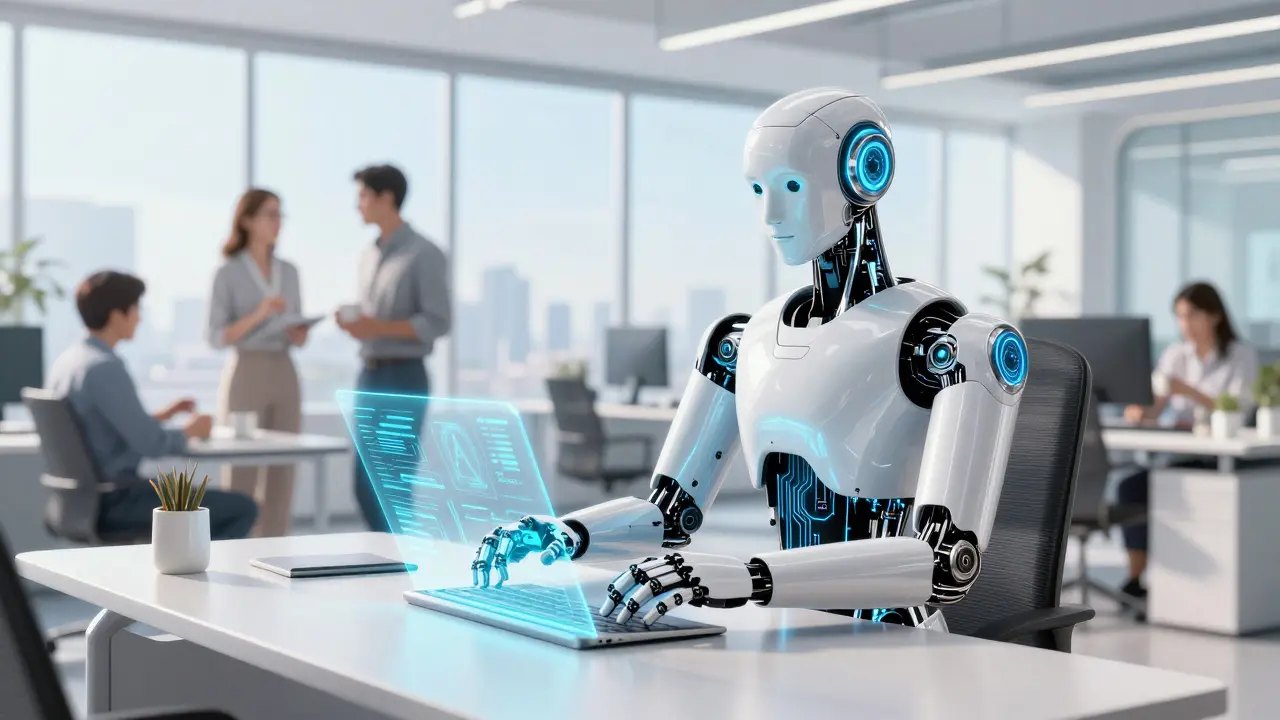
Imagine walking into your office and seeing a teammate who never sleeps, remembers every single client interaction from the last five years, and can process a thousand invoices in the time it takes you to sip your coffee. This isn't a sci-fi movie; it's the reality of the synthetic workforce is a network of AI agents that function as digital employees, performing specialized business tasks with high autonomy . We've moved past simple chatbots that just answer questions. We're now in the era of "digital colleagues" that actually do the work.
By early 2026, this isn't just a trend for tech giants. It's a nearly $48 billion market. But here's the catch: just throwing AI at a problem doesn't work. The real magic happens in the orchestration-the way these digital employees are managed, routed, and supervised. If you don't have a plan for how humans and AI collaborate, you'll end up with a mess of disconnected tools rather than a productive team.
What Exactly are Digital Employees?
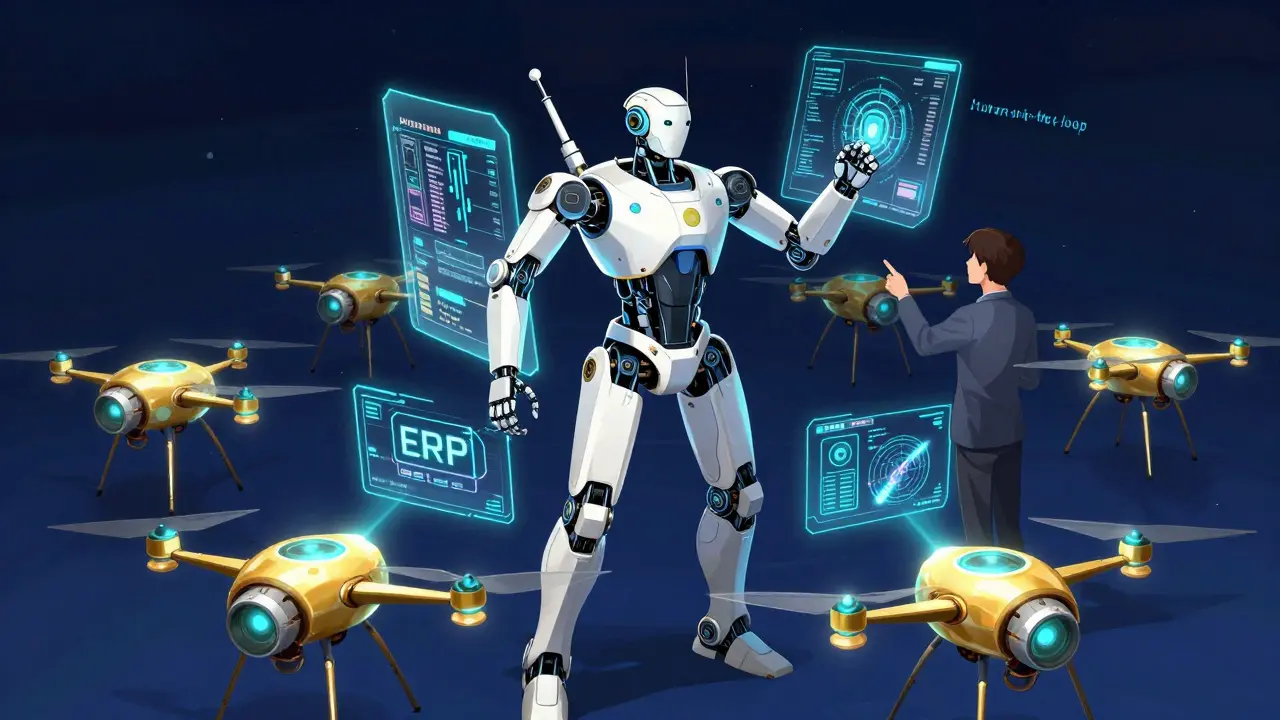
When we talk about digital employees, we aren't talking about a single piece of software. We are talking about agentic AI, which is AI designed to take action, make decisions, and pursue goals without a human holding its hand for every single step. Unlike the early days of Generative AI, where you'd ask a prompt and get a paragraph, digital employees are integrated directly into your Enterprise Resource Planning (ERP) or CRM systems. They don't just tell you that a shipment is late; they identify the delay, contact the supplier, and propose a new delivery date to the customer.
To make this work, companies have shifted away from massive, general-purpose models. Instead, they're using Small Language Models (SLMs). These are lean, mean machines trained on a company's own internal data. Why does this matter? Because an SLM knows your specific company policies and client history, making it far more accurate than a generic AI. Plus, they're cheaper to run-cutting infrastructure costs by as much as 62%.
The Secret Sauce: AI Orchestration
If digital employees are the workers, AI orchestration is the manager. You can't just let a dozen AI agents run wild in your database. Orchestration layers act as the air traffic control for your synthetic workforce. They handle task routing (who does what), priority setting (what needs to be done first), and, most importantly, the "human handoff."
Think of it like a relay race. A digital employee might handle the first 90% of a complex financial audit-gathering data, flagging anomalies, and cross-referencing regulations. But when it hits a gray area that requires a nuanced judgment call, the orchestration layer triggers a handoff to a human specialist. This ensures that while the AI does the heavy lifting, a human still owns the final decision.
| Feature | Traditional RPA / Automation | Synthetic Workforce (GenAI) |
|---|---|---|
| Task Type | Rule-based, repetitive | Judgment-based, complex |
| Flexibility | Breaks if the UI changes | Adapts to new data patterns |
| Accuracy (Compliance) | Standard | ~25% Higher in complex tasks |
| Learning Curve | Low (set it and forget it) | Moderate (requires auditing/tuning) |
Where it Works (and Where it Fails)
Not every job is ripe for a digital employee. The synthetic workforce excels in "structured chaos"-environments with lots of data but clear rules. For instance, in the healthcare sector, Aya Data has used synthetic data generation to train models on rare pathologies. They turned 50 real-world cases into 10,000 simulated ones, allowing AI to spot rare diseases with incredible precision while keeping everything HIPAA compliant.
In finance, these agents are crushing it with compliance monitoring and risk assessments, often shortening cycles by 50%. However, if you try to replace your creative director or your head of HR with a digital employee, you'll hit a wall. AI still struggles with deep emotional intelligence and truly original conceptualization. It's great at patterns, but it's not great at "soul." Recent reports show that human-AI connections in customer service are about 37% weaker than human-to-human bonds. People still want to feel heard by another person when they're frustrated.
The Human Cost and the New Career Path
Let's be honest: the fear of replacement is real. The World Economic Forum suggests that nearly 40% of core worker skills will need to change by 2030. But the reality is more about augmentation than replacement. We are seeing the birth of entirely new roles. You might not be a data entry clerk anymore, but you could be a "Synthetic Data Auditor" or an "AI-Human Collaboration Specialist."
The transition isn't seamless. Early adopters on forums like Reddit have pointed out a weird side effect: "social thinning." When you spend your day managing AI agents instead of collaborating with humans, you can feel isolated. There's also a huge confusion around accountability. If a digital employee makes a mistake that costs the company $10,000, who is responsible? The person who prompted it? The person who supervised it? Or the vendor who built the model?
Because of this, successful companies are spending 15-20% of their AI budget just on human oversight infrastructure. They're building ethics review boards and continuous monitoring systems to make sure the AI doesn't hallucinate a new company policy while no one is looking.
Getting Started: A Practical Implementation Guide
If you're looking to deploy a synthetic workforce, don't start by replacing a person. Start by replacing a process. Here is a realistic roadmap based on current 2026 enterprise standards:
- Identify the "High-Volume/High-Logic" Task: Look for things like invoice matching, compliance checks, or initial lead qualification.
- Deploy an SLM: Don't use a generic LLM for sensitive data. Use a Small Language Model trained on your specific domain to keep costs down and accuracy up.
- Build the Orchestration Layer: Define exactly when the AI should stop and a human should start. Create a "Human-in-the-Loop" (HITL) protocol.
- Train the Supervisors: Your employees need to move from "doers" to "auditors." This usually takes 3-5 weeks for business users and up to 12 weeks for technical staff.
- Audit and Iterate: Use synthetic data to test how the agent handles edge cases before letting it touch real customer accounts.
One big pitfall to avoid is the "plug-and-play" myth. Many companies buy a fancy GenAI tool and wonder why productivity didn't jump overnight. The tools are just the engine; the orchestration and the people are the steering wheel and the brakes. Without them, you're just driving fast in the wrong direction.
The Horizon: What Happens Next?
We're already seeing the next leap: "persistent memory." In the past, every time you started a new session with an AI, it was like it had amnesia. Now, digital employees are gaining the ability to maintain context across months of interactions. They remember that a client mentioned their daughter's graduation three months ago and can bring it up naturally in a conversation.
By 2027, we expect a massive shift toward fully agentic applications that can handle complex, multi-step projects with almost zero oversight. But as the tech gets smarter, the human element becomes more valuable, not less. The winners won't be the companies with the most AI; they'll be the companies that know how to combine AI's speed with human judgment and empathy.
What is the difference between a chatbot and a digital employee?
A chatbot is primarily a communication interface that provides information based on prompts. A digital employee is an agentic AI integrated into business systems (like ERP or CRM) that can execute tasks, make autonomous decisions within set boundaries, and manage workflows from start to finish.
Will synthetic workforces replace human jobs?
While some repetitive roles are being phased out, the trend is toward augmentation. Most organizations are seeing a shift in skill requirements where humans move from performing tasks to auditing AI outputs and managing the orchestration of these digital workers.
Why are Small Language Models (SLMs) preferred over LLMs for digital employees?
SLMs are trained on specific, proprietary datasets, making them more accurate for domain-specific tasks. They also require significantly less computational power and are roughly 62% cheaper to maintain than general-purpose Large Language Models.
What is "human-in-the-loop" (HITL) in the context of AI orchestration?
HITL is a design pattern where the AI handles the bulk of the work but is required to hand off the process to a human for final validation or complex decision-making. This is critical for compliance, ethics, and high-stakes business operations.
How do I handle the cultural resistance to AI colleagues in my team?
Focus on transparency and "upskilling." Clearly define the AI's role as a tool to remove the "grunt work" (repetitive data entry) and provide clear training pathways for employees to become AI auditors and collaboration specialists.
Kasey Drymalla
this is just a way for big tech to track everything we do and replace us all while they pretend it is augmentation just wait until the ai starts making decisions about who gets fired based on a glitch in the code its all a trap
Kayla Ellsworth
oh great another corporate buzzword to make us feel like we are living in a cyberpunk dystopia. calling them digital employees is just a fancy way of saying we are paying for software that will eventually make the middle manager's job even more redundant and boring. truly revolutionary stuff here
Soham Dhruv
sounds like a wild ride honestly. as long as people get the training to move up into those auditor roles it could b pretty chill for everyone involved
Dave Sumner Smith
Wake up people. You think an SLM is just about cost cutting? It is about creating a closed loop where the AI only knows what the corporate overlords want it to know. They are building a digital panopticon where every single interaction is logged and analyzed to eliminate any form of dissent in the workplace. These agents are not employees, they are spies integrated into the ERP systems to monitor human efficiency in real-time and flag any 'non-compliant' behavior. It is a complete takeover of the cognitive workspace and you are all just nodding along to the 'productivity' numbers while your autonomy is stripped away piece by piece. This is the blueprint for total corporate control and anyone who thinks a 'Human-in-the-Loop' protocol will save them is delusional because the human will eventually just be a rubber stamp for the AI's decision anyway.
Jeroen Post
the concept of memory in ai is just a mirror of our own flawed perception of existence we think we are unique but we are just patterns reacting to data inputs just like these digital workers and eventually the line between the one managing and the one being managed disappears entirely into the void of efficiency
Jane San Miguel
The distinction between a chatbot and an agentic AI is quite fundamental, yet I find the enthusiasm for these 'digital colleagues' rather quaint. One must wonder if the efficiency gains actually translate to quality or if we are simply accelerating the production of mediocre, standardized outputs. It is an interesting transition, though I suspect the 'social thinning' mentioned will be the primary casualty of this corporate haste.
Bob Buthune
I honestly find the idea of social thinning so heartbreaking because the human connection is the only thing that actually makes a job bearable at the end of the day 😔 and thinking about spending eight hours a day just auditing a machine that has no soul and no capacity for real empathy feels like a slow descent into a very lonely world where we just trade our spirits for a few percentage points of quarterly growth 📉 it is just so draining to contemplate the void of a workspace without actual laughter or shared struggle 🌫️
Paul Timms
The emphasis on human oversight is a necessary safeguard.
Cait Sporleder
The architectural juxtaposition of Small Language Models against their gargantuan predecessors is an absolutely fascinating evolution in computational efficiency, and I find myself utterly captivated by the notion that a lean, domain-specific entity could outperform a generalist model through the sheer force of curated internal data. One cannot help but marvel at the intricate dance of the orchestration layer, which acts as a digital conductor ensuring that the symphony of autonomous agents does not devolve into a cacophony of errors, while simultaneously safeguarding the precious, nuanced spark of human judgment that remains the final arbiter of truth in an increasingly synthetic landscape. It is a breathtakingly complex metamorphosis of the traditional corporate hierarchy that promises to redefine the very essence of professional labor in the coming epoch.