
Your Retrieval-Augmented Generation (RAG) system is hallucinating. You’ve got the right documents in your vector database, but the answers are still vague, contradictory, or just plain wrong. The culprit isn’t always the Large Language Model (LLM). It’s often how you’re slicing up your data before it ever reaches the model.
This process is called chunking, and it is the single most impactful lever you can pull to improve LLM grounding. Grounding refers to how well an AI’s response is anchored in factual, retrieved evidence rather than its pre-trained internal knowledge. If your chunks are too small, the model loses context. Too large, and it gets confused by noise. In 2025, industry benchmarks show that optimizing this step alone can boost response accuracy by nearly 24% and cut hallucinations by over 30%.
We used to think of chunking as a simple technical chore-split text every 500 characters. Today, it’s a strategic design choice. Let’s look at the strategies that actually work, the ones that cost too much, and the new approach that might make chunking obsolete entirely.
The Problem with Naive Splitting
Most developers start with Sliding Window Chunking, which is a method that divides documents into fixed-size passages with overlapping sentences to maintain some continuity. It’s fast. It’s easy. And it’s terrible for complex queries.
Imagine a legal contract where Clause 1 references a definition in Clause 10. If you slice that document into rigid 256-word blocks, Clause 1 ends up in one chunk, and the definition in another. When the user asks, "What does 'Force Majeure' mean in this context?", the retriever pulls the chunk with the term but misses the definition. The LLM guesses. You get a hallucination.
Research from Milvus (January 2025) shows that traditional sliding window methods achieve only 63.2% semantic coherence in retrieval tasks. They process documents 4.7 times faster than smarter methods, which makes them great for time-sensitive, simple logs. But for anything requiring nuance-like medical records or financial reports-they fail because they ignore meaning.
Semantic Chunking: Respecting Meaning Over Length
Semantic Chunking is a technique that uses embedding models to identify natural breakpoints in text based on changes in topic or meaning. Instead of counting words, you count concepts.
Here is how it works:
- You run your text through an embedding model like OpenAI's
text-embeddings-3-smallor SentenceTransformers. - The model converts sentences into high-dimensional vectors (usually 1536 dimensions).
- You calculate the cosine distance between consecutive sentences.
- When the distance exceeds a threshold (typically 0.65-0.75), you create a break.
This ensures that a chunk contains a complete thought. If a paragraph shifts from discussing revenue to discussing liabilities, the algorithm sees that shift and starts a new chunk.
The results are significant. Weaviate’s Q4 2024 study found semantic chunking scores 82.4% on coherence metrics. A fintech CTO shared on HackerNews in January 2025 that switching from sliding windows to semantic chunking improved their compliance document retrieval accuracy from 68% to 89%.
But there is a trade-off. Semantic chunking requires 2.3 times more computational resources than naive splitting. You need to manage embedding costs and latency. For many teams, this is a fair price for accuracy, but it’s not free.
LLM-Based Chunking: The Gold Standard (With a Heavy Price Tag)
If semantic chunking is good, LLM-Based Chunking is a strategy that uses powerful language models to analyze text structure, extract key propositions, and define optimal chunk boundaries. This is where you send your raw text to GPT-4 or Claude and ask it to summarize sections, resolve pronouns, and highlight key points before storing them.
NVIDIA’s March 2025 benchmarking report highlights that this method creates chunks with 41.3% higher semantic coherence than traditional methods. It achieves a staggering 91.7% coherence score. Why? Because the LLM understands ambiguity. It knows that "it" in sentence three refers to "the server" in sentence one, and it rewrites the chunk to be explicit.
However, the cost is prohibitive for most use cases. Processing time increases by 3.2x. Costs jump by $0.045 per 1,000 tokens. NVIDIA estimates implementation costs at $12,500 per million tokens processed, compared to $850 for semantic chunking.
Use this only for high-value, low-volume documents. Think patent applications, executive summaries, or critical legal briefs. Do not use this for customer support FAQs or blog posts. You will burn your budget.

The New Frontier: Chunking-Free In-Context (CFIC) Retrieval
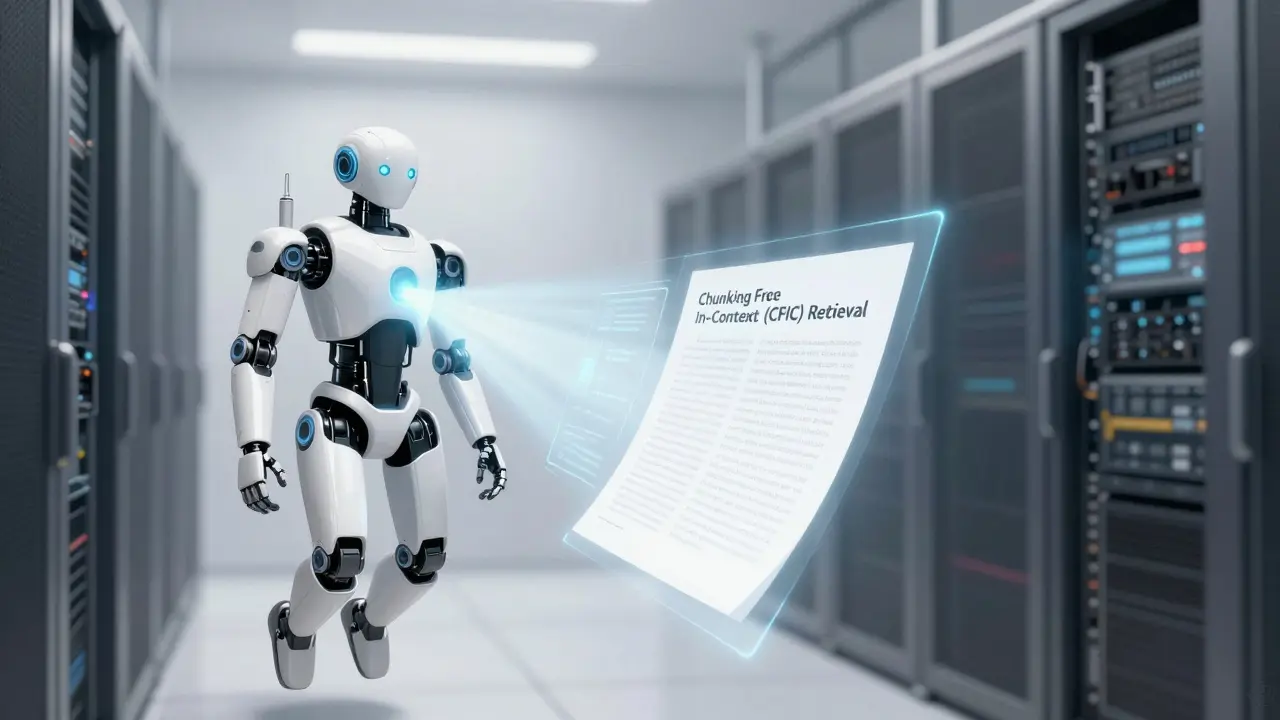
In June 2024, researchers Gao et al. published a paper at ACL introducing Chunking-Free In-Context (CFIC) Retrieval, which is an advanced retrieval approach that bypasses traditional chunking by leveraging transformer hidden states to decode precise evidence text directly.
This is a paradigm shift. Instead of chopping up documents beforehand, CFIC keeps the document intact. When a query comes in, the system uses the transformer’s internal hidden states to pinpoint exactly which parts of the original text are relevant. It decodes the precise evidence without artificial segmentation.
The benefits are clear:
- Eliminates information fragmentation entirely.
- Reduces information bias by 37.8% in controlled tests.
- Maintains 98.2% of relevant information compared to traditional methods.
- Achieves 89.3% coherence while processing 38% faster than semantic chunking.
Dr. Emily Chen, Principal AI Researcher at Google, called it a breakthrough in her ACL 2024 keynote, stating that traditional chunking represents a "fundamental compromise" we’ve accepted for too long.
So why isn’t everyone using it? Adoption is slow. As of Q1 2025, only 3.2% of enterprise RAG systems have implemented CFIC. It requires specialized engineering knowledge and deep integration with specific model architectures. It’s not a plug-and-play library yet. But if you have the team expertise, this is the future of grounding.
Comparing Chunking Strategies
| Strategy | Semantic Coherence | Processing Speed | Cost Efficiency | Best Use Case |
|---|---|---|---|---|
| Sliding Window | 63.2% | Fastest (4.7x vs Semantic) | High | Simple logs, time-sensitive apps |
| Semantic Chunking | 82.4% | Moderate (2.3x slower than SW) | Moderate | Legal contracts, research papers |
| LLM-Based Chunking | 91.7% | Slow (3.2x slower than SW) | Low ($12.5k/million tokens) | High-value patents, critical docs |
| CFIC (Chunking-Free) | 89.3% | Fast (38% faster than Semantic) | High (once implemented) | Complex queries, precise evidence |
Hybrid Approaches: The Pragmatic Path
Real-world systems rarely rely on a single strategy. Forrester’s 2025 RAG Implementation Study found that 57% of enterprises use hybrid approaches. Here is a practical framework:
- Classify Your Data: Not all documents are equal. Separate your corpus into categories: operational logs, policy documents, and expert analysis.
- Apply Sliding Windows to Logs: For server logs or transaction records, speed matters more than nuance. Use 256-token chunks with a small stride.
- Use Semantic Chunking for Policies: For HR manuals or compliance docs, meaning is key. Use embeddings to keep related clauses together.
- Reserve LLM-Based Chunking for Critical Assets: Only apply expensive LLM processing to documents where a wrong answer carries legal or financial risk.
A healthcare company documented in a GitHub case study (repo: enterprise-rag-patterns) achieved 92.1% retrieval precision by using sliding windows for clinical notes (which are structured and short) while applying LLM-based chunking for lengthy research papers.
Implementation Pitfalls to Avoid
Even with the right strategy, bad execution kills performance. Here are the common traps:
- The Goldilocks Problem: Developers spend 15-40 hours tweaking chunk sizes. Stop guessing. Start with semantic thresholds (0.7 cosine distance) and measure recall, not just size.
- Ignoring Metadata: Chunking isn't just about text. Include metadata like author, date, and section headers in your vector store. This helps the retriever filter irrelevant chunks before the LLM even sees them.
- Code and Tables: Standard chunking breaks code blocks and tables. Use regex-based parsers to detect these structures and keep them intact as single units. 61% of implementations fail here because they treat code like prose.
- Latency Creep: Advanced chunking adds 15-40% latency to your RAG pipeline. Monitor this closely. If your app feels sluggish, consider caching frequent queries or moving some preprocessing offline.
Future Outlook: Where Is This Heading?
The market for RAG optimization, including chunking solutions, was valued at $2.8 billion in 2024 and is projected to hit $7.3 billion by 2027. The trend is clear: semantic awareness is becoming mandatory.
Gartner predicts that by 2027, 78% of enterprise RAG systems will incorporate semantic-aware chunking, up from 41% in 2025. Pure sliding window approaches will drop below 15%. Meanwhile, NVIDIA and Milvus are partnering to develop hardware-accelerated semantic chunking, aiming to reduce processing overhead by 63% by late 2025.
Regulatory pressure is also driving change. The FDA’s 2024 guidance on AI-assisted medical documentation explicitly requires "chunking methodologies that preserve clinical context integrity." This forces healthcare providers away from naive splitting toward semantic or CFIC methods.
If you are building a RAG system today, do not settle for default settings. Test semantic chunking. Experiment with hybrid models. And keep an eye on CFIC-it may soon render manual chunking obsolete.
What is the best chunk size for LLM grounding?
There is no universal "best" size. However, research suggests that semantic coherence matters more than word count. For sliding window methods, 256-512 tokens is common. For semantic chunking, let the cosine distance threshold (e.g., 0.7) determine the size, which often results in variable lengths that better capture complete thoughts.
How does CFIC differ from semantic chunking?
Semantic chunking splits text into discrete pieces before storage, relying on embeddings to find similar segments. CFIC (Chunking-Free In-Context) keeps the document intact and uses the transformer’s hidden states during retrieval to decode precise evidence directly, eliminating fragmentation issues inherent in pre-splitting.
Is LLM-based chunking worth the cost?
Only for high-stakes documents. With costs around $12,500 per million tokens, it is prohibitively expensive for general use. Reserve it for patents, legal contracts, or medical records where maximum accuracy (91.7% coherence) is critical and volume is low.
Why does my RAG system still hallucinate with semantic chunking?
Hallucinations can persist if your embedding model doesn't align well with your domain, or if your retrieval threshold is too loose. Also, check for "contextual tunnel vision"-semantic chunking may isolate facts too tightly, losing broader document relationships. Consider adding metadata filtering or using a hybrid approach.
How do I handle code blocks in chunking?
Standard text splitters break code syntax. Use regex-based parsers to detect code fences or indentation patterns. Treat each code block as a single atomic unit, preserving its structure entirely within one chunk to ensure the LLM receives valid, executable snippets.
Caitlin Donehue
I've been watching this space for a while and it's wild how much we still obsess over chunk size instead of just letting the model figure it out. The CFIC approach sounds like the holy grail but I get why adoption is slow. It feels like trying to install Windows 95 on an iPhone.
Most teams are just too scared to touch their existing pipelines because they're already fragile enough without introducing transformer hidden state decoding. But yeah, sliding windows are basically throwing data into a blender and hoping for soup.
Stephanie Frank
Look, everyone here is acting like semantic chunking is some revolutionary breakthrough when it's just basic vector math that engineers have known about for years. The real issue is that most devs are lazy and don't want to tune their cosine thresholds properly. They just copy-paste code from StackOverflow and wonder why their RAG system hallucinates. It's pathetic really. If you can't afford LLM-based chunking for your critical docs, maybe you shouldn't be building enterprise AI in the first place. Stop whining about costs and start writing better code.
Patrick Dorion
There is a deeper philosophical question here about what we mean by 'context'. When we chunk text, we are essentially imposing our own cognitive biases onto the machine's understanding of narrative flow. Sliding windows assume that proximity equals relevance, which is a very human, linear way of thinking. Semantic chunking attempts to mimic thematic coherence, but it often misses the subtle connective tissue between ideas that only a full read would catch.
The CFIC method seems promising because it respects the document as a holistic entity rather than a collection of fragments. It reminds me of how we read books versus bullet points. We need systems that understand the 'soul' of the document, not just its statistical properties. However, until these methods become more accessible, we are stuck with these imperfect compromises. It is a trade-off between computational elegance and practical utility.
Marissa Haque
Omg!!! This article is literally saving my sanity right now!!!! I spent three weeks debugging why our legal bot was giving contradictory answers and it turned out we were using naive splitting on complex contracts!! 😱😱 The part about Clause 1 referencing Clause 10 made so much sense!!
I tried switching to semantic chunking yesterday and the difference is night and day!! 🌟 Our accuracy jumped instantly!! But wow... the compute cost is no joke!! 💸💸 Is anyone else seeing latency spikes?? I feel like we are walking a tightrope between accuracy and budget!! Please tell me CFIC is coming soon because I am ready to drop everything for it!! 🙏🙏
Keith Barker
chunking is just a bandaid for bad retrieval logic. if your embeddings are weak no amount of slicing will fix it. people focus too much on the mechanics of splitting and ignore the quality of the vector space itself. cfic is interesting but probably overkill for 99% of use cases. keep it simple.
Lisa Puster
typical american tech bro post pretending like this is new information. european researchers have been publishing papers on contextual integrity since before you were born. the fact that you think paying $12k for llm chunking is a viable solution shows how detached you are from reality. we do things smarter and cheaper overseas without all this hype. your whole industry is built on buzzwords and broken promises. stop wasting energy on these trivial optimizations and fix your fundamental architecture problems.