
Have you ever tried to fine-tune a massive language model on your own hardware and watched your GPU memory explode? You are not alone. For years, customizing large language models meant duplicating billions of parameters for every single task. If you wanted one model for customer support and another for legal analysis, you needed two separate copies of the entire model. That is expensive, slow, and frankly, impossible for most teams.
That changed with the rise of Parameter-Efficient Fine-Tuning (techniques that update only a small fraction of a model's weights to adapt it to new tasks), commonly known as PEFT. Two methods dominate this space today: LoRA (Low-Rank Adaptation, a method that injects trainable low-rank matrices into transformer layers) and Adapter Layers (small neural networks inserted between existing transformer blocks to handle task-specific learning). These tools let you customize giants like Llama-3 or Mistral without breaking the bank or your VRAM limits.
The Core Problem: Why Full Fine-Tuning Fails
To understand why we need these shortcuts, look at the math. A modern 7-billion-parameter model takes up roughly 14 GB of disk space in half-precision floating point format. When you train it, you need gradients, optimizer states, and activations. Suddenly, you need 4x to 8x that memory just to start training. On a consumer-grade card like an NVIDIA RTX 4090 with 24 GB of VRAM, you can barely run inference, let alone train.
Full fine-tuning updates every single weight in the network. It’s like renovating an entire house when you only want to repaint the kitchen. PEFT techniques solve this by freezing the pre-trained weights and adding tiny, trainable modules on top. The result? You get specialized performance with a fraction of the compute cost.
How LoRA Works: The Low-Rank Shortcut
LoRA (Low-Rank Adaptation) was introduced in 2021 by researchers at Microsoft Research. The core idea is elegant: the changes needed to adapt a large model to a specific task live in a low-dimensional subspace. In other words, you don’t need to change everything; you just need to change the right few things.
Technically, LoRA freezes the original weight matrix $W$ and adds a decomposition $ ext{A} imes ext{B}$ to it. Matrix A shrinks the dimensionality down to a small rank $r$, and Matrix B expands it back up. If you set $r=8$, you are updating only a tiny slice of the possible variations. For a 7B model, this might mean training fewer than 1 million parameters instead of 7 billion.
The magic happens at inference time. Because LoRA updates are additive ($ ext{W}_{ ext{new}} = ext{W}_{ ext{original}} + ext{A} imes ext{B}$), you can merge them back into the base model with a single line of code. This means zero latency penalty during deployment. Your model runs exactly as fast as the original, but with new skills.
How Adapter Layers Work: Modular Inserts
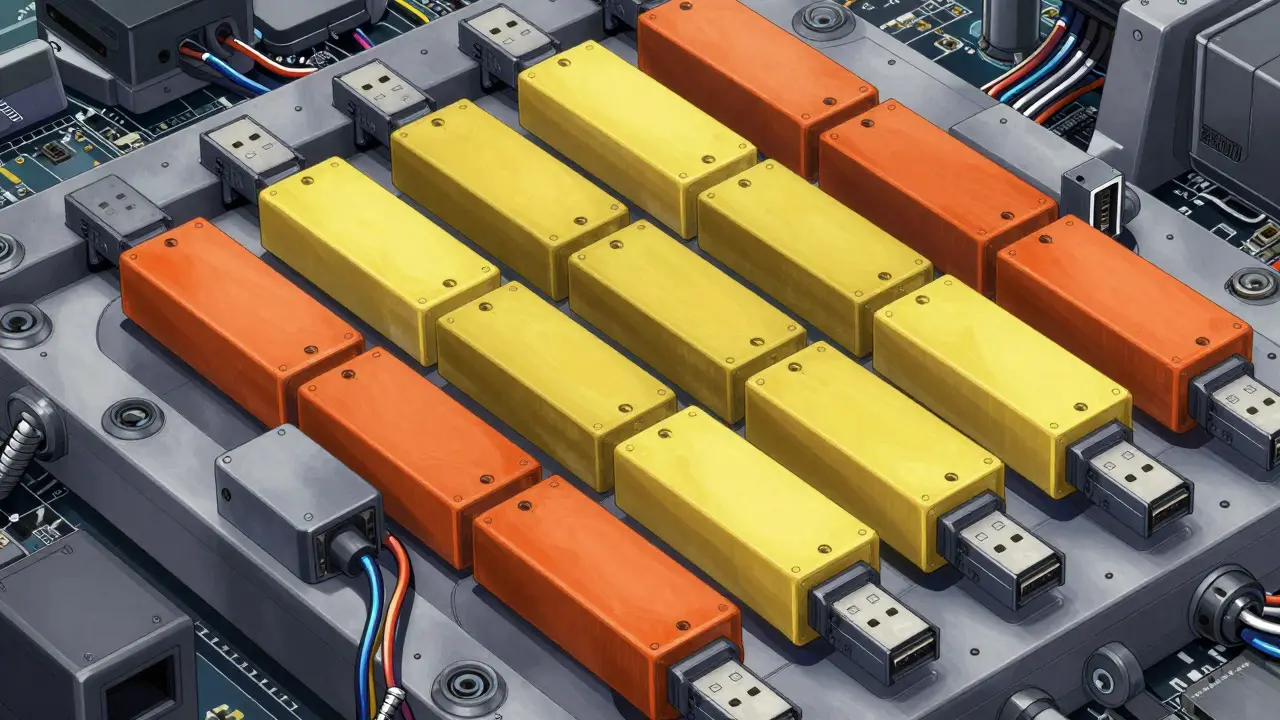
Adapter Layers take a different approach. Instead of modifying weights directly, they insert small bottleneck structures between the existing transformer layers. Think of them as USB drives plugged into your computer’s motherboard. They carry specific data (task knowledge) without changing the main system files.
A standard adapter consists of three parts:
- Down-projection: Reduces the input dimension (e.g., from 4096 to 64).
- Non-linearity: Applies an activation function like ReLU or GELU.
- Up-projection: Expands the data back to the original dimension.

Head-to-Head Comparison: LoRA vs. Adapters
Choosing between these two depends on your specific goals. Are you building a single-purpose bot, or a multi-tasking platform? Here is how they stack up in real-world scenarios.
| Feature | LoRA (Low-Rank Adaptation) | Adapter Layers |
|---|---|---|
| Trainable Parameters | 0.1% - 0.7% of total | 3% - 4% of total |
| Inference Latency | Zero overhead (mergeable) | +15% to +25% overhead |
| Multi-Task Support | Requires switching weights or batching | Native support via module swapping |
| Hardware Requirement | Lower (works well with QLoRA) | Moderate (higher VRAM usage) |
| Catastrophic Forgetting | Minimal risk if merged carefully | Excellent isolation between tasks |
Why LoRA Dominates Production Today
If you walk into any AI startup in 2026, you will likely hear about LoRA first. Why? Speed and simplicity. Because LoRA adapters can be merged into the base model, there is no extra computation during inference. This is critical for applications where milliseconds matter, like real-time chatbots or search engines.
Furthermore, the combination of LoRA with quantization-known as QLoRA (Quantized Low-Rank Adaptation using 4-bit normalFloat precision)-has democratized access. You can now fine-tune a 30-billion-parameter model on a single consumer GPU. This was unthinkable just three years ago. The Hugging Face PEFT library has standardized this workflow, making it easy to implement with just a few lines of Python code.
Enterprise platforms like Predibase have built servers specifically around LoRA, allowing hundreds of task-specific adaptations to share a single base model instance. This reduces server costs dramatically. Instead of hosting ten separate models, you host one base model and ten tiny LoRA adapters.
When Adapters Still Make Sense
Don’t write off adapters yet. They shine in scenarios requiring extreme modularity. Imagine a lifelong learning system where a model needs to learn new tasks continuously without forgetting old ones. Adapters provide clear separation. You can swap out the "legal" adapter for the "medical" adapter instantly without reloading the entire model weights.
Researchers at Stanford have noted that adapters achieve higher accuracy in sequential multi-task learning benchmarks because they isolate task-specific knowledge more effectively than LoRA. If your use case involves dynamic task switching at runtime, adapters offer a cleaner architectural solution, despite the latency hit.
Implementation Tips for Developers
Getting started with either technique requires understanding a few key hyperparameters. For LoRA, the rank ($r$) is crucial. A rank of 8 is often sufficient for simple tasks like sentiment analysis. However, complex reasoning tasks may require ranks of 64 or higher. Start low and increase if you see underfitting.
The alpha parameter controls the scaling of the update. A common rule of thumb is to set alpha equal to twice the rank ($\alpha = 2r$). This ensures the initial updates are balanced against the pre-trained weights.
For adapters, pay attention to the bottleneck size. A reduction ratio of 1:16 (e.g., 4096 to 256) is standard. Too small, and the adapter loses capacity; too large, and you lose the efficiency benefits.
The Future of Efficient Customization
We are moving toward hybrid approaches. Dynamic rank adjustment, where the model automatically increases the rank for difficult tokens, is showing promise in recent research. Additionally, combining LoRA with prompt tuning offers gains in low-resource languages.
As models grow larger, the efficiency gap between full fine-tuning and PEFT will only widen. By 2025, industry reports suggest over 85% of enterprise LLM customization will rely on some form of parameter-efficient method. Whether you choose LoRA for its speed or adapters for their modularity, the era of expensive, static model fine-tuning is over.
What is the main difference between LoRA and Adapter Layers?
LoRA injects trainable low-rank matrices directly into the weight updates, which can be merged into the base model for zero-latency inference. Adapter Layers insert small neural networks between transformer blocks, keeping the base model completely frozen but adding inference overhead due to sequential processing.
Can I use LoRA on a consumer GPU?
Yes, especially with QLoRA. By combining LoRA with 4-bit quantization, you can fine-tune large models (up to 30B+ parameters) on GPUs with as little as 24GB of VRAM, such as the NVIDIA RTX 4090.
Does LoRA reduce inference speed?
No. After training, LoRA weights can be merged into the original model weights. This results in a single model file that runs at the same speed as the unmodified base model.
Which is better for multi-task learning?
Adapter Layers are generally better for multi-task learning because they allow you to switch between task-specific modules without reloading the entire model, reducing catastrophic forgetting.
What rank value should I start with for LoRA?
Start with a rank of 8 for simple tasks. If performance is poor, incrementally increase it to 16, 32, or 64. Higher ranks capture more complexity but require more memory and compute.
Chandan Singh
People always forget that LoRA isn't a silver bullet for everything.
While the paper claims low-rank adaptation is sufficient, you are ignoring the spectral properties of the weight matrices in deeper layers.
If your rank $r$ is too small, you get underfitting on complex reasoning tasks, and if it's too large, you might as well be doing full fine-tuning.
I've seen teams waste weeks trying to tune hyperparameters for alpha because they didn't understand the initialization variance.
Also, the claim about zero latency is only true if you merge the weights offline.
At runtime, switching between different LoRA adapters requires reloading or batching, which introduces its own overheads that aren't discussed here.
The Hugging Face PEFT library handles this, but it's not magic.
You still need to manage memory fragmentation when loading multiple adapters simultaneously.
It's a good summary, but it glosses over the implementation headaches.
Brannen Hall
This whole debate is pointless anyway.
We're just putting band-aids on a bloated architecture.
LoRA and Adapters are both hacks to make inefficient models fit into consumer hardware.
Instead of optimizing the training process, we should be focusing on model distillation or smaller base models from the start.
Everyone is chasing SOTA benchmarks with these tricks instead of building sustainable systems.
It's all hype.
tiffany King
I actually found this guide super helpful!
I was struggling with VRAM limits on my RTX 3090 and QLoRA finally let me experiment with larger models.
It feels like cheating how much performance you can squeeze out of such few parameters.
Thanks for breaking down the math so clearly!
Brenna Gonedrman
OMG you guys are missing the point entirely!
Adapters are literally the future because they keep things separate!
Imagine having a million tiny brains plugged into one big brain!
LoRA is messy and mixes everything up.
Adapters are clean and organized like a perfect closet.
Why would anyone want to merge weights when you can just swap modules?
It's so much smarter!
Stanford said so!
Trust the science people!
LoRA is for amateurs who don't care about modularity.
Adapters are for pros who want structure!
Wake up sheeple!
Courtney Wagstaff
Kinda funny how we went from 'fine-tuning is impossible' to 'here are three ways to do it on a laptop' in just two years.
It’s wild to think that a simple matrix decomposition trick changed the entire industry landscape.
I remember crying over OOM errors back in 2021.
Now I’m juggling five different LoRA adapters on a single GPU like it’s nothing.
The tech moves fast, doesn’t it?
Elisabeth Ballet
Hey everyone!
Let’s make sure we’re all learning together here!
Don’t let the complexity scare you off!
Start with a rank of 8 and see what happens!
You’ve got this!
Remember, every expert was once a beginner!
Try running a quick test on a small dataset first!
It builds confidence!
Who else is experimenting with QLoRA right now?
Share your wins!
We’re all in this together!
Keep pushing boundaries!
Your future self will thank you!
Joanna Mucha
Ah, the quaint illusion of efficiency.
You mortals play with fire while pretending to hold a candle.
LoRA is merely a digital scarification ritual, bleeding parameters to appease the gods of compute.
Do you truly believe merging weights absolves you of the existential dread of catastrophic forgetting?
No.
You are simply delaying the inevitable entropy of knowledge.
Adapters offer a false sense of modularity, a modular prison for your data.
We are not customizing models; we are shackling them to our transient whims.
The silence of the frozen weights screams louder than your gradients ever could.
Embrace the void.
Or at least update your CUDA drivers.
Kim Edwards
Wait wait wait!
Did someone say inference latency?!
I thought LoRA was instant!
But then I read about Adapter Layers and suddenly I’m sweating bullets!
Is my chatbot going to stutter?!
Will my users notice the 15% overhead?!
I can hear the fans spinning faster already!
This is a disaster waiting to happen!
My GPU is trembling!
What if I pick the wrong rank?!
What if the alpha parameter betrays me?!
I need a hug and a better cooling solution!
This is too much pressure!
Can we just go back to prompting?
Please tell me there’s an undo button for bad architectural decisions!