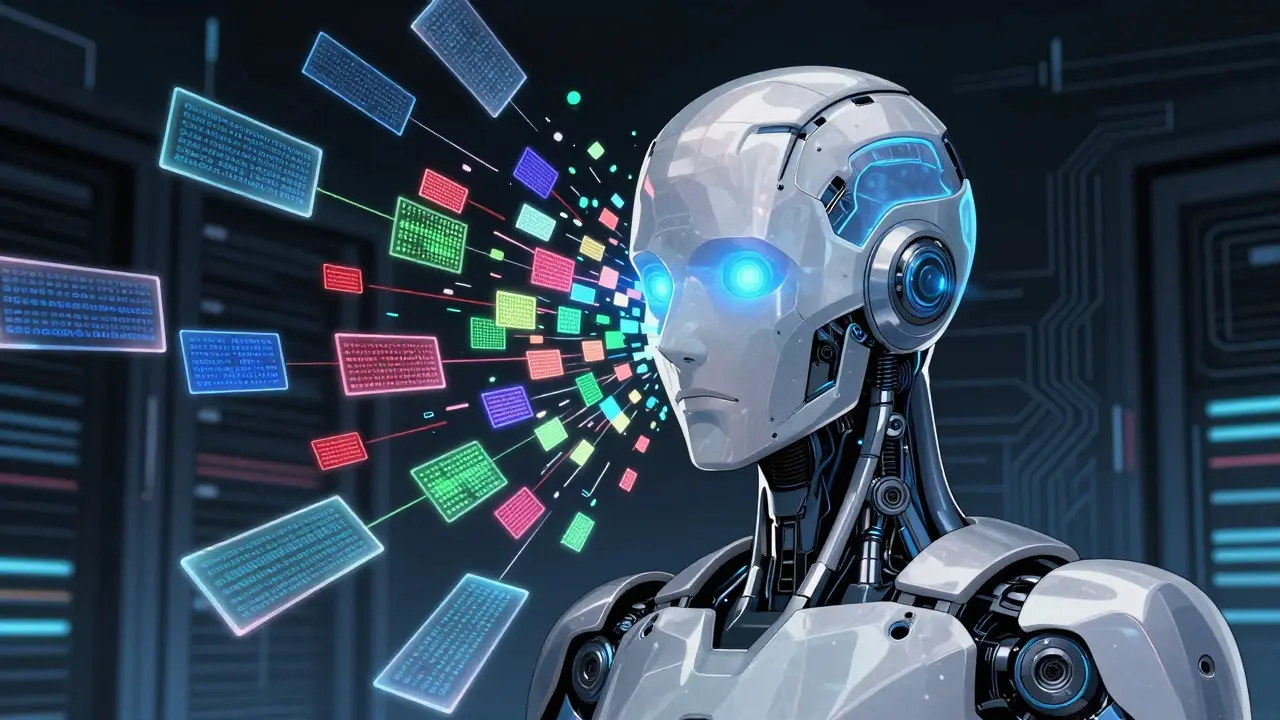
We used to think of artificial intelligence as a tool that either saw, heard, or read. You uploaded an image, you typed text, or you recorded audio. The system processed one thing at a time. That era is ending fast. As we move through 2026, the real breakthrough isn't just making AI smarter at one task; it's teaching it to experience the world the way humans do-by combining sight, sound, touch, and spatial awareness into a single, cohesive understanding.
This shift toward multimodal AI is no longer theoretical. It’s happening now, driven by architectural changes that allow models to process diverse data types simultaneously. We are moving beyond simple text-and-image pairing into complex integrations involving 3D environments, haptic feedback, and deep sensor fusion. This evolution promises to reshape everything from how we design virtual worlds to how autonomous systems navigate physical spaces.
The End of "Late Fusion" Architectures
To understand where we are going, you have to look at what came before. For years, most multimodal systems relied on what researchers call "late fusion." Imagine you upload a photo and ask a question about it. In a late-fusion system, the image goes to a vision encoder, and your text goes to a language model. They live in separate mathematical worlds until the very end, where a bridge connects them. It works, but it’s clunky. It’s like having two translators speaking different languages who only meet at the finish line to compare notes.
This approach created an illusion of understanding. The AI wasn’t truly connecting the visual context with the linguistic query during processing; it was stitching results together post-hoc. The breakthrough arrived with unified architectures like GPT-4o. These models don’t use separate encoders for every input type. Instead, they train on images, audio, and text simultaneously from the ground up. This creates a shared representational space where a pixel and a word can occupy the same conceptual neighborhood. The result? Faster reasoning, better accuracy, and a deeper grasp of context that earlier systems simply couldn’t achieve.
Unified Tokenization: The New Foundation
The secret sauce behind this leap is unified tokenization. In traditional computing, text becomes tokens, images become tensors, and audio becomes waveforms. They are fundamentally different formats. Unified tokenization changes the game by converting all these inputs into the same kind of digital building blocks. Whether it’s a snippet of speech, a frame of video, or a reading from a temperature sensor, the system translates it into a standardized format that flows through shared transformer layers.
This allows the model to learn relationships between modalities naturally. If you show an AI a video of a glass breaking while playing the sound of shattering glass, a unified model learns the connection between the visual shards and the auditory crunch directly. It doesn’t need a separate rulebook for "video" and "audio." This efficiency is critical because it reduces the computational overhead required to process complex, multi-sensory data. Companies like Meta have already demonstrated this with their Llama 4 series, which handles text, video, images, and audio in a single pipeline, proving that this architecture scales effectively.
| Feature | Late Fusion (Legacy) | Unified Multimodal (Current) |
|---|---|---|
| Data Processing | Separate encoders for each modality | Shared transformer layers for all inputs |
| Integration Point | End of pipeline (post-processing) | Ground-up training (pre-training) |
| Context Understanding | Siloed; limited cross-modal reasoning | Integrated; rich cross-modal connections |
| Efficiency | High latency due to multiple passes | Optimized via unified tokenization |
| Example Models | Early CLIP adaptations | GPT-4o, Gemini, Llama 4 Scout |
Expanding Beyond Sight and Sound: 3D and Spatial Awareness
Text, image, and audio were just the beginning. The next frontier is spatial data. As generative AI moves into the metaverse, augmented reality (AR), and robotics, it needs to understand three-dimensional space. Traditional 2D images flatten depth, losing crucial information about volume, distance, and occlusion. Modern multimodal systems are now ingesting 3D point clouds, mesh data, and volumetric captures.
Imagine an AI assistant helping you redesign your living room. In the past, it could suggest colors based on a photo. Now, with 3D integration, it understands the physical constraints of the space. It knows where the light hits the sofa at 2 PM because it processes the geometric data alongside the lighting conditions. This level of spatial reasoning is essential for applications in architecture, gaming, and industrial design. It transforms AI from a flat observer into a spatial participant.

Haptics: Adding Touch to the Digital World
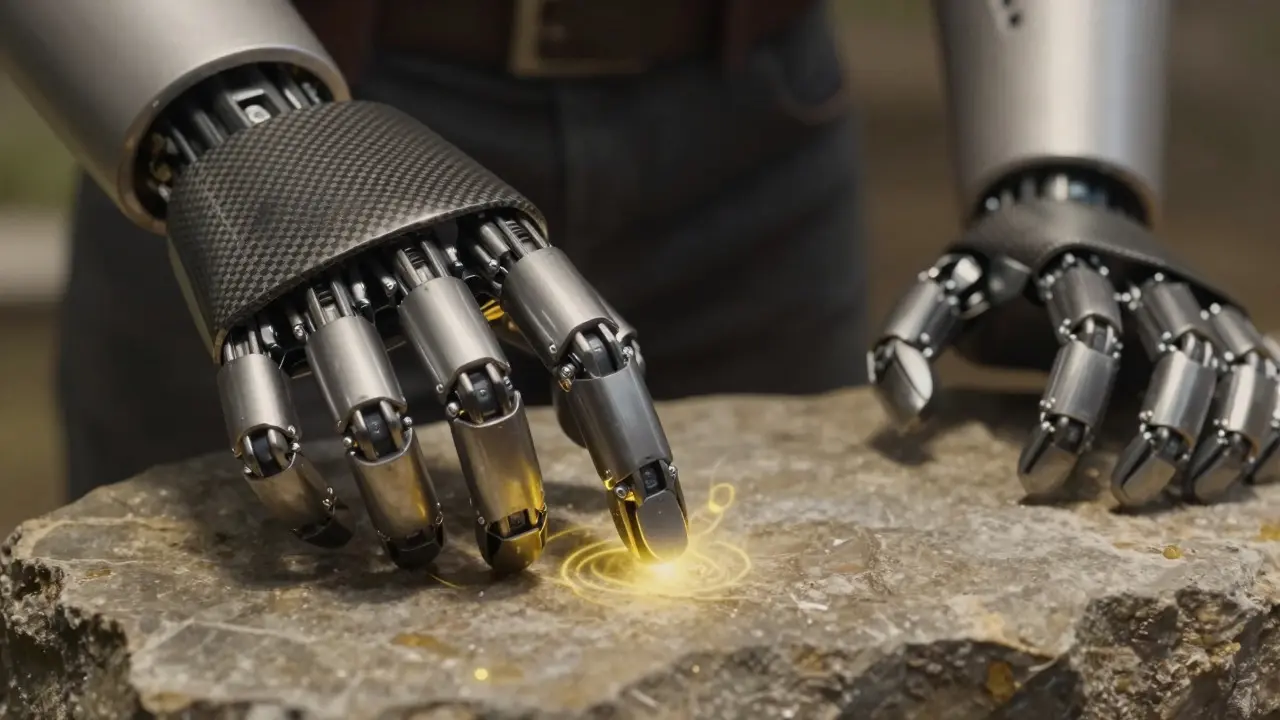
If 3D gives AI eyes and ears, haptics give it hands. Haptic feedback involves the sense of touch-pressure, texture, vibration, and temperature. Integrating haptic data into generative AI is one of the most exciting developments in human-computer interaction. Currently, most VR and AR experiences lack tactile realism. You see a virtual ball, but when you grab it, there’s no resistance.
Multimodal AI is changing this by generating dynamic haptic responses. By analyzing visual and audio cues, the AI can predict what physical sensation should accompany a digital event. If a user interacts with a simulated rough stone surface, the AI calculates the appropriate vibration pattern and force feedback to send to a haptic glove or suit. This requires the model to understand material properties, friction coefficients, and impact forces in real-time. It’s not just about feeling something; it’s about feeling the *right* thing based on the context provided by other sensors.
Sensor Fusion: The Brain of Autonomous Systems
Perhaps the most critical application of this evolution is sensor fusion. In the age of IoT (Internet of Things) and autonomous vehicles, devices are drowning in data. A self-driving car uses cameras, LIDAR, radar, ultrasonic sensors, and GPS. Each sensor has strengths and weaknesses. Cameras struggle in fog; LIDAR fails in heavy rain; radar lacks visual detail.
Multimodal AI solves this by fusing these disparate signals into a single, coherent picture of reality. This isn’t just averaging data; it’s intelligent reconciliation. If the camera sees a pedestrian but the LIDAR signal is weak due to rain, the AI weighs the probabilities, cross-references historical patterns, and makes a safer decision than any single sensor could. This "Sensor 4.0" approach extends beyond cars to smart factories, where chemical sensors, thermal cameras, and acoustic monitors work together to predict equipment failure before it happens. The AI doesn’t just react; it anticipates by synthesizing a holistic view of the environment.
Market Growth and Commercial Reality
This technology is moving fast because the market demands it. According to Grand View Research, the global multimodal AI market was valued at $1.73 billion in 2024 and is projected to hit $10.89 billion by 2030. That’s a compound annual growth rate (CAGR) of 36.8%. Why such explosive growth? Because businesses need systems that can handle the complexity of real-world data. Customer service bots that analyze voice tone, facial expressions, and text history simultaneously provide far better support than text-only chatbots. Manufacturing plants that integrate visual inspection with thermal and vibrational data reduce downtime significantly.
The commercial landscape is shifting rapidly. Major players like Google, with its Gemini models, and OpenAI, with GPT-4o, have set the standard for unified architectures. But the innovation isn’t confined to giants. Smaller, specialized models like Gemini Nano prove that multimodal capability can run on-device, bringing powerful sensor fusion and haptic processing to smartphones and wearables without relying on cloud servers. This decentralization lowers latency and enhances privacy, making advanced multimodal AI accessible to everyday consumers.
Challenges and Future Trajectories
Despite the progress, challenges remain. Training unified models requires massive amounts of paired data-images linked to audio, text linked to 3D scans, etc. Collecting and labeling this data is expensive and time-consuming. There’s also the issue of computational cost. While mixture-of-experts models help distribute the load, running true multimodal inference still demands significant power. Researchers are actively working on more efficient tokenization methods and compression techniques to make these systems lighter and faster.
Looking ahead, the convergence of these technologies will blur the lines between physical and digital realities. We’re heading toward a future where AI doesn’t just generate content but interacts with the physical world through robots and wearable tech. It will feel textures, navigate 3D spaces, and interpret complex sensor arrays in real-time. For developers and businesses, the key is to start integrating these capabilities now. The tools are available, the architectures are proven, and the demand is undeniable. The question isn’t whether multimodal AI will dominate; it’s how quickly you can adapt to its evolving capabilities.
What is the difference between late fusion and unified multimodal AI?
Late fusion processes different data types (like text and images) separately using distinct encoders and combines them only at the end of the pipeline. Unified multimodal AI, seen in models like GPT-4o, trains on all data types simultaneously using shared transformer layers and unified tokenization, allowing for deeper, native cross-modal understanding from the ground up.
How does sensor fusion improve autonomous systems?
Sensor fusion combines data from multiple sources like cameras, LIDAR, and radar to create a more accurate and reliable perception of the environment. It compensates for the weaknesses of individual sensors-for example, using radar when cameras fail in poor weather-leading to safer and more robust decision-making in autonomous vehicles and robotics.
What role does haptic feedback play in multimodal AI?
Haptic feedback adds the sense of touch to digital interactions. Multimodal AI analyzes visual and audio contexts to generate realistic tactile responses, such as vibration patterns or force feedback, enhancing immersion in VR/AR and enabling more intuitive control in robotic interfaces.
Why is unified tokenization important for AI efficiency?
Unified tokenization converts diverse data types (text, image, audio, sensor data) into a common format that can be processed by shared neural network layers. This eliminates the need for separate, redundant processing pipelines, reducing computational overhead and enabling the model to learn direct relationships between different modalities.
Which companies are leading the development of multimodal AI?
Major leaders include OpenAI (with GPT-4o), Google (with Gemini models), and Meta (with Llama 4 series). These companies have pioneered unified architectures that process multiple data types simultaneously, setting the industry standard for performance and efficiency.