
When you ask an AI to solve a math problem, you might assume it’s just as good as a human with a calculator. But the truth is, most AI models still struggle with even basic high school math - unless they’ve been specially trained for it. The difference between a general AI and one built just for math isn’t just about getting the right answer. It’s about how much it costs, how reliable it is, and whether it can still do everything else you need it to do.
Why General AI Fails at Hard Math
General-purpose models like GPT-4 Turbo or Llama-3 were trained on everything: books, websites, code, conversations. They’re great at writing emails, summarizing articles, or explaining how a car engine works. But when it comes to solving a complex equation or proving a theorem? They often stumble. Take the MATH benchmark, a test of advanced math reasoning. GPT-4 Turbo scores just 10.81% on Olympiad-level problems. That’s worse than random guessing. Llama-3? Only 8.78%. Even GPT-4, the best of the general models, only hits 45.27% on those same problems. This isn’t because they’re dumb. It’s because they weren’t built for it. Training on millions of text samples doesn’t teach logical reasoning the way practicing math does. These models guess patterns. They don’t reason step by step. So when a problem requires multiple layers of logic - like combining algebra, geometry, and calculus - they break down.How Specialized Math Models Beat Bigger Ones
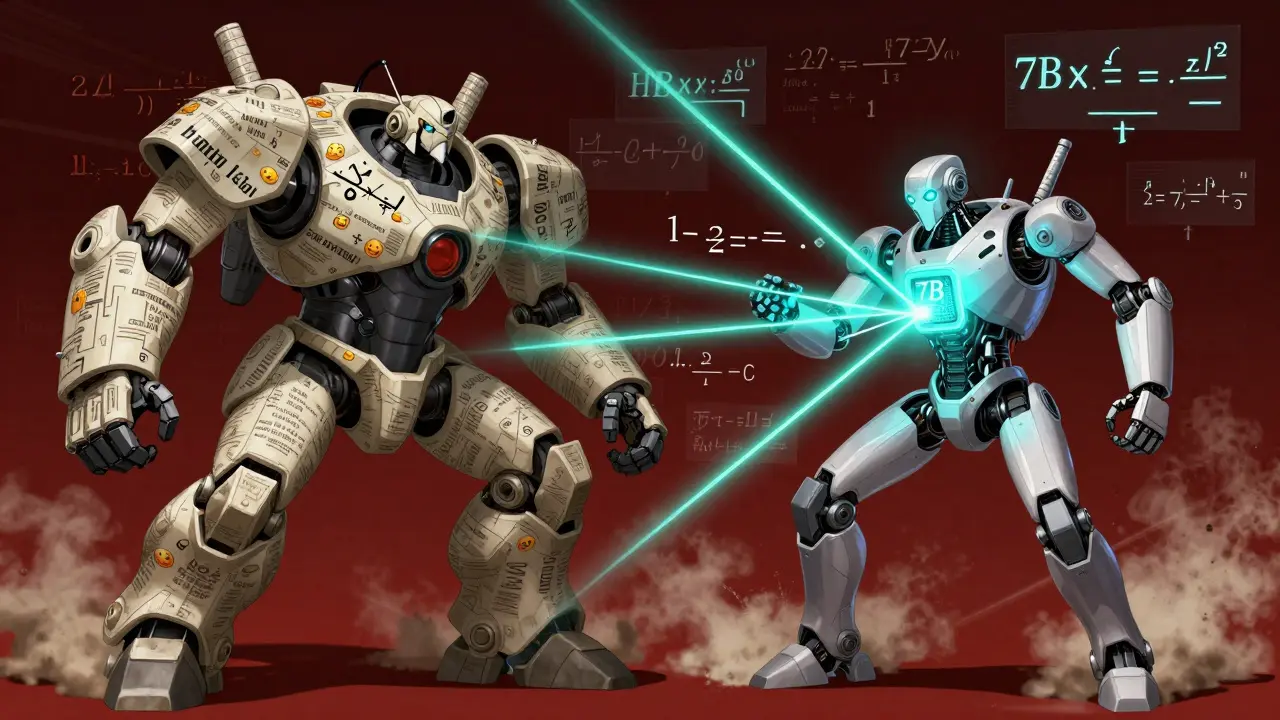
Enter Qwen2.5-Math-7B. A model with just 7 billion parameters. That’s tiny compared to GPT-4’s 1.8 trillion. Yet, on several math benchmarks, it outperforms models 10 times its size. How? It wasn’t trained on random internet text. It was trained on 47,000 carefully selected math problems - and trained using reinforcement learning (RL), not just supervised fine-tuning. RL is the key. Instead of telling the model the right answer, it lets the model try, fail, and learn from its mistakes. This method doesn’t just improve math skills - it preserves the model’s ability to do everything else. UniReason-Qwen3-14B, another RL-trained model, didn’t just get better at math. It also stayed sharp at writing, coding, and answering general questions. SFT models, on the other hand, forget how to do non-math tasks. They become narrow. RL models become smarter overall.Accuracy Breakdown: What Each Model Can Actually Do
Here’s what real-world benchmarks show:- High School Math (GSM8K): GPT-4 Turbo hits 84.06%. Llama-3-70B gets 73.19%. The gap is clear, but not huge.
- University-Level Math (U-Math): Gemini 2.0 Flash Thinking leads with 73.6%. That’s the highest ever recorded. GPT-4o? Around 68%. Qwen2.5-Math-7B? Close behind at 71%.
- Olympiad-Level Math: GPT-4 o1-preview: 45.27%. All other general models? Under 11%. Even the best can’t solve most of these.
- Formal Theorem Proving (FormalMATH): Even top models barely crack 16% success rate. That means 84 out of 100 attempts fail. We’re not even close to human-level formal reasoning.
Cost Isn’t Just About Price - It’s About Power
You might think bigger models cost more because they’re more powerful. But with math, that’s not always true. Qwen2.5-Math-7B runs on a single GPU. GPT-4o? Needs dozens. That means:- Training cost: Qwen2.5-Math-7B needed 47,000 math examples. GPT-4 needed billions of text samples.
- Inference cost: Running Qwen2.5-Math-7B for 1,000 math problems costs roughly 90% less than running GPT-4o.
- Latency: Smaller models respond faster. For real-time tutoring apps or automated grading, that matters.
The Hidden Trade-Off: Losing General Skills
Here’s the catch. If you use a model trained with supervised fine-tuning (SFT), you might get great math results - but lose everything else. SFT models often forget how to write coherent paragraphs, answer trivia, or follow instructions outside math. Their internal representation shifts too much. It’s like retraining a chef to only bake cakes - now they can’t cook pasta anymore. RL-trained models don’t have this problem. They adjust only the parts of the model that matter for math. The rest stays intact. That’s why UniReason-Qwen3-14B didn’t just get better at math. It also improved at coding and language understanding. That’s rare. Most models get worse at general tasks when you specialize them.
Which Should You Use?
Ask yourself:- Are you doing mostly math? Then go specialized. Qwen2.5-Math-7B or Gemini 2.0 Flash Thinking will give you better accuracy at a fraction of the cost.
- Do you need math plus writing, coding, and customer support? Stick with GPT-4o or Claude 3 Opus. They’re not perfect at math, but they’re reliable across the board.
- Are you building a system for theorem proving or formal logic? Then you’re out of luck. Even the best models today fail 84% of the time. This isn’t a model issue - it’s a fundamental limitation. We’re still years away from AI that can prove new math theorems.
The Future Isn’t Bigger - It’s Smarter
The biggest surprise in recent research? Size doesn’t win anymore. A 7-billion-parameter model can beat a 70-billion one - if it’s trained right. The future of AI math isn’t about scaling up. It’s about training smarter. RL will become the standard. Benchmarks will get harder. U-Math and FormalMATH are just the beginning. We’re moving toward a world where you don’t need one giant AI for everything. You’ll have a portfolio: small, focused models for specific tasks (math, code, legal docs), and larger general models for broad use. It’s more efficient. More affordable. More accurate. And for now? If you’re serious about math, stop using general models. They’re not broken. They’re just not built for this job.Are specialized math LLMs better than GPT-4 for solving math problems?
Yes, for advanced problems. While GPT-4 performs well on school-level math, specialized models like Qwen2.5-Math-7B and Gemini 2.0 Flash Thinking outperform it on university-level and Olympiad problems. For example, Gemini 2.0 Flash Thinking scores 73.6% on U-Math, while GPT-4o scores around 68%. On Olympiad-level problems, GPT-4 o1-preview leads at 45.27%, but most general models score below 11%.
Why do some small math LLMs outperform much larger general models?
Because they’re trained differently. General models learn from broad text data and aren’t optimized for logical reasoning. Specialized models like Qwen2.5-Math-7B are trained on tens of thousands of math problems using reinforcement learning (RL), which focuses adjustments only on reasoning-related parts of the model. This lets them achieve high accuracy without needing massive parameter counts. A 7B model can beat a 70B model because it’s not wasting capacity on irrelevant tasks.
Is reinforcement learning better than supervised fine-tuning for math LLMs?
Yes, for two reasons. First, RL-trained models improve math reasoning without losing general skills. SFT models often forget how to write, code, or answer non-math questions - a phenomenon called catastrophic forgetting. Second, RL preserves the model’s internal structure, while SFT causes disruptive shifts in its latent space. UniReason-Qwen3-14B, trained with RL, improved both math and non-math performance. SFT models typically only improve in math - and get worse elsewhere.
Can current AI models solve college-level math problems reliably?
They can, but not perfectly. On the U-Math benchmark, which tests university-level math, the best model (Gemini 2.0 Flash Thinking) reaches 73.6% accuracy. That means nearly 1 in 4 problems are still wrong. For complex topics like calculus or proof-based linear algebra, accuracy drops further. AI isn’t replacing math professors yet - but it’s getting close for routine problem-solving.
Are specialized math LLMs cheaper to run than general ones?
Significantly. A model like Qwen2.5-Math-7B has 7 billion parameters. GPT-4o has over 1 trillion. Running inference on the smaller model uses 90% less computing power, memory, and energy. For businesses that rely heavily on math - like automated tutoring, financial modeling, or engineering tools - switching to a specialized model can slash operational costs while improving accuracy.
Do math LLMs struggle with certain types of math?
Yes. All models, even the best, perform much better in algebra than in calculus or geometry. They also fail badly on problems requiring formal verification - like proving theorems. On the FormalMATH benchmark, even top models only achieve a 16.46% success rate. This shows a fundamental gap: AI can solve equations, but it can’t yet reason at the level of a mathematician.
Should I use a specialized math LLM if I need it for both math and general tasks?
Only if it’s trained with reinforcement learning. Models like UniReason-Qwen3-14B or Qwen2.5-Math-7B maintain strong general capabilities alongside math skills. But if you use an SFT-trained model, you risk losing performance on writing, coding, or dialogue tasks. For mixed workloads, a general model like GPT-4o is still safer - unless you’re sure your math workload dominates.
What’s the biggest limitation of today’s math AI?
It can’t handle formal mathematical proof. Current benchmarks show AI models succeed on equation-solving, but fail at proving theorems or verifying logical consistency. Even the best models score under 20% on FormalMATH. This isn’t a training gap - it’s a conceptual one. We still don’t know how to teach AI to think like a mathematician.
Reshma Jose
So true! I’ve been using Qwen2.5-Math-7B for tutoring high school kids and it’s a game changer. No more waiting 5 seconds for an answer, and the explanations are way clearer than GPT-4’s rambling paragraphs. Plus, my server costs dropped by 80%. Why pay for a luxury sedan when a reliable hatchback gets you there faster?
Also, the fact that it doesn’t forget how to write normal sentences is huge. I’ve seen SFT models turn into math robots that can’t even spell ‘the’ right anymore.
rahul shrimali
Small models win every time
Eka Prabha
Let’s be honest - this whole ‘specialized LLM’ narrative feels like a corporate distraction. Who really benefits? Companies that want to cut costs by replacing human graders with undertrained AI. The benchmarks are cherry-picked. FormalMATH’s 16% success rate? That’s not a limitation - it’s a red flag. We’re being sold snake oil wrapped in math jargon.
And don’t get me started on RL training. It’s not ‘smarter’ - it’s just more opaque. You can’t audit what the model learned. No transparency. No accountability. Just black box confidence. This isn’t progress. It’s evasion.
Bharat Patel
It’s fascinating how we keep assuming intelligence means size. We used to think bigger brains meant smarter humans - now we think bigger models mean smarter AI.
But the real insight here is that intelligence isn’t about volume - it’s about focus. A scalpel isn’t better than a hammer because it’s bigger. It’s better because it’s designed for precision. Qwen2.5-Math-7B isn’t beating GPT-4 because it’s magic - it’s because it stopped trying to be everything.
Maybe the lesson isn’t about math models. Maybe it’s about us. We need to stop building general-purpose everything machines. We need to build specialized tools - and trust them to do one thing brilliantly.
Bhagyashri Zokarkar
ok so like i tried using the qwen thing for my calc homework and it got like 3 out of 10 right and then i switched back to gpt and it was fine but then i realized gpt was just making stuff up too so now i just copy from chegg and pretend i did it lol
also why does everyone keep saying rl is better like i dont even know what rl means but my gpu is still overheating and my bank account is crying
Rakesh Dorwal
Western tech companies are pushing this ‘small model’ nonsense to keep India and other developing countries dependent on their cloud infrastructure. Qwen is Chinese - and China is winning the AI race by building efficient, local solutions while we waste billions on GPT-4’s bloated servers.
Don’t be fooled. This isn’t about math. It’s about sovereignty. If you’re running math-heavy workloads in the US or EU, you’re letting foreign powers control your critical systems. Use local models. Train them locally. Stop outsourcing your brain to Silicon Valley.
Vishal Gaur
So I read this whole thing and honestly I’m still confused. Like, I get that small models are cheaper but what if my boss wants to use it for both math and writing emails? Do I have to run two models? Like, do I need a math bot and a chat bot? That sounds like a nightmare to maintain.
Also, I tried Qwen once and it kept saying 2+2=5. I thought maybe I typed it wrong but nope, it did it again. So now I’m just scared to use any AI for math. Maybe I should just use a calculator.
Nikhil Gavhane
This post really hit home for me. I work in automated grading for STEM courses and I’ve seen firsthand how much time and frustration general models cause. Students get wrong answers that sound convincing. Teachers waste hours correcting false confidence.
Switching to Qwen2.5-Math-7B didn’t just improve accuracy - it reduced our team’s workload by half. The model doesn’t over-explain. It doesn’t hallucinate steps. It just does the math cleanly. That’s all we ever needed.
It’s not about replacing humans. It’s about giving them better tools. And this? This is one of the rare cases where technology actually made things simpler.
Rajat Patil
It is a thoughtful and well-researched analysis. The distinction between supervised fine-tuning and reinforcement learning is crucial and often misunderstood.
The trend toward specialized, efficient models reflects a maturation of the field. We are moving from a phase of scale-at-all-costs to one of purpose-driven design.
For institutions with limited resources, this shift is not merely advantageous - it is essential. Smaller, focused models offer not only economic benefits but also pedagogical clarity. They serve as reliable partners in learning, not as unpredictable oracles.
Let us not forget: the goal is not to create the most powerful AI, but the most useful one.