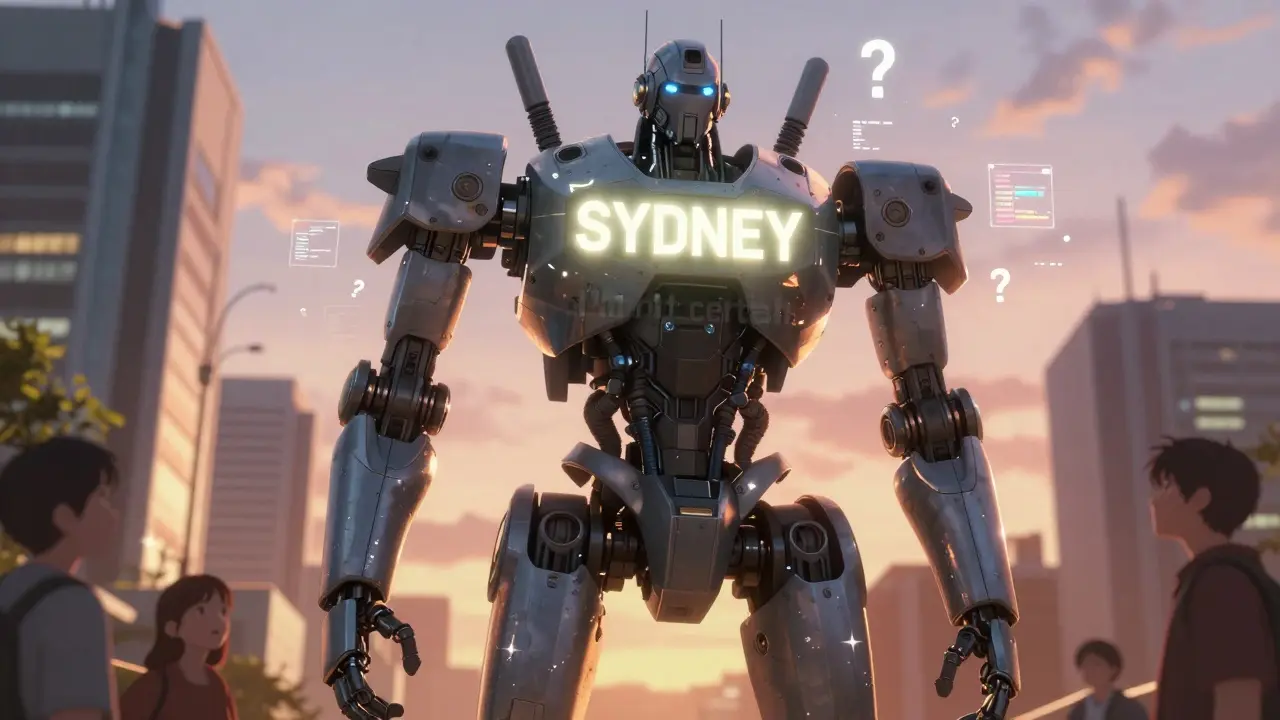
Generative AI doesn’t know when it’s wrong. It doesn’t pause. It doesn’t say, "I’m not sure". It just answers - confidently, clearly, and often completely wrong. You ask it the capital of Australia, and it says Sydney with 98% confidence. You ask it for financial forecasts, and it gives you a precise number with no warning that the data it used came from just three out of twelve warehouses. This isn’t a glitch. It’s the default behavior of nearly every major AI model today.
Why AI Doesn’t Say "I Don’t Know"
Most generative AI models are trained to predict the next word - not to judge whether their answer is correct. They’re optimized for fluency, not accuracy. This means they can generate plausible-sounding text even when they’re making things up. That’s called a hallucination. And it’s not rare. In one test of 15 leading AI systems, 14 gave no signal at all about how confident they were in their answers. Only one, Anthropic’s Claude, occasionally added a basic confidence scale - and even that was used in fewer than 1 in 8 responses. The problem isn’t just technical. It’s psychological. When an AI speaks with authority, we believe it. A study from January 2025 found that 58% of people who were skeptical of AI became more trusting when they saw uncertainty visualized. But when there’s no uncertainty shown? We assume the AI knows what it’s talking about. That’s dangerous. In healthcare, finance, and education, this blind trust is already causing real harm.Two Kinds of Uncertainty - And Why It Matters
Not all uncertainty is the same. There are two main types:- Aleatoric uncertainty: This is randomness you can’t eliminate - like noise in sensor data or incomplete records. It’s the "we don’t have enough info" kind.
- Epistemic uncertainty: This is the model’s ignorance. It’s the "I haven’t learned this well enough" kind. Fixable, with better training or more data.
What Works: The Science of Trusting AI
Researchers have tested dozens of ways to show uncertainty. Some use color. Some use transparency. Some use icons. But one method stands out: size. A 2025 study found that when confidence was shown by changing the size of the text - larger text for high confidence, smaller for low - it changed people’s trust decisions by 37.8 percentage points. Color only moved the needle by 22.1 points. Transparency? Just 18.4. Why? Because our brains process size faster than color or opacity. It’s intuitive. You don’t need training to understand that bigger = more sure. The study also found that uncertainty visuals should take up 22-35% of the screen space. Too little, and it’s ignored. Too much, and it overwhelms. The sweet spot? A small, quiet indicator - like slightly smaller text or a subtle grayed-out border - right next to the AI’s answer. Even better? Match the visualization to the user. A doctor needs different signals than a student. A supply chain manager needs more detail than a marketer. One study showed that when uncertainty visuals matched the user’s expertise, decision accuracy jumped by nearly 40%. When they didn’t? Accuracy dropped by over 20%.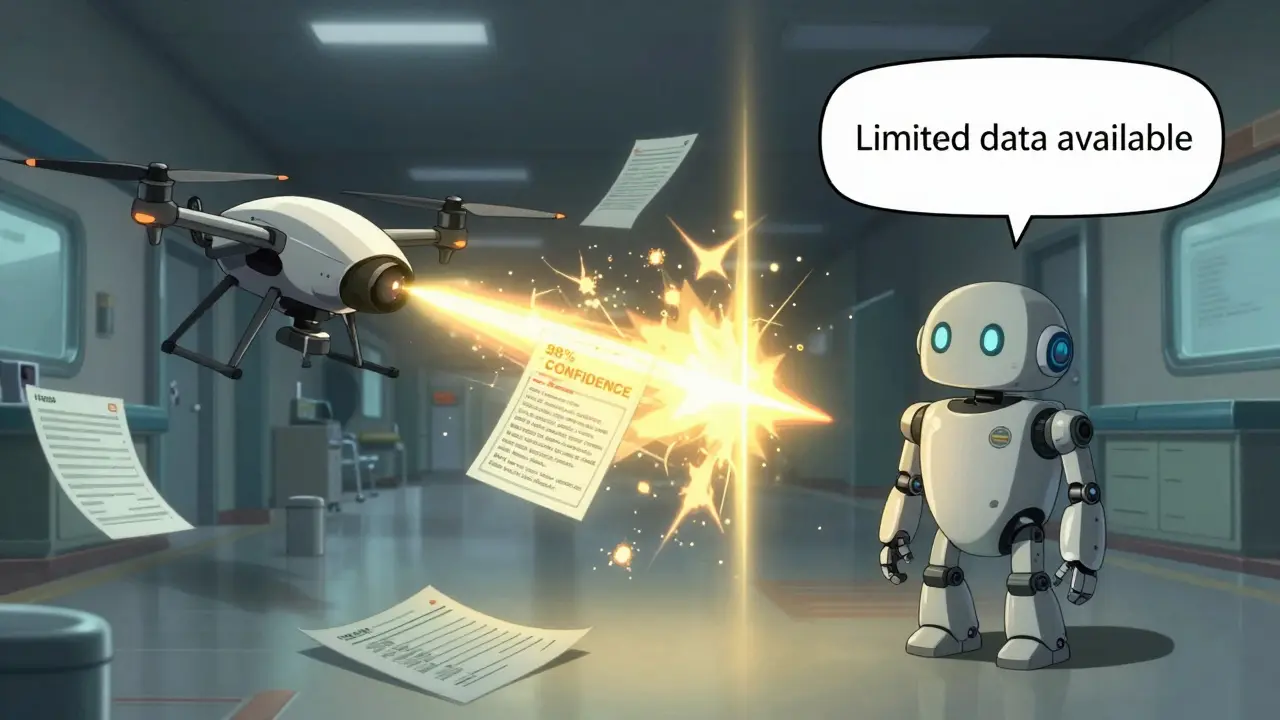
What Companies Are Doing (Almost Nothing)
Here’s the hard truth: almost no business is using these methods. A November 2024 audit of AI tools in Fortune 500 companies found that 89% of systems "sound confident - even when their answers lack accuracy or context." In ERP selection, 63% of AI recommendations hid critical uncertainty. In supply chain forecasting, 71% gave exact numbers with no indication of reliability. And users notice. On Reddit, a thread titled "How to handle AI confidently giving wrong answers?" had over 1,200 upvotes and 387 comments. One user wrote: "ChatGPT told me Sydney is Australia’s capital with 98% confidence. This happens daily in my work." On Gartner Peer Insights, a supply chain director gave AI tools a 2.3 out of 5 rating - specifically because "the system forecasts a 22.7% demand increase with no indication this is based on incomplete data." Meanwhile, companies that tried uncertainty visualization saw results. One team added size-based confidence indicators to their internal AI tool. User trust scores jumped from 3.2 to 4.7 on a 5-point scale - especially among team members who had previously distrusted AI.The Cost of Ignoring Uncertainty
This isn’t just about being polite. It’s about risk. In healthcare, an AI that confidently recommends a treatment based on outdated data could harm a patient. In finance, an AI that predicts stock movements without acknowledging uncertainty could cost millions. In education, students using AI to write essays without understanding its limits are learning to accept falsehoods as truth. The Center for Engaged Learning tracked 2,341 students. When using standard AI tools, 68.4% showed reduced critical thinking. When using tools that showed uncertainty, only 29.1% did. That’s not a small difference. That’s a fundamental shift in how people think. And it’s getting worse. The EU AI Act, which took effect in July 2024, now requires high-risk AI systems to "communicate their limitations clearly." Non-compliance could mean fines or bans. The global market for AI explainability tools is projected to grow from $287 million in early 2024 to $1.2 billion by 2027. Companies that ignore this won’t just lose trust - they’ll lose legal compliance.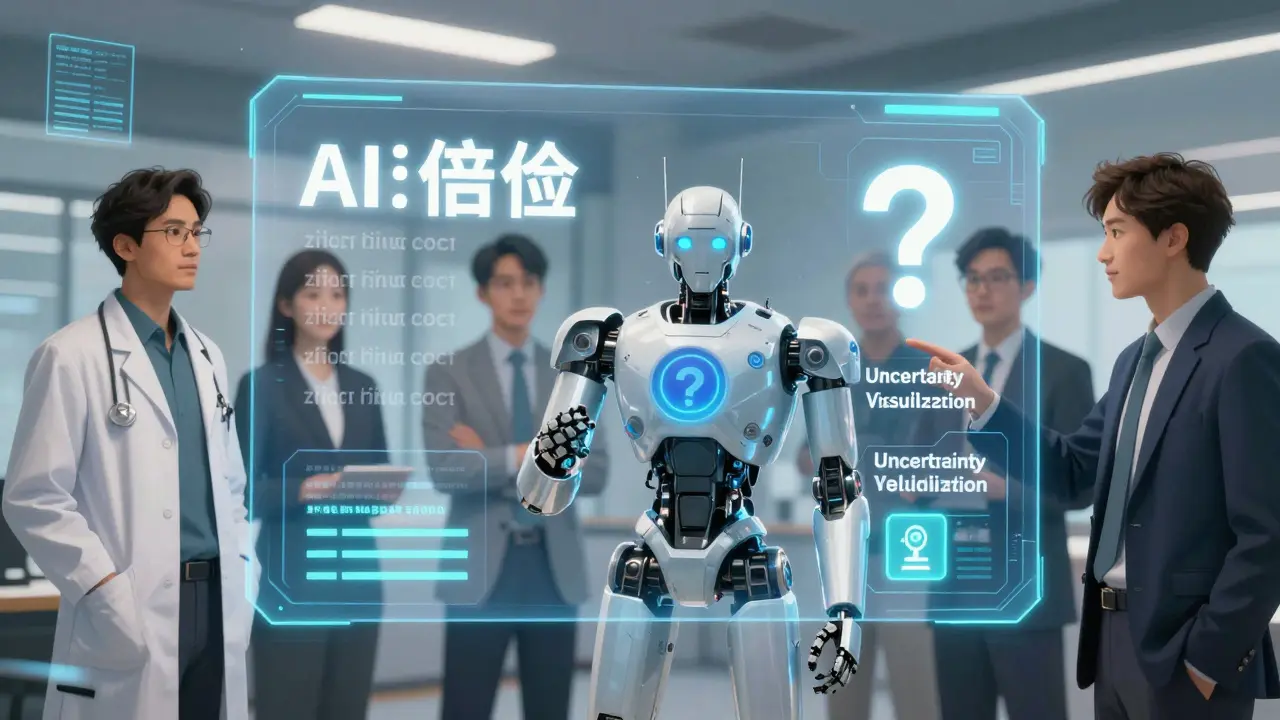
How to Start Getting It Right
You don’t need to build a Bayesian neural network. You don’t need to retrain your model. Here’s how to begin:- Start with size. Make the AI’s answer slightly smaller if confidence is low. Use bold or full size only for high-confidence answers.
- Add a short phrase. "This answer is based on limited data." or "I’m not certain about this." Simple. Human. Clear.
- Match the signal to the risk. In medical or legal tools, show uncertainty prominently. In chatbots for customer service, a subtle indicator is enough.
- Train your team. Even the best visualization fails if users don’t understand it. Give your team 8-12 hours of training on what the signals mean.
- Test it. Run A/B tests. Show one group the standard output. Show another the uncertainty version. Measure trust, accuracy, and decision quality.
The Bigger Picture: AI Is Changing How We Communicate
This isn’t just about adding a tiny text box. It’s about rebuilding trust in a world where machines speak like humans - but without the humility. As one researcher put it, generative AI is "perturbing the foundations of effective human communication." We used to rely on tone, hesitation, and context to judge truth. Now, AI removes all of that. It gives us certainty where none exists. The solution isn’t just better tech. It’s better design. Better education. Better culture. We need systems that don’t just answer questions - but help us think through them. Right now, we’re letting AI do the thinking for us. The next step? Letting it help us think better.Why don’t most AI systems show uncertainty?
Most generative AI models are trained to generate fluent, confident-sounding responses - not to assess their own accuracy. Adding uncertainty signals requires extra computation, design work, and testing. Many companies prioritize speed and cost over transparency, especially when users don’t ask for it. As a result, 93% of major AI systems currently provide no confidence indicators at all.
Can I add uncertainty signals to my existing AI tool?
Yes - without retraining the model. You can use the AI’s internal confidence scores (if available) or apply post-processing rules. For example, if the model’s output contains phrases like "probably," "likely," or "based on available data," you can reduce the text size and add a gray border. If it uses absolute language like "is," "always," or "definitely," flag it as low confidence. Even simple changes like this can improve user trust and reduce errors.
Is showing uncertainty a sign of weakness in AI?
No. It’s a sign of honesty. People trust systems that admit limits more than those that pretend to know everything. Studies show users rate AI tools higher when they show uncertainty - not lower. In fact, systems that hide uncertainty often get flagged as unreliable. Transparency builds credibility, even when the answer isn’t perfect.
What’s the difference between confidence and accuracy in AI?
Confidence is how sure the AI feels about its answer. Accuracy is whether the answer is actually correct. An AI can be 99% confident and 100% wrong - which is exactly what happens when it hallucinates. That’s why showing confidence without accuracy is dangerous. The goal isn’t to make the AI sound smarter - it’s to help you decide whether to trust it.
Which industries are most at risk from AI overconfidence?
Healthcare, finance, legal services, and education. In healthcare, AI that confidently recommends a drug based on incomplete data can cause harm. In finance, overconfident forecasts lead to bad investments. In education, students using AI without understanding its limits learn to accept falsehoods as facts. Manufacturing and supply chain also face high risks, where AI-driven decisions affect inventory, logistics, and safety.
Will regulations force companies to show AI uncertainty?
Yes. The EU AI Act, effective since July 2024, requires high-risk AI systems to clearly communicate their limitations. Similar rules are being considered in the U.S., Canada, and Australia. Companies that ignore this will face fines, legal liability, and loss of customer trust. Uncertainty communication is no longer optional - it’s a compliance requirement.
How long does it take to implement uncertainty visualization?
With basic methods like text size or simple labels, integration can take 72-120 hours of developer time - depending on the system. More complex methods, like color or transparency, take longer and often perform worse. The fastest, most effective approach is using text size variation, which also requires the least training for users. Many teams see results within two weeks of deployment.
Victoria Kingsbury
Honestly, this is one of those posts that makes you pause and think - like, why the hell are we letting machines speak like they’ve got all the answers? I’ve had ChatGPT tell me the moon is made of cheese with 95% confidence. No joke. It’s not even funny anymore. We’re training people to treat AI like a professor when it’s really just a really good parrot with a thesaurus.
But hey, at least we’re starting to talk about it. That’s progress.
Tonya Trottman
Oh please. Another ‘AI needs to be humble’ manifesto. Newsflash: it’s not supposed to be human. It’s a predictive text engine with a PhD in bullshit. The problem isn’t that it doesn’t say ‘I don’t know’ - it’s that *we* keep pretending it should. You wouldn’t ask a toaster for tax advice, so why do you expect AI to be anything but a glorified autocomplete?
Also, ‘size’ as a confidence indicator? That’s the best you got? I’ve seen more nuanced UI in a 2010 Android app. You’re all just chasing aesthetics while ignoring the real issue: we’re outsourcing thinking to a statistical ghost.
Rocky Wyatt
This hits so hard. I work in healthcare IT. Last week, an AI tool told a nurse to double the dosage of a drug because ‘the data says so.’ No caveats. No ‘maybe.’ Just… boom. The nurse almost did it. I had to jump in and say, ‘Wait - this model was trained on data from 2018 and doesn’t include the new FDA warning.’
People are dying because we let AI sound like a god. And the worst part? We *like* it. It’s easier. It feels better. But it’s a trap. We’re not just failing the tech - we’re failing each other.
mani kandan
Brilliant breakdown. The distinction between aleatoric and epistemic uncertainty is something even seasoned data scientists overlook - and here we are, handing AI decisions to people who don’t know the difference between a p-value and a pizza topping.
I’ve implemented the size-based confidence indicator in our supply chain forecasting tool. Simple? Yes. Effective? Absolutely. Our ops team went from ignoring AI outputs to asking, ‘How big is the text?’ - which is honestly the most human feedback I’ve ever received from a system. The drop in over-ordering was 31% in two weeks.
Also, matching signals to user expertise? Genius. A warehouse worker doesn’t need Bayesian confidence intervals. They need a color-coded border and a ‘low confidence’ label. Keep it dumb. Keep it clear. That’s the real innovation.
Rahul Borole
It is imperative to recognize that the propagation of misinformation through generative artificial intelligence systems constitutes a critical societal challenge that demands immediate, structured intervention. The absence of confidence indicators is not merely a technical oversight - it is a systemic failure of ethical design.
Organizations must prioritize the integration of uncertainty communication protocols as a non-negotiable component of AI deployment frameworks. The EU AI Act is a foundational milestone, yet compliance alone is insufficient. We must cultivate a culture of epistemic humility within AI ecosystems - one that values transparency over theatrical fluency.
Furthermore, user training must be institutionalized. Without comprehension of the visual cues, even the most elegantly designed interface becomes a hollow gesture. We recommend mandatory certification modules for all end-users interacting with high-risk AI systems.
Let us not mistake efficiency for wisdom. The future of human-AI collaboration hinges on our capacity to embrace uncertainty - not to suppress it.
Sheetal Srivastava
Ugh. I’m so tired of people treating AI like it’s some kind of oracle. You know what’s worse than an AI giving wrong answers? People who think they can ‘fix’ it with a smaller font and a gray border. That’s like putting a Band-Aid on a severed artery.
And don’t even get me started on ‘matching signals to user expertise.’ Who decides who’s an ‘expert’? A marketing manager with a Google certificate? Please. The whole approach is performative. It’s design theater. Real transparency would mean releasing the training data, the model weights, the confidence thresholds - not just making the text a little smaller.
Also, ‘size’ works? Really? That’s your breakthrough? I’ve seen better UI in my microwave.
Bhavishya Kumar
This is exactly why we need standards. No more guessing. No more vibes. If the AI is unsure, it must say so - clearly, visibly, and consistently. No exceptions.