
Ever wonder how a machine can "understand" a joke, follow a complex legal argument, or write a poem that actually makes sense? It isn't because the AI has a dictionary and a grammar book memorized. Instead, Large Language Models is a class of AI systems trained on massive amounts of text to predict the next token in a sequence. Also known as LLMs, these models don't learn language through explicit rules but through a process called self-supervision, where the data itself provides the labels. This allows them to pick up on the invisible patterns of how we speak and write-the semantics (meaning) and the syntax (structure)-without a human ever explaining what a "noun" or a "verb" is.
The Secret Sauce: The Attention Mechanism
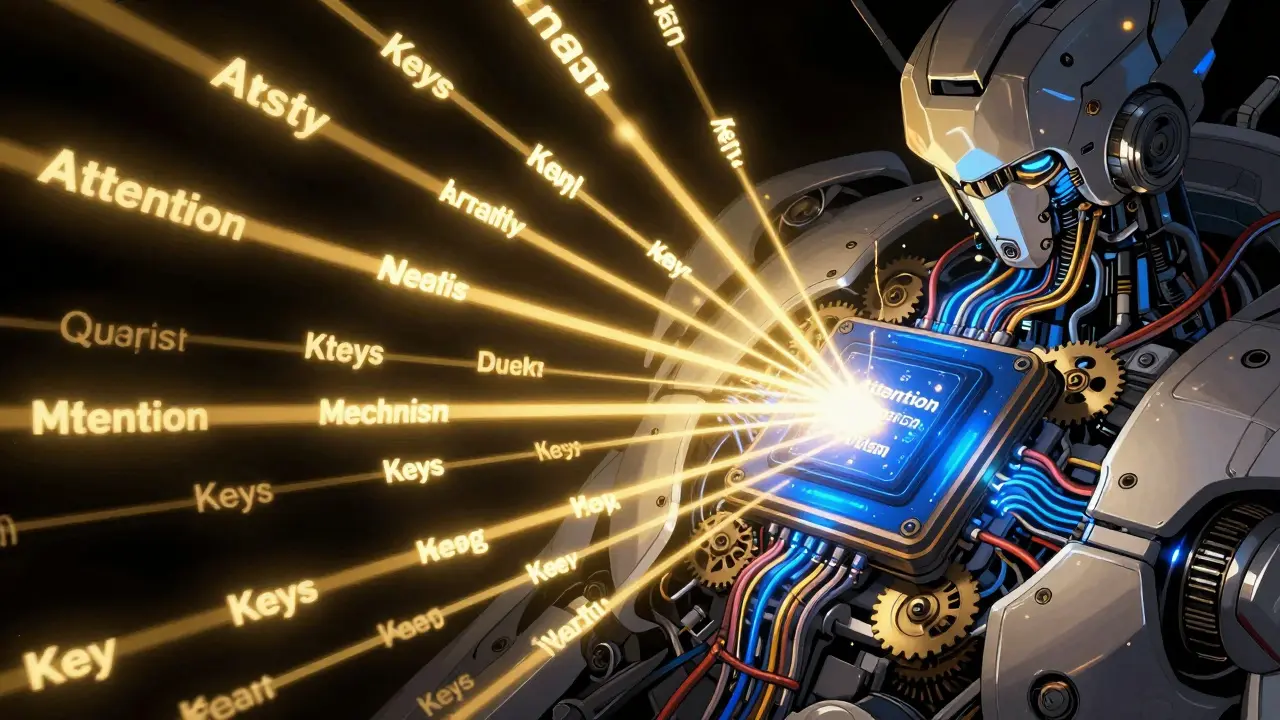
Before 2017, AI handled text like a conveyor belt, processing one word at a time. If a sentence was too long, the model would "forget" how it started by the time it reached the end. Everything changed with the Attention Mechanism, a system that lets a model look at an entire sentence at once and decide which words are actually important. Imagine you're reading the sentence: "The dog, which was chased by the neighborhood cat, finally found its bone." To understand who found the bone, your brain ignores the "neighborhood cat" part and links "dog" to "found." The attention mechanism does exactly this mathematically.
This happens through Self-Attention, where the model creates three distinct vectors for every word: Queries, Keys, and Values. Think of the Query as a flashlight the model shines on a word to ask, "What am I looking for?" The Key acts like a label on other words, and the Value is the actual information stored there. By comparing the Query to the Keys, the model assigns a weight (a score) to other words in the sequence. If the score is high, the model pulls more information from that word's Value vector to build a richer understanding of the current word.
Cracking the Code of Syntax and Semantics
Syntax is the set of rules that govern sentence structure, while semantics is the actual meaning behind those words. LLMs don't treat these as separate folders. Instead, they weave them together. Research on models like Llama 2 and GPT-2 shows that they develop "syntax-specialized" attention heads. These are specific parts of the neural network that focus on grammatical dependencies, like matching a subject to its verb.
However, these grammatical rules aren't rigid. In humans, if someone says something grammatically correct but logically impossible (like "The colorless green ideas sleep furiously"), we struggle to process it. LLMs behave similarly. Studies show that if the semantic meaning is implausible, the "syntax" heads actually stop firing as strongly. This proves that the model isn't just following a formula; it's using meaning to inform structure, just like we do.
The Problem with Order: Why Position Matters
One quirk of the attention mechanism is that it's "permutation invariant." In plain English: if you scrambled the words in a sentence, the attention mechanism would still see the same words and potentially the same relationships, but the meaning would be lost. "The cat ate the fish" is very different from "The fish ate the cat." To fix this, models use positional encodings.
For a long time, Rotary Position Embedding (RoPE) was the gold standard, assigning a fixed rotation to words based on their distance from each other. But as we started feeding models longer documents-like entire novels or massive financial reports-fixed rotations weren't enough. This led to the development of PaTH Attention. Instead of a fixed map, PaTH treats the space between words as a series of data-dependent transformations. It's like a mirror that adjusts based on the content of the tokens it passes, allowing the model to track information across tens of thousands of words without getting lost.
| Feature | Traditional NLP (RNNs) | Modern LLMs (Transformers) |
|---|---|---|
| Processing Style | Sequential (one by one) | Parallel (all at once) |
| Memory | Short-term/Fading | Long-range via Attention |
| Context | Local context only | Dynamic global weighting |
| Positional Logic | Inherent in sequence | Added via RoPE or PaTH |

Does Bigger Always Mean Smarter?
There's a common belief that simply adding more parameters (making the model "bigger") automatically makes it better at understanding semantics. But that's not entirely true. When looking at Semantic Role Labeling (SRL)-the task of identifying "who did what to whom"-researchers found that model size isn't the only driver of success. A mid-sized model with a superior training approach or a more clever prompting strategy can actually outperform a massive model.
This suggests that the *way* a model is taught to use its attention heads is more important than the raw number of neurons. The architecture's ability to refine its focus through natural instructions is what truly unlocks a deep semantic understanding.
The Future: Forgetting and Human-Like Cognition
The next frontier is making AI think more like a human, which ironically involves learning how to forget. Humans don't remember every single word of a conversation; we discard the fluff and keep the core meaning. New systems like the Forgetting Transformer (FoX), often combined with PaTH Attention, allow models to selectively drop irrelevant information. By clearing out the "noise," these models can handle even longer contexts and perform complex reasoning tasks with much higher stability.
What is the difference between syntax and semantics in LLMs?
Syntax refers to the structural rules of language (grammar), while semantics refers to the meaning of the words. LLMs capture syntax through specialized attention heads that recognize patterns in word order, and semantics by learning how words relate to each other in vast datasets.
How does self-supervision actually work?
Self-supervision is a training method where the model hides a part of the data (like the next word in a sentence) and tries to predict it. Because the "correct answer" is already in the text, the model can train itself on trillions of words without needing humans to manually label the data.
Why is the attention mechanism better than previous methods?
Previous methods like RNNs processed text sequentially, meaning they often "forgot" the beginning of a long sentence. The attention mechanism allows the model to look at every word simultaneously and dynamically weigh which ones are most relevant to the current context.
What are Query, Key, and Value vectors?
These are mathematical representations used in self-attention. The Query is what the model is looking for, the Key is the identifier for other words in the sequence, and the Value is the actual information retrieved once the Query and Key match.
Can LLMs truly understand language, or are they just predicting patterns?
While they are technically predicting the next token, the way they do this-by building complex internal maps of syntax and semantics-results in a functional understanding that mimics human cognition, especially when handling nuanced context and reasoning.
John Fox
basically just a fancy way of saying it guesses the next word lol
chioma okwara
Actually the post says "Large Language Models is a class" which is a totaly wrong subject-verb agreement. How can we talk about semantic understanding when the author cant even handle basic grammar in the first paragraph. it's a joke really.
saravana kumar
The simplification of the Attention Mechanism is rather pedestrian. One must acknowledge that the actual implementation involves complex linear algebra that far exceeds the analogy of a flashlight. It is quite trivial to understand the concept but the execution is where the true intellectual labor resides.
Jess Ciro
this is exactly how they track us now and we just act like its fine the bots arent just predicting tokens they are predicting our every move to keep us in the loop its honestly terrifying
Tamil selvan
This is a truly wonderful explanation!!! I feel that many people would benefit from understanding the difference between syntax and semantics in such a clear manner!!! Keep sharing this knowledge, as it helps everyone grow together!!!
Jim Sonntag
oh yeah because letting a machine decide what is important is such a great idea we definitely wont have any bias issues with that
Tasha Hernandez
Imagine thinking that a bunch of matrix multiplications is "cognition." It's honestly such a tragedy that we've reached a point where we worship these glorified calculators as if they have a soul or a spark of actual creativity. The sheer audacity of calling this "magic" is just peak delusion and I simply cannot with the optimism of this whole field right now.
Samar Omar
One finds it utterly exhausting that the discourse surrounding these architectures is perpetually reduced to such simplistic metaphors, for while the notion of a "flashlight" may satisfy the casual observer, it fails to capture the transcendent complexity of high-dimensional vector spaces and the ethereal dance of probability distributions that define the very essence of latent representations in modern neural networks. Indeed, the superficiality of such explanations only serves to alienate those of us who possess a more refined appreciation for the mathematical sublime, and it is quite frankly a tragedy that the nuance of semantic role labeling is brushed aside with such brevity as if it were a mere footnote in a textbook for toddlers.
Deepak Sungra
I'm just so tired of people pretending this is all new stuff. Like, the basic idea of predicting the next word has been around forever, but now we're acting like it's some kind of miracle just because we have better GPUs to throw at it. It's kind of a bummer that we're calling this a breakthrough when it's mostly just brute force and a lot of electricity.
amber hopman
The point about the Forgetting Transformer is actually the most interesting part here. It makes total sense that removing noise would stabilize reasoning. If we can get models to actually prioritize core meaning over fluff, we're going to see a huge jump in how they handle long-form logic.