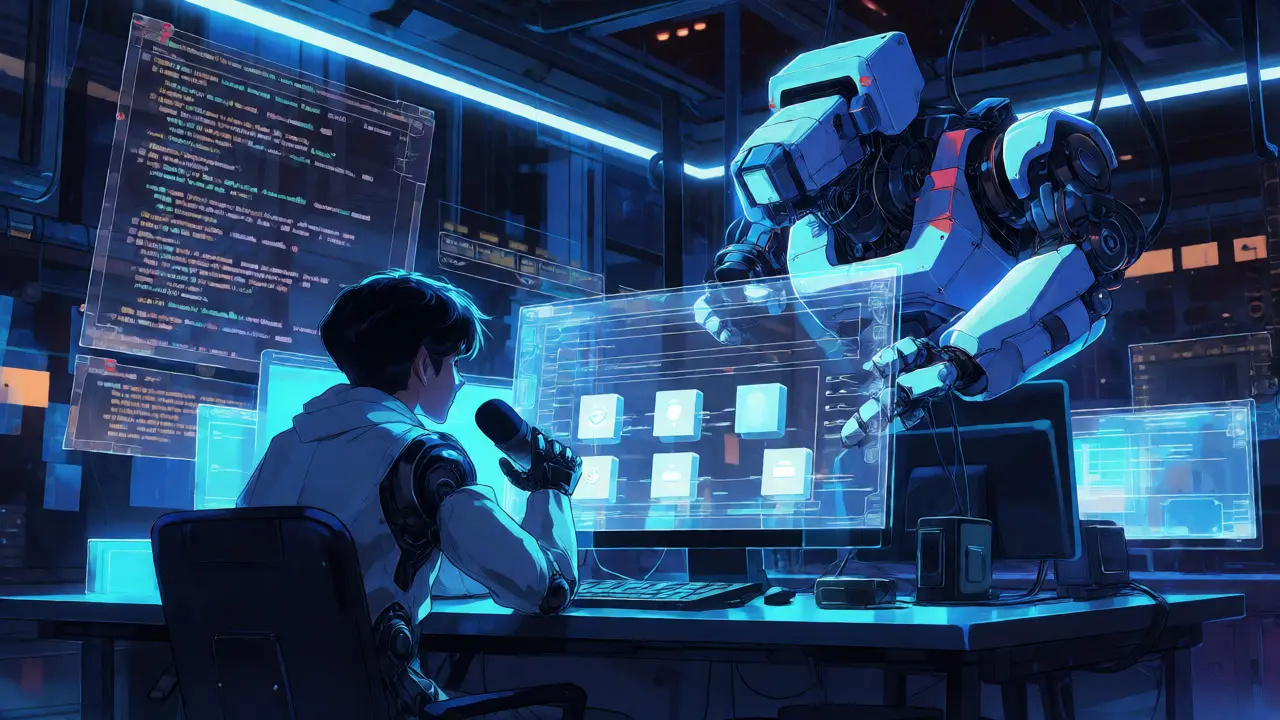
Imagine telling your computer exactly what you want it to build, not in rigid syntax, but in plain English-or even just by sketching a diagram. That’s vibe coding, a development paradigm where generative AI translates natural language and visual cues into functional software. It sounds like science fiction, but it is rapidly becoming the standard for how we create applications. If you’re wondering whether this is just another hype cycle or a fundamental shift in the tech landscape, the numbers tell a compelling story. We are moving from an era of writing every line of code manually to one of orchestrating intelligent agents that write the code for us.
What Exactly Is Vibe Coding?
Vibe coding isn’t just about using autocomplete. It represents a move toward higher abstraction layers in software creation. Instead of worrying about semicolons and memory management, developers describe the "vibe" or intent of the application. The AI handles the implementation details. This approach combines generative artificial intelligence with low-code/no-code (LCNC) platforms, allowing both seasoned engineers and non-technical users to build complex systems through conversation and visual interfaces.
The core value proposition here is speed and accessibility. Traditional development cycles are slow and expensive. Vibe coding promises to slash time-to-market by automating routine tasks. But it’s more than just convenience; it’s about democratization. When barriers to entry drop, innovation spikes. Suddenly, a marketer can prototype a customer portal without waiting six weeks for an engineering sprint. This shift addresses a critical market need for accelerated development cycles and cost reduction, positioning vibe coding as a key driver in the global AI code tools market, which is currently in a hyper-growth phase.
Market Projections: A Tale of Two Forecasts
When you look at the market data, things get interesting-and slightly confusing. Different research firms define the market differently, leading to wildly different projections. Some narrow definitions focus strictly on generative AI coding assistants, projecting growth from roughly US$25.9 million in 2024 to nearly US$100 million by 2030. Others take a broader view, including all AI-assisted development tools, forecasting a massive jump from US$21 billion in 2025 to almost US$98 billion by 2030.
Why the discrepancy? It comes down to scope. One group counts only the specific chat-based code generators. The other includes the entire ecosystem of AI-driven IDEs, automated testing tools, and low-code platforms enhanced by AI. Regardless of which number you trust, the direction is clear: robust growth. Most analysts agree on a Compound Annual Growth Rate (CAGR) between 20% and 36%. For context, the "code generation" segment specifically is expected to grow at a staggering 52% CAGR. That’s not just growth; that’s an explosion.
| Source Type | Estimated 2024/2025 Value | Projected 2030 Value | CAGR |
|---|---|---|---|
| Narrow Definition (GenAI Assistants Only) | US$25.9 Million | US$97.9 Million | 24.8% |
| Broad Definition (AI-Assisted Dev Tools) | US$21.1 Billion | US$97.8 Billion | 35.9% |
| Low-Code/No-Code Platform Synergy | US$45.5 Billion | US$101.7 Billion | 22.3% - 31% |
Adoption Scenarios: Who Will Use Vibe Coding?
So, who is actually going to use these tools? The adoption curve won’t be uniform. Startups are likely to lead the charge. By 2030, it’s projected that 25% of Y Combinator startups will use AI to generate most of their code. These companies automate up to 80% of routine tasks, speeding up project completion by over half. For a startup, speed is survival. They don’t have the luxury of hiring large teams for boilerplate code.
Enterprises move slower but carry more weight. Gartner predicts that by 2028, enterprises will use vibe coding techniques to create 40% of new production software. This isn’t just about prototyping anymore; it’s about mission-critical applications. In fact, enterprise low-code platforms are expected to power 80% of mission-critical apps globally by 2029. This suggests that vibe coding will transition from a developer productivity tool to a core component of enterprise IT strategy.
The Startup Ecosystem Boom
Investors aren’t just watching; they’re betting big. The valuation of leading vibe coding startups-names like Cognition, Lovable, Replit, Cursor, and Vercel-has skyrocketed. Collectively, their valuations jumped 350% year-on-year, reaching over US$36 billion in 2025. Despite being relatively young companies, many less than three years old, they collectively generate around US$800 million in annual recurring revenue (ARR).
This momentum signals strong investor confidence. However, there’s a catch. These products are compute-heavy. Real-time code generation and multi-step reasoning require significant processing power, which drives up inference costs. While adoption metrics look great, unit economics remain fragile. We’ve already seen some traffic declines among major platforms after initial peaks, suggesting that retention depends on solving these cost structures quickly.
Challenges and Risks
It’s not all smooth sailing. Vibe coding introduces new risks that traditional coding didn’t face to the same degree. Code quality can be inconsistent. Developers might become overconfident, trusting AI-generated code without thorough review, leading to security vulnerabilities. Maintainability becomes a nightmare if no one understands the underlying logic because it was generated by a black box.
Then there’s the organizational hurdle. Technology is easy; people are hard. Industry analysts suggest that 80% of developers will need reskilling by 2027 to adapt to AI-guided workflows. Organizations must establish governance frameworks to manage ethical concerns and intellectual property rights. Who owns the code when an AI writes it based on a prompt? These legal and operational questions need answers before widespread enterprise adoption can stabilize.
The Future Outlook Beyond 2030
Looking further ahead, we see emerging trends that could redefine programming entirely. Voice-to-code programming is on the horizon. Imagine describing a complex app verbally while watching it materialize in real-time. This could make development accessible to people with visual impairments or motor disabilities, broadening the talent pool significantly.
We’ll also see domain-specific AI assistants. Instead of a general-purpose coder, you’ll have a banking AI that understands regulatory compliance out of the box, or a healthcare AI that automatically incorporates privacy protocols. Visual development paradigms may replace text-based interactions entirely, allowing developers to manipulate diagrams that the AI translates into functional code.
Sustainability is another factor. Green SDLC practices will become core, with carbon-aware pipelines optimizing resource use. As quantum-native and edge-native development lifecycles emerge, vibe coding tools will need to adapt to hybrid computing environments, ensuring that the convenience of AI doesn’t come at an unacceptable environmental cost.
Frequently Asked Questions
Is vibe coding replacing human developers?
Not exactly. It is shifting the role of developers from writers of syntax to architects of solutions. Developers will spend less time typing code and more time reviewing, refining, and integrating AI-generated components. The demand for skilled humans remains high, but the nature of their daily work changes significantly.
How much does vibe coding cost compared to traditional development?
Initial costs can be lower due to reduced labor hours. However, ongoing costs include subscription fees for AI tools and significant cloud compute expenses for inference. Over time, as efficiency gains compound, total cost of ownership often decreases, but early-stage projects may see higher infrastructure bills.
What are the main security risks with AI-generated code?
The primary risks include hallucinated libraries that don't exist (supply chain attacks), insecure default configurations, and subtle logical errors that pass basic tests but fail under load. Developer overconfidence is a major factor, so rigorous code review and automated security scanning remain essential.
Will vibe coding work for complex enterprise applications?
Yes, but with caveats. Current tools excel at boilerplate and standard patterns. Complex legacy integrations and highly specialized business logic still require deep human expertise. However, by 2028, projections suggest 40% of new production software in enterprises will leverage these techniques, indicating growing capability for complex tasks.
Do I need to know how to code to use vibe coding tools?
For simple prototypes, no. Many tools are designed for non-technical users. However, to debug, optimize, and deploy production-ready applications, a basic understanding of programming concepts and system architecture is increasingly necessary. It helps to think like a developer, even if you aren't writing every line.