
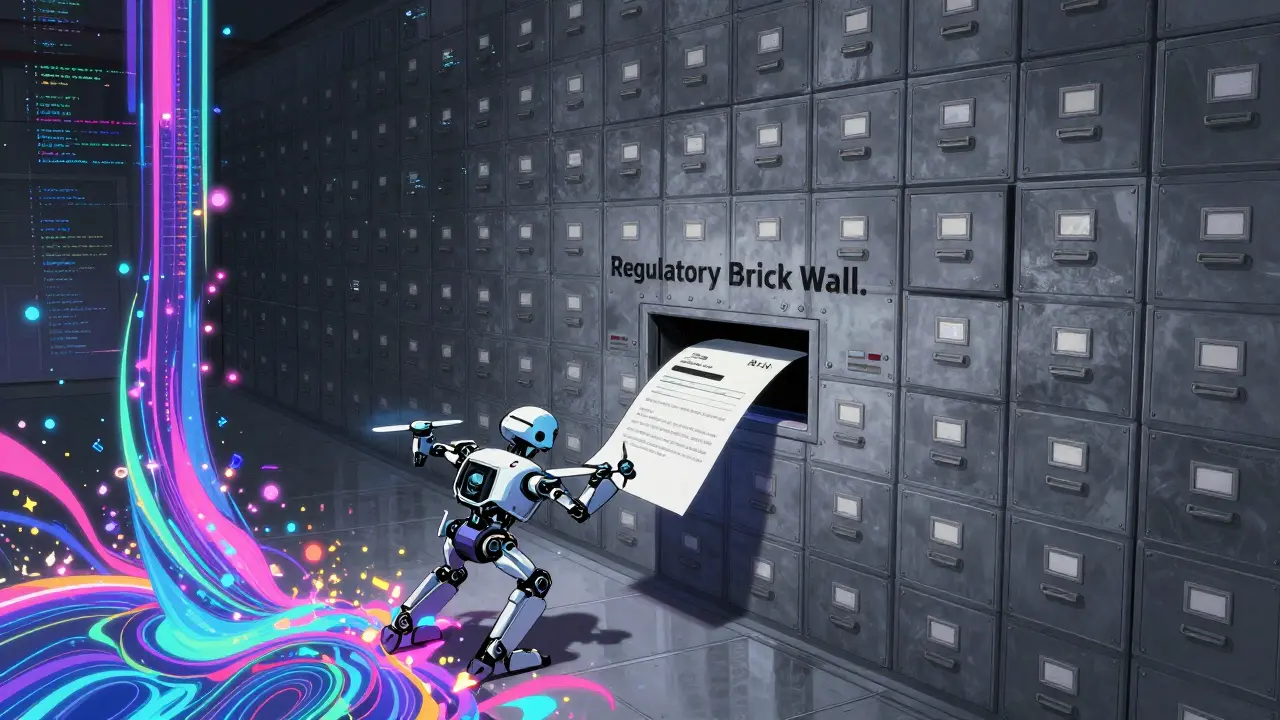
Imagine a world where you can build a complex app just by chatting with an AI, describing the "vibe" of how it should work, and watching the code write itself in real-time. For a startup founder or a freelance dev, this is the current reality of vibe coding is a prompt-based development model where large language models (LLMs) lead the production of code based on natural language instructions rather than formal architectural planning. It's fast, intuitive, and incredibly productive. But try bringing that approach into a high-stakes hospital system or a global investment bank, and you'll hit a brick wall. While the rest of the tech world is sprinting ahead with AI-assisted development, the regulated sectors are barely walking.
This isn't because doctors or bankers hate new tech. It's because there is a fundamental "regulatory paradox" at play. On one side, you have vibe coding, which prizes speed, iteration, and a "fix it as you go" mentality. On the other, you have regulatory frameworks that demand every single line of code be traceable, documented, and approved before it ever touches a production server. When your job is to ensure a patient's heart monitor doesn't glitch or a billion-dollar trade doesn't vanish, "the vibe was right" doesn't hold up in an audit.
The Traceability Gap: Why Audits Kill the Vibe
In most software projects, if a bug pops up, you patch it and move on. In regulated industries, that's a compliance nightmare. For example, healthcare software must often adhere to ISO/IEC 62304, a standard that requires complete traceability from a specific requirement to the code that implements it and the test that proves it works. Vibe coding essentially skips the "requirements" phase and goes straight to the "result."
Financial institutions face similar hurdles. With the Sarbanes-Oxley Act (SOX) and PCI-DSS, banks must provide an airtight audit trail of who changed what, when, and why. An AI that iteratively rewrites a function ten times in ten minutes based on a prompt like "make it feel more responsive" creates a documentation void. Auditors don't want to know that the AI thought it was a good idea; they want a human signature and a documented rationale. This gap in auditability is the primary reason why vibe coding is currently viewed as too risky for core production systems.
A Philosophical Clash: Iteration vs. Validation
Vibe coding is built on the philosophy of experimental optimization. You prompt, you see the result, you tweak, and you repeat. However, the FDA and other regulatory bodies operate on a validation model. In the pharmaceutical world, for instance, a tool used for drug development isn't just "tested"-it is validated. This means proving the system consistently produces the expected result under specific conditions.
When a developer uses vibe coding to iteratively change a tool, each "vibe shift" potentially creates a new version of the software. Under traditional rules, each of those versions might require its own separate validation evidence. The sheer volume of paperwork would swallow the time saved by the AI. This creates a scenario where the methodology of development is fundamentally orthogonal to the requirements of the law. The speed of AI is effectively neutralized by the friction of compliance.
| Feature | Vibe Coding Approach | Regulated Sector Requirement |
|---|---|---|
| Planning | Conversational/Emergent | Formal Specifications |
| Documentation | Minimal/Post-hoc | Traceable Audit Trails |
| Iteration | Rapid & Continuous | Gated Validation Phases |
| Risk Management | Empirical Testing | Predictive Risk Analysis |
Where the Vibe Actually Works: Safe Zones
Despite the restrictions, vibe coding isn't totally banned in these sectors; it's just being pushed into the "safe zones." The most successful use case right now is rapid prototyping. In healthcare, a team might use AI to quickly build a mock-up of an Electronic Medical Record (EMR) interface using fake data. This allows them to figure out the user experience without risking patient privacy or violating HIPAA. Once the "vibe" is perfected, human engineers step in to rewrite the core logic using traditional, validated methods for the actual production launch.
Another goldmine for vibe coding is non-critical internal infrastructure. Think of backend schedulers, internal analytics scripts, or JSON validators. These tools don't directly impact patient safety or financial solvency, so the oversight is lighter. In the superannuation sector, for example, developers are using vibe coding to build dashboards that help compliance officers spot risks early. By using AI to automate the "grunt work" of data formatting and reporting templates, senior engineers can spend more time on the high-risk, compliance-critical features that actually require a human brain.
The V.E.R.I.F.Y. Framework: Bridging the Gap
To make AI-generated code palatable for auditors, some organizations are implementing a tiered governance approach. One emerging method is the V.E.R.I.F.Y. checklist, which forces vibe-coded outputs through six strict gates before they can be merged into a codebase:
- Validate: Does the code actually do what the functional requirement asks?
- Enforce: Does it meet the organization's strict coding and style standards?
- Review: A qualified human engineer must conduct a line-by-line review.
- Inspect: Run the code through security scanners to find vulnerabilities.
- Format: Turn the AI's "reasoning" into a formal audit trail.
- Yield: Produce the final compliance artifacts required by law.
Alongside this, firms are deploying technical guardrails. This includes Static Analysis (SAST) and the generation of a Software Bill of Materials (SBOM) to ensure no mystery libraries were snuck in by the AI. By treating AI as a "junior dev who hallucinates," companies can leverage the speed of vibe coding while maintaining a human-in-the-loop safety net.

Regulatory Evolution: PreCert and Sandboxes
Regulators are starting to realize that the old "waterfall" model of approval is too slow for the AI age. The FDA's Digital Health Software Precertification (PreCert) Program is a glimpse into the future. Instead of reviewing every single update to a piece of software, the FDA evaluates the company. If the organization has a proven track record of quality and safety, they get a "pre-certified" status that allows them to deploy updates more fluidly.
We're also seeing the rise of regulatory sandboxes. These are controlled environments where developers can pilot vibe-coded tools under the watchful eye of regulators. It's essentially a "safe space" to fail and iterate without getting hit with a massive fine. While these programs are still in the pilot phase as of 2026, they represent the only viable path toward full-scale adoption. The goal is to move from a "product-by-product" review to a "process-based" assessment.
The Danger of the Innovation Gap
There is a real risk here: a widening technological divide. Consumer tech companies and SaaS firms are seeing massive productivity gains from vibe coding. If a bank takes six months to ship a feature that a FinTech startup ships in six days because of "compliance lag," the bank doesn't just lose a feature-they lose talent. Engineers don't want to work at places where they have to spend 80% of their time writing documentation for code an AI could have written in seconds.
This pressure might actually be the catalyst that forces regulators to modernize faster than they usually do. However, the reality for 2026 and beyond is likely to be a bifurcated system. We will see a world where the "front-end" and internal tools are vibe-coded for speed, while the "core"-the ledgers, the medical dosing algorithms, the flight controls-remains the domain of slow, deliberate, and heavily documented human engineering.
What exactly is vibe coding?
Vibe coding is a high-level approach to software development where the developer uses natural language prompts to describe the desired outcome and behavior of an application. Instead of writing detailed technical specifications or manual code, the developer iterates on the "vibe" or feel of the app through a conversational loop with an AI, which then generates the underlying code.
Why can't healthcare companies just use AI to write their compliance docs?
Because regulators require evidence of intent and validation. An AI can summarize what a piece of code does, but it cannot prove that the code was designed specifically to mitigate a known clinical risk. Documentation in healthcare isn't just about describing the code; it's about proving that the development process followed a rigorous, safety-first methodology.
Is vibe coding secure for financial data?
Not by default. Vibe coding often relies on external LLMs, which can lead to data leakage if protected health information (PHI) or personally identifiable information (PII) is included in prompts. For it to be secure, firms must use private, air-gapped AI instances and implement strict prompt-filtering controls.
Will vibe coding eventually replace traditional engineers in these sectors?
Unlikely in the near term. While it replaces the "typing" part of coding, the need for architectural oversight, security auditing, and regulatory sign-off remains. The role of the engineer is shifting from a "writer of code" to a "reviewer and validator of AI-generated systems."
What is the 'Regulatory Paradox' mentioned?
The paradox is that AI provides the tools to build software faster than ever, but the laws governing that software were written for a much slower, manual era. The faster the AI can iterate, the more documentation is required to prove those iterations are safe, effectively canceling out the speed advantage.
Tyler Springall
Calling this "coding" is an insult to the profession. We are basically watching the death of engineering and replacing it with a bunch of prompt-monkeys who wouldn't know a memory leak if it hit them in the face. The fact that people think "vibes" are a substitute for actual architectural rigor is honestly embarrassing for the industry.
Amy P
Omg, the idea of a heart monitor just "vibing" its way through a surgery is absolutely terrifying!!
Imagine the absolute chaos in a boardroom when an auditor asks for a trail and the dev is just like "trust me, the AI felt it was right!" It's a total nightmare scenario but also kind of fascinating how these two worlds collide!
Ashley Kuehnel
I've seen a few teams try to implement those V.E.R.I.F.Y. gates and it actually helps a lot with the onboarding of junior devs! Just a heads up tho, you really need to make sure your SAST tools are updated or you'll miss the weird hallucinated libraries the AI loves to invent. It's a great way to learn as long as you keep a human in the loop to catch the slip-ups!
adam smith
The provided analysis is quite acceptable. It is a pleasant read.
Mongezi Mkhwanazi
One must realize that the obsession with speed is a symptom of a decaying intellectual curiosity... for if we abandon the slow, methodical process of validation, we are not merely risking a glitch in a bank ledger, but are fundamentally eroding the very concept of objective truth in software engineering... a tragedy of the highest order, really!!!
Mark Nitka
Look, we can argue about the purity of the craft all day, but the reality is that if the regulators don't evolve, these industries will just collapse under their own weight while startups eat their lunch. We need to find a middle ground where the AI handles the boilerplate and the humans focus on the high-level risk management without the endless red tape.