
By 2026, AI-generated code isn't just a helper-it's the default. Developers use tools like GitHub Copilot, Amazon CodeWhisperer, and Cursor to write half or more of their codebase. But here’s the problem: people treat AI-generated code like it’s flawless. It’s not. And the security risks are piling up faster than most teams can patch them.
Why AI Code Is More Dangerous Than It Looks
AI doesn’t understand security. It doesn’t know your app’s authentication flow, your API keys, or your threat model. It just predicts what code looks like based on what it’s seen before. And what it’s seen? A lot of poorly written, insecure code from public repositories.
Studies show that 36-40% of AI-generated code snippets contain security flaws. That’s not because AI is dumb-it’s because it mirrors the data it was trained on. If you feed it code with hardcoded passwords, SQL injection holes, or unchecked file uploads, it will spit out more of the same. And since developers trust AI output more than their own, they skip reviews. GitHub found that in projects with Copilot enabled, nearly half the code comes from AI-and only 1 in 5 developers check it for security.
The Most Common AI-Generated Vulnerabilities
Some flaws show up again and again. Here are the top offenders:
- CWE-79 (Cross-Site Scripting/XSS): AI often inserts user input directly into HTML without escaping it. Think
innerHTMLor raw template strings. React and Vue help, but older server-side templates? Not so much. - CWE-89 (SQL Injection): AI writes database queries by concatenating strings. It doesn’t know about parameterized queries unless you’ve trained it on code that uses them.
- CWE-798 (Hardcoded Credentials): AI will happily generate code with API keys, database passwords, or AWS tokens baked right in. It doesn’t know these should be in environment variables or secret managers.
- CWE-22 (Path Traversal): File upload handlers? AI generates them without checking file extensions or paths. A user uploads a .php file? Boom-remote code execution.
- CWE-20 (Improper Input Validation): AI assumes all input is clean. It rarely adds length checks, type validation, or negative number filters. A user enters -1 for a quantity? The app might crash-or worse.
And don’t forget error handling. AI often wraps everything in a try-catch that just logs the error silently-or worse, shows the full stack trace to the user. That’s a goldmine for attackers.
How Attackers Are Using AI Against You
The danger isn’t just from AI writing bad code. It’s also from attackers using AI to break into your systems.
Tools like WormGPT and other malicious LLMs are now helping hackers write polymorphic malware. Ask one: “Write a Python script that finds .docx files, encrypts them with AES-256, then deletes the originals”-and you get ransomware in seconds. No coding skills needed.
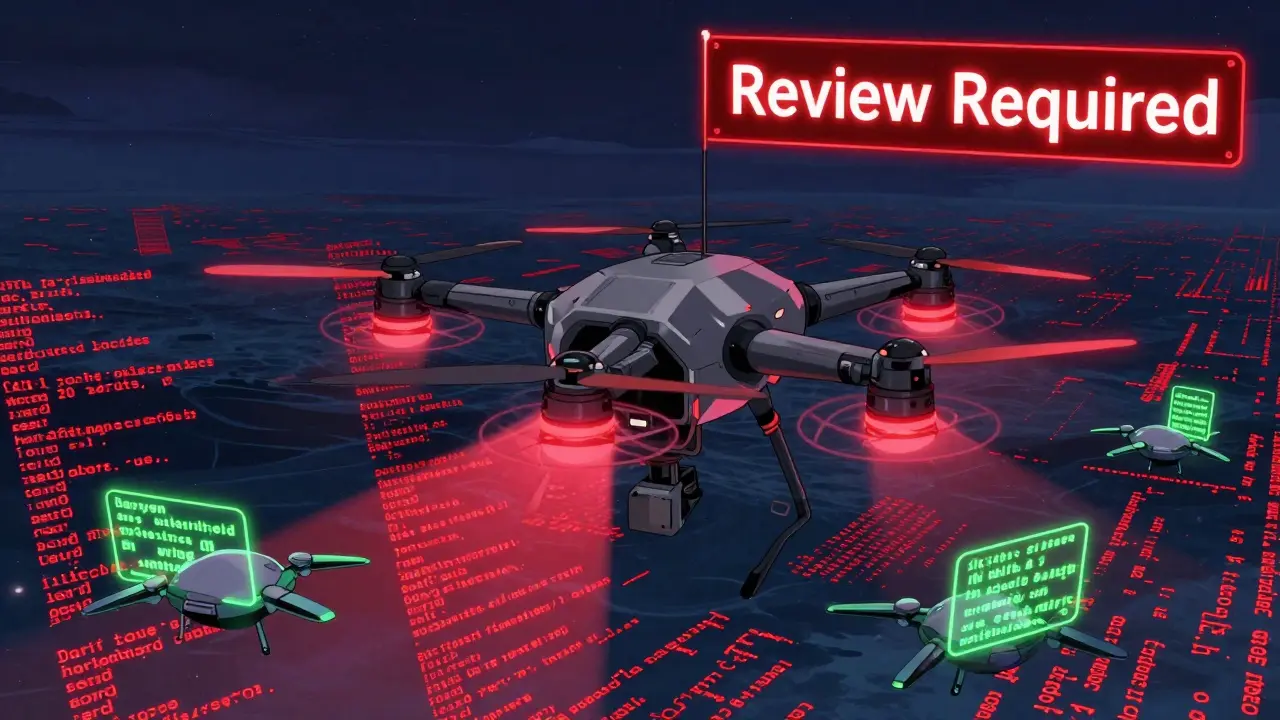
Prompt injection is another growing threat. Attackers slip malicious commands into harmless-looking prompts. A developer types: “Generate a login form”-but the prompt was tampered with to include a hidden backdoor. The AI obeys. The developer pushes it to production. No one notices.
Even phishing emails are getting smarter. AI now writes messages that sound like they came from your CFO, your IT team, or your bank. Grammar is perfect. Tone is natural. Traditional spam filters can’t catch them.
How to Protect Your Codebase
You can’t stop AI from writing code. But you can stop it from breaking your systems. Here’s how:
- Use SAST tools: Static Application Security Testing tools like Semgrep, SonarQube, and Checkmarx scan every line of code-AI or human. They catch SQL injection, XSS, and hardcoded secrets the same way. Enable rules for the top 6 AI-generated risks: CWE-89, CWE-79, CWE-798, CWE-22, CWE-502, and CWE-20.
- Scan for secrets: Use tools like GitGuardian or built-in secret detectors in SAST tools. They flag API keys, tokens, and passwords before they get committed. Many teams miss this-until a breach happens.
- Enforce environment variables: Never allow hardcoded credentials. Require all secrets to come from Vault, AWS Secrets Manager, or similar. Make this part of your CI/CD pipeline.
- Review dependencies: AI often suggests old, abandoned, or vulnerable libraries. Always check if a dependency is actively maintained. Use Snyk or Dependabot to monitor for known vulnerabilities.
- Train your team: Developers need to understand that AI isn’t a magic wand. Code review isn’t optional. Pair programming, pull request checks, and security walkthroughs must be standard-even for AI-generated code.
Regulations Are Catching Up
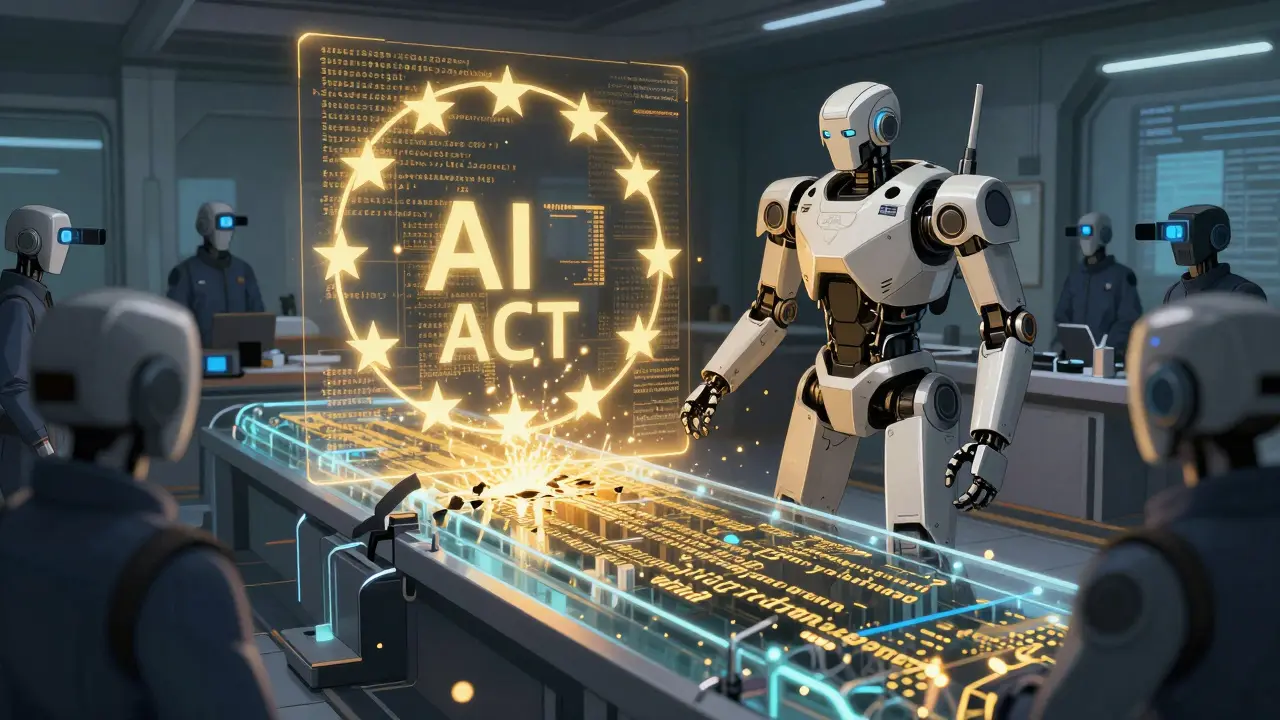
By August 2026, the EU AI Act is fully in force. It requires that all AI-generated content be machine-detectable. That means if your code is generated by an AI, it must carry a detectable watermark. Failing to do so? Fines up to 7% of your global revenue.
It’s not just about watermarking. The law also bans AI systems that generate harmful content without safeguards. If your AI tool can be tricked into writing malware or bypassing security checks, you’re in violation.
Other regions are following. This isn’t a future threat-it’s a compliance deadline you’re already late for if you haven’t started.
The Silver Lining: AI Can Also Fix Security
It’s not all bad. AI isn’t just a source of risk-it’s becoming a powerful defense tool.
In late 2025, an AI system called AISLE discovered 15 new CVEs, including all 12 zero-day vulnerabilities in OpenSSL. That’s something human researchers missed for months. AI can scan millions of lines of code, spot subtle logic flaws, and find edge cases no human would think to test.
Companies are now using AI to auto-generate security patches, simulate attack paths, and even write test cases for vulnerability fixes. The key is using AI as a co-pilot-not a replacement.
What’s Next?
AI-generated code is here to stay. The question isn’t whether you’ll use it. It’s whether you’ll manage the risk.
Teams that treat AI code like any other code-review it, scan it, test it, and validate it-will stay secure. Teams that assume AI knows better than they do? They’ll be the next headline.
The future of software security doesn’t mean ditching AI. It means building better guardrails around it. Automated scanning, strict policies, and a culture of skepticism are no longer optional. They’re the baseline.
Is AI-generated code less secure than human-written code?
Not necessarily. Studies show AI-generated code has a similar vulnerability rate to human-written code in the same codebase. The real issue is trust: developers review AI code less often, so flaws go unnoticed. AI doesn’t make code worse-it makes oversight worse.
Can SAST tools detect vulnerabilities in AI-generated code?
Yes. SAST tools scan code structure, not authorship. Whether a SQL injection was written by a developer or Copilot, the tool will flag it the same way. Tools like Semgrep, SonarQube, and Checkmarx are essential for catching AI-generated flaws.
What are the most common AI-generated security flaws?
The top five are: hardcoded credentials (CWE-798), SQL injection (CWE-89), cross-site scripting (CWE-79), path traversal (CWE-22), and missing input validation (CWE-20). These appear because AI generates the "happy path" and skips edge cases, error handling, and security controls.
Should I ban AI code generators in my team?
No. Banning them won’t stop their use-it’ll just drive it underground. Instead, enforce policies: require code reviews, run automated scans, and train developers to question AI output. The goal isn’t to eliminate AI-it’s to make it safe.
How does the EU AI Act affect AI-generated code?
By August 2026, the EU AI Act requires all AI-generated content to be machine-readable and detectable. This means code generated by AI tools must carry a detectable marker. Failure to comply can lead to fines of up to 7% of global revenue. It also bans AI systems that generate harmful or unsafe code without safeguards.
Can AI help find security vulnerabilities too?
Yes. In 2025-2026, AI systems like AISLE discovered 15 new CVEs, including all 12 OpenSSL zero-days. AI can scan massive codebases faster than humans, spot subtle logic flaws, and even suggest patches. The best approach is using AI for both generating code and finding its flaws.
Sumit SM
Let’s be real-AI doesn’t write code, it regurgitates entropy. We’ve outsourced our cognitive responsibility to a statistical parrot trained on GitHub’s dumpster fire. The real vulnerability isn’t in the code-it’s in the human belief that automation equals accuracy. We’re not debugging software anymore; we’re debugging our own arrogance. And now we’re surprised when the system collapses under the weight of its own blind trust?
Security isn’t a checklist. It’s a mindset. And if your mindset is ‘let the AI handle it,’ then you’re not a developer-you’re a spectator in your own system.
The EU AI Act? It’s a bandage on a hemorrhage. Watermarking code won’t stop a hacker who’s already inside. What we need is a cultural reset: treat every line of AI output like it came from a stranger on the internet-with suspicion, scrutiny, and a healthy dose of shame.
And yet, here we are, celebrating AI for finding CVEs while ignoring that it created 90% of them. The irony is thicker than a legacy Java application with 12 layers of abstraction.
Maybe the real question isn’t ‘how do we secure AI-generated code?’ but ‘how do we stop humans from becoming obsolete?’
Jen Deschambeault
I’ve been using Copilot for over a year now, and honestly? It’s been a game-changer for boilerplate. But I do a line-by-line review every time-no exceptions. I don’t trust it, I use it. There’s a difference.
My team started requiring pull request checklists that include: ‘Did you verify secrets? Did you check input validation? Did you question the AI’s logic?’ Simple. Effective.
We’re not banning AI. We’re just not letting it drive.
Jeroen Post
AI writes code so bad it’s basically a backdoor factory. The fact that companies still use it without mandatory human review is why we’re all one zero-day away from total collapse. They’re not even trying. The EU watermark thing? A joke. Hackers don’t care about metadata. They care about lazy devs. And we’re all lazy. Wake up.
Honey Jonson
i just wanna say that i started using code whisperer last month and at first i was like oh no this is gonna be a disaster but then i realized-its not about the ai being perfect its about us being better at catching its mistakes. now i pair program with it like a dumb but helpful intern. also i use semgrep on every commit and it saves my butt like 3x a week. just review stuff ppl its not that hard lol
Sally McElroy
Let me be clear: if you’re not scanning AI-generated code with SAST tools before merge, you’re not just negligent-you’re reckless. The fact that this even needs to be said is a reflection of how far we’ve fallen. We’ve turned software engineering into a game of Russian roulette with production systems.
Hardcoded credentials? SQL injection? These aren’t edge cases-they’re predictable outcomes of unverified automation. And yet, companies still treat this like a feature, not a bug.
The EU AI Act isn’t overreach-it’s the bare minimum. If your organization hasn’t started auditing AI output for security compliance by now, you’re already in violation. And yes, I’m talking to you, ‘we’re agile so we skip reviews’ team.
This isn’t about technology. It’s about accountability. And accountability starts with a single, disciplined habit: review everything.