You've just spent three hours prompts-engineering a perfect summary of a complex topic using an AI tool. The output looks professional, the logic is sound, and it's almost ready for your report. But then you hit a wall: how do you actually cite this without risking your professional or academic reputation? This isn't just about where to put a comma or a parenthesis. The real danger is the citation strategies for generative AI are currently fighting a losing battle against "hallucinations"-the AI's tendency to invent plausible-sounding but entirely fake sources.
If you cite a fake journal article created by a chatbot, you aren't just making a mistake; you're committing a breach of academic integrity. Because AI doesn't "know" facts-it predicts the next likely token in a sequence-it often creates "phantom citations." In one study by University of Washington researchers, ChatGPT invented non-existent scholarly citations in 65% of test cases. This means your primary goal isn't just formatting a citation, but verifying the actual claim against a real-world document.
The Big Three: Comparing MLA, APA, and Chicago Styles
Different fields have different rules. Depending on whether you're writing a sociology paper, a medical report, or a history thesis, your approach to AI attribution will change. The core challenge is that AI outputs are generally not stable; they change every time you hit "regenerate," making traditional URLs unreliable.
The MLA (Modern Language Association) focuses on the prompt. They want to know exactly what you asked the AI to get that specific result. This makes the process more reproducible, though it can make your paper feel cluttered. The APA (American Psychological Association) prioritizes the tool's version and the company, treating the AI more like a software product. Then there's the Chicago Manual of Style, which takes a more skeptical view, often suggesting that AI content be cited in notes but left out of the final bibliography entirely because it lacks a permanent, public record.
| Style Guide | Primary Focus | Bibliography Entry? | Key Requirement |
|---|---|---|---|
| MLA | The Prompt | Yes | Exact prompt text |
| APA | The Tool/Version | Yes | Model version in brackets |
| Chicago | The Interaction | Usually No | Note-style attribution |
The Hallucination Trap: Why You Can't Trust AI Sources
Here is the hard truth: an AI cannot be a "source" of factual information. It is a processor of information. When you ask ChatGPT or Claude for a reference, it isn't searching a database of real papers in the way Google Scholar does. It is guessing what a citation should look like.
Professor Edward Ayers from the University of Richmond pointed out a particularly dangerous trend: AI tools often cite real authors and real journals but attribute completely fake claims to them. This "hybrid fiction" is harder to spot than a totally made-up title. You might see a citation for a real paper in *Nature* and assume the content is correct, only to find that the actual paper says the exact opposite of what the AI claimed.
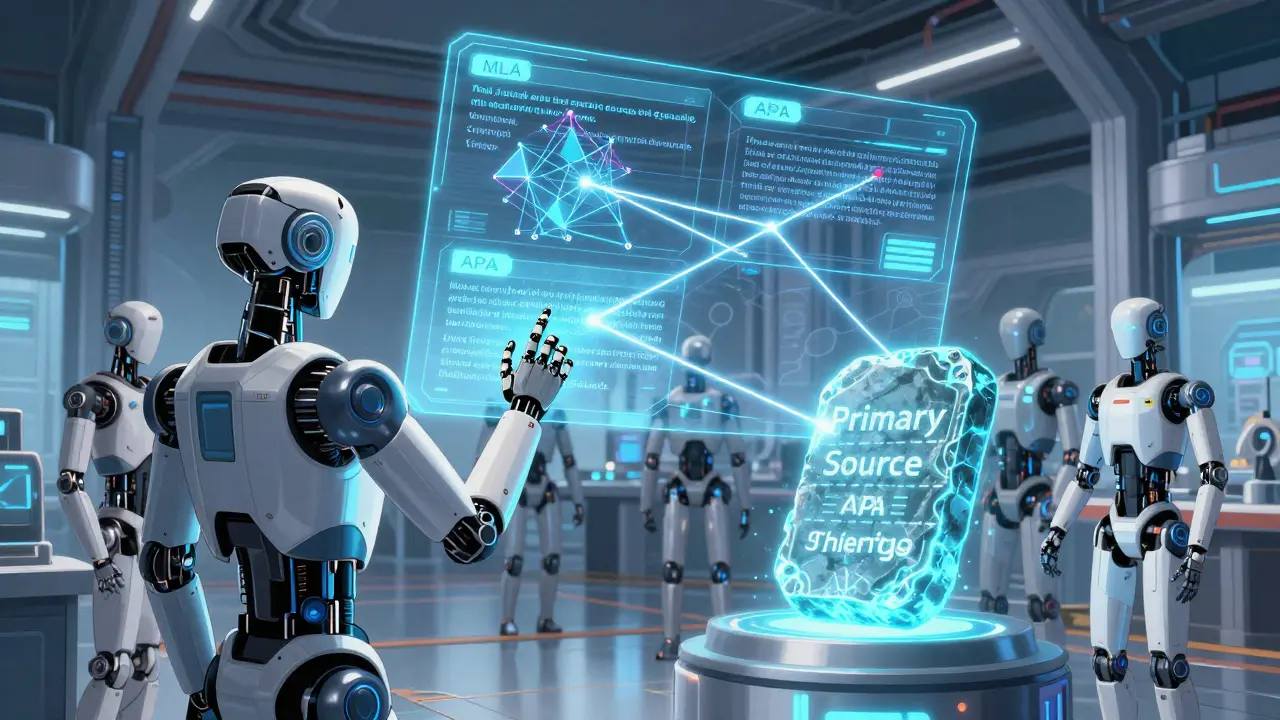
This is why the Association of College and Research Libraries is so blunt: AI should never be your final source. If the AI gives you a fact, your job is to leave the AI environment and find that fact in a peer-reviewed journal or a primary document. Only then do you cite the original source, not the bot.
A Practical Workflow for Verifying AI Claims
To avoid the "AI Citation Nightmare"-a term popular on academic forums where students waste hours chasing fake leads-you need a systematic approach. The University of California, Davis Library suggests a three-step verification process that separates the tool from the truth.
- Preliminary Research: Use the AI to brainstorm, structure your thoughts, or find general keywords. Treat everything it says as a "tip" rather than a fact.
- Active Verification: Take every factual claim and specific citation the AI provided. Search for them in a trusted database like PubMed, JSTOR, or a university library. If you cannot find the document in a third-party archive, assume it is a hallucination.
- Source Replacement: Once you find the real document that supports the claim, cite that document. If you are required to disclose that AI helped you find the information or structure the argument, use a methodology statement.
For those using AI for research design, such as generating interview questions or survey prompts, a methodology statement is the gold standard. For example: "Interview questions were developed using Gemini 1.5 (Google) with the prompt: 'Generate 10 open-ended questions about climate change policy.'" This provides transparency without falsely claiming the AI as a factual authority.
Technical Implementation and Tooling
Fortunately, the tools we use to manage citations are evolving. Zotero and EndNote have both added native support or templates for AI citations. These tools help you keep track of the specific version of the model (e.g., GPT-4o or Claude 3 Opus) and the exact date of the interaction, which is critical because these models are updated frequently.
One of the biggest shifts is the introduction of "Shareable Chat Links." Until recently, a chat was a private conversation that no one else could see, which is why the Chicago Manual of Style hated them in bibliographies. Now that companies like OpenAI allow users to share a permanent link to a conversation, these interactions are becoming more like "published" documents. This is slowly pushing the academic world toward treating AI chats as a form of digital correspondence or specialized software output.
Dealing with Images and Non-Text AI
It's not just about text. If you use DALL-E 3 or Midjourney to create a figure for a presentation, you can't just say "Image generated by AI." You need to provide the prompt and the tool. The University of North Carolina's guidelines suggest a format like: 'Prompt text' prompt, *DALL-E 3*, OpenAI, [Date], [URL].
The key here is the prompt. Because AI art is stochastic (random), the prompt is the only piece of evidence that shows how the image was created. Without the prompt, the image is a black box; with it, it becomes a documented piece of work.
The Future of AI Attribution
We are moving toward a world where "AI disclosure statements" will be as common as "Conflict of Interest" statements in scientific journals. Organizations like Crossref are even piloting DOI-like systems for AI content to give these fleeting conversations a permanent digital identity.
However, as Dr. Joy Buolamwini has noted, no matter how fancy the citation format is, it can't fix a fundamental lack of reliability. The trend among top-tier institutions is shifting: they aren't just asking how you cite AI, but if you should be using it as a source at all. The most respected researchers are moving toward a "Dual-Citation" approach: citing the AI for the process (how the idea was generated) and a primary source for the fact (why the idea is true).
Can I cite an AI tool as the primary author of a fact?
No. Major academic bodies, including the Association of College and Research Libraries, state that AI should never be cited as a source of factual information. Because AI can hallucinate (invent) facts and citations, you must verify the claim using a credible primary source and cite that source instead.
What is the difference between MLA and APA AI citations?
MLA emphasizes the prompt used to generate the text, requiring the specific query in the citation. APA emphasizes the version and the model type (e.g., [Large language model]) and lists the company (e.g., OpenAI) as the author.
Why does the Chicago Manual of Style suggest excluding AI from the bibliography?
Traditionally, Chicago style views AI outputs as non-recoverable data. Since most AI chats were private and lacked a stable, public URL that others could use to verify the text, they were treated like personal communications-cited in notes but not in the final reference list.
What should I do if an AI provides a citation that I can't find anywhere?
Assume the citation is a hallucination. AI often creates "phantom citations" by combining real author names with plausible-sounding titles. If you cannot find the paper in a verified database, do not use the information and do not cite the fake source.
How do I cite AI when it's used for research methodology rather than content?
Include a methodology statement in your paper. Clearly state the tool used, the version, the date, and the specific prompts used to develop your research instruments (like survey questions or interview guides). This ensures transparency without claiming the AI as a factual authority.
Jeff Napier
funny how they call it hallucinations like the machine is just dreaming when really its just the corporate overlords scrubbing the data to fit a narrative the guidelines are just a way to keep us playing by their rules while they control the flow of info who actually believes the mla knows what is real anyway
Sibusiso Ernest Masilela
The absolute audacity of some people to think they can just 'prompt' their way into academic legitimacy is staggering. It's pathetic. If you're relying on a chatbot to structure your thoughts, you aren't a researcher, you're a glorified copy-paster with zero intellectual rigor. Truly an embarrassment to the pursuit of knowledge.
Ronak Khandelwal
This is such a beautiful way to look at the evolution of knowledge! 🌟 It's not just about the rules, but about how we grow alongside our tools to find a deeper truth. Let's all remember to support each other as we navigate this digital wilderness together! ✨💖🌈
Tina van Schelt
It's a total minefield out there. One minute you're cruising through a summary and the next you're staring at a citation that looks absolutely pristine but is actually a complete fever dream of a source. Just a kaleidoscopic mess of fake data!
Daniel Kennedy
Look, we need to stop pretending that 'hallucinations' are some mysterious glitch. They are a feature of how LLMs work. If you're too lazy to check a primary source, you deserve to get flagged for academic dishonesty. Period. Get your head out of the clouds and actually do the legwork if you want your work to mean anything.