
Imagine training a world-class generative AI model on medical records from five different hospitals, without a single patient file ever leaving its original server. For years, this was the holy grail of data science-a way to unlock the power of diverse datasets while keeping sensitive information locked down tight. Today, that future is here, and it’s built on a foundation called Federated Learning combined with Generative AI technologies that create synthetic data and insights without exposing raw private inputs. The traditional approach to building powerful AI involved hauling terabytes of raw data into central cloud servers. This created massive security risks, regulatory headaches, and bottlenecks. Federated learning flips this script. Instead of moving data to the model, you move the model to the data. This shift isn't just a technical tweak; it's a fundamental change in how organizations collaborate on intelligence. By 2026, as privacy regulations tighten globally and generative models demand more nuanced training data, this decentralized approach has become the standard for secure collaboration.
How Federated Learning Actually Works
To understand why this matters, you need to see the mechanics under the hood. In a centralized system, your laptop sends photos to Google or Apple, their servers analyze them, and they send back suggestions. In a federated system, the process stays local. Your device downloads a base model, trains it on your specific data locally, and then sends only the mathematical updates-often called gradients-to a central server. Think of it like a group of chefs trying to perfect a secret recipe. Instead of sharing their ingredient lists (the raw data), each chef tastes the dish, adjusts the seasoning slightly based on their own pantry, and sends back a note saying "add a pinch more salt" or "reduce heat." The head chef aggregates these notes to improve the master recipe. No one ever sees anyone else's ingredients, but everyone benefits from the collective wisdom.
This lifecycle repeats in rounds. Each participating entity-whether it’s a smartphone, a hospital server, or a factory IoT sensor-performs local training. These local parameter updates are then aggregated at a central server. The server computes an optimal global update and distributes it back to all participants. This cycle allows the model to learn from millions of diverse sources without ever centralizing the underlying sensitive information.
The Intersection with Generative AI
Generative AI, which includes large language models and image generators, thrives on variety. The more diverse the training data, the better the output. However, high-quality, diverse data is often siloed behind strict privacy walls. This is where federated learning becomes a game-changer for generative models. When you apply federated principles to generative AI, you enable the creation of synthetic data that mimics real-world distributions without containing actual private records. For example, a bank might use federated learning to train a generative model that can produce realistic financial transaction patterns. These synthetic transactions can then be used to train fraud detection systems or test new algorithms, all without exposing a single real customer's account details. This synergy solves two problems at once. First, it provides the data diversity needed for robust generative outputs. Second, it ensures that the generated content doesn't inadvertently leak private training examples-a common concern with large language models known as "memorization." By keeping the raw data local, the risk of direct data leakage is significantly reduced.

The Four Pillars of Privacy Protection
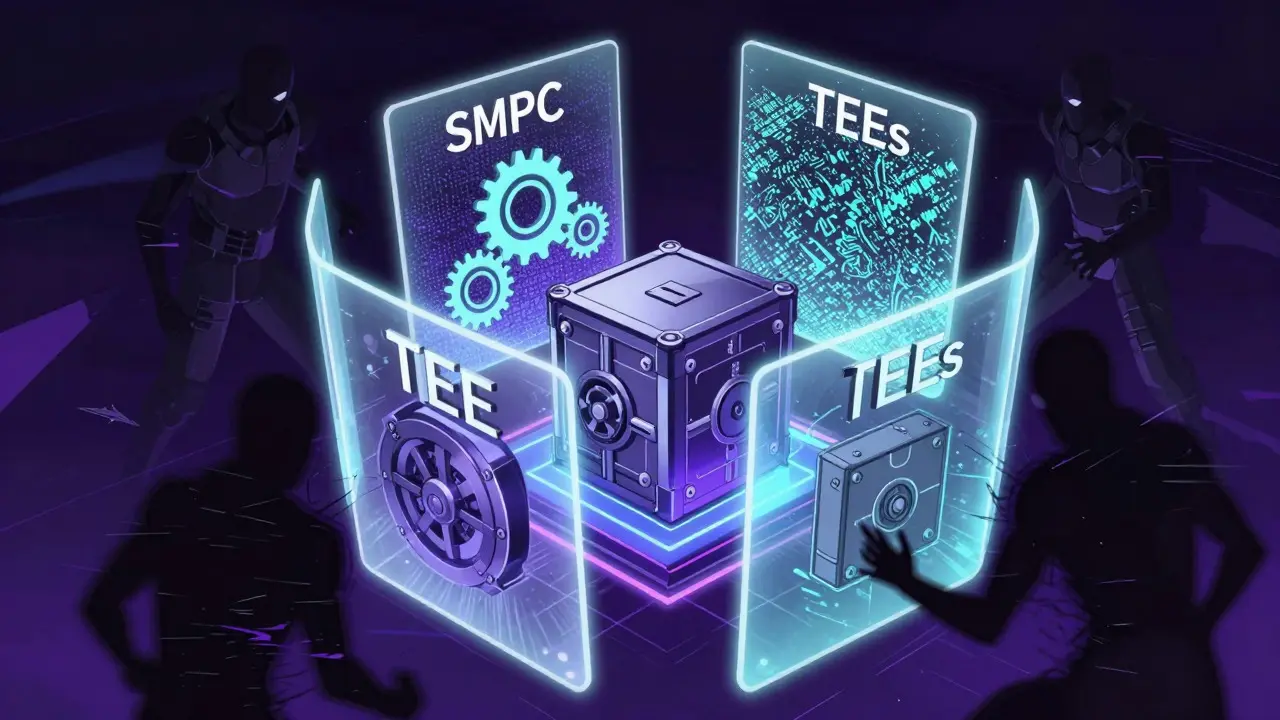
Simply moving training to the edge isn't enough to guarantee privacy. Model updates themselves can sometimes reveal clues about the underlying data through techniques like gradient inversion. To plug these leaks, modern federated systems layer multiple cryptographic and statistical defenses. Research from cybersecurity leaders like Palo Alto Networks highlights four primary techniques that form a layered defense system.
- Secure Multi-Party Computation (SMPC): This allows several parties to jointly compute results without revealing individual inputs. Imagine three people wanting to know their average salary without telling each other theirs. SMPC makes this mathematically possible. In federated learning, it ensures that even if the aggregation server is compromised, it cannot reverse-engineer any single participant's contribution.
- Homomorphic Encryption (HE): This is perhaps the most futuristic aspect. HE enables computations to be performed on encrypted data. The central server processes the model updates while they remain unreadable, even to the server itself. It’s like doing math inside a sealed box-you put numbers in, do the calculation, and get the result out, but never see the intermediate values.
- Differential Privacy (DP): DP introduces small amounts of statistical noise to the model updates. This noise makes it mathematically difficult to trace any specific update back to a specific user or record. It guarantees that the presence or absence of any single individual’s data does not significantly affect the final model output.
- Trusted Execution Environments (TEEs): TEEs provide hardware-level protection. They isolate sensitive computations within secure enclaves on the processor, preventing tampering or unauthorized access by the operating system or other software. This adds a physical layer of trust to the digital process.
These methods don't work in isolation. They cover each other's gaps. For instance, homomorphic encryption is computationally heavy, so it might be used for critical aggregations, while differential privacy handles the day-to-day noise injection. Together, they create a robust shield around your data.
Real-World Applications Beyond Theory
This technology isn't just academic anymore. It’s being deployed in industries where data sovereignty and privacy are non-negotiable. In the automotive industry, vehicles generate massive amounts of data. However, data collected in one country often cannot be shared with business units in another due to compliance laws like GDPR or China's PIPL. Federated learning allows car manufacturers to train autonomous driving models globally using vehicle data that never leaves the local region. The model gets smarter everywhere, but the data stays compliant locally. In healthcare, hospitals have long been hesitant to share patient records due to HIPAA and other regulations. With federated learning, multiple institutions can jointly develop AI models for disease diagnosis or drug discovery. A radiology AI can be trained on X-rays from ten different hospitals without those images ever leaving their respective archives. This leads to more accurate diagnostics because the model sees a wider variety of cases, yet patient privacy remains intact. Financial institutions are also leveraging this for fraud detection. Banks can collaborate to identify new fraud patterns without sharing their proprietary transaction logs. This creates a community-wide defense against bad actors, raising the cost of crime while lowering the barrier to entry for smaller banks that lack massive internal datasets.
| Feature | Centralized Training | Federated Learning |
|---|---|---|
| Data Location | Central Cloud Server | Local Devices/Servers |
| Privacy Risk | High (Single point of failure) | Low (Distributed, no raw data sharing) |
| Regulatory Compliance | Complex (Data transfer restrictions) | Simplified (Data sovereignty respected) |
| Communication Cost | High (Uploading raw data) | Moderate (Uploading model weights) |
| Scalability | Limited by server capacity | High (Leverages edge compute) |
Challenges and Security Risks to Watch
Despite its advantages, federated learning is not a silver bullet. It introduces new complexities and attack surfaces that organizations must manage. First, there’s the issue of non-IID data. In centralized training, data is usually shuffled and uniform. In federated settings, data is "non-independent and identically distributed." One hospital might specialize in cardiology, while another focuses on oncology. Their local datasets look very different. If the aggregation algorithm isn’t smart enough, the global model can become biased or unstable. Advanced techniques like personalized federated learning are emerging to address this by allowing some local adaptation alongside global learning. Second, system heterogeneity poses a logistical nightmare. Not all devices have the same battery life, processing power, or internet connection. A smartphone might drop out of the training loop because the user went offline. The system must be resilient enough to handle stragglers and incomplete updates without collapsing. Third, security threats have evolved. Adversaries can launch "model poisoning" attacks, where a malicious participant injects bad data to skew the model. Or they might attempt "gradient inversion" to reconstruct private images from the shared updates. Defending against these requires continuous monitoring, anomaly detection, and rigorous validation of incoming model updates. Trusting the aggregation server is also critical; if the server is compromised, the entire chain breaks. Hence, the reliance on verifiable computation and zero-knowledge proofs is growing.
Why This Matters for Your Organization
If you’re considering AI initiatives in 2026, the question isn’t whether to use federated learning, but where to start. The benefits extend beyond just privacy. You gain access to a wider range of data partners who were previously too wary to share. You reduce the computational load on your central infrastructure by distributing it to the edge. And you build a reputation for ethical, secure AI practices, which is increasingly valuable to consumers and regulators alike. However, implementation requires investment. You need strong cryptography libraries, robust aggregation infrastructure, and skilled engineers who understand both machine learning and security. It’s not a plug-and-play solution. But for industries handling sensitive personal data-from healthcare to finance-the payoff is a competitive advantage that relies on collaboration rather than hoarding.
Is Federated Learning completely secure?
No technology is 100% secure. While federated learning reduces the risk of large-scale data breaches by keeping raw data local, it introduces new risks like model inversion and data poisoning. Security depends on implementing additional layers like differential privacy, homomorphic encryption, and trusted execution environments. It shifts the threat model rather than eliminating it entirely.
Can small businesses implement Federated Learning?
Yes, but often through managed services or platforms rather than building from scratch. Many cloud providers now offer federated learning frameworks that handle the complex cryptography and aggregation logic. Small businesses can participate in industry consortia to benefit from shared models without bearing the full infrastructure cost.
How does Federated Learning differ from Edge Computing?
Edge computing refers to processing data near the source to reduce latency. Federated learning is a specific method of training machine learning models across distributed edges. While federated learning often runs on edge devices, its primary goal is collaborative model improvement with privacy preservation, whereas edge computing’s primary goal is performance and bandwidth reduction.
What is the role of Differential Privacy in this context?
Differential Privacy adds statistical noise to the model updates before they are sent to the central server. This ensures that the contribution of any single individual’s data is obscured, making it mathematically impossible to re-identify specific users from the aggregated model. It acts as a mathematical guarantee of privacy.
Does Federated Learning slow down model training?
It can be slower per round due to communication overhead and the need for synchronization. However, because it leverages the computational power of millions of devices, it can scale horizontally in ways centralized servers cannot. Techniques like asynchronous updates and selective participation help mitigate latency issues.