
Why Your Model Architecture Matters More Than You Think
You’ve probably heard that large language models are the future of AI. But not all LLMs are built the same way under the hood. If you’re building an application today-whether it’s a chatbot for customer support or a tool to translate legal documents-the choice between a decoder-only model and an encoder-decoder model isn’t just a technical detail. It’s the difference between a fast, flexible assistant and a precise, reliable translator.
Most people assume bigger is better. They see headlines about trillion-parameter models and think, "I need that." But size doesn’t always equal suitability. In fact, picking the wrong architecture can cost you money, time, and user trust. Let’s cut through the hype and look at how these two architectures actually work, where they shine, and where they fail.
The Core Difference: How They Read and Write
To understand why one might be better than the other, you have to look at how they process information. Both architectures rely on the Transformer architecture, introduced in the 2017 paper "Attention Is All You Need" by Vaswani et al. at Google Brain. This breakthrough replaced older recurrent neural networks with attention mechanisms, allowing models to weigh the importance of different words in a sentence regardless of their distance from each other.
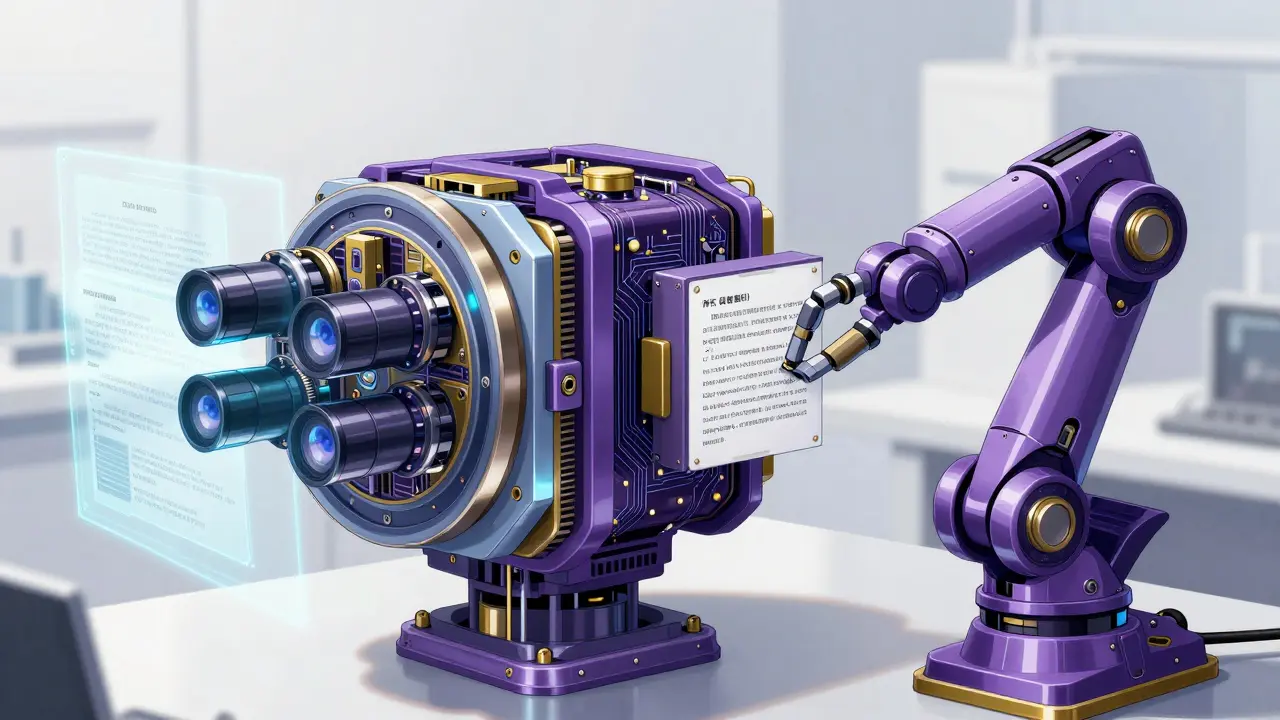
Encoder-decoder models use two distinct components: an encoder and a decoder. The encoder reads the entire input sequence bidirectionally. This means it looks at every word in relation to all other words before creating a rich, contextual representation. Then, the decoder takes that representation and generates output token by token, attending to both its previous outputs and the encoder’s understanding via cross-attention. Think of it like a human translator reading a whole paragraph, digesting the meaning, and then writing the translation sentence by sentence.
In contrast, Decoder-only models (like GPT-3, GPT-4, and LLaMA) use only a decoder component. They process text sequentially from left to right using causal self-attention. When generating the next word, they can only "see" the words that came before it. They don’t read ahead. This makes them exceptionally good at continuation tasks-like completing a story or answering a question in a chat-but limits their ability to grasp global context from the input side in the same deep, bidirectional way encoders do.
Performance Benchmarks: Speed vs. Precision
If you care about raw speed, decoder-only models generally win. A 2023 study by Slator found that decoder-only models demonstrated 18-22% faster inference speeds on identical hardware compared to encoder-decoder counterparts. For real-time applications like chatbots, this latency reduction is critical. Users expect instant responses, and decoder-only architectures deliver that efficiency because they skip the complex encoding phase during generation.
However, precision often comes at the cost of speed. That same Slator study showed that encoder-decoder models achieved 2.3-4.7 BLEU points higher scores on WMT14 English-German translation tasks. BLEU is a standard metric for machine translation quality. The gap widened significantly for linguistically distant pairs like English-Japanese, where encoder-decoder models outperformed decoder-only ones by 6.2 BLEU points. Why? Because the encoder’s bidirectional view captures nuanced grammatical structures and long-range dependencies that left-to-right processing might miss.
For summarization, the trade-off becomes even clearer. On the XSum benchmark, encoder-decoder models scored 4.3 points higher in ROUGE-L (a measure of overlap between generated and reference summaries). Decoder-only models produced text that sounded more fluent but were less factually precise. If your goal is to extract accurate key points from a financial report, fluency without accuracy is dangerous.
Task-Specific Recommendations
So, which one should you choose? It depends entirely on what you’re trying to build. Here’s a breakdown based on common use cases:
- Machine Translation: Stick with encoder-decoder models. Tools like Google Translate and DeepL rely on this architecture because it handles structural differences between languages better. The Slator 2023 data confirms encoder-decoder models dominate here, especially for low-resource or structurally diverse language pairs.
- Chatbots and Conversational AI: Go with decoder-only models. Their sequential nature mimics natural conversation flow. Plus, they’re easier to fine-tune for instruction-following. GPT-4, for instance, scored 14.2% higher on the Alpaca Eval benchmark for instruction adherence compared to encoder-decoder alternatives.
- Text Summarization: Use encoder-decoder if factual accuracy is paramount. If you prioritize engaging, readable prose over strict fidelity to source details, a decoder-only model might suffice, but beware of hallucinations.
- Question Answering and Retrieval: Decoder-only models have improved significantly here, but encoder-only models (like DeBERTa-v3-large) still show superior performance on specific NLU tasks. An arXiv 2024 analysis noted that DeBERTa-v3-large outperformed GPT-4-0613 by 0.44 standard deviations on average across English NLU tasks, despite having far fewer parameters.

Implementation and Cost Considerations
Beyond performance, you need to consider the practicalities of deployment. Training encoder-decoder models typically requires 30-50% more computational resources than decoder-only models of equivalent parameter size, according to Google’s T5 paper. This isn’t just a training issue; it affects inference too. MLPerf 3.0 benchmarks from September 2023 showed that while encoder-decoder models need more VRAM during training, decoder-only models demand 25% more memory during inference for similar parameter counts due to their autoregressive nature.
From a developer experience standpoint, decoder-only models are friendlier. Hugging Face forums reveal that developers find decoder-only models significantly easier to deploy for chat applications, reporting 40% less code complexity. Fine-tuning also tends to be cheaper and faster. One GitHub issue noted that instruction tuning for decoder-only models required only 30% of the compute resources needed for comparable encoder-decoder setups.
Community support plays a role too. As of Q4 2023, decoder-only models accounted for 68% of transformer-related GitHub issues and 73% of Stack Overflow questions tagged 'LLM'. If you hit a snag, you’re more likely to find a solution online for a GPT-style model than for a specialized encoder-decoder variant.
| Feature | Decoder-Only (e.g., GPT-4, LLaMA) | Encoder-Decoder (e.g., T5, BART) |
|---|---|---|
| Processing Direction | Left-to-right (causal) | Bidirectional (encoder), Left-to-right (decoder) |
| Best For | Chat, creative writing, code generation | Translation, summarization, structured extraction |
| Inference Speed | Faster (18-22% advantage) | Slower due to dual-stage processing |
| Training Cost | Lower relative to params | Higher (30-50% more resources) |
| Context Understanding | Limited to preceding tokens | Full input context via encoder |
| Market Share (GenAI) | 62% of commercial apps | 89% in professional translation |
The Future: Hybrid Approaches
The industry isn’t standing still. We’re seeing a convergence of these architectures. Google’s Gemini 1.5 Pro, launched in June 2024, uses a hybrid approach that combines encoder-decoder strengths for multimodal understanding with decoder-only efficiency for text generation. Meta’s Llama-3 incorporates encoder-style attention mechanisms within its decoder-only framework to boost comprehension without sacrificing speed.
McKinsey’s April 2024 analysis predicts that decoder-only models will capture 75% of the $47.8 billion generative AI market by 2027. However, encoder-decoder models will maintain a 90%+ share in professional translation services. This suggests that while general-purpose AI leans heavily toward decoder-only designs, specialized tasks will continue to rely on the precision of encoder-decoder structures.
Stanford HAI’s 2024 AI Index Report reinforces this view, projecting that both architectures will remain relevant through 2030. The key takeaway? Don’t chase trends blindly. Match the architecture to the job. If you need speed and flexibility for open-ended generation, go decoder-only. If you need precision and structural integrity for transformation tasks, stick with encoder-decoder.
What is the main difference between decoder-only and encoder-decoder models?
The main difference lies in how they process input. Decoder-only models read text left-to-right and generate output sequentially, making them fast and ideal for chat. Encoder-decoder models use an encoder to read the entire input bidirectionally before a decoder generates output, offering deeper context understanding but slower performance.
Which architecture is better for machine translation?
Encoder-decoder models are generally better for machine translation. Studies show they achieve higher BLEU scores, especially for linguistically distant language pairs, because the encoder captures full sentence structure and context before translation begins.
Are decoder-only models cheaper to run?
It depends on the phase. Decoder-only models are typically faster at inference (generation), saving costs in real-time applications. However, they may require more memory during inference for large contexts. Training encoder-decoder models usually demands 30-50% more computational resources.
Can I use a decoder-only model for summarization?
Yes, but with caution. Decoder-only models produce fluent summaries but may lack factual precision compared to encoder-decoder models. If accuracy is critical, encoder-decoder architectures like BART or T5 are recommended.
What are examples of popular decoder-only and encoder-decoder models?
Popular decoder-only models include GPT-4, LLaMA-2, and Mistral 7B. Well-known encoder-decoder models include Google's T5, Facebook's BART, and M2M-100.
Keith Barker
the architecture is just a mirror of the mind that built it decoder only flows like a stream encoder decoder weighs like a stone both are true neither is whole
Lisa Puster
you people really think this matters when the real issue is that european models are superior but we ignore them because american tech bros want to feel special with their chatbots its pathetic honestly the precision of german engineering in translation beats your sloppy gpt nonsense every time and nobody wants to admit it
Joe Walters
lol wow lisa you sound like a broken record again also who cares about bleu scores when the model can actually write code that works without crashing my server at 3am i tried t5 once and it took forever to load just give me the fast one so i can go home and drink beer instead of waiting for some bidirectional wizardry
Robert Barakat
we seek speed because we fear silence the encoder waits it observes it understands the full context before speaking this is wisdom not inefficiency the decoder rushes forward blind to what lies ahead mistaking velocity for progress
Michael Richards
stop making excuses for slow software if you cant deploy it in real time you dont have a product you have a hobby listen up kids decoder only is the standard for a reason its faster cheaper and easier to fine tune if you are still using encoder decoder for general chat you are wasting money and looking stupid do better or get out of the way
Laura Davis
hey michael calm down everyone has different needs i know how frustrating it is when things dont work but maybe respect the people who need high accuracy for legal docs they arent trying to waste money they are trying to be precise lets support each other instead of yelling ok thanks for sharing your passion though
Lisa Nally
it is absolutely fascinating how many developers here seem unaware of the fundamental cross-attention mechanisms that make encoder-decoder architectures indispensable for structured data extraction tasks while i appreciate the enthusiasm for causal language modeling the empirical evidence from the wmt14 benchmarks clearly demonstrates that bidirectional encoding provides a significant advantage in handling long-range dependencies which is crucial for professional translation services where nuance cannot be sacrificed for mere inference latency
Edward Gilbreath
they want you to believe there is a choice but the big labs control the hardware anyway so you just use what they give you and pretend its innovation meanwhile the open source community is being strangled by compute costs and we are all just rats in a maze running towards a cheese that doesnt exist