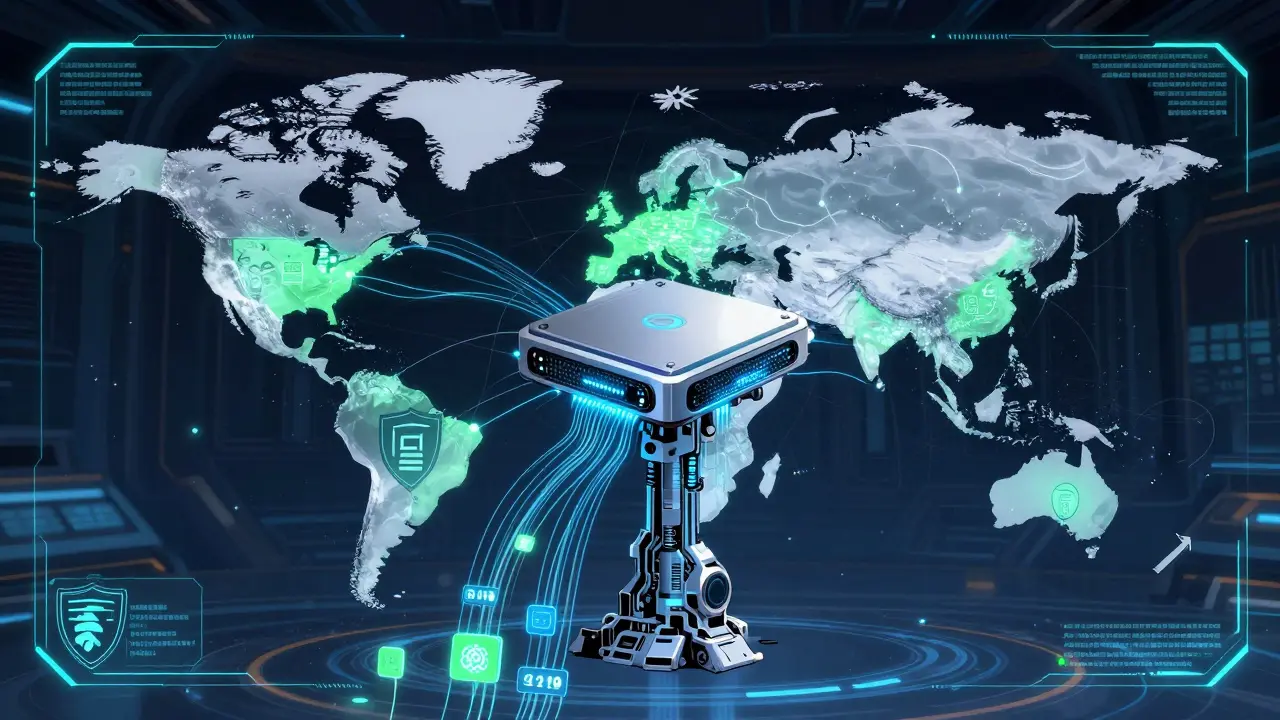
You think you can just plug an API key into your app and go global? Think again. In 2026, the map of where your data is allowed to live has changed drastically. It’s no longer just about keeping secrets safe; it’s about obeying laws that dictate exactly which physical server rack processes your users' prompts. If you’re deploying Large Language Models (LLMs) for a business with international users, you are standing at a crossroads between convenience and compliance.
The core tension today isn't just technical-it's legal. You have two main paths: using a centralized Cloud API, which offers ease but often routes data through unknown jurisdictions, or deploying Open-Source LLMs on infrastructure you control, which gives you sovereignty but demands heavy engineering lift. With the EU AI Act taking effect in August 2026, the cost of getting this wrong isn't just a bad user experience-it's a fine up to 4% of your global revenue.
The New Reality of Data Residency in 2026
Data residency sounds simple: "Where is my data stored?" But in the world of AI, it’s messier. When a user types a prompt, that text goes to a model, gets processed, and generates a response. That entire chain-input, processing, output, and even the metadata about who asked what-must stay within specific borders depending on where your user is located.
In 2026, we aren't just dealing with GDPR. We are facing a fragmented global landscape:
- European Union: The upcoming EU AI Act classifies certain AI systems as "high-risk." For these, you need judicial authorization and thorough risk assessments. Data must generally stay within the EU or adequate third countries.
- China: The Personal Information Protection Law (PIPL) is strict. Personal data of Chinese citizens must be stored inside China. Cross-border transfers require security assessments.
- Australia: Critical infrastructure and government data must reside in Australian-based data halls. Fines for breaches can hit 28% of annual turnover.
- UAE & Brazil: Financial records in the UAE must stay local. Brazil’s LGPD allows transfers only to countries with adequate protection standards.
This fragmentation means a single, global API endpoint is becoming a liability. If your US-based SaaS product serves customers in Berlin, Beijing, and São Paulo, sending all their queries to a single model in Virginia violates multiple laws.
API vs. Open-Source: The Core Trade-Off
When choosing how to deploy LLMs, you’re really choosing between speed and control. Let’s break down the two dominant strategies.
| Feature | Centralized Cloud API (e.g., OpenAI, Anthropic) | Self-Hosted Open-Source (e.g., Llama 3, Mistral) |
|---|---|---|
| Data Control | Low. Provider may use data for training unless explicitly opted out. | High. You own the infrastructure and the data flow. |
| Compliance Ease | Easy for domestic users; hard for multi-region. | Hard to set up; easy to scale across regions once built. |
| Latency | Variable. Depends on distance to provider’s data center. | Predictable. Can deploy edge nodes close to users. |
| Cost Structure | Pay-per-token. Predictable OPEX. | High CAPEX/OPEX for GPU clusters. Fixed costs. |
| Model Updates | Automatic. Always latest version. | Manual. Requires MLOps pipeline for updates. |
If you choose a Cloud API, you trade control for simplicity. Providers like AWS Bedrock or Azure AI now offer regional endpoints, which helps. However, you still rely on their roadmap for compliance features. If they don’t support a new jurisdiction’s requirement, you’re stuck.
On the other hand, Open-Source LLMs like Meta’s Llama 3 or Mistral allow you to host the model yourself. This is the gold standard for data residency because you decide where the GPUs sit. You can spin up a cluster in Frankfurt for EU users and another in Sydney for APAC users. But here’s the catch: you are now responsible for everything. Security, scaling, disaster recovery, and model maintenance fall on your team.

Architecting for Compliance: The Hybrid Approach
Most successful enterprises in 2026 aren’t picking one side. They’re building hybrid architectures. This approach uses Jurisdiction-Aware Routing to direct traffic based on the user’s location and data sensitivity.
Here is how a compliant architecture typically looks:
- Tiered Workload Classification: Not all data is equal. Classify requests into "Public," "Internal," and "Sensitive." Public queries (like general knowledge questions) might be routed to a cheaper, centralized API. Sensitive queries (containing PII or financial data) are routed to local, self-hosted instances.
- Regional Edge Nodes: Deploy lightweight inference servers in key regions. These handle the actual LLM processing locally, ensuring data never leaves the border.
- Centralized Orchestration: Use a gateway service to manage routing logic. This service checks the user’s IP, applies compliance rules, and directs the request to the correct backend.
This setup solves the latency issue too. By processing data closer to the user, you reduce ping times. Studies show that strictly localized deployments can incur 15-22% higher latency if not optimized, but with edge computing, you can mitigate this significantly.

The Hidden Cost: Operational Complexity
Don’t let the tech stack fool you. The biggest hurdle isn’t buying GPUs; it’s managing them across borders. According to recent industry surveys, 63% of enterprises report 30-45% higher operational costs when implementing tiered residency models.
Why? Because you’re running parallel infrastructures. You need separate monitoring, logging, and backup systems for each region. And here’s a trap many fall into: Disaster Recovery (DR). If your primary server in London fails, your DR plan shouldn’t automatically failover to a server in New York if your users are in France. That transfer would violate GDPR. You need region-specific DR plans, which doubles your complexity.
Additionally, talent is scarce. You need engineers who understand both cloud architecture and data protection law. Most teams take 4-7 months to become proficient in hybrid deployment architectures. Consider hiring specialists early or partnering with compliance-focused platforms like TrueFoundry or InCountry, which offer managed services for these complex setups.
Future-Proofing Your Strategy
The regulatory landscape will only get stricter. The IAPP predicts that by 2027, 45% of global enterprises will maintain at least three separate LLM deployment environments to comply with regional requirements. This isn’t a temporary trend; it’s the new normal.
To stay ahead, focus on modularity. Design your application so that swapping out an LLM provider or changing a data region doesn’t require rewriting your codebase. Use abstraction layers in your code to hide the complexity of routing from your frontend developers.
Also, keep an eye on training data. Some jurisdictions are beginning to view model training as a form of data processing. If you fine-tune a model on customer data, that training process must also respect residency rules. Ensure your ML pipelines are isolated by region, not just your inference engines.
Is using a major Cloud API enough for GDPR compliance?
Not necessarily. While providers like AWS and Azure offer regional endpoints, you must ensure that the specific model instance you are using does not route data outside the EU for processing or logging. Additionally, the EU AI Act imposes additional transparency and risk assessment requirements that generic APIs may not fully address without explicit configuration and contractual guarantees.
What is the difference between data residency and data localization?
Data residency refers to the preference or requirement for data to be stored in a specific country. Data localization is a stricter form of residency that mandates data must remain within national borders and prohibits cross-border transfer entirely. For example, China’s PIPL enforces localization for personal data, while the EU focuses more on adequacy frameworks for residency.
How much does self-hosting an LLM cost compared to an API?
Self-hosting has high upfront costs due to GPU hardware and engineering labor. However, for high-volume usage, it can be cheaper per token than paying API rates. A rough rule of thumb: if you process more than 10 million tokens per month consistently, self-hosting often breaks even within 6-12 months, especially when factoring in compliance savings.
Can I use open-source models without worrying about licensing?
No. Even open-source models have licenses. For example, Meta’s Llama 3 has a custom license that restricts commercial use for companies with over $700 million in revenue unless they follow specific guidelines. Always review the model card and license agreement before deploying any open-source LLM in a production environment.
What happens if my disaster recovery plan violates data residency laws?
You face significant legal penalties and potential loss of customer trust. In severe cases, regulators can shut down your operations in that region. To avoid this, implement region-specific DR plans where backups and failover systems reside within the same jurisdiction as the primary data.