
You type a prompt, and an image appears. You upload a video, and a detailed description pops out. This feels like magic, but it is actually cross-modal generation, a specialized subset of generative AI that translates data from one format to another while preserving semantic meaning. It’s not just about making pretty pictures; it’s about teaching machines to understand the world the way we do-through sight, sound, and language simultaneously.
If you’ve ever tried to get an AI to describe a complex scene accurately or generate a specific visual from a vague idea, you’ve hit the limits of simple models. Cross-modal systems bridge that gap. They don’t just guess; they align different types of data into a shared space where "cat" in text means the same thing as a picture of a cat. As of late 2024, this technology has moved from academic experiments to enterprise-grade tools, with market value projected to hit $14.2 billion by 2027. But how does it actually work? And why do some tools fail so spectacularly at video-to-text tasks?
The Core Mechanics: How Machines Translate Between Senses
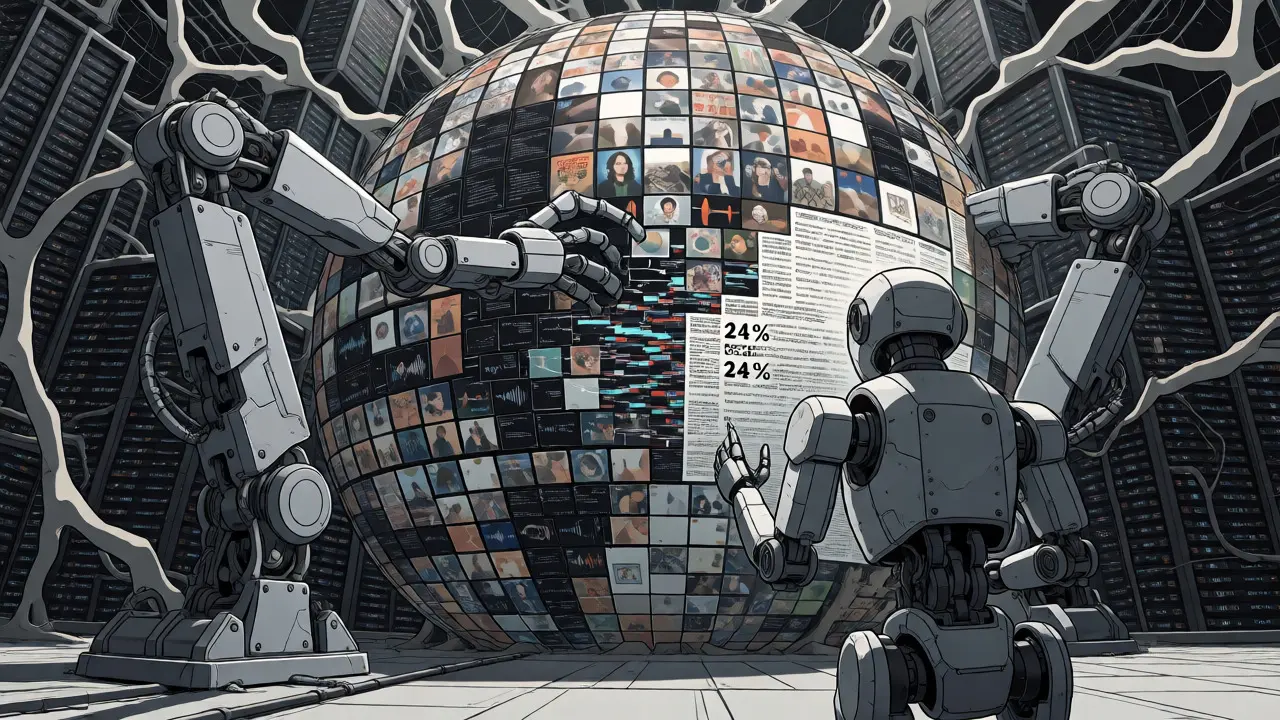
At its heart, cross-modal generation relies on creating a shared latent space. Think of this as a universal dictionary where words, pixels, and sounds all have coordinates. When you input text, the model doesn't just look for keywords; it maps those concepts into this mathematical space. Then, it uses techniques like diffusion models or Generative Adversarial Networks (GANs) to reconstruct that concept in a new format, like an image.
This process isn't linear. Early attempts, like the CMCGAN framework introduced around 2017, struggled because audio and visual data are fundamentally different. Audio is sequential time-series data; images are spatial grids. To fix this, newer architectures use attention mechanisms that act as translators. For instance, Stable Diffusion 3, released in March 2024, uses a two-phase diffusion process. First, it adds noise to the target modality until it’s pure static. Then, guided by the source modality (like your text prompt), it reverses the noise step-by-step to reveal the coherent output. This method achieves 87.3% accuracy on standard benchmarks like MS-COCO, which is impressive but still leaves room for error.
The challenge lies in dimensionality. Text embeddings typically require 768 dimensions, while high-resolution images might need 1024 to 2048. The model must compress and expand these representations without losing critical details. If the alignment fails, you get what experts call "semantic drift," where the generated image technically matches the words but misses the intent. IBM’s recent assessments show this happens in nearly 24% of text-to-image generations, a significant hurdle for professional users who need precision.
From Text-to-Image to Video-to-Text: A Spectrum of Complexity
Not all cross-modal tasks are created equal. Text-to-image generation is relatively mature because the relationship between a word and a visual object is often direct. If you say "apple," the model knows what an apple looks like. But video-to-text? That’s a beast of a different color. Videos add the dimension of time. An action like "running" isn't just a shape; it's a sequence of frames changing over milliseconds.
Current state-of-the-art models struggle here. While GPT-4o handles text and images well, true video understanding remains tricky. Researchers note that current systems lack "true cross-modal reasoning." They can describe superficial elements-a red car moving left-but often miss context, such as whether the car is fleeing a crime scene or just driving home. This limitation stems from data scarcity. There are only about 12,000 publicly available paired examples for high-quality video-to-text training, compared to millions for text-image pairs. Without enough data, the model hallucinates actions or misinterprets temporal sequences.
| Task Type | Primary Challenge | Current Accuracy/Success Rate | Best Use Case |
|---|---|---|---|
| Text-to-Image | Semantic Drift & Style Consistency | ~87% on retrieval benchmarks | Creative design, marketing assets |
| Image-to-Text | Factual Hallucination | High for objects, low for relationships | Accessibility, cataloging |
| Video-to-Text | Temporal Coherence & Data Scarcity | Lower reliability, improving rapidly | Content indexing, security monitoring |
| Audio-to-Text | Noise Robustness & Accent Variance | Very High (>95% in clean audio) | Transcription, voice assistants |
Despite these hurdles, the trajectory is promising. OpenAI’s recent updates to GPT-4.5 claim a 32% improvement in temporal coherence for video tasks. This means the AI is getting better at understanding cause and effect over time, rather than just listing objects frame by frame.

Why Cross-Modal Beats Unimodal (And Where It Fails)
You might wonder, why bother with cross-modal when unimodal models (like a text-only LLM) are so good? The answer is context. Unimodal models operate in silos. They know everything about text but nothing about visuals unless explicitly told. Cross-modal models integrate both, leading to richer outputs. In comparative tests, cross-modal systems outperform unimodal ones by over 34 percentage points on retrieval tasks. If you ask a system to find an image based on a complex story, a cross-modal model understands the mood and setting, not just the keywords.
However, this power comes at a cost. Training these models requires 3 to 5 times more paired data than unimodal systems. Computationally, they are heavyweights. Generating a single high-res image might take 2.3 seconds on a powerful NVIDIA A100 GPU, while DALL-E 3 takes closer to 4.7 seconds. For enterprises, this latency matters. If you’re building a real-time application, every millisecond counts.
Moreover, reliability lags behind capability. The AI Now Institute rates current systems at 7.8/10 for capability but only 5.2/10 for reliability. Why? Bias propagation. If the training data contains stereotypes, cross-modal models amplify them across formats. A text prompt about "CEO" might consistently generate images of men, reinforcing bias visually even if the text didn't specify gender. This makes human oversight essential, especially in sensitive fields like healthcare or journalism.
Real-World Implementation: What Developers Need to Know
Implementing cross-modal generation isn't plug-and-play. It requires robust infrastructure and careful tuning. Most successful deployments use open-source foundations like Stable Diffusion or proprietary APIs like GPT-4o. Stability AI’s ecosystem is particularly vibrant, with over 128k stars on GitHub and thousands of active contributors. This community support helps debug issues quickly, whereas proprietary systems rely on official channels with slower response times.
Developers face a steep learning curve. Proficiency in transformer architectures and cross-attention mechanisms is non-negotiable. Expect 4 to 6 months to reach production readiness. A major pitfall is data alignment. According to industry reports, 62% of implementation time is spent ensuring your text and image datasets match perfectly. If your captions don't accurately reflect the images, the model learns incorrect associations.
Quality validation is another headache. Standard metrics like BLEU scores don't capture visual fidelity. Teams often build custom evaluation pipelines. For example, architectural firms using Stable Diffusion report saving 15-20 hours per project on concept visualization but still manually correcting perspective errors in 40% of outputs. Automation speeds up creation, but human expertise ensures correctness.
The Future: Multimodal Fusion and Ethical Risks
We are moving toward multimodal fusion, where models don't just translate but reason across modalities. Imagine an AI that watches a news clip, reads the transcript, and generates a fact-checked summary with relevant graphics-all in one go. This is the next frontier. By 2027, analysts predict 75% of enterprise AI applications will incorporate cross-modal capabilities.
But with great power comes ethical complexity. The rise of "deep media"-synthetic content combining fake videos, voices, and text-poses disinformation risks. Security experts warn that distinguishing real from generated content is becoming harder. Regulatory frameworks like the EU AI Act now demand transparency disclosures for these systems. Companies must label AI-generated media clearly, adding compliance costs but also building trust.
For now, cross-modal generation is a tool, not a replacement for human judgment. It excels at creative exploration and rapid prototyping but struggles with precise technical translation. If you’re looking to adopt it, start with clear, bounded tasks. Don’t expect it to write a novel from a movie script yet. Start with generating thumbnails from blog posts or summarizing short clips. These smaller wins build confidence and refine your workflow before tackling the big leaps.
What is the difference between multimodal and cross-modal AI?
Multimodal AI processes multiple data types simultaneously for understanding or classification. Cross-modal generation specifically focuses on translating data from one modality to another, such as turning text into an image, while maintaining semantic integrity. All cross-modal systems are multimodal, but not all multimodal systems perform generation across modalities.
Why is video-to-text generation harder than text-to-image?
Video adds the dimension of time, requiring the model to understand temporal sequences and causality, not just static objects. Additionally, there is significantly less high-quality paired training data available for video-text pairs compared to text-image pairs, leading to lower accuracy and higher rates of hallucination.
Do I need expensive hardware to run cross-modal models?
For local deployment, yes. Models like Stable Diffusion 3 require GPUs with at least 40GB VRAM (like NVIDIA A100) for optimal performance. However, many users access these capabilities via cloud APIs (like OpenAI or Adobe Firefly), which shift the computational burden to the provider, though this incurs ongoing service fees.
How accurate are current cross-modal models?
Accuracy varies by task. Text-to-image models achieve around 87% accuracy on standard retrieval benchmarks. However, reliability scores are lower, around 5.2/10, due to issues like semantic drift and bias. Complex tasks like medical image captioning still see error rates above 40%, indicating that human review is still necessary for critical applications.
Can cross-modal AI help with accessibility?
Yes, significantly. Image-to-text generation creates alt-text for visually impaired users, while audio-to-text aids those with hearing impairments. Emerging video-to-text tools can provide real-time descriptions of visual events, enhancing accessibility in media and education.