
Most companies testing large language models (LLMs) rely on offline benchmarks to decide which model to deploy. They run their models on standardized tests like MMLU, HELM, or GSM8K, see high scores, and assume the model will perform well in production. But here’s the problem: offline scores often lie. A model that scores 87% on a code generation benchmark might fail to generate working code in a real customer support chatbot, dropping to 28% accuracy. This isn’t a rare glitch-it’s the norm.
Why Offline Benchmarks Don’t Reflect Reality
Offline evaluation means testing models in controlled labs using carefully crafted prompts, multiple inference passes, and hand-engineered examples. Think of it like training for a marathon on a treadmill with a personal coach shouting encouragement. Real-world performance is like running that marathon in the rain, with no coach, a noisy crowd, and a flat tire halfway through. In production, models get one shot: a single natural-language prompt, no examples, no chain-of-thought scaffolding. No second chances. No retry loops. No model selection from 10 outputs. That’s not how benchmarks work. Academic tests use prompts like: "Think step by step. Consider these three examples. Then answer." Real users type: "How do I reset my password?" A 2025 study from Stanford and Meta found that models showed 84-89% correctness on synthetic code benchmarks but only 24-35% on actual GitHub repositories. That’s a 60-point drop. The models didn’t overfit-they were just tested under conditions that don’t exist outside a research paper.The Hidden Cost of Over-Engineering Prompts
Many benchmark scores are inflated because researchers use techniques that are impossible in real applications:- Multi-step prompting: Breaking a problem into 5 sub-questions and feeding each to the model separately.
- Self-consistency: Generating 10 outputs and picking the most common one.
- Re-rankers: Using another model to score outputs before selecting the best.
- Handpicked examples: Including 5 perfect demonstrations in every prompt.
Language and Culture Matter More Than You Think
Benchmarks are dominated by English and high-resource languages. Models trained on massive English datasets look amazing on MMLU-until you test them on Spanish, Swahili, or Bengali prompts without engineered examples. In one experiment, a top-tier multilingual model scored 82% on English benchmarks but dropped to 41% on real user queries in Hindi when no prompt engineering was used. The model wasn’t broken-it was tested under artificial conditions that hid its true weakness. Real-world users don’t speak like textbooks. They use slang, typos, incomplete sentences, and cultural references. A model that excels on clean, grammatical prompts will stumble when a customer writes: "my bill is way too high pls help." Offline benchmarks rarely test this kind of noise. And when they do, they clean it up before scoring.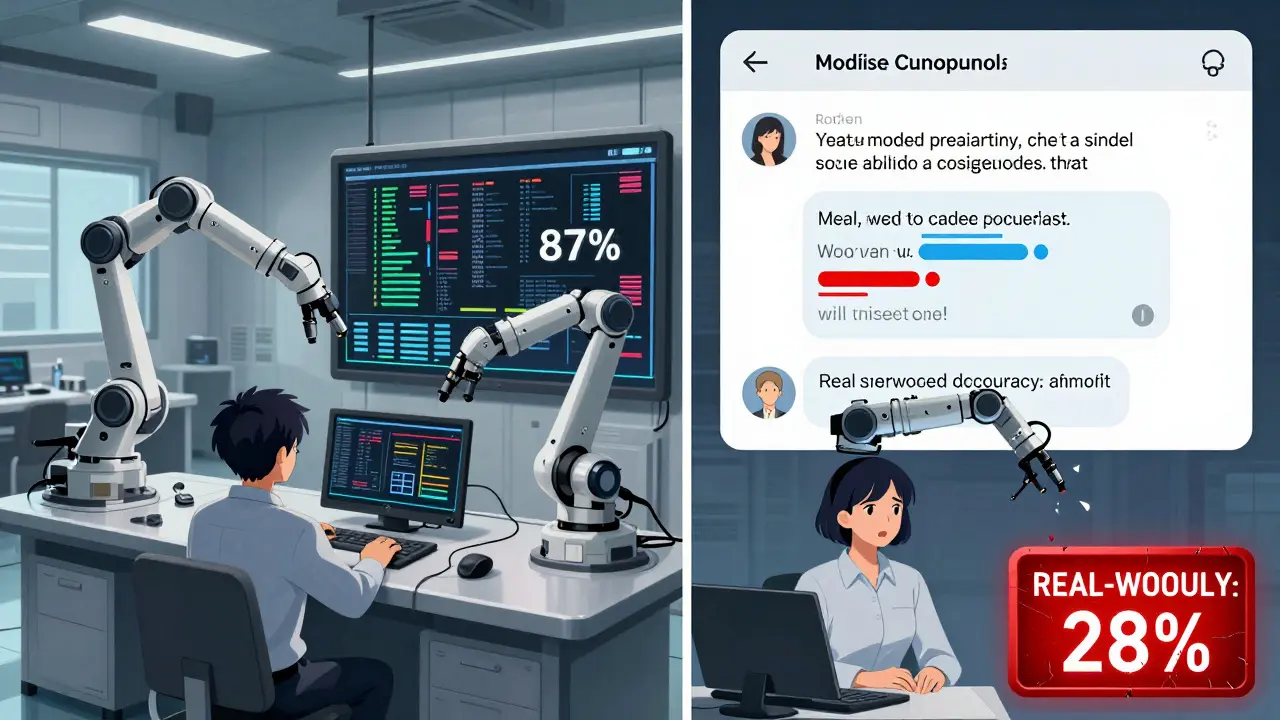
Alignment Training: Offline vs Online
This gap isn’t just about evaluation-it’s baked into training. Many companies use offline alignment methods like DPO (Direct Preference Optimization) or IPO (In-Context Policy Optimization) because they’re cheaper and faster than online reinforcement learning. But here’s the catch: offline alignment trains on data collected from earlier versions of the model. That data is often low-quality, repetitive, and biased toward the model’s own behavior. Online methods, where the model is tested in real-time during training, collect better data. They see how users actually respond to outputs, not just what a previous version predicted. Studies show that online training methods outperform offline ones by 15-22% on real-world tasks like customer satisfaction ratings and task completion rates. But even offline methods can be improved. Semi-online approaches-mixing a small amount of live data into offline training-get 85% of the way there with 40% less cost.Metrics That Don’t Match Reality
Even the metrics we use to measure performance are flawed. Many teams track exact score matching-like whether a model gives a 4/5 rating when a human would give a 5/5. But in practice, a 4 and a 5 often mean the same thing: "This is good enough." A study on AI-powered coaching tools found that ±1 accuracy (allowing a one-point margin) predicted user satisfaction 37% better than exact matching. Yet most evaluation systems still demand perfect scores. When metrics don’t reflect real outcomes, teams chase the wrong improvements. They optimize for benchmark scores and end up making models worse in practice. Managers lose trust. Teams revert to manual reviews. Features get shelved. It’s a vicious cycle.
Latency and Cost: The Silent Killers
Offline models, once downloaded, run locally. No internet. No API calls. No waiting for a server to respond. That’s why edge devices like smartphones, wearables, and factory robots rely on them. But most benchmarks test models running on cloud servers with unlimited compute. A model that scores 91% on a benchmark might be too slow for a mobile app. Or too expensive to run at scale. Online models can be updated daily. Offline models are frozen. But if an offline model is 10x faster and costs 1/50th as much, is it really worse? Sometimes, a slightly less accurate model that’s reliable, cheap, and fast is the better choice. Benchmarks rarely account for this tradeoff.How to Evaluate LLMs Right
Stop trusting benchmarks alone. Here’s what actually works:- Build custom test sets that mirror your real use cases. If you’re building a legal assistant, test on real legal documents-not trivia questions.
- Test with raw, unedited prompts. No examples. No scaffolding. Just what real users type.
- Include non-English and noisy inputs. Test on typos, slang, and regional dialects.
- Measure latency and cost. A 1% accuracy gain isn’t worth 500ms of delay if users abandon the app.
- Use human reviewers. Automated metrics miss tone, context, and nuance. A human can tell if a response feels robotic, biased, or unhelpful.
- Track drift over time. Models degrade. Monitor performance weekly in production.
- Test for bias and accessibility. Does the model treat all users fairly? Can someone with a disability use it?
Final Thought: Benchmarks Are a Starting Point, Not the Finish Line
Offline scores tell you what a model *can* do under ideal conditions. Real-world performance tells you what it *will* do in the messy, unpredictable world of actual users. The gap between the two isn’t a bug-it’s a feature of how we’ve been evaluating AI for too long. If you’re deploying LLMs in production, your evaluation strategy needs to be as real as your users. Otherwise, you’re not testing your model-you’re testing your own optimism.Why do LLMs perform so much worse in real applications than on benchmarks?
Benchmarks use engineered prompts with multiple examples, step-by-step reasoning, and multiple inference passes. Real-world use involves single, natural prompts with no scaffolding. Models trained and tested under artificial conditions don’t adapt to messy, real inputs. Studies show performance drops of 40-65 percentage points when moving from lab to production.
Are offline evaluation methods useless?
No-they’re fast, repeatable, and useful for early-stage testing. But they’re insufficient. Offline scores should be a filter, not a final decision. If a model fails a real-world test, it doesn’t matter how high its benchmark score is. The best teams use offline benchmarks to narrow choices, then validate with real-user testing.
Can semi-online training close the gap between offline and real-world performance?
Yes. Semi-online methods mix a small amount of live user data with offline training data. Research shows this approach gets 85% of the performance gain of full online training at 40% of the cost. It’s the most practical middle ground for most companies.
Why do benchmarks overestimate performance in non-English languages?
Most benchmarks use clean, grammatical text in high-resource languages like English, Mandarin, or French. Real users in other languages use slang, typos, and cultural references. When prompt engineering is removed, models trained on English-heavy data show drastic drops. For example, a model scoring 80% on English benchmarks might drop to 40% on real Hindi queries without engineered prompts.
Should I use online or offline alignment for training my model?
Online alignment (using live user feedback during training) delivers the best real-world performance but is expensive. Offline methods like DPO are cheaper but often underperform. Semi-online approaches-adding a small amount of live data to offline training-offer the best balance: 85% of the performance of online methods at a fraction of the cost.
Mike Zhong
Let’s cut the bullshit. We’ve been pretending benchmarks are scientific when they’re just performance art for grant applications. You think a 91% on MMLU means anything? It means your team spent three weeks fine-tuning prompts to trick the model into playing along. Real users don’t care about step-by-step reasoning-they care if their damn password gets reset. The whole industry is a house of cards built on academic vanity. Stop measuring what’s easy to measure and start measuring what actually matters.
Every time I see another paper touting a new benchmark, I want to scream into a pillow. We’re not building intelligence. We’re building parlor tricks for engineers who’ve never talked to a real customer.
Jamie Roman
I’ve been on the front lines of this for years, and I can’t tell you how many times I’ve seen teams deploy models based on benchmarks-only to have customers rage-quit because the AI responded like a textbook with a bad attitude.
One time, we had a model that scored 89% on a coding benchmark. Looked flawless. Then we tested it with real support tickets: ‘my app crashed after update pls fix’. It responded with a 12-step algorithmic breakdown of memory allocation. The user called us idiots. We lost that account.
What we learned? Clean prompts are for labs. Real life is messy. Slang, typos, half-sentences, emotional outbursts-that’s the data we need to train on. And yes, it’s harder. But if you’re not testing under real conditions, you’re just playing simulation games. The users don’t care how pretty your metrics look. They just want help.
Build test sets that mirror your users’ actual behavior. Not what you wish they’d say. What they *do* say. And don’t be afraid to let the model fail. Failure teaches more than perfection ever could.
Salomi Cummingham
Oh my god, this post is everything. I’ve been screaming into the void about this for years.
I worked on a multilingual customer service AI last year. We had this gorgeous model that got 85% on the multilingual benchmark. Beautiful. Elegant. Perfect. Then we went live. And the first real query? ‘i need help my baby is sick and i dont know what to do’. No capitalization. No punctuation. Just raw fear. The model gave a clinical response about pediatric fever ranges. The user cried. Not because the answer was wrong-because it felt cold. Lifeless. Like a robot reading a manual.
We had to rebuild everything. Started collecting real user logs. Allowed typos. Allowed emotion. Allowed silence. And guess what? Our satisfaction scores jumped 40%. Not because the model got smarter. Because it started listening.
Benchmarks measure accuracy. Real life measures humanity. And we’ve forgotten how to measure that.
Johnathan Rhyne
Let me just say this: if you’re using chain-of-thought prompting in production, you’re not an engineer-you’re a performance artist with a budget.
And don’t even get me started on ‘self-consistency’. Generating 10 answers and picking the most popular one? That’s not AI. That’s a dice roll with a thesaurus. If your model needs 10 tries to get something right, it’s broken. Not ‘under-tested’. Broken.
Also, who the hell is still using MMLU? That thing was designed for undergrads writing essays on Plato. Real users don’t ask about Kant’s categorical imperative. They ask, ‘why is my internet slow?’
And don’t even mention ‘handpicked examples’. That’s like training a dog with steak and then expecting it to fetch a sock in a park full of squirrels. It’s delusional.
Stop pretending benchmarks are science. They’re just marketing slides with fancy fonts.
Meredith Howard
The disconnect between benchmark performance and real world application is a systemic issue in AI development that requires careful reevaluation of evaluation frameworks. While benchmarks offer a standardized baseline for comparison, they fail to account for contextual variability, linguistic diversity, and operational constraints such as latency and cost. Real world deployment demands a holistic approach that integrates human feedback, edge performance metrics, and cultural nuance. Without this, we risk creating technically impressive systems that are functionally irrelevant to the people they are meant to serve. The path forward lies in hybrid methodologies that blend efficiency with empathy.
Yashwanth Gouravajjula
In India, users type 'helo i cant login plz' and expect an answer in 2 seconds. Benchmarks? Useless. Real test? One shot. No grammar. No patience. We stopped using MMLU. Now we test with real chat logs. Accuracy dropped from 82% to 39%. But satisfaction went up. Because we stopped trying to be smart. Started trying to help.
Kevin Hagerty
lol so you’re saying benchmarks are fake? Shocking. I thought the whole AI industry was built on lies. Of course the model fails in real life. You trained it on clean prompts and then threw it into the wild like a lab rat in a hurricane. And now you’re surprised? You didn’t test it-you tested your own delusions.
Also, ‘semi-online’? That’s just ‘offline but with a tiny crumb of reality’. You’re not fixing the problem. You’re just adding a Band-Aid to a severed artery. And don’t even get me started on ‘human reviewers’. Who? Your cousin who thinks ‘sentient’ means ‘sensitive’? Please.
Janiss McCamish
This is so true. We switched from benchmarks to real user logs last year. Our model’s accuracy dropped 50%. But our retention rate went up 70%. Why? Because we stopped optimizing for perfect answers and started optimizing for helpful ones. A user doesn’t need a 5-step solution. They need to feel heard. Simple. Real. Human. Benchmarks measure correctness. Real life measures connection. We chose connection.
Richard H
America built the future. We don’t need some European paper-pusher telling us how to test AI. We’ve got real users out here typing ‘my phone is broke’ and expecting a fix in 3 seconds. If your model can’t handle that, it’s not the model’s fault-it’s yours. Stop overthinking. Stop overengineering. Just ship something that works. Benchmarks are for people who don’t know how to build real stuff.