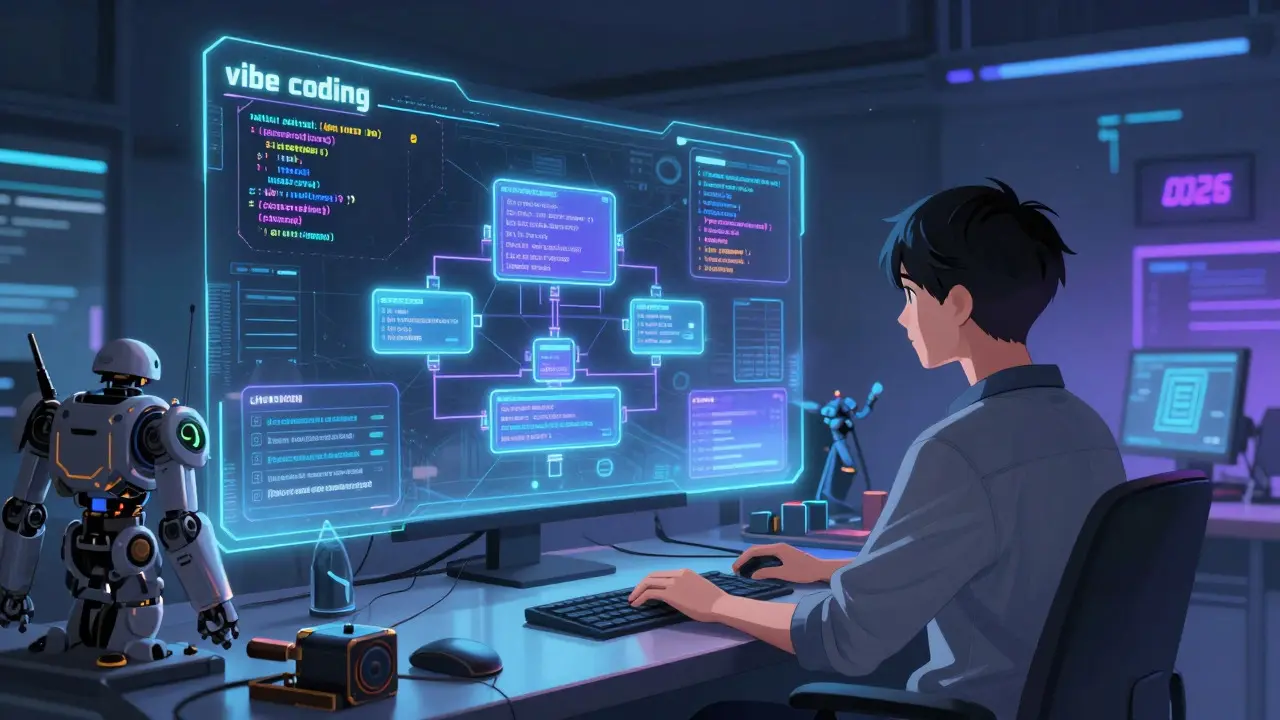
Remember when writing code meant typing every single bracket and semicolon? Those days are fading fast. In late 2023, Andrej Karpathy coined the term vibe coding, describing it as a way of developing by 'fully giving in to the vibes' through natural language prompts rather than rigid syntax. It sounded like a fun experiment for simple apps. But now, in mid-2026, we are asking a much harder question: can this approach handle the chaos of complex distributed systems? The short answer is yes, but with serious caveats.
The landscape has shifted dramatically since those early days. A January 2025 Gartner survey found that 67% of developers at large tech companies now use some form of vibe coding. We aren't just building basic Create, Read, Update, Delete (CRUD) interfaces anymore. Teams are using AI assistants to architect microservices, manage data consistency, and handle network failures. However, moving from a simple blog post generator to a system that processes millions of transactions requires more than just good vibes. It requires a new set of guardrails.
The Reality of Vibe Coding in Production
Let’s look at the numbers. Microsoft’s Azure Labs recently benchmarked vibe-coded distributed systems against traditionally developed ones. They found that while initial prototypes deploy 38% faster, these systems require 22% more iterative refinement cycles. Why? Because AI struggles with the subtle, emergent behaviors that occur when services talk to each other over unreliable networks.
In stress tests simulating 1,000 requests per second with artificial network failures, vibe-coded systems showed 17% higher latency in cross-service communication and 23% increased error rates during partitions. This isn't to say vibe coding fails; it means it behaves differently. You trade upfront speed for downstream debugging effort. If you don't have robust observability tools in place, that extra debugging time can eat up all your initial gains.
| Metric | Vibe Coding | Traditional Development |
|---|---|---|
| Initial Prototype Speed | 38% Faster | Baseline |
| Iterative Refinement Cycles | 22% More Required | Fewer Cycles |
| Cross-Service Latency | 17% Higher | Lower/Lower Variance |
| Error Rate (Network Partitions) | 23% Higher | More Predictable |
| Best Practice Compliance (Out-of-the-box) | 67% | 92% |
Why Distributed Systems Are Different
Building a single-page app is linear. Building a distributed system is probabilistic. Dr. Jane Chen, Principal Researcher at Microsoft Research, put it bluntly in her May 2025 ACM keynote: "The probabilistic nature of AI-generated code fundamentally conflicts with the deterministic requirements of distributed systems."
When you vibe code a user profile page, an error might mean a button looks wrong. When you vibe code a payment service, an error could mean double-charging a customer or losing a transaction entirely. The core issue is that current AI models lack true understanding of system-wide state. They generate code based on patterns they’ve seen, not on a real-time map of how Service A affects Service B under load.
This gap becomes critical in scenarios requiring strict transactional integrity. MongoDB’s 2025 case study showed that failure rates increased by 33% in systems where vibe coding was used without additional governance layers. Specifically, implementing complex patterns like Saga transactions proved difficult. In one analysis, vibe-coded implementations missed critical compensation logic in 41% of cases, compared to just 12% in traditionally written code. That missing logic is what rolls back changes when a step in a multi-step process fails.
The Three Pillars of Successful Implementation
If you want to move beyond CRUD, you need structure. A February 2025 Google Cloud study analyzed 78 enterprise codebases and identified three non-negotiable components for successful vibe coding in distributed environments:
- Contextual Awareness Frameworks: These maintain system-wide understanding across microservices. Without them, the AI generates code for one service in isolation, unaware of breaking changes in another. This was present in 63% of successful cases.
- Real-Time Constraint Validation: Think of this as a spell-checker for architecture. It enforces boundaries, ensuring the AI doesn’t suggest a synchronous call between two services that should communicate via an event bus. Found in 58% of production-ready implementations.
- Automated Feedback Loops: Continuous validation against principles like the CAP theorem. If your system prioritizes Consistency, the validator should flag any code that introduces eventual consistency risks.
Language choice also matters here. The IBM Institute for Business Value reported that Python (42%), TypeScript (31%), and Go (19%) dominate vibe coding workflows. For infrastructure-as-code, Terraform leads with 67%, followed by AWS CloudFormation at 24%. Sticking to these mainstream stacks ensures better training data coverage for the AI models.

Governance: The Missing Link
You can’t just prompt and pray. Governance is the bridge between chaotic generation and stable deployment. A December 2024 Forrester study highlighted that while vibe coding reduced initial development time by 41%, it increased technical debt accumulation by 63% in complex environments. However, teams using enterprise-grade governance tools like Superblocks' Vibe Governance Suite saw compliance rates jump from 67% to 89%.
What does this governance look like in practice? It involves mandatory pattern validation before code is merged. The Cloud Native Computing Foundation (CNCF) recommends explicit specification of CAP theorem choices before coding begins. Do you want Availability or Consistency during a partition? Define it first. Then, let the AI generate the code within those constraints.
Another crucial step is using AI to generate test cases for distributed failure scenarios. Instead of manually writing tests for network timeouts, ask the AI to simulate them. Companies integrating tools like Chaos Mesh to automatically test vibe-coded systems against network partitions reported 44% fewer production incidents.
Skills Gap and Learning Curve
There is a myth that vibe coding lowers the barrier to entry for everyone. For distributed systems, it actually raises the bar for strategic thinking. A March 2025 Pluralsight survey revealed that only 28% of developers attempting vibe coding for distributed systems possessed strong foundational knowledge in the field. Meanwhile, proficiency in prompt engineering for complex technical domains sat at just 41%.
The learning curve is steep. JetBrains’ 2025 developer productivity report indicates that developers with 5+ years of distributed systems experience need 3-4 weeks to effectively integrate vibe coding into their workflow. Less experienced developers take 8-12 weeks. Why? Because you need enough expertise to recognize when the AI is hallucinating a solution that looks correct syntactically but fails architecturally.
Expertise in distributed tracing and observability tools is equally vital. Only 33% of surveyed developers had high proficiency here. If you can’t trace a request across five microservices, you won’t know why your vibe-coded system is failing under load.
Market Trends and Future Outlook
Despite the challenges, adoption is accelerating. The global AI-assisted development market hit $8.7 billion in Q1 2025, growing at 34% year-over-year. Distributed systems development represents 29% of enterprise use cases. Currently, 73% of companies with existing distributed systems are experimenting with vibe coding for non-critical components, though only 18% apply it to core transactional systems.
The tooling is catching up. Google Cloud released Distributed Systems Copilot in June 2025, which includes specialized knowledge of consensus algorithms like Paxos and Raft, reducing implementation errors by 39% in internal testing. Microsoft’s acquisition of Baseten signals deeper investment in this space. Furthermore, the CNCF announced a working group focused on 'AI-Assisted Distributed Systems Development' with members including Netflix, Uber, and Capital One.
Regulatory pressure is also shaping the future. The EU's AI Act, effective January 2026, requires detailed documentation of AI-generated code for critical infrastructure. This has prompted 62% of European enterprises to implement enhanced audit trails for vibe coding outputs. As Gartner predicts, by 2027, 55% of distributed systems will incorporate vibe coding for non-critical components, provided AI reasoning capabilities continue their current 12% annual improvement trajectory.
Practical Next Steps for Your Team
If you are ready to try this, start small. Don't vibe code your payment gateway next week. Start with internal developer portals or logging services-areas where 76% of organizations reported success. Implement the three pillars: context awareness, constraint validation, and automated feedback. Invest in training your team on distributed systems fundamentals, not just prompt engineering. And always, always assume the AI will miss an edge case until proven otherwise.
Is vibe coding suitable for financial transaction systems?
Currently, it carries significant risk. While useful for prototyping, vibe-coded systems have shown higher error rates in scenarios requiring strict transactional integrity. For core financial systems, traditional development remains safer unless paired with rigorous, enterprise-grade governance layers and extensive manual auditing.
Which programming languages work best for vibe coding distributed systems?
According to recent industry reports, Python (42%), TypeScript (31%), and Go (19%) are the most common languages used. These languages have vast training datasets available to AI models, leading to more accurate code generation. For infrastructure, Terraform and AWS CloudFormation are the dominant choices.
How long does it take to learn vibe coding for distributed systems?
For experienced engineers with 5+ years in distributed systems, it takes about 3-4 weeks to integrate effectively. For less experienced developers, the learning curve extends to 8-12 weeks due to the need for deeper architectural understanding to validate AI output.
What are the biggest risks of using AI for microservices architecture?
The primary risks include missing compensation logic in Saga transactions, improper retry logic, and lack of circuit breakers. These oversights can lead to cascading failures during network partitions. Additionally, there is a risk of increased technical debt if governance frameworks are not implemented alongside the AI tools.
Does vibe coding replace the need for distributed systems expertise?
No. In fact, it demands more expertise. You need deep knowledge to define constraints, validate architectural decisions, and debug emergent system behaviors. AI acts as an augmentation tool, speeding up implementation, but human oversight is critical for reliability and correctness in complex environments.