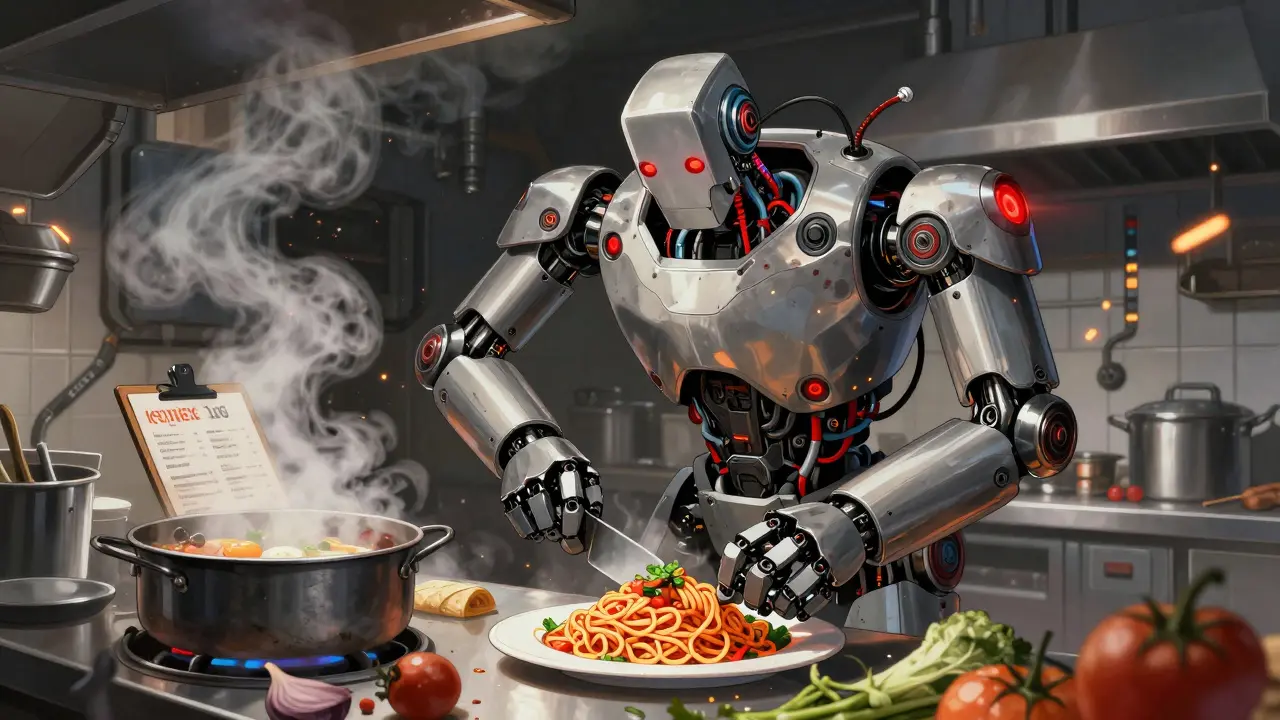
Have you ever asked a large language model to do three complex things at once, only to get a messy, half-baked result? You aren't alone. As of mid-2026, developers are hitting a wall with single-shot prompts. These monolithic instructions try to force the AI to analyze, format, and act in one go. It’s like asking a chef to chop vegetables, boil pasta, and plate the dish while also writing the menu description-all in under five seconds. The result? Burnt food and confused customers.
The solution isn't a smarter model; it's a better process. Enter Prompt Chaining, which is a technique that breaks complex tasks into sequential, specialized subtasks. By splitting your request into discrete steps, you give the AI room to breathe, think, and correct itself. This article cuts through the hype to show you exactly when to chain your prompts, how much it costs, and why your current workflow might be leaking money and accuracy.
Why Single-Shot Prompts Fail at Scale
Single-shot prompting works fine for simple queries. "Translate this sentence" or "Summarize this paragraph" are low-hanging fruit. But as soon as you add layers-"Summarize this legal contract, extract the risk clauses, and format them for a non-lawyer client"-the quality drops sharply.
Research from the ACL 2024 Findings paper highlights a critical flaw: when models handle multi-faceted tasks in one shot, they suffer from context dilution. The model tries to attend to every instruction equally, resulting in shallow processing of each part. In controlled experiments, single-shot approaches showed a significant drop in output quality for complex summarization tasks compared to chained methods.
Consider a real-world scenario. A marketing team uses a single prompt to generate a blog post, SEO meta tags, and social media snippets from a raw data dump. The AI often hallucinates facts in the social snippets because its attention was consumed by the blog post generation. With single-shot prompts, error propagation is silent. You don't know where it went wrong until the final output is useless.
How Prompt Chaining Fixes the Workflow
Prompt Chaining is an architecture where the output of one prompt serves as the input to the next. Instead of one giant brain-twister, you create a pipeline. Step 1 extracts data. Step 2 analyzes it. Step 3 formats it. Each step has a clear, narrow goal.
This approach mirrors how human experts work. An editor doesn't write, fact-check, and design a book cover simultaneously. They draft first, then edit, then design. Prompt chaining enforces this discipline on the AI.
The benefits are measurable:
- Higher Accuracy: Studies show a 37% increase in accuracy on complex tasks when using chaining versus single-shot methods.
- Better Debugging: If the final output is wrong, you can inspect intermediate steps to see exactly where the logic broke.
- Reduced Hallucinations: By validating outputs at each stage, you catch errors before they compound. Developers report an 87% reduction in hallucinations in chained workflows.
For example, instead of one prompt saying "Analyze this financial report," you use three:
- Extraction: "Extract all revenue figures and year-over-year changes."
- Analysis: "Identify trends in the extracted data and flag anomalies."
- Synthesis: "Write a concise executive summary based on the identified trends."
Prompt Chaining vs. Chain-of-Thought (CoT)
People often confuse prompt chaining with Chain-of-Thought (CoT), which is a technique that encourages the model to show its reasoning steps within a single response. They are different tools for different jobs.
| Feature | Prompt Chaining | Chain-of-Thought (CoT) |
|---|---|---|
| Structure | Multiple separate API calls/prompts | Single prompt with internal reasoning |
| Error Correction | High (92% efficiency at individual stages) | Low (requires full re-evaluation if error occurs) |
| Flexibility | High (adjust individual steps independently) | Low (changing one part affects the whole context) |
| Latency | Higher (150-200ms per additional step) | Lower (single round-trip) |
| Best For | Complex, multi-stage workflows | Math problems, logical puzzles, simple reasoning |
CoT is great for getting the AI to "think out loud" on a math problem. But if you need to build a customer support bot that retrieves data, checks policy, and drafts a response, CoT falls short. You can't easily insert a database lookup into a CoT stream without breaking the flow. Prompt chaining allows you to inject external tools (like APIs) between steps, making it far more powerful for enterprise applications.

The Cost and Latency Trade-Offs
Nothing is free. The biggest argument against prompt chaining is cost and speed. Every additional step means another API call, more tokens consumed, and higher latency.
Data from Maxim.ai's April 2024 benchmarking shows that prompt chaining increases token consumption by 25-35% compared to single-shot approaches. Latency increases by approximately 150-200ms per chain step. For a 5-step chain, that's nearly a second added to your response time.
Is it worth it? It depends on your use case.
- Real-Time Chatbots: If users expect responses under 500ms, chaining might be too slow. Stick to optimized single-shot or few-shot prompts here.
- Background Processing: For generating reports, analyzing code, or creating content batches, latency is irrelevant. Accuracy is king. Chaining saves money in the long run by reducing the need for human correction.
Dr. Elena Rodriguez, commenting in IEEE Spectrum (March 2024), warns against over-engineering. Her research shows diminishing returns beyond 5-7 chain steps. If you're chaining ten tiny tasks together, you're likely wasting resources. Keep chains lean and purposeful.
When to Use Which Approach
Not every task needs a factory line. Here is a practical decision tree to help you choose:
Use Single-Shot Prompts When:
- The task is simple (translation, basic summarization).
- Speed is critical (real-time user interactions).
- You are prototyping and need quick iterations.
Use Prompt Chaining When:
- The task involves multiple distinct operations (extract, transform, load).
- Accuracy is mission-critical (legal, medical, financial analysis).
- You need to integrate external tools (database lookups, calculators).
- Debugging is difficult with single shots (you need visibility into intermediate steps).
A common mistake I see is developers applying chaining to simple tasks just because it's trendy. If you're asking the AI to "write a tweet about our new product," a single prompt is faster, cheaper, and perfectly adequate. Save the chains for the heavy lifting.

Implementing Your First Prompt Chain
Getting started doesn't require a PhD. You need three things: clear schemas, validation steps, and a framework.
1. Define Input/Output Schemas
The hardest part of chaining is ensuring the output of Step 1 matches the input of Step 2. Use JSON schemas to enforce structure. If Step 1 returns unstructured text, Step 2 will fail. Force the AI to return valid JSON at each stage.
2. Add Validation Prompts
Don't trust the AI blindly. Insert a "validator" step between major transformations. For example, after extracting data, ask a lightweight prompt: "Does this JSON match the required schema? If not, correct it." This catches errors early.
3. Use Orchestration Tools
Managing chains manually in code is messy. Frameworks like LangChain, LlamaIndex, or Microsoft's Semantic Kernel handle the plumbing. They manage state, retries, and logging automatically. For visual designers, tools like PromptFlow offer drag-and-drop chain building with built-in schema validation.
Start small. Build a two-step chain. Test it. Break it. Fix it. Then add a third step. The learning curve is moderate-most developers become proficient within 2-3 weeks, according to Metaflow's 2024 survey.
Future Trends: Adaptive Chaining
We are moving toward adaptive chaining. Instead of fixed pipelines, future systems will dynamically decide how many steps are needed. Anthropic's announced "ChainTune" tool aims to automatically identify optimal chain lengths. Imagine a system that starts with a single shot, detects ambiguity, and then automatically branches into a chain to resolve it.
Gartner predicts that by 2026, 78% of enterprise LLM deployments will incorporate some form of prompt chaining. It's becoming as standard as CI/CD pipelines were for software development a decade ago. The key is not to chase the latest trend, but to apply the right tool for the job. If your current single-shot prompts are failing, don't blame the model. Blame the workflow. Break it down. Chain it up. Watch the quality soar.
What is the main difference between prompt chaining and single-shot prompting?
Single-shot prompting attempts to complete an entire task in one API call with one prompt. Prompt chaining breaks the task into multiple sequential steps, where the output of one prompt becomes the input for the next. Chaining improves accuracy and control for complex tasks but adds latency and cost.
Does prompt chaining really improve accuracy?
Yes. Research from ACL 2024 and industry benchmarks show improvements of 30-40% in success rates for complex tasks. By isolating specific subtasks, the model focuses better, reduces hallucinations, and allows for intermediate validation.
How much more expensive is prompt chaining?
Prompt chaining typically increases token usage by 25-35% compared to single-shot approaches. However, this cost is often offset by reduced need for human correction and higher overall output quality. The exact cost depends on the number of steps and the complexity of each prompt.
When should I avoid using prompt chaining?
Avoid chaining for simple tasks like translation or basic summarization where single-shot prompts work well. Also, avoid it in real-time applications requiring sub-500ms response times, as the added latency of multiple API calls may degrade user experience.
Can I combine prompt chaining with Chain-of-Thought?
Yes. Hybrid approaches are emerging where individual steps in a chain use Chain-of-Thought reasoning. For example, Step 1 might use CoT to solve a logical puzzle, and Step 2 uses a separate prompt to format the answer. This combines deep reasoning with structured workflow control.
What tools help manage prompt chains?
Popular frameworks include LangChain, LlamaIndex, and Microsoft Semantic Kernel. For visual design and debugging, tools like PromptFlow and Maxim's Playground++ provide interfaces to build, test, and monitor chains with schema validation and performance tracking.
Lisa Puster
honestly this is such a basic take that it makes me sick. everyone in the industry knows chaining is better for complex tasks but you act like its some new discovery. typical american tech bro writing explaining what smart engineers already do. stop wasting my time with obvious shit.
Marissa Haque
Oh my gosh!! I am SO glad someone finally wrote about this!!! I have been struggling with single-shot prompts for MONTHS and getting these weird half-baked results every single time! It is literally driving me crazy!!! The part about context dilution really resonated with me because I felt like the AI was just... giving up halfway through!!! Thank you so much for breaking it down!!! This article is a lifesaver!!!
Keith Barker
the distinction between structure and reasoning is often overlooked. we treat the model as a black box rather than a process. chaining externalizes the thought process which allows for intervention. it is less about the model intelligence and more about architectural discipline.
Joe Walters
look i tried langchain and it was a total nightmare to debug. the whole premise of this article is fine but in practice adding 5 steps means your latency goes through the roof and users bounce. nobody cares about 37% accuracy if they wait 2 seconds for a response. keep it simple or go home.
Michael Richards
You are missing the point entirely. If your latency is too high, you are not optimizing your prompts correctly. Chaining is mandatory for any serious enterprise application. Stop making excuses for lazy engineering. Implement validation schemas and stop complaining about speed when accuracy is on the line.
Robert Barakat
there is a philosophical shift here from monolithic truth to fragmented verification. by breaking the task we acknowledge the limits of singular attention. it mirrors the human cognitive need to pause and reflect before acting. the chain is not just code it is a ritual of verification.