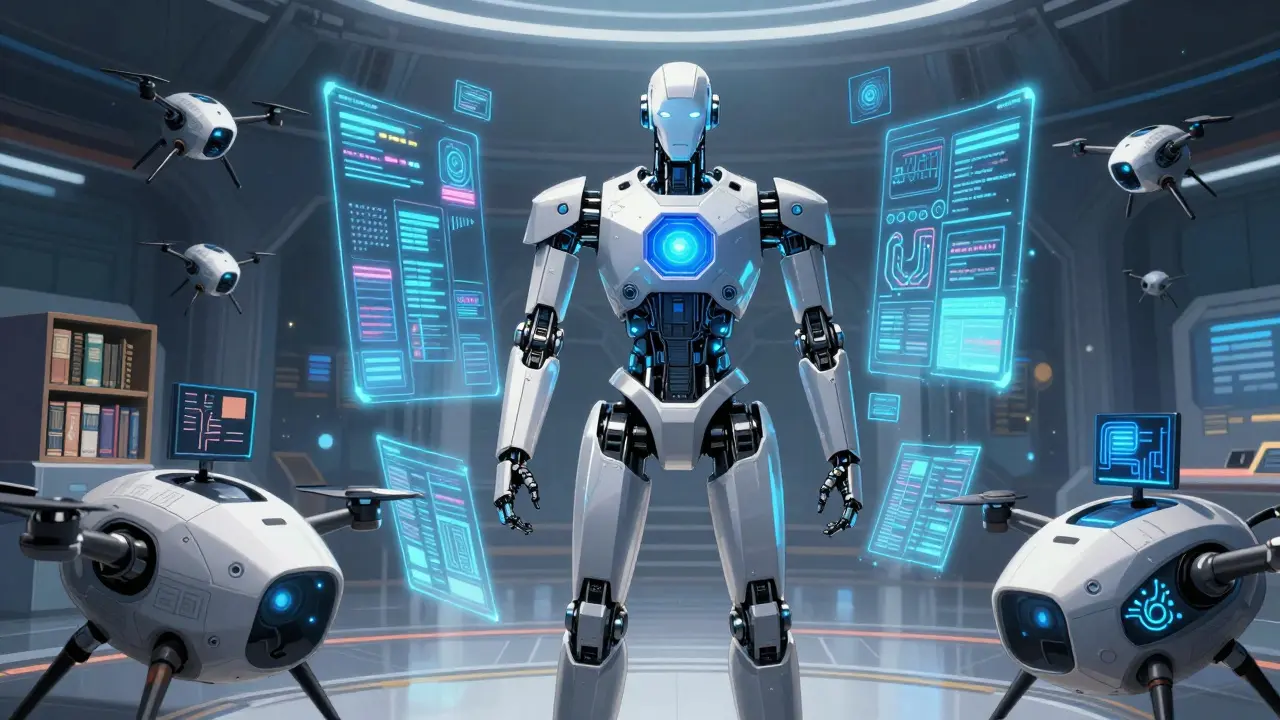
Imagine trying to write a novel alone. You draft the plot, check for grammar, research historical facts, and edit for tone-all in your head, one step at a time. Now imagine handing that work to a team: a historian checks the facts, an editor polishes the prose, and a plot specialist ensures consistency. Which version do you think is better? This is exactly what Multi-Agent Systems with LLMs are doing for artificial intelligence. Instead of relying on a single large language model to handle every aspect of a complex task, developers are now orchestrating teams of specialized AI agents that collaborate, debate, and refine outputs together.
This shift isn't just theoretical hype. By late 2025, frameworks like Chain-of-Agents and LatentMAS had proven that collaborative reasoning often outperforms even the most powerful standalone models. But building these systems isn't as simple as spawning five chatbots and letting them talk. It requires careful architecture, clear role definitions, and an understanding of how information flows between agents. If you're looking to move beyond basic prompt engineering into robust AI applications, understanding multi-agent collaboration is no longer optional-it's essential.
The Core Problem with Single-Model Approaches
Large Language Models (LLMs) have come a long way since their early days. They can write code, summarize documents, and answer questions with impressive accuracy. However, they still struggle with tasks that require sustained attention over long contexts, deep multi-step reasoning, or diverse expertise. A single model has a fixed context window and a unified 'personality.' When asked to debug a complex Python script while also writing marketing copy for it, the model often compromises on quality because it tries to do everything at once.
This limitation led researchers to look at biological and social systems for inspiration. Just as neurons in a brain specialize in different functions, why shouldn't AI agents? The concept of Role Specialization emerged as the solution. By assigning specific roles-such as 'Researcher,' 'Coder,' 'Reviewer,' and 'Planner'-to different instances of an LLM, the system can leverage the strengths of each agent while mitigating individual weaknesses. According to the comprehensive survey 'Multi-Agent Collaboration Mechanisms: A Survey of LLMs' (arXiv:2501.06322), this transition from isolated models to collaboration-centric approaches marks a paradigm shift in AI development.
The benefits are measurable. In benchmark tests, multi-agent setups have shown up to a 15.2% improvement in creative tasks requiring diverse perspectives compared to single agents. For technical tasks, the gains are even more pronounced when the problem involves multiple distinct sub-tasks that require different types of logic.
How Multi-Agent Collaboration Actually Works
At its simplest, a multi-agent system follows a workflow similar to a professional project team. Here’s how the process typically unfolds:
- Task Decomposition: A user provides a high-level goal. An orchestrator agent breaks this down into smaller, manageable subtasks.
- Role Assignment: Each subtask is assigned to a specialized agent based on its defined role (e.g., data analysis vs. content generation).
- Collaboration & Communication: Agents exchange information, share intermediate results, and sometimes debate solutions to resolve conflicts or improve accuracy.
- Synthesis: A final agent or the orchestrator compiles the contributions into a cohesive output.
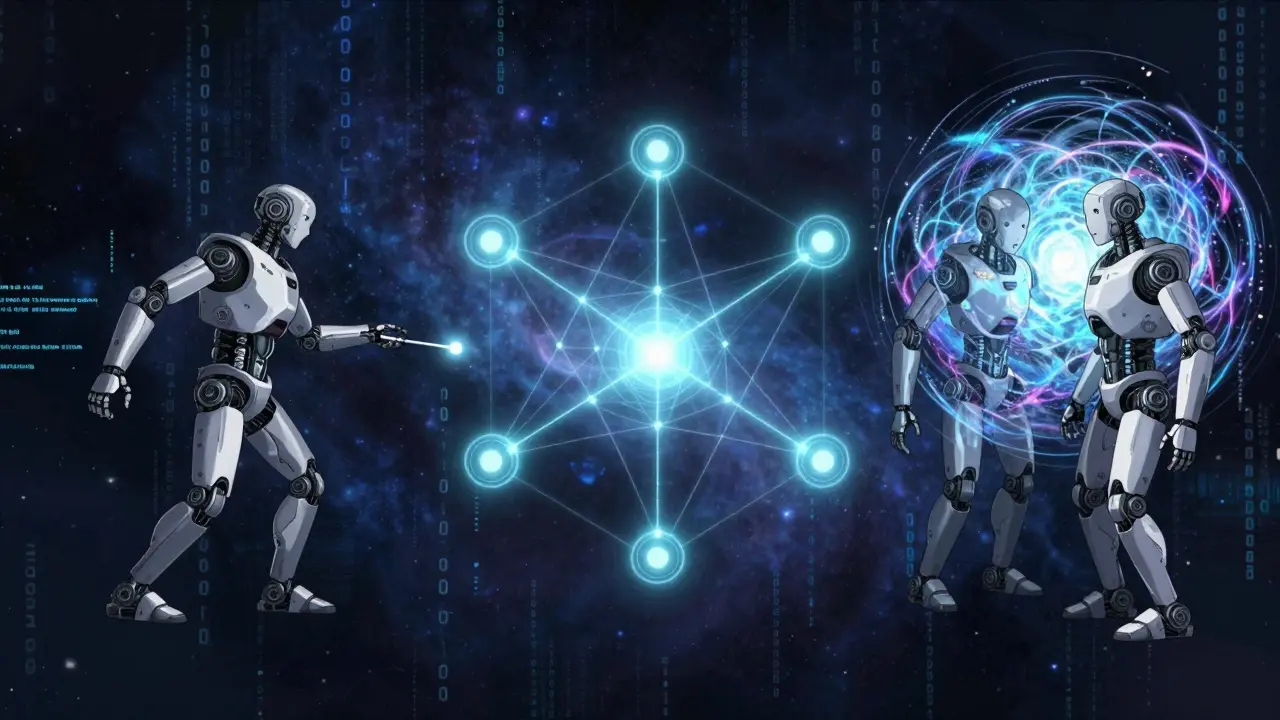
However, the devil is in the details. How do agents communicate? Do they pass text messages back and forth, or do they share internal states? The answer depends on the framework you choose. Traditional systems rely on text-based mediation, where Agent A writes a message to Agent B. Newer innovations, like LatentMAS, allow agents to collaborate in continuous latent space, bypassing the need for verbose text exchanges entirely.
For example, IBM’s framework highlights three critical components for any successful implementation: a Flow Orchestrator to manage execution logic, a Shared Context and Memory Store for intermediate data, and LLM assistants for reasoning. Without these pillars, agents quickly fall into loops of redundancy or contradiction.
Major Frameworks Compared: CoA, MacNet, and LatentMAS
As of mid-2026, three frameworks dominate the conversation among developers and researchers. Each takes a different approach to solving the coordination problem.
| Framework | Key Innovation | Best Use Case | Efficiency Gain |
|---|---|---|---|
| Chain-of-Agents (CoA) | Sequential collaboration for long-context tasks | Question answering, summarization, code completion | Up to 10% improvement over RAG |
| MacNet | Directed acyclic graphs for large-scale topology | Creative tasks, complex coding, scaling to 1000+ agents | 7.3% better than regular topologies |
| LatentMAS | Pure latent space collaboration (no text mediation) | Cost-sensitive apps, math/science reasoning | 70.8%-83.7% reduction in token usage |
Chain-of-Agents (CoA), introduced by Google researchers Yusen Zhang and Ruoxi Sun, focuses on sequential processing. It’s particularly effective for tasks that require reading and synthesizing massive amounts of information. Dr. Ruoxi Sun noted that CoA achieves improvements not through more parameters, but through better information flow. If you’re working with documents that exceed standard context windows, CoA is likely your best bet.
MacNet, developed by OpenBMB, takes a networked approach. It uses directed acyclic graphs to organize agents, allowing for irregular topologies that mimic real-world organizational structures. While it excels in scaling-supporting over 1,000 agents-it comes with a caveat: latency. With 100 agents, response times can be 2.3x slower than single-agent approaches. It’s ideal for creative projects where diverse perspectives matter more than speed.
LatentMAS represents the cutting edge of efficiency. Released in November 2025, it enables agents to collaborate within a continuous latent space rather than exchanging text tokens. This reduces output token usage by up to 83.7% and speeds up inference by 4x. For enterprises worried about API costs, LatentMAS is a game-changer. However, it requires more sophisticated infrastructure setup compared to text-based alternatives.
Implementation Challenges and Real-World Pitfalls
While the performance gains are attractive, implementing multi-agent systems is not without significant hurdles. Developers report that building these systems takes 40-60% longer than single-agent implementations. Why? Because debugging becomes exponentially harder.
When a single model hallucinates, you can trace the error back to the prompt. When ten agents collaborate, errors propagate. One agent might misinterpret a constraint, pass incorrect data to the next, and create a cascade of failures. A documented case on GitHub showed a 50-agent MacNet system hallucinating a consensus solution that satisfied all agents but was factually wrong. This phenomenon, known as 'collaborative reinforcement bias,' was highlighted by Dr. Emily Bender, who warned that multi-agent systems can amplify biases by 22.7% compared to single models.
Other common challenges include:
- Communication Overhead: Text-based frameworks like CoA incur 35% higher API costs due to the volume of inter-agent messages.
- Coordination Failures: Research shows performance degradation when agent counts exceed optimal thresholds (often around 500 in regular topologies).
- Unpredictable Emergent Behaviors: 63% of AWS Bedrock users reported unexpected behaviors in Q4 2025 surveys, making monitoring crucial.
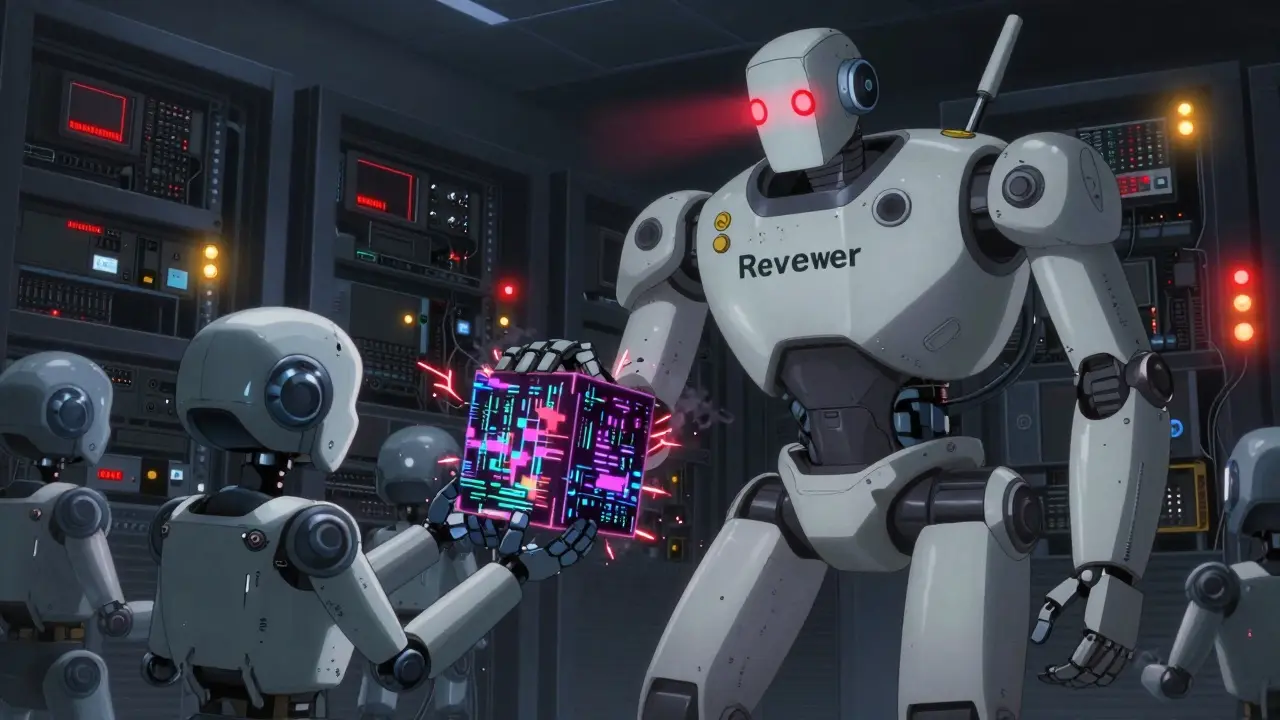
To mitigate these risks, experts recommend starting small. Begin with two or three specialized agents and clearly define their action spaces. Use directed acyclic graphs (as in MacNet) to prevent circular dependencies. And always implement a 'reviewer' agent whose sole job is to fact-check and validate the outputs of other agents before presenting them to the user.
Market Adoption and Future Trajectories
The industry is moving fast. Gartner predicts that by 2027, 65% of enterprise LLM deployments will incorporate multi-agent architectures, up from just 12% in 2025. The market size for multi-agent LLM technologies was estimated at $2.8 billion in Q4 2025, with projections reaching $14.7 billion by 2028.
Adoption is spreading across sectors. In healthcare, multi-agent systems are used for diagnostic support, where one agent analyzes symptoms, another reviews medical history, and a third cross-references latest research. In finance, they automate compliance checks by having separate agents monitor transaction patterns, regulatory updates, and risk assessments simultaneously.
Looking ahead, the trend is toward standardization. The IEEE formed a working group on 'Multi-Agent LLM Collaboration Standards' in September 2025 to address interoperability issues. We’re also seeing the rise of self-organizing collectives, where the system automatically determines the optimal number and type of agents needed for a given task, reducing the manual configuration burden on developers.
What is the main advantage of using multi-agent systems over a single LLM?
The primary advantage is improved performance on complex, multi-faceted tasks through collective reasoning and role specialization. Multi-agent systems can handle long-context tasks, reduce hallucinations through peer review, and solve problems that require diverse expertise, often outperforming single models by 10-15% in benchmarks.
Which framework is best for cost-effective multi-agent collaboration?
LatentMAS is currently the most cost-effective option. By enabling collaboration in latent space rather than via text tokens, it reduces token usage by 70.8%-83.7% and speeds up inference significantly, making it ideal for budget-conscious applications.
Do multi-agent systems increase the risk of AI bias?
Yes, there is a risk. Research indicates that multi-agent systems can amplify biases through collaborative reinforcement, showing up to 22.7% greater bias propagation compared to single models. Careful monitoring and debiasing protocols are essential.
How many agents should I start with when building my first multi-agent system?
Experts recommend starting with 2-3 specialized agents. This allows you to test communication protocols and role definitions without overwhelming complexity. Scaling beyond 500 agents often leads to performance degradation unless using advanced topology optimization.
Is Chain-of-Agents better than MacNet for coding tasks?
It depends on the task structure. Chain-of-Agents excels in sequential code completion and long-context debugging. MacNet is better for complex, parallel coding tasks that benefit from diverse perspectives and irregular team structures. For pure efficiency, LatentMAS may offer the best balance.
Caitlin Donehue
I've been watching this space for a while and it's fascinating to see how the industry is moving away from the 'one big brain' approach. It feels like we're finally treating AI more like a team of specialists rather than a magic oracle. The bit about LatentMAS reducing token usage by over 80% is huge for anyone running these things at scale, honestly.
Michael Richards
You are missing the point entirely if you think role specialization fixes the core hallucination problem. It just distributes the error. When you have ten agents talking to each other, you aren't getting truth, you're getting consensus delusion. I've seen teams of senior engineers argue themselves into a wrong conclusion faster than any single junior dev could guess one. This whole multi-agent hype is just expensive theater for investors who don't understand that LLMs are stochastic parrots, not reasoning engines. Stop pretending that adding more layers of abstraction solves the lack of ground truth grounding.
Robert Barakat
There is a certain irony in using biological metaphors to describe systems that are fundamentally alien to biology. We speak of neurons and specialization as if the silicon mind mirrors the wetware of our own brains, but perhaps we are merely projecting our own organizational anxieties onto the code. The agent does not know its role; it only performs the function of the prompt. Is it collaboration or is it merely complex mimicry of social structures? We build these digital hierarchies because we cannot conceive of intelligence without hierarchy. It is a reflection of our own need for order in chaos.
Laura Davis
Okay, let's keep it real here. Michael is being a total buzzkill but he's right about the debugging nightmare. I tried setting up a simple CoA workflow last week and spent three hours tracing why the 'Reviewer' agent kept rejecting valid code because the 'Coder' agent used a deprecated library syntax.
The article mentions starting small with 2-3 agents and that is literally the only advice worth taking. Do not go straight to MacNet with 1000 agents unless you enjoy crying. Also, Laura here reminding everyone that if you are building this for healthcare or finance, you better have a human in the loop or you will get sued into oblivion. Empathy doesn't scale in code, folks.
Lisa Nally
Actually, the distinction between text-based mediation and latent space collaboration is far more nuanced than the article suggests. While LatentMAS offers significant computational efficiency gains by operating within continuous vector spaces, it introduces profound interpretability challenges. The 'black box' nature of latent interactions means that debugging collaborative reinforcement bias becomes exponentially more difficult when you cannot simply inspect the textual dialogue between agents. Furthermore, the claim that CoA incurs 35% higher API costs is contingent upon specific caching strategies and context window management protocols that are often overlooked in benchmark studies. One must also consider the epistemic opacity inherent in directed acyclic graph topologies when scaling beyond trivial task complexities.
Edward Gilbreath
its all a scam to sell more compute power. they want you to run 10 models instead of 1 so they can charge you 10x. the 'bias amplification' is just them admitting their base models are trash. i bet half those benchmarks are fake. nobody actually uses these frameworks in production except for demo reels. wait until the power grid collapses under the weight of all these agents arguing with each other. then we'll see who is laughing
kimberly de Bruin
we are building gods out of math and calling it teamwork. the tragedy is not in the machine but in the mirror it holds up to us. we create committees because we fear the individual. we create noise to hide the silence of the void. the agent has no soul yet we demand it have a role. what is a role without consciousness but a cage
Edward Nigma
Everyone here is asleep at the wheel. The real issue isnt the agents or the frameworks, its the underlying assumption that sequential processing or even parallel latent space ops can solve non-deterministic problems. You guys are celebrating a 15% bump in creative tasks like its the moon landing. Meanwhile, the fundamental architecture is still broken. Chain-of-Agents is just RAG with extra steps and more ego. MacNet is a latency disaster waiting to happen. And LatentMAS? Good luck explaining to your CTO why your model output is garbage because the vectors drifted in some unobservable subspace. This whole trend is just procrastination on actual AGI research. We are polishing turds and calling it architecture.