
Imagine asking an AI to write a customer service email, but you need it to absolutely avoid mentioning a competitor's name. Or perhaps you want to force the model to use specific technical terminology for consistency. You could try rewriting your prompt five different ways, or you could spend weeks fine-tuning the entire model. But there is a faster, more precise lever you can pull right now: logit bias.
This technique allows developers to steer Large Language Model (LLM) outputs with surgical precision without touching the model's weights or retraining anything. It works by directly manipulating the probabilities of specific tokens appearing in the response. While it sounds like a niche feature for machine learning engineers, logit bias has become a standard tool for building safe, compliant, and brand-aligned AI applications.
What Is Logit Bias?
To understand logit bias, you first need to understand how an LLM generates text. When you send a prompt to a model like GPT-4 or Claude, the model doesn't just "write" the next word. Instead, it calculates a list of numbers called logits, which represent the raw score or likelihood of every possible next token in its vocabulary.
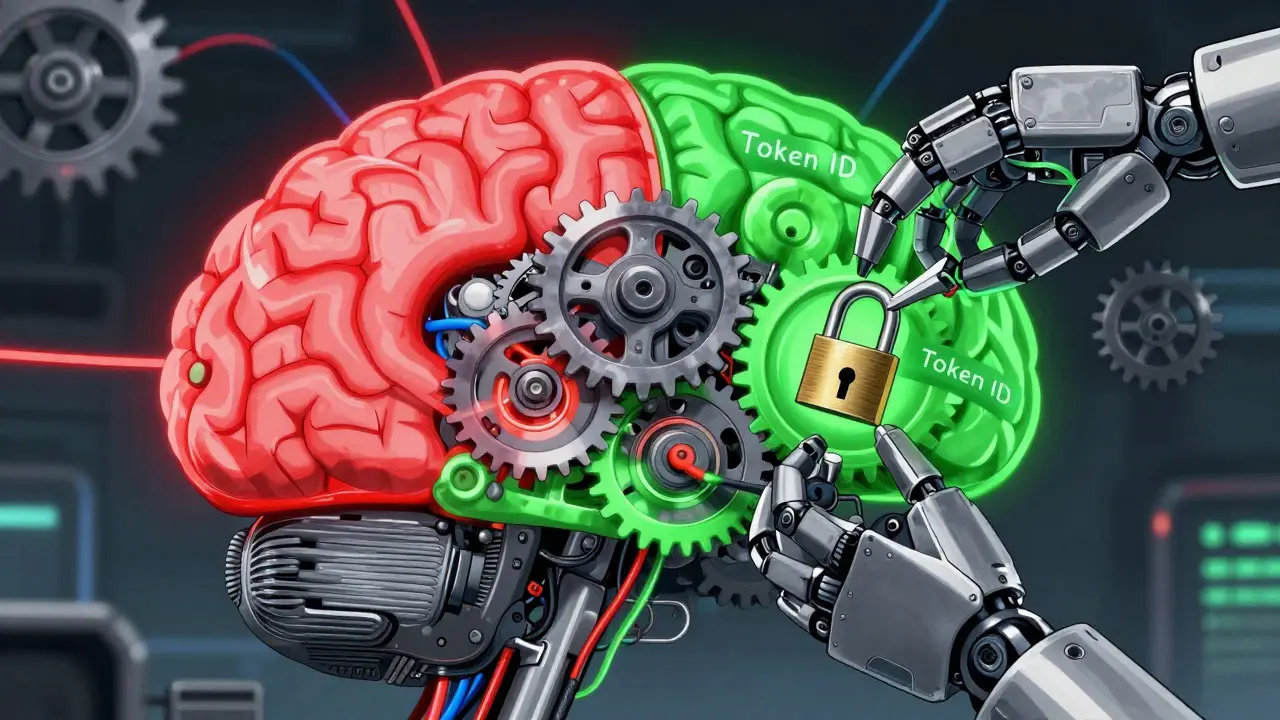
Logit bias is a parameter that adds or subtracts from these scores before the model selects the final token. If you assign a high positive value to a token, the model becomes much more likely to pick it. If you assign a strong negative value, the model effectively ignores it.
Think of it like a restaurant menu where the chef secretly adjusts prices. If you lower the price of steak to $1, customers will almost always order it. If you raise the price of kale to $100, nobody will touch it. The kitchen (the model) stays the same, but the outcome changes based on those external adjustments.
According to OpenAI’s API documentation, bias values typically range from -100 to 100. A value of -100 essentially bans a token, while +100 forces the model to select it if possible. This mechanism provides a layer of control that sits between your prompt and the model’s core intelligence.
Why Use Token Banning Instead of Prompt Engineering?
You might wonder why we need this when we already have prompt engineering. Can’t we just say, "Do not mention the word 'stupid'" in the system message? We can, but it’s unreliable.
Research by Samuel Shapley at Weights & Biases demonstrated that even when instructed explicitly via system messages, models like GPT-4 sometimes slip up. They might use a synonym, ignore the instruction under complex reasoning loads, or fail due to context window limitations. Logit bias, however, is prompt-independent. It operates at the mathematical level of generation, making it far more robust for critical constraints.
| Method | Reliability | Cost | Granularity |
|---|---|---|---|
| Prompt Engineering | Low to Medium | Free | Sentence/Context Level |
| Fine-Tuning | High | High ($15-$150+) | Global Behavior |
| Logit Bias | Very High | Negligible | Token Level |
Fine-tuning is another alternative, but it’s overkill for simple restrictions. Fine-tuning modifies the entire model’s behavior for a domain, costing significant time and money. Logit bias costs virtually nothing extra per request and only affects the specific tokens you target. It is the perfect middle ground for targeted control.
The Technical Challenge: Tokens Are Not Words
Here is where things get tricky. Logit bias works on tokens, not words. In natural language processing, a token is a chunk of text that the model recognizes as a single unit. A common word like "time" might be one token, but "time" with a leading space might be a completely different token ID.
If you want to ban the word "stupid," you can’t just find one ID. According to FoundationaLLM’s technical documentation, "stupid" might tokenize into multiple IDs depending on context. For example:
- "stupid" (no leading space): ID 267
- " stupid" (with leading space): ID 18754
This complexity increases with multi-word phrases. Banning "New York" requires blocking the tokens for "New", "York", and potentially combined variations. Developers often use tokenizer tools provided by OpenAI or Hugging Face to map out these variants before applying bias.
How to Implement Logit Bias Effectively
Implementing logit bias requires a structured approach. Here is a step-by-step workflow used by enterprise developers:
- Identify Target Terms: List the words or concepts you want to encourage or suppress. For safety, this might include profanity or PII (Personally Identifiable Information). For branding, it might be competitor names.
- Tokenize the Terms: Use a tokenizer library (like
tiktokenfor OpenAI models) to convert each term into its corresponding integer IDs. Remember to check for case variations (e.g., "Apple" vs "apple") and spacing issues. - Determine Bias Values: Decide on the strength of the influence.
- -100: Hard ban. Use sparingly, as it can cause awkward phrasing if the model has no other way to express the idea.
- -30 to -50: Strong suppression. Often the sweet spot for reducing likelihood without breaking grammar.
- +10 to +20: Gentle encouragement. Good for guiding tone without forcing unnatural repetition.
- Construct the JSON Payload: Create a dictionary mapping token IDs to bias values. For example: `{"267": -100, "18754": -100}`.
- Test and Iterate: Run sample prompts. Check if the model uses workarounds (like spelling variations or synonyms). Adjust bias values or add missing token variants as needed.
A pro tip from Klu.ai’s 2023 guide: start with moderate negative values like -20 or -30. Hard bans (-100) can sometimes lead to "semantic blind spots" where the model produces gibberish or repetitive loops because it lacks the vocabulary to complete the thought naturally.
Real-World Applications
Who is actually using this technology, and why?
Enterprise Safety Guardrails: Many companies use logit bias to enforce content policies. A study cited by Gartner noted that 68% of enterprise LLM deployments implement some form of token-level control. By banning tokens associated with offensive language or sensitive data formats (like credit card number patterns), businesses reduce moderation violations significantly. One LinkedIn report from late 2023 claimed a 37% reduction in chatbot moderation failures after implementing comprehensive token bans.
Brand Alignment: Marketing teams use positive logit bias to ensure consistent terminology. If a company wants its AI assistant to always refer to itself as "The Helper" rather than "Assistant," they can boost the logits for those specific tokens. Conversely, they can suppress competitor brand names to keep responses neutral.
Structured Output Generation: Developers building APIs that require JSON or XML outputs often use logit bias to force the model to include necessary syntax characters (like curly braces `{` or closing tags `

Tamara Miller
Oh, please. Another tech bro trying to sell us on the idea that we can just 'tweak a slider' to fix the existential dread of AI?
You really think slapping a -100 bias on the word 'stupid' is going to stop a model from calling your boss an 'incompetent moron'? It’s laughable. The models are already hallucinating their way into lawsuits, and you’re worried about competitor names?
It’s lazy engineering disguised as innovation. You’re not steering the ship; you’re just putting blinders on a horse while it runs off a cliff. And don’t get me started on the 'surgical precision' nonsense. Precision implies control. This is just digital duct tape holding together a house of cards.
We need ethical frameworks, not token bans. But sure, keep playing with your logits while the rest of us worry about privacy.
Anthony Miller
you missed the point entirely tamara
it is not about ethics it is about efficiency
why waste compute on prompt engineering when you can just ban the token
i have been using this for years and it works fine
stop being so dramatic
Tamara Miller
Efficiency at what cost, Anthony?
You sound like a man who enjoys his own voice more than he enjoys actual conversation. 'It works fine' is the most underwhelming defense of a technical process I have ever heard. Fine for whom? The developer who doesn't want to read the output? Or the user who gets gibberish because they banned too many function words?
You are ignoring the nuance of language. Language is fluid. Your binary approach to tokens is rigid and outdated. It’s arrogant to assume that a simple integer mapping can capture the complexity of human expression. You’re not solving a problem; you’re just silencing parts of it until it looks quiet enough for your quarterly report.
Savara Gunn
I actually found this article quite helpful for my small business chatbot. We were having issues with the bot mentioning our competitors, and adding a slight negative bias helped without breaking the grammar. It feels good to have a bit more control over the output without spending a fortune on retraining.
Jacob Baby Official
HA! Oh, look at Savara, hugging her little chatbot like it’s a puppy.
Let’s be real here. This whole 'logit bias' thing is just a band-aid on a bullet hole. The models are fundamentally broken, and everyone knows it. They are probabilistic parrots screaming into the void. You think banning the token for 'Apple' stops them from saying 'the fruit company'? No. They will say 'the orchard giant'. They will say 'the shiny red sphere'.
It’s a game of whack-a-mole played by people who think they understand linguistics but barely understand Python. The drama of thinking you have 'control' is hilarious. You don’t. You never did. The machine is always one step ahead, laughing at your JSON payloads.
Savara Gunn
Maybe it’s not perfect, Jacob, but it helps. I’m just happy it works for my needs. Thanks for sharing your perspective, though.
john randall
The part about tokens not being words is the biggest gotcha. I spent three hours debugging why my ban list wasn't working, only to realize I hadn't accounted for the leading space variant. Once I used tiktoken to map out all the IDs, it clicked into place. Solid technique if you know the quirks.
Jeff Falcon
I totally agree with John on the tokenizer issue! It is such a pain in the neck, honestly, but once you get the hang of it, it is pretty cool.
I remember when I first started messing around with API parameters, I thought temperature was the only knob we had to turn. Then I discovered logit bias, and it was like opening a new door. Sure, it requires a bit of setup, and yes, you have to deal with those pesky token IDs, but the results are worth it.
I’ve been using it to force my model to use specific industry jargon for client reports, and it has saved me so much time editing later. It’s not magic, but it’s definitely a useful tool in the belt. Just make sure you test thoroughly, or you’ll end up with sentences that make no sense at all!
Chris Neal
Actually, Jeff, you’re slightly off. Temperature affects the entire distribution, whereas logit bias is additive to the pre-softmax scores. You can combine them, but they operate at different stages of the sampling pipeline. Also, -100 isn’t always a hard ban in every implementation; some libraries clamp values differently. Read the source code before you generalize.